Canada’s Big Bet: Inside the Carney Government’s Trillion-Dollar Investment Summit
By Laith on 13th of August 2026
Canada’s Big Bet: Inside the Carney Government’s Trillion-Dollar Investment Summit
By Laith on 13th of August 2026
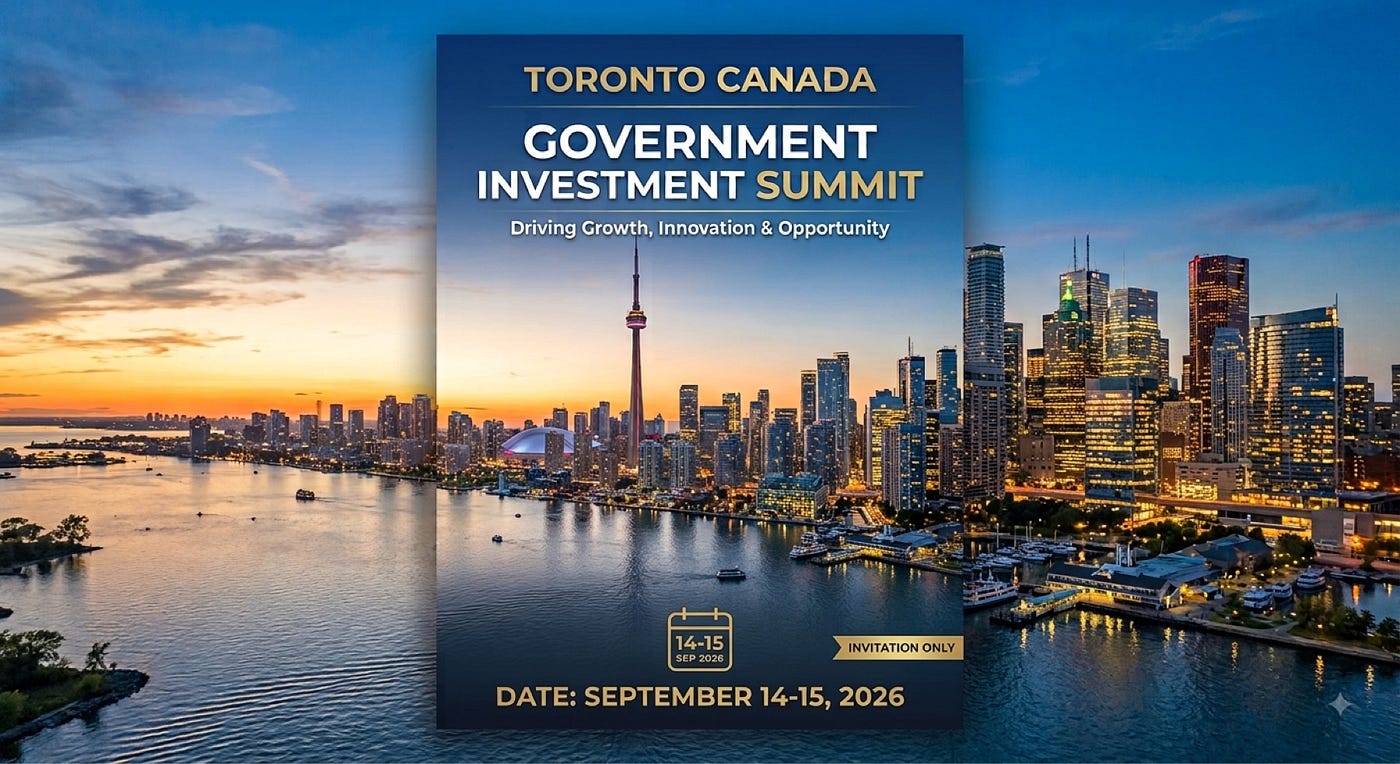
On September 14 and 15, 2026, Toronto will host the first-ever Canada Global Investment Summit – a two-day, invitation-only gathering that Prime Minister Mark Carney is betting can help reverse a decade of foreign capital flight and unlock as much as $1 trillion in new investment over five years.
The Pitch
The summit is co-hosted by the federal government alongside two of Canada’s largest institutional investors, CPP Investments and PSP Investments, in partnership with Invest in Canada.
The government’s case to the world’s money managers rests on a familiar set of talking points: a AAA credit rating (for now), the lowest net debt-to-GDP ratio in the G7, the top ranking among G7 countries for banking stability, an educated workforce, 16 free trade agreements covering 1.5 billion consumers, and competitive tax treatment for new business investment.
Carney has framed the effort as part of a broader push to reduce Canada’s economic dependence on the United States amid Donald Trump’s trade war, while capitalizing on shifts in global energy markets triggered by the war in Ukraine and instability in the Middle East, Three sectors are getting top billing: energy (pipelines and refineries), critical minerals, high speed trains, technology and artificial intelligence.
Who’s Invited and attending
Organizers said More than 100 of the world’s largest investors were sent invitations under Carney’s name in April, targeting firms and funds that collectively control trillions of dollars in capital – names like BlackRock, Blackstone, and Singapore’s sovereign wealth fund GIC among them.
As of the most recent reporting, the guest list is not yet finalized, but organizers say the summit is on track to draw executives from nearly 100 global investment organizations across 28 countries, managing close to $120 trillion in combined assets, Roughly 250 people are expected to attend, most of them CEOs and senior executives from Canada and abroad.
Names circulating in recent coverage include Blackstone president Jonathan Gray and BlackRock chairman and CEO Larry Fink, along with the chief executives of KKR, PIMCO, and TPG, and the co-CEO of French asset manager Ardian.
JPMorgan’s Jamie Dimon and Berkshire Hathaway’s Greg Abel are reportedly sending senior deputies rather than attending personally, Senior officials from major Middle Eastern sovereign wealth funds – including Saudi Arabia’s Public Investment Fund, the Abu Dhabi Investment Authority, and the Qatar Investment Authority – are also expected, along with representation from major Asian funds.
Organizers have insisted, where possible, that company leaders attend in person rather than send deputies – a detail that underscores how much symbolic weight the government has put on this event.
Skepticism and Stakes
Not everyone is convinced the summit will deliver much beyond good optics and photos including me, Analysts have cautioned that there is typically a significant lag between an investment announcement and any measurable change in hard economic numbers – one described Canada’s progress as being in the “third or fourth inning” of a much longer process.
As recently as mid-summer, government officials were unable to say publicly how many invitees had actually confirmed attendance, even while insisting that “interest is strong.”
The summit’s timing is also notable: it lands just after Toronto hosted World Cup matches and overlaps with the Toronto International Film Festival, giving the city an unusually high-profile backdrop.
A parallel event, the Milken Institute’s “Global Dialogues Toronto,” will run the morning of September 14 at the Park Hyatt, featuring the CEOs of TD, RBC, TMX Group, and AGF Management, before handing off to the main summit that evening.
Critics on the other side have raised a different concern – not that the summit will fail to attract capital which’s a real possibility and problem, but that it will succeed in ways that raise questions about what’s actually for sale.
The real test isn’t the guest list – it’s what, if anything, gets signed.
Summits of this kind typically produce memoranda of understanding MOUs, letters of intent LOIs, and public pledges rather than fully executed capital deployment on the spot.
The government’s own target is a five-year horizon, not a two-day one, Whether the September gathering produces genuine follow-through, or simply a well-attended photo opportunity, will likely only become clear well after the delegations have gone home.
Final Thoughts: A Skeptic’s Prediction
Not every observer is convinced the guest list will hold up as billed, I predict a much thinner turnout than organizers are projecting – the argument being that major U.S. institutional investors (will be blocked by president trump) , GCC sovereign wealth funds (will be blocked by ongoing war in gulf) , and Asian pension and sovereign funds (will be blocked by economic downturn) will largely decline to show, leaving a mostly Canadian and partial European crowd, and that the event will amount to a “photo op” with little in the way of actual signed deals.
It’s worth being clear about where that prediction stands relative to the record: as of the most recent reporting, it runs against nearly every confirmed detail – named executives from BlackRock, Blackstone, KKR, PIMCO, TPG, and major Middle Eastern and Asian funds are all still listed as expected attendees, and organizers (who are a fun folks to watch talking) say the guest list is on track, not shrinking.
That doesn’t make the prediction wrong; guest lists shift, and “expected” isn’t the same as “signed a contract to attend.” But it does mean the pessimistic case is currently a forecast, not a documented trend – one that will either be borne out or disproven when the doors open on September 14.
The reasoning behind this skepticism goes beyond attendance optics, though, The underlying argument is structural: that a glossy two-day summit can’t substitute for the deeper reforms investors actually price in – competition policy that opens up gatekept industries to real rivalry, and easier access for venture capital and foreign direct investment that isn’t bottlenecked by regulatory or incumbent-protecting friction.
On this view, global capital doesn’t move because a government hosts a well-catered summit (saudi did many ones but recently cancelled their neom one trillion dollar project due to lack of FDI) ; it moves when the rules of entry and competition change durably enough to be trusted over a multi-year horizon.
If Canada’s structural gatekeeping – in telecoms, banking, and other concentrated sectors – remains largely intact after September 15, the argument goes, the summit risks being remembered as a marketing exercise rather than a turning point, regardless of who does or doesn’t show up in the room.
This article reflects reporting available as of mid-August 2026 and my personal opinion, Attendance figures and commitments may change before the summit takes place.
메타데이터
- post_id
- 5972f0ecbb7c
- slug
- canadas-big-bet-inside-the-carney-government-s-trillion-dollar-investment-summit-5972f0ecbb7c
- url
- https://medium.com/@thelaith/canadas-big-bet-inside-the-carney-government-s-trillion-dollar-investment-summit-5972f0ecbb7c
- canonical_url
- https://medium.com/@thelaith/canadas-big-bet-inside-the-carney-government-s-trillion-dollar-investment-summit-5972f0ecbb7c
- author_url
- https://medium.com/@thelaith
- status
- ok
- fetched_at
- 2026-08-18 18:48:57