How to Quantify Hitter Process and Approach
Process over Results
How to Quantify Hitter Process and Approach
Process over Results
A hitter lines out hard right at somebody to finish off an 0–3 day at the plate. He’s ready to run through a wall, but did he actually have a bad night? It depends on how we choose to evaluate. Over a season, what separates good hitters from the rest lies in their process at the plate: staying within their strengths, avoiding chase, and consistently making the right swing decisions. Results will always vary, especially in a small sample, but if we can establish that a hitter’s process and approach are sound, the outcomes will take care of themselves over time. Judging the performance of a single game requires a closer look at the choices a hitter made, not just a box score or how hard a ball was hit. That’s exactly what Paradigm postgame hitting reports are built to give you.
Inside the Post-Game Hitting Report
The problem with grading such a small sample on results alone is that the same process produces different box scores. A hitter might pick the right pitch to attack, put a good swing on it, and line out to short, but the next night, that same approach and decision produces a double in the gap. The hitter’s approach and decision-making didn’t waver, so neither should our evaluation of that at-bat. To help with that, our postgame report lays out the game, pitch by pitch for each hitter, and gives you the context that the box score doesn’t.
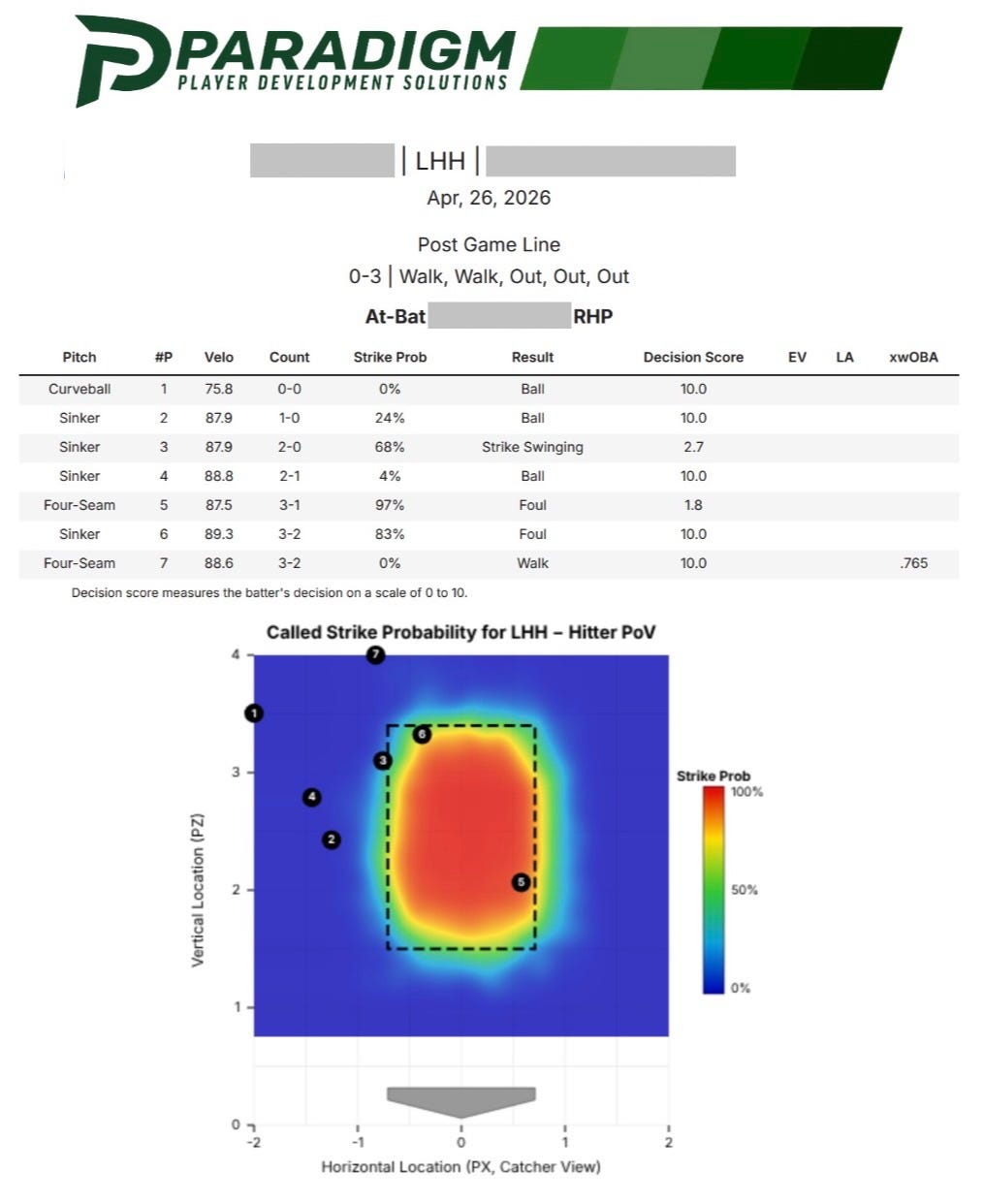
For each ball in play, the hitter receives his batted-ball data and xwOBA, a measure of how valuable that batted ball is likely to be given its exit velocity, launch angle, and direction. For a take, the hitter receives the pitch’s location and its probability of being called a strike, so you can tell a disciplined take from a hittable pitch that went by. Put together, this report gives the context and immediate feedback a coach needs to judge the process behind a hitter’s game instead of the results that come out of it.
Alongside all of that sits our swing decision score. Where the rest of the report gives you the context, this puts an actual run value on the decision itself, individualized to each hitter’s profile. The decision score grades whether swinging or taking was the right call given the pitch location, its speed/movement, and the hitter’s hot zones. This is the most granular piece of the report. The swing decision score strips down each pitch to a simple 0–10 score of a hitter’s decision to swing or take.
How the Score is Built
At its core, the decision score is built on run value, the runs a hitter gains or gives up with every choice at the plate. Pitch by pitch, the model weighs what taking is worth against what swinging is worth for that hitter, and credits the option he took.

Taking is graded with the count in mind. Run values will vary in magnitude depending on the situation. For example, taking a 2–0 breaking ball won’t hurt a hitter’s score very much, but taking that same pitch in a 2-strike count will have a much lower expected run value.
Swinging is worth what this hitter tends to produce on that specific pitch, depending on location and his damage zones. Not every strike is the same, and just because a pitch is in the zone doesn’t mean it’s worth swinging at. A guy who can’t handle a high fastball shouldn’t be swinging at one in an 0–0 count, and the model reflects that.
Tailored to the Hitter

Take this at bat for example. The hitter watches a first-pitch fastball catch the outside corner for strike one. On paper, it looks like a mistake: this is a first-pitch fastball taken for a strike that puts the hitter behind in the count. But the cost of going 0–0 to 0–1 isn’t steep, and the pitch happens to be in a zone that the hitter really struggles to do anything with. Laying off costs him very little and keeps him in an at-bat where he can still hunt something driveable, which he does on the very next pitch. When we consider the context, this is a good, repeatable decision, and the high decision score behind it considers what this hitter can and can’t damage.
The damage zones are the piece that makes the score personal to each hitter. Damage Zones aren’t about how much power a hitter has but rather where his damage lives. Two hitters can see the same dotted fastball away, but because one takes that pitch backside with ease and the other can only fight it off, swinging isn’t the right decision for both of them.
A hitter with more raw power doesn’t automatically earn a better score — what matters is whether he picked a spot he actually handles. The model rewards a hitter for knowing his zones, attacking what he handles well, and passing on what he doesn’t, and it dings a hitter who chases instead of getting his pitch.
The Full Picture
On its own, the swing decision score is just a tool. Its real value is how it works alongside the rest of the report: batted-ball data and xwOBA on contact, called-strike probability on takes, and the decision score tying them together. The process and results are displayed side by side. Some nights, the box score won’t show what a hitter did well, but between all of these pieces, the report will give a comprehensive picture of a hitter’s process.
Where the score really earns its value is over a full season. Add the decisions up across months, and the noise of any single game falls away, leaving a stable read on how a hitter actually operates: whether he works within his strengths, where he tends to expand, and which pitches he lets go that he should be attacking. Good decisions are the foundation under everything else a hitter does at the plate, and over a season, the score gives you a true read on the part of hitting that’s his to control.
Paradigm’s postgame hitting reports turn every at-bat into a coaching opportunity. Programs using SHIFT get pitch-by-pitch post-game swing decision scores, batted-ball data, and called-strike probabilities built around each hitter’s individual profile. Reach out now to see how Paradigm can bring this level of process-based evaluation to your program.
**Follow Us: @ParadigmPDS on X**
Written By: Nick Kinget
메타데이터
- post_id
- 5981eb8ac52a
- slug
- how-to-quantify-hitter-process-and-approach-5981eb8ac52a
- url
- https://medium.com/@ParadigmPDS/how-to-quantify-hitter-process-and-approach-5981eb8ac52a
- canonical_url
- https://medium.com/@ParadigmPDS/how-to-quantify-hitter-process-and-approach-5981eb8ac52a
- author_url
- https://medium.com/@ParadigmPDS
- status
- ok
- fetched_at
- 2026-07-14 15:46:17