Field Dialogue 4: Speculative practice as research for sense-waking and world-making
Snapshots from a living field — surfacing stories, practices, and insights in the evolving work of engaging the More-than-Human (For the…
Field Dialogue 4: Speculative practice as research for sense-waking and world-making
Snapshots from a living field — surfacing stories, practices, and insights in the evolving work of engaging the More-than-Human (For the full version of this Field Dialogue, consisting of an audio track & written synthesis, go to the Substack of the **Co-creation with the More-than-Human sandbox**)
Listen to the conversation:
▶️🎙️Access the audio track on Substack
Read the synthesis:
🌿 Field Dialogue #4 — Speculative practice as research for sense-waking and world-making
A speculative practice in motion: from Cuerpo Enjambre to Pulsos
What does it take to give form to an encounter with the more-than-human? And what becomes possible — for humans, for the living systems they’re embedded in — when that encounter stops being something to monitor and starts being something to practice?
In this fourth Field Dialogue, we spoke with Isabel Cavelier and Javi Guillot of **mundo común — a Colombia-based organization that describes itself as “a speculative practice of the future in the present” and, in a newer formulation, as a biomimetic design lab for culture change. We first encountered mundo común’s work in Learning Session 4 of our sandbox (June 2025), when the [Cuerpo Enjambre](https://mundocomun.org/en/cuerpoenjambre/)* (Body Swarm*) program was still mid-flight — a small group of artists, scientists, and indigenous collaborators in the Amazon were in the process of creating deep listening devices. Now, those devices exist. And mundo común is already building what comes next.
The conversation moves across three territories:
- what the completion of Cuerpo Enjambre revealed — about giving form to a more-than-human encounter, and about what those forms make possible for those who encounter them;
- the emergence of a new prototype called **Pulsos* (Pulses*), which is mundo común’s attempt to reimagine how we assess and understand the health of living systems; and
- the broader arc of mundo común’s work — how its understanding of what it means to be human in relation to the more-than-human has been shifting, and where that inquiry is taking the practice next.
When the swarm completed itself — what form revealed
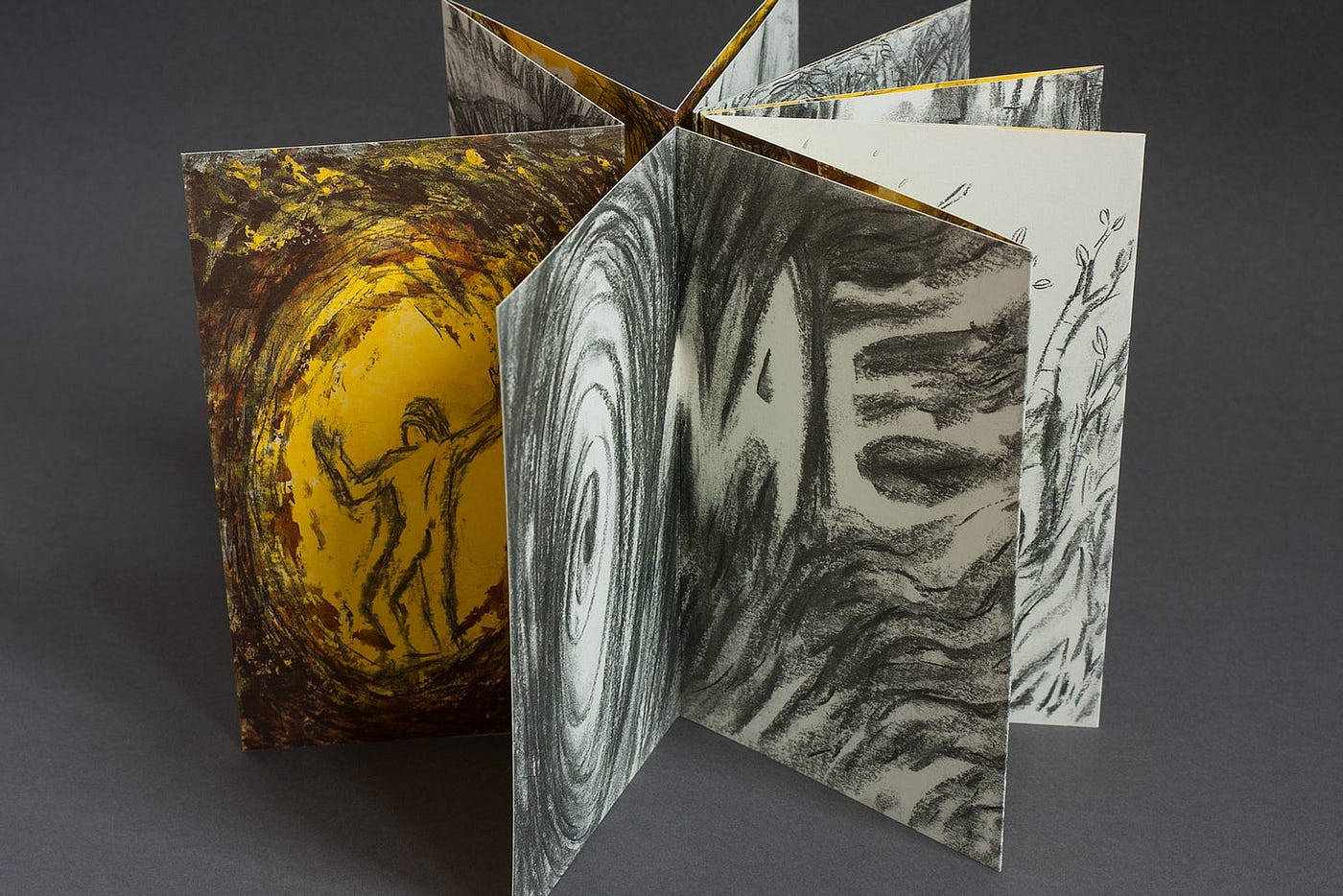
Three primary listening devices emerged from Cuerpo Enjambre: a book, an exhibition, and a short film. Each makes possible what the others can’t — and together they make a broader argument about what listening, given form, can do.
The book, *The Fall of the Tree River*, is an illustrated myth of the Maguta people of the Amazon River, co-created with artists, scientists, and local elders. In the oral tradition, a myth gains life each time it is told — and the physical book is designed around exactly that: its architecture is activated by being read aloud. The more-than-human beings it holds are not only the Amazon’s creatures and ecosystems, but the stories themselves. Oral knowledge woven across millennia is as alive, as agential, as any fungus or river. This is the device’s first quietly radical move: it expands what “more-than-human” means. It is not just what we have conventionally called nature — plants, animals, fungi, bacteria. It includes myths, stories, living cultural memories: non-human entities with their own presence and their own way of shaping the world.
The exhibition, *Invisible Worlds* — first open in Bogotá and coming to London in summer 2026 — does something different again. It makes the invisible material. Flying rivers, the atmospheric currents that carry water invisibly from the Amazon basin across the continent, are captured as cloud droplets. As they fall, they nurture fungi that grow into the exhibition’s speakers. The drops of falling water make sound. You can hear the travel of water. This is not metaphor: the installation invites visitors into an embodied relationship with planetary water cycles, fungal underground worlds, the breathing mechanisms of global climate — not thinking about these systems, not honoring them in principle, but actually being in sensorial contact with them.
What both devices reveal is that listening is not a passive act. It has agency. It is relational. When new ways of sensing are opened, new forms of sense-making emerge — not just new thoughts, but new capacities. The devices don’t only communicate something about the more-than-human; they perform a new kind of relationship between those who encounter them and the worlds they hold.
What changes when a listening device travels
Invisible Worlds is itinerant. It was shaped by the Amazon basin and the atmospheric rivers of South America — and it is now moving to London, a different hemisphere, a different climate, a different river. What does a listening device carry when it leaves the territory that made it?
The answer is not “itself.” It carries the possibility of new entanglement.
In London, the cloud-capture mechanism won’t catch Amazonian atmospheric water — it will catch humidity from the Thames, from the breath of the people who come. That moisture will entangle with the speakers — grown from mycelium — in an explicitly material way. Two lands, connected not symbolically but physically, through the living matter of the installation. And the myth told in London or New York is never quite the same myth — like anything truly alive, the devices are not static. They shift with the territory they enter.
This reveals something important about the world the devices are pointing toward. The connection between the Amazon and the rest of the planet is not a metaphor. Dust from the Sahara travels each year to fertilize the Amazon. The Amazon basin regulates water cycles that determine rainfall patterns on other continents. These entanglements already exist; the devices, traveling, make them legible in the body.
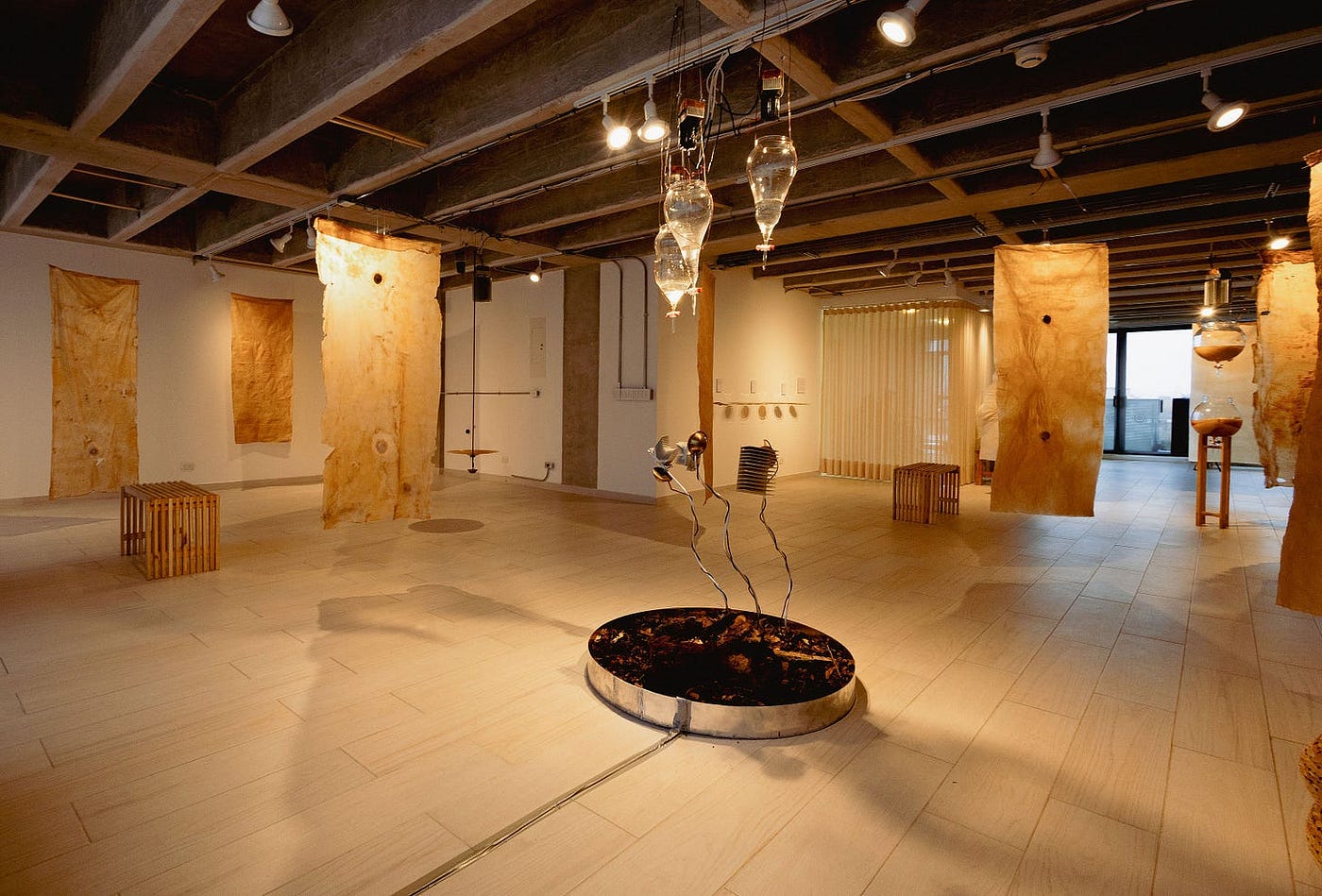
Image from the Invisible Worlds exhibition (credits: Rio Represent)
The bee — still the right teacher?
Cuerpo Enjambre began with the bee as its organizing intelligence: a creature that navigates through collective dance and vibration, that builds new homes when the existing one is under threat. Now that the program has run its full course, does that model still hold?
Yes — and with a surprise.
The bee intelligence of collaborative navigation through individual dance proved intensely, challengingly apt. Building something together is genuinely hard. It requires iteration, a division of labor, each contributor’s specific genius. Not every swarm found equally abundant territory — but all found something valuable. The metaphor held all the way through.
The deeper surprise was water. When Cuerpo Enjambre began, water was not its central focus. Yet most of the swarms, and the team itself, found themselves drawn directly toward it. Perhaps because the Amazon’s presence was inescapable. Perhaps because when humans try to mimic bees, they arrive quickly at something more primordial — the element all life comes from. Whatever the reason, the bees pointed, and the swarms followed, toward what was most fundamental.
Pulsos — listening as an alternative to monitoring
The program that mundo común is now prototyping has carried several names. It began as the Interspecies Auditorium. It is becoming **Pulsos* (Pulses*). The name change is itself a finding.
The starting point was a critique of what the environmental field calls MEL — monitoring, evaluation, and learning. Conventional MEL, even when well-intentioned, tends to rest on extractivist, anthropocentric logic: the human deploys instruments, extracts data, decides what counts as signal and what is discarded as noise. The more-than-human is measured. The human measures. Even when the stated goal is to include more-than-human perspectives, the underlying stance keeps the human as the only true perceiver.
Pulsos proposes something structurally different: perception as an embodied, relational practice. Not observation at a distance, but implication in the observed. The act of listening is not neutral to the listener — you change in the encounter. And because you change, what you perceive also changes. Observer and observed are always, in some sense, co-constructing what is being listened to.
The system integrates three modes of listening that are usually kept apart — as separate disciplines, and as separate conversations:
The biophysical mode — the sounds of a territory and its living beings, currently prototyped through ecoacoustics.
The social-narrative mode — the stories circulating among human inhabitants of a place: what they say about the land, about each other, about what is changing.
The somatic mode — what bodies register in relation to place. This includes human bodies first, but also the bodies of other beings, and the territory itself understood as a body.
The question the system is asking is not: what living beings are present? It is: how are all the signals in this space organized among themselves — and how are we, embodied and listening, relating to them?
What makes integration across these three modes possible is a discovery from the prototyping phase: they share a common matrix. Time. Signals, frequencies, rhythms, cycles — a vocabulary shared across biophysical, social, and somatic listening. A forest pulses at multiple timescales: dawn chorus and dusk chorus, rain season and dry season, migrations, the slow shift of rivers. Human narratives pulse too. Bodies pulse. What Pulsos is attempting is to bring these three registers into sustained dialogue — currently planned as at least eighteen months in a territory close to Bogotá — and listen for what their intersection reveals about the health of a living system: not a single signal, but the web of relationships between signals.
Early findings from the prototyping are already suggestive. Participants who engaged in sustained somatic practice began using richer, more complex language to describe what they were perceiving in the territory. The vocabulary grew. There seems to be a connection between the somatic and the narrative — a widening of the relational register through the body. This echoes something visible in indigenous languages: the deeper a community has listened to a landscape over generations, the more intricate the language becomes for describing its details and dynamics. Listening and language co-evolve.
This is also why “auditorium” gave way to “pulses.” An auditorium, however reimagined, carries the ghost of stage and audience — of a focal point, a one-way transmission, a hierarchy between who performs and who receives. A pulse has no center. Every living system pulses from multiple points simultaneously. The performance/audience distinction dissolves: whoever listens is also being listened to. The question of who is the audience, in an interspecies context, may not be the right question. Perhaps everyone is the audience. Perhaps no one is.
What gets in the way
Two conditions stand out from the prototyping so far — not at the level of method, but at the level of the human being doing the listening.
The first is time. Listening must be sustained. A one-off encounter with a territory reveals something. But it cannot reveal the connections between cycles — the patterns that emerge across seasons, the dialogue between what a forest sounds like in January and what it sounds like in July. Genuine interspecies listening requires committing to the long arc, treating the practice not as a project with a delivery date but as an ongoing co-construction with what is being listened to.
The second is reflexivity. The human hand is always present, even in the most interspecies of intentions. Choosing where to place a microphone. Deciding what to call noise and what to call signal. These are not neutral acts. A condition for interspecies listening to really take place is an ongoing, acute awareness of how your own agency is shaping the system you claim to be perceiving — not as a reason for paralysis, but as a starting point for hypothesizing: what would happen if we had listened from a different position?
The body as the site of legibility
Across Cuerpo Enjambre and now Pulsos — and across mundo común’s wider portfolio, including Refugia and Cuerpos de Agua — the body appears as a consistent thread: the site where the more-than-human becomes legible.
This is not incidental. It is, in mundo común’s framing, one of the core thresholds for transiting toward a new praxis of being human. The body as place — a continuation of the land, perhaps the first land we are. The body as technology — a sensor, our most material way of existing in a world inextricably entangled with everything else. And the body as the possibility itself. A core concept from Bayo Akamolafe surfaces here: the body is not just the thing that is cracked — it is the \crack\ itself. The opening through which we connect with everything else.
There is no sense-making, in this framework, that bypasses the flesh. Sense-waking comes before sense-making. You cannot relate to the more-than-human from inside your head. You have to arrive in your body first.
A speculative practice — what the phrase has come to mean
Mundo común describes itself as “a speculative practice of the future in the present.” Through the work, that phrase has deepened.
One layer is about holding questions rather than closing them. The paradigm most of us have been formed by is hungry for answers — for the silver bullet, the causal attribution, the definitive finding. A regenerative stance calls for something different: finding the questions and holding them, iterating across time, the way evolution works across generations. What does genuine interspecies listening actually require? That question cannot be answered in advance. It has to be discovered in the doing.
The fractal image is emerging as a structuring insight: the body as the nearest fractal of the territories we inhabit. The organizing patterns of an ecosystem’s sounds, a community’s narratives, and a human body’s somatic rhythms may be the same patterns expressed at different scales. The ambition of Pulsos is to make that perception tangible — not as a metaphor, but as something you can actually come to feel.
At a deeper level, the phrase points to something more radically open than its first reading suggests. It is not about modeling the future and pulling it into the present. It is about holding “that quivering quality of the uncertainty that the future will always be.” There is no future out there somewhere; we are always here. A speculative practice, at its depth, is a practice of radical presence — and a practice of rebellion against the hunger for crystallization that modern culture has trained into most of us. The longing for things that are stable, distinguishable, classifiable. To hold the crack open so something else can emerge is to resist that pull — and to practice being at ease with constant becoming.
Being human, in this view, is a practice that is never finished. The question is only whether we practice it in more loving, more caring, more entangled ways.
A closing note
This conversation does not offer a completed method. It documents a practice in progress — one that is visibly deepening, and that is already generating real findings, even as it keeps its questions open.
Listening, in mundo común’s work, is not the destination. It is an entry point — a practice that opens perceptual channels that were previously closed, and through those channels, something more fundamental becomes possible: a different kind of relationship with the living world, and a different practice of being human within it. Not human as the observer standing apart, but human as participant in systems that were always already entangled with us.
What makes this more than a philosophy is that it keeps insisting on the concrete. A book designed to be read aloud. A cloud-capture mechanism on a London rooftop. Eighteen months of sustained somatic practice in a territory. The fractal of the body. The pulse. These are not metaphors for a new worldview — they are attempts to actually build the conditions under which that worldview becomes livable.
The question mundo común is really asking is not how to listen better. It is: what kind of human being becomes possible when we do?
The **Invisible Worlds exhibition opens in London in June 2026. The book [The Fall of the Tree River](https://www.instagram.com/p/DQrnDnhjqHa/) is available in Bogotá and can be ordered online. The [Cuerpo Enjambre short film](https://youtu.be/WP0VYh4ionc) is on YouTube. The [Pulsos](http://pulsos.mundocomun.org/)** website has recently been launched.
Follow mundo común at **@mundo.comun** for open calls and upcoming programs, including somatic narrative performances at TEDx Amazonia in Ecuador (late August 2026).
The **Co-creation with the More-than-Human sandbox** is a collaboration between The Repatterning Collective and Kincentric Leadership.
If you’d like to receive announcements of our popular monthly online learning sessions, which use live dialogue & discussion to explore different approaches and praxes for meaningful co-creation with the more-than-human (natural) world, then register here for the sandbox’s mailing list.
To receive syntheses of Learning Sessions and Field Dialogues directly in your inbox, find us on Substack, LinkedIn Newsletter, and of course here.
메타데이터
- post_id
- 59c1fdeb0901
- slug
- field-dialogue-4-speculative-practice-as-research-for-sense-waking-and-world-making-59c1fdeb0901
- url
- https://medium.com/enlivenment/field-dialogue-4-speculative-practice-as-research-for-sense-waking-and-world-making-59c1fdeb0901
- canonical_url
- https://medium.com/enlivenment/field-dialogue-4-speculative-practice-as-research-for-sense-waking-and-world-making-59c1fdeb0901
- author_url
- https://medium.com/@rbecque
- status
- ok
- fetched_at
- 2026-07-10 23:26:47