I Had 7 Islamic Apps on My Phone.
The Islamic digital fragmentation problem — and the free, comprehensive platform built to solve it entirely
I Had 7 Islamic Apps on My Phone. None of Them Were Enough. Then I Found One Website That Replaced All of Them.
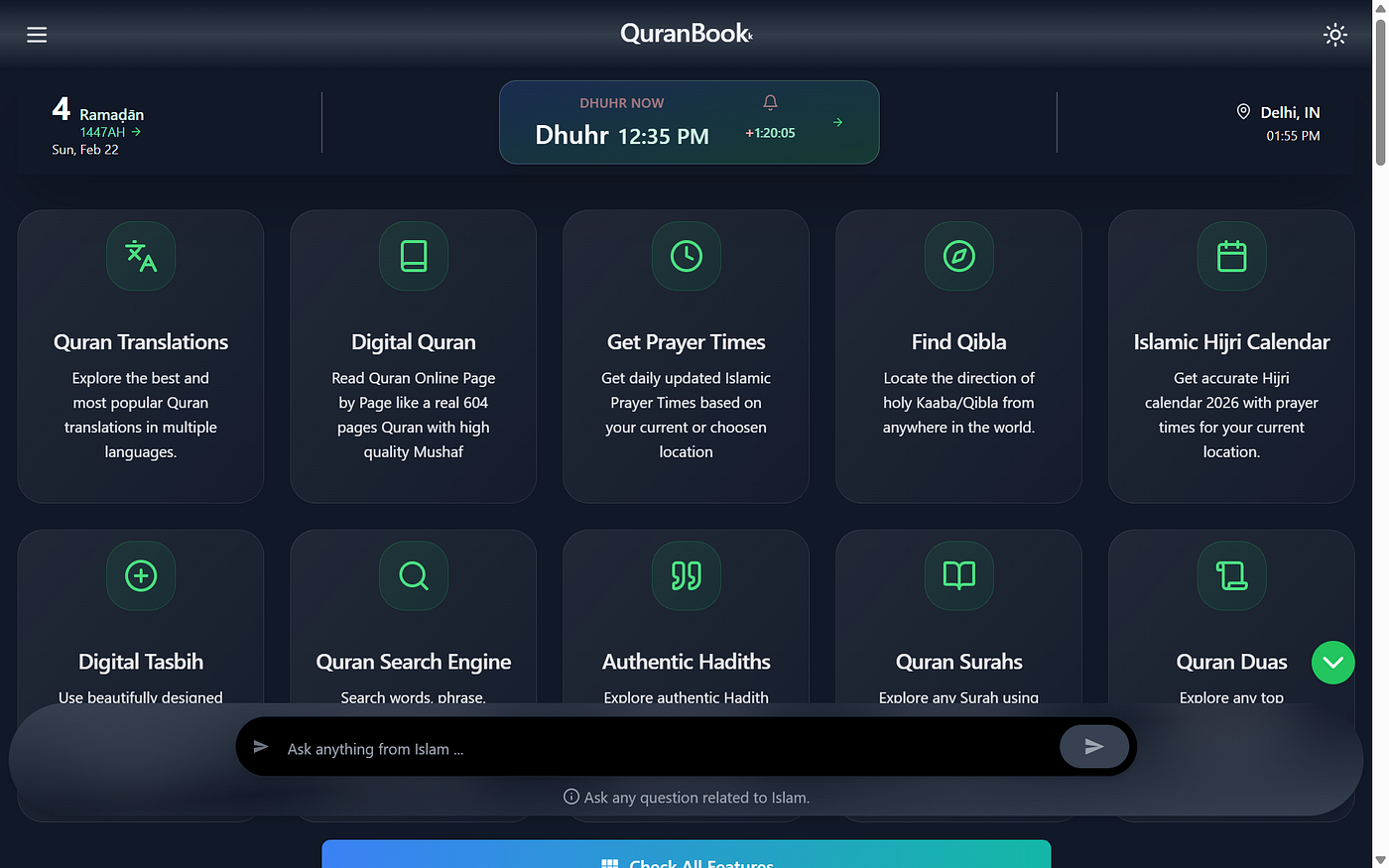
Quranbookk.com — the free comprehensive Islamic platform featuring Quran, prayer times, Qibla finder, Hijri calendar, hadith collections, Islamic AI, 99 Names of Allah, Digital Tasbih, and more. No account. No download. Any browser. Available for every Muslim worldwide.
The Islamic digital fragmentation problem — and the free, comprehensive platform built to solve it entirely
Let me describe a morning.
Fajr adhan. You reach for your phone. You open the prayer times app — a separate download, a separate login — to check whether you have time before the prayer window closes. You check the Qibla — a different app, downloaded specifically for that, occupying storage and requiring occasional updates. You want to read a few pages of Quran before the day begins. Another app. You want to read the translation alongside the Arabic. Another app, or a website — because the Quran app you use does not have the translation you prefer. You have a quick question about a Ramadan ruling. You open Google. You sort through results of varying quality and reliability, eventually landing on a forum post with no scholarly citation, or a YouTube video that is 45 minutes long when you have four minutes.
You have not yet left your bed. You have already opened four applications and a browser, switched between them five times, and received Islamic guidance of uncertain provenance.
This is the Islamic digital life of 2026. And it is not the fault of any individual Muslim. It is the result of a structural problem that nobody has named clearly:
Islamic digital infrastructure has been built in fragments — and the fragments do not connect.
The Fragmentation Problem Nobody Talks About
There are good Islamic apps. There are good Islamic websites. There are good prayer time calculators, good Quran readers, good hadith databases, good Qibla compasses, good Hijri calendar tools. They exist. Some of them are built by organizations with significant resources and millions of users.
But they are separate. Each was built to solve one problem. Each lives in its own silo. Each requires its own interface, its own learning curve, its own memory footprint on your device. And the Muslim who wants a complete Islamic digital practice — Quran, prayer times, Qibla, calendar, hadith, Dhikr, supplication, AI guidance, the 99 Names — has had to assemble that practice manually, from pieces that were never designed to work together.
The cost of this fragmentation is real. Every additional app is an additional friction point between a Muslim and their practice. Every additional website is an additional tab to manage, an additional account to remember. The Muslim who gives up on finding the right surah in the right translation because it requires navigating three different applications is not failing in their intention. They are being failed by infrastructure.
**Quranbookk.com** was built to solve this problem — completely, honestly, and without asking Muslims to pay for the solution.
What “Comprehensive” Actually Means
Every platform claims to be comprehensive. Claiming comprehensiveness is easy. Building it is not. Here is what genuine comprehensiveness requires — and what Quranbookk delivers:
Prayer and Direction — The Foundation of the Islamic Day
Every Muslim’s day is structured around five prayers. Those prayers require two things: knowing when and knowing which direction.
Prayer times are not fixed. They are recalculated every day from your precise GPS coordinates, using recognized scholarly calculation methods — Muslim World League, ISNA, Umm al-Qura, Karachi, Egyptian. A printed monthly timetable can be 10–15 minutes off by mid-month as the sun’s position shifts. **Quranbookk’s prayer times tool** recalculates every day, for your exact location, covering all six time points: Fajr, Sunrise, Dhuhr, Asr, Maghrib, Isha.
For Muslims traveling, moving, or with family in other countries: the **worldwide prayer times directory** covers any city on Earth — daily updated, GPS-precise, with the full range of scholarly calculation methods.
The Qibla is not “east.” It is the precise geodesic bearing from your exact GPS coordinates to the Kaaba — a calculation that changes with every degree of longitude and latitude. From New York it is approximately 58° northeast. From Cape Town it is nearly due north. From Jakarta it is 295° northwest. **The live Qibla finder calculates your exact bearing in real time, from wherever you are on Earth, without an app or account. The [global Qibla directory](https://www.quranbookk.com/qibla-finder/worldwide/)** generates the correct bearing for any city — for travel preparation, for setting up prayer spaces, for helping someone abroad.
The Islamic Calendar — Holding Both Worlds Simultaneously
The Muslim lives in two calendar systems — Gregorian for the secular world, Hijri for the Islamic one. Most Muslims carry the Gregorian calendar on every device and the Hijri calendar nowhere — which means the sacred months (Ramadan, Dhul Hijjah, Muharram) arrive as surprises rather than as anticipated seasons.
**Quranbookk’s Islamic calendar shows both calendars simultaneously — Hijri and Gregorian dates on the same grid, with Islamic events across all twelve months integrated, prayer times for your GPS location built into each day, and support for all major scholarly calculation methods. The [global Hijri calendar directory](https://www.quranbookk.com/islamic-calendar/worldwide/)** generates the correct Islamic calendar for any country — because Ramadan begins on different days in Saudi Arabia, Pakistan, and Indonesia, and a global ummah deserves a global calendar tool.
The Quran — Every Form, Every Language, Every Entry Point
The Quran is Quranbookk’s center. Every other feature of the platform orbits the Book of Allah — because the Islamic life orbits it, and a platform that does not center the Quran has misunderstood what Islamic infrastructure is for.
The written Quran:
**The Digital Quran** preserves the Mushaf as it has always existed — 604 pages, the standard Madinah print, precise page breaks that hafiz and students have memorized alongside the text. A digital Quran that destroys the page structure to optimize for scrolling destroys something important. Quranbookk preserves it: Al-Fatihah to An-Nas, page by page.
**Quran translations** in multiple languages — because 78–85% of the world’s 1.8 billion Muslims are not native Arabic speakers, and for them the translation is not a supplement to the Quran. It is the primary access point to the Quran’s meaning. English (Sahih International, Yusuf Ali), Urdu, Indonesian, and more. Multiple translations per language — because no single translation captures every dimension of any verse.
**All 114 Surahs** with Arabic text, multiple translations, audio recitations, and video content — each surah as the complete literary and spiritual unit it is.
**All 30 Juzs / Para** — the Quran’s thirty equal parts, 20 pages each, the structural backbone of the Ramadan Khatm. One Juz’ per day across 30 days of Ramadan: one complete reading of the Book of Allah.
The searchable Quran:
**The Quran search engine** accepts any word, phrase, verse reference (2:255, 112:1), or Islamic topic and returns every relevant verse with surah name, ayah number, and translation — searching the Arabic text and translations simultaneously. For the Muslim who remembers the feeling of a verse but not its location. For the Muslim who wants to verify whether a “Quranic verse” circulating on WhatsApp actually exists in the Quran before forwarding it.
The heard Quran:
The word Quran (القُرْآن) means The Recitation — not The Book. The Quran was revealed as sound. The Angel Jibreel ﷺ recited to the Prophet ﷺ; the Prophet ﷺ recited to his companions. For two decades before its written compilation, the Quran existed entirely in human memory and voice. **Quran audio provides surah-by-surah recitations from the world’s most celebrated qaris: Abdul Basit Abd us-Samad, Mishary Rashid Al-Afasy, Maher Al-Muaiqly, Abdur-Rahman As-Sudais, Saad Al-Ghamdi, Al-Minshawi. [Quran video](https://www.quranbookk.com/quran/video/)** adds the visual dimension — essential for Tajweed learners, for the visual learner, for the complete audio-visual Quranic experience.
The discovered Quran:
The Quran has 6,236 verses. Most Muslims genuinely engage with fewer than 300 across a lifetime. The remaining thousands carry identical divine weight and have been waiting. **The random verse tool** delivers one verse at a time, with translation, from the complete Quran — in English (Sahih International), Urdu, Malayalam, and more. One verse per day across Ramadan: 30 verses you have likely never met. Thirty encounters with the part of the Book that has been waiting for you.
The Quran of supplication:
Every Dua inside the Quran is categorically different from any other prayer. It is a supplication that Allah chose to preserve in His own revelation — the crisis prayers of prophets at the extremity of human experience, answered by Allah and kept in the Book for every Muslim who would come after. Yunus ﷺ from inside the whale. Musa ﷺ before Pharaoh. Ibrahim ﷺ while building the Kaaba. Ayyub ﷺ after years of unrelenting suffering. **The Quran Duas collection** gathers every significant Quranic supplication — Arabic text, multiple translations, verse references — in a single, organized resource.
The Sunnah — The Prophet’s ﷺ Authenticated Legacy
Imam al-Bukhari reviewed an estimated 600,000 narrations across sixteen years of travel across the Islamic world. He included 7,563. The most rigorous editorial process in human history — producing the most authenticated collection of the Prophet’s ﷺ words in existence.
**The authentic hadith collections** at Quranbookk provide direct access to the canonical six: Sahih al-Bukhari, Sahih Muslim, Sunan Abi Dawud, Jami al-Tirmidhi, Sunan an-Nasa’i, Sunan Ibn Majah — plus Muwatta Imam Malik — with verified English translations. Not paraphrases. The actual collections, with full hadith references, organized for reading and study.
**The random hadith tool** draws one authenticated narration from Sahih Bukhari per visit — complete with book, hadith number, and translation. One per day: 30 Ramadan encounters with the vast, largely unexplored interior of the Prophet’s ﷺ recorded guidance.
AI-Powered Islamic Guidance — Honest About What It Is
There are approximately 57 million Muslims living as minorities in Western countries, with limited accessible Islamic scholarship. Hundreds of thousands of new converts annually. Rural Muslims globally without proximity to scholars. Every one of them has questions — and many of them go unanswered because the access infrastructure does not exist.
Quranbookk’s three specialized Islamic AIs address this honestly. They are knowledge access tools, not scholarly authorities. They do not issue fatwas. They do not replace qualified Islamic scholars. They make the informational layer accessible — so that Muslims can understand their situation, ask better questions, and approach scholars more informed.
**Ask Islam AI handles broad Islamic questions — Quran, Hadith, fiqh, Islamic history, Muslim practice, contemporary Islamic ethics. [Ask Quran AI](https://www.quranbookk.com/ask-quran-ai/) is purpose-built for Quran-specific inquiry: verse meanings, revelation context, tafsir perspectives, comparative interpretation. [Ask Hadith AI](https://www.quranbookk.com/ask-hadith-ai/)** addresses the most complex access challenge in Islamic knowledge — the hadith sciences: narration search, authenticity grading, collection identification, scholarly context across all six canonical books.
The specialization matters. Islamic knowledge is organized by source and discipline. A single generic Islamic chatbot that conflates Quran, Hadith, and fiqh serves none of them well. Three tools, each focused, each honest about its limits, each connected to the same platform — that is the right architecture.
Dhikr, the Divine Names, and the Practice of Remembrance
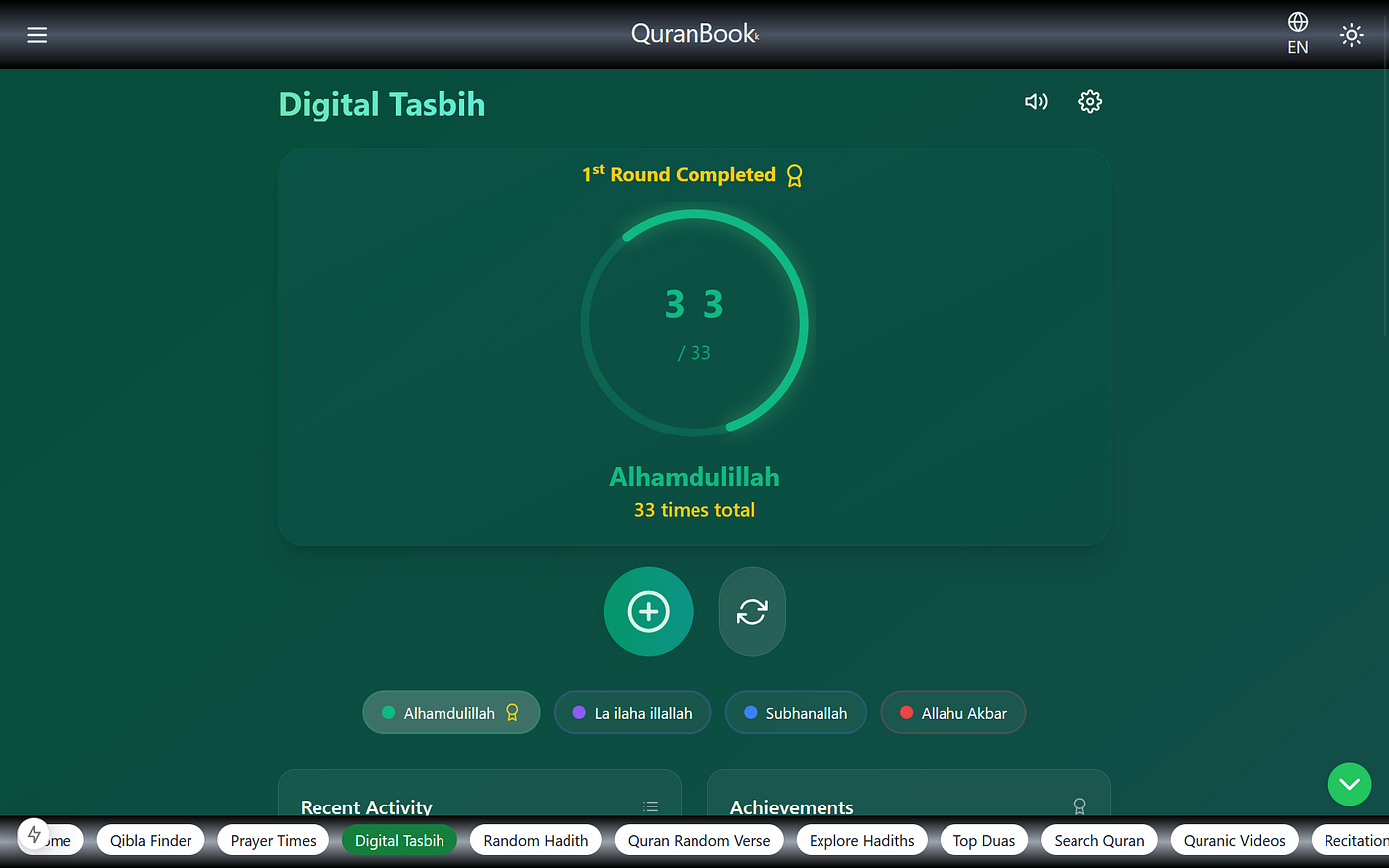
**The Digital Tasbih* exists because the most recommended act of worship in the Sunnah — Dhikr, the Remembrance of Allah — should have no barriers. No beads to lose. No app to install. A beautifully designed browser-based counter for SubhanAllah, Alhamdulillah, Allahu Akbar, La ilaha illallah, Astaghfirullah — any Dhikr, any count, any device. The Prophet ﷺ said of SubhanAllahi wa bihamdihi: “Light on the tongue, heavy on the Scale, and beloved to the Most Merciful.”* (Bukhari, 6682). The tool removes every barrier between that lightness and your tongue.
**The 99 Names of Allah* — al-Asma ul Husna — with Arabic text, audio pronunciation, meanings, and transliteration. Allah commands their use: “And to Allah belong the Most Beautiful Names — so call upon Him by them.” (7:180). Call upon Him by them* — meaning bring your specific need to the Name that specifically describes the help you need. Al-Fattah when a door is closed. Al-Razzaq when provision feels uncertain. Al-Ghaffar after a significant mistake. Al-Qareeb when you feel spiritually alone. Al-Mujeeb when prayer feels unheard. Ninety-nine names. Ninety-nine doors into the same relationship.
What No Other Platform Has Built
The Islamic digital landscape in 2026 includes well-funded platforms, non-profit organizations with institutional backing, and apps with millions of downloads. The honest question is not whether they exist — they do. The honest question is whether any of them have closed the fragmentation problem.
They have not. Because closing it requires building everything at once, integrating it genuinely, and making it available without barriers — no account, no download, no subscription, no premium tier for the features that matter most.
Here is what Quranbookk provides that no fragmented multi-app approach can replicate:
Genuine integration. The prayer times on the calendar page are the same calculation as the prayer times tool. The Quran you read in the Digital Mushaf is the same Quran you search in the search engine, hear in the audio player, and receive verses from randomly. The hadith you encounter in the random tool connects to the same collection you can read in full. Nothing is siloed. Everything connects.
Zero-friction access. No email address. No password. No storage consumed. No update required. Open a browser — any browser, on any device, in any country on Earth — and every feature of the platform is immediately available. For the Muslim traveling with a work device that cannot install apps, for the convert in a country where Islamic apps are restricted, for anyone who simply wants Islamic tools without managing another account: the browser is the access point and it works everywhere.
Worldwide coverage at city level. Qibla direction, prayer times, and Hijri calendars for thousands of cities globally — not only the major metropolitan centers that most platforms prioritize. Muslims live everywhere. The platform covers everywhere.
Scholarly integrity in calculations. Every prayer time, every Qibla bearing, every Hijri calendar date reflects recognized Islamic scholarly methodology — Muslim World League, ISNA, Umm al-Qura, Egyptian General Authority, Karachi standards — not a developer’s best interpretation. The calculations are the ones that Islamic authorities use.
Honest AI. The three Islamic AIs are labeled accurately: knowledge access tools, not muftis. The platform says this openly, at the point of use, because Islamic honesty about what AI can and cannot do is itself an Islamic obligation.
Complete and free. Every feature described in this article is available at no cost. No premium tier. No feature-locked behind a subscription. The complete Islamic digital infrastructure — for any Muslim, anywhere on Earth.
This Is What the Infrastructure Looks Like When It Is Complete
Fajr adhan. You reach for your phone. One tab open. Quranbookk.
Prayer times — today’s Fajr, precise for your GPS location. The direction of prayer — your exact Qibla bearing. A random verse to begin the day with, in Arabic and translation. One random hadith from Bukhari. The day’s Juz’ for your Ramadan Khatm. Your Tasbih counter for the post-prayer Dhikr. A Quranic Dua for what this specific day brings. The Name of Allah that most specifically describes what you need from Him today.
One tab. No logins. No switching. No friction between intention and practice.
This is what Islamic digital infrastructure looks like when it is built completely — when the goal is not solving one problem but solving the whole problem, for every Muslim who faces it, everywhere on Earth.
**Quranbookk.com — Free. Complete. No account. No download. Any browser. For every Muslim, anywhere.**
The complete feature list: Live Qibla · Global Qibla · Prayer Times · Global Prayer Times · Islamic Calendar · Global Hijri Calendars · Digital Quran · Quran Translations · Quran Surahs · Quran Juzs · Quran Search · Quran Audio · Quran Video · Random Verse · Quran Duas · Authentic Hadiths · Random Hadith · Ask Islam AI · Ask Quran AI · Ask Hadith AI · Digital Tasbih · 99 Names of Allah
메타데이터
- post_id
- 59cbc38bdda5
- slug
- i-had-7-islamic-apps-on-my-phone-59cbc38bdda5
- url
- https://medium.com/@farhan7reza7/i-had-7-islamic-apps-on-my-phone-59cbc38bdda5
- canonical_url
- https://medium.com/@farhan7reza7/i-had-7-islamic-apps-on-my-phone-59cbc38bdda5
- author_url
- https://medium.com/@farhan7reza7
- status
- ok
- fetched_at
- 2026-06-29 22:44:20