What Are the DPDP Rules 2025? | Key Requirements and a Practical Compliance Checklist
Gain insights into the details of the India DPDP Rules 2025: key changes, definitions, penalties, and compliance readiness checklist.
What Are the DPDP Rules 2025? | Key Requirements and a Practical Compliance Checklist
From Act to Rules
India’s **DPDP Act, *passed in 2023, established the legal foundation for personal data protection. However, the Act alone provided only high-level obligations. Organizations still lacked clarity on how *to operationalize compliance.
That clarity arrived on 14 November 2025, when the government of India released the DPDP Rules 2025 — transforming the Act’s principles into enforceable processes, mechanisms, and safeguards. The Rules detail practical requirements for consent, notices, governance, security, breach handling, cross-border transfers, and special protections for children and high-risk processing.
This guide provides a structured breakdown of the DPDP Rules 2025.
1. Key Changes in the DPDP Rules 2025
While the DPDP Act set the overarching principles, the DPDP Rules introduce specific operational changes that organizations must now implement.
Key differences include:
1) Detailed Consent & Notice Framework
The Act required consent; the Rules now define how consent must be obtained, verified, and withdrawn. New elements include:
- Plain-language notices in specified languages
- Standardized notice components (purpose, categories, retention, grievance contact)
- Mechanisms for consent withdrawal
- Procedures for integrating Consent Managers
2) Mandatory Logging, Monitoring & Retention
The Act required “reasonable safeguards”; the Rules specify:
- Minimum log-retention periods (e.g., one year or more)
- Requirements for monitoring access, modifications, and transfers
- Periodic risk-based security reviews
3) Enhanced Verification for Children & Vulnerable Individuals
The Rules define:
- How to verify parent/guardian identity
- Documentation formats for verification
- Restrictions on profiling or targeted advertising to children
4) Practical Security Safeguards
The Act referenced “security measures”; the Rules list them explicitly:
- Encryption and masking/tokenization
- Access controls and authentication standards
- Backup and recovery requirements
- Vendor security alignment and processor oversight
5) Structured Breach Notification Mechanism
The Act required breach reporting; the Rules define:
- Notification timelines
- Information to include in breach reports
- Requirements to inform affected Data Principles
- Cooperation expectations with the Data Protection Board
6) Governance, Audits & Accountability
The Rules introduce:
- Documented retention schedules
- Governance structures for Data Fiduciaries
- Internal escalation workflows
- Additional documentation expectations for audits
In short, the Rules convert the Act into a practical compliance system with concrete steps, procedures, and evidence requirements.
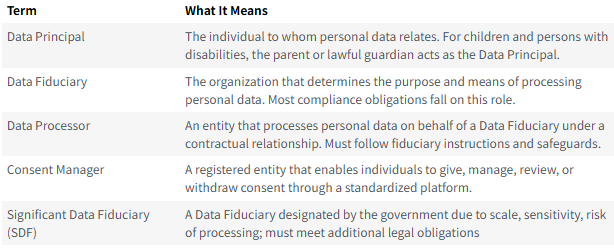
2. Key Definitions Introduced or Clarified
To help organizations understand their obligations, the Rules refine and expand several important terms.
3. Who Falls Under DPDP, and Who is Exempt
1) Covered Under DPDP
- All organizations processing digital personal data within India
- Entities outside India processing personal data of individuals located in India (e.g., global SaaS platforms, e-commerce, telecoms)
- Data Fiduciaries and Data Processors — public or private
- Any organization digitizing offline personal data
2) Exemptions
- Personal or household use (non-commercial)
- Government functions involving national security, law enforcement, or court operations
- Data made publicly available by the individual or under the law
- Research, statistical, or archiving work where data is anonymized
- Specific processing categories exempted by the government notification
These exemptions typically relax some obligation, not removing them entirely.
4. Penalties Under DPDP
The DPDP imposes some of the highest data-protection penalties in Asia. The Data Protection Board of India (DPB) oversees investigating complaints and imposing financial penalties .
Penalties for key violations are:

5. Additional Obligations for Significant Data Fiduciaries (SDFs)
SDFs face higher compliance requirements due to scale, sensitivity, or risk.
Obligations include:
- Appointment of a Data Protection Officer (DPO)
- Mandatory Data Protection Impact Assessments (DPIAs)
- Annual independent data-protection audits
- Algorithmic and automated processing risk assessments
- Enhanced record-keeping and governance measures
Organizations handling large-scale profiles, behavioral data, or sensitive datasets should assume SDF designation.
6. Cross-Border Data Transfers Under DPDP Rules 2025
The Rules empower the government to:
- Restrict transfers of specific categories of personal data
- Notify “negative lists’ of countries where data cannot be transferred
- Require additional conditions for certain transfers
- Impose localization requirements for specific data types
Organizations must map all data flows and ensure that offshore vendors, cloud services, and international teams comply with upcoming restrictions.
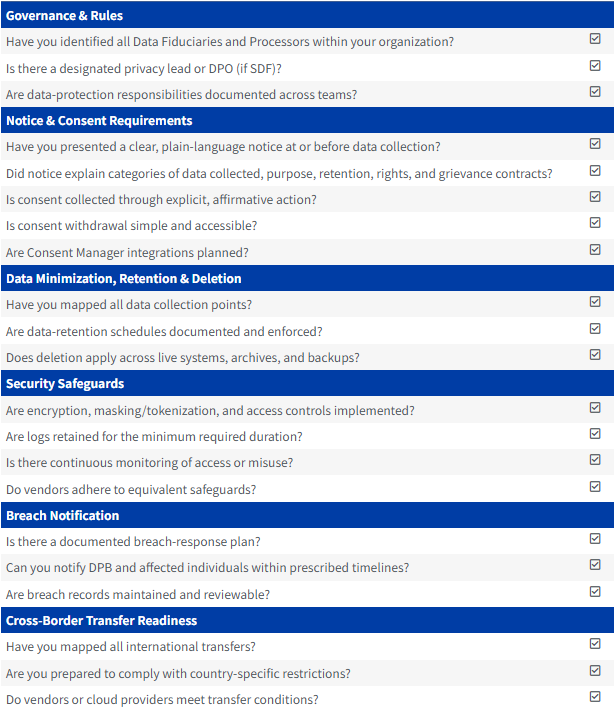
7. DPDP Rules 2025 Compliance Readiness Checklist
The checklist below serves as a practical tool for CISOs, DPOs, compliance teams, and IT governance teams to evaluate their current readiness under the DPDP Rules 2025 and identify gaps that require immediate attention.
Data-Centric Governance for DPDP Readiness
With the DPDP Rules 2025, India now has a complete operational framework governing personal data. As organizations prepare for enforcement, the challenge will be less about interpreting the law and more about demonstrating real, continuous control over how personal data is collected, used, shared, stored, and deleted.
This is where next-generation information protection and governance technologies, like Fasoo Data Security Platform, play an important role. The comprehensive platform helps organizations maintain persistent control over privacy data, regardless of whether it resides on endpoints, in cloud applications, or with external partners. By unifying discovery, classification, encryption, access control, and audit logging, Fasoo supports many of the operational disciplines required under the DPDP Rules. As the enforcement timeline approaches, organizations that invest in scalable, data-level controls will be better positioned to meet compliance obligations, reduce regulatory exposure, and strengthen the overall integrity of their data-handling practices.
메타데이터
- post_id
- 59cf5dbef9fd
- slug
- what-are-the-dpdp-rules-2025-key-requirements-and-a-practical-compliance-checklist-59cf5dbef9fd
- url
- https://medium.com/fasoo-global/what-are-the-dpdp-rules-2025-key-requirements-and-a-practical-compliance-checklist-59cf5dbef9fd
- canonical_url
- https://medium.com/fasoo-global/what-are-the-dpdp-rules-2025-key-requirements-and-a-practical-compliance-checklist-59cf5dbef9fd
- author_url
- https://medium.com/@jihoon.kim_47874
- status
- ok
- fetched_at
- 2026-07-18 02:42:05