The Manual Is the Map, Not the Territory
Why books can point toward seeing, but cannot replace the lived encounter of walking into the street and finding out what your attention…
The Manual Is the Map, Not the Territory
Why books can point toward seeing, but cannot replace the lived encounter of walking into the street and finding out what your attention can actually do
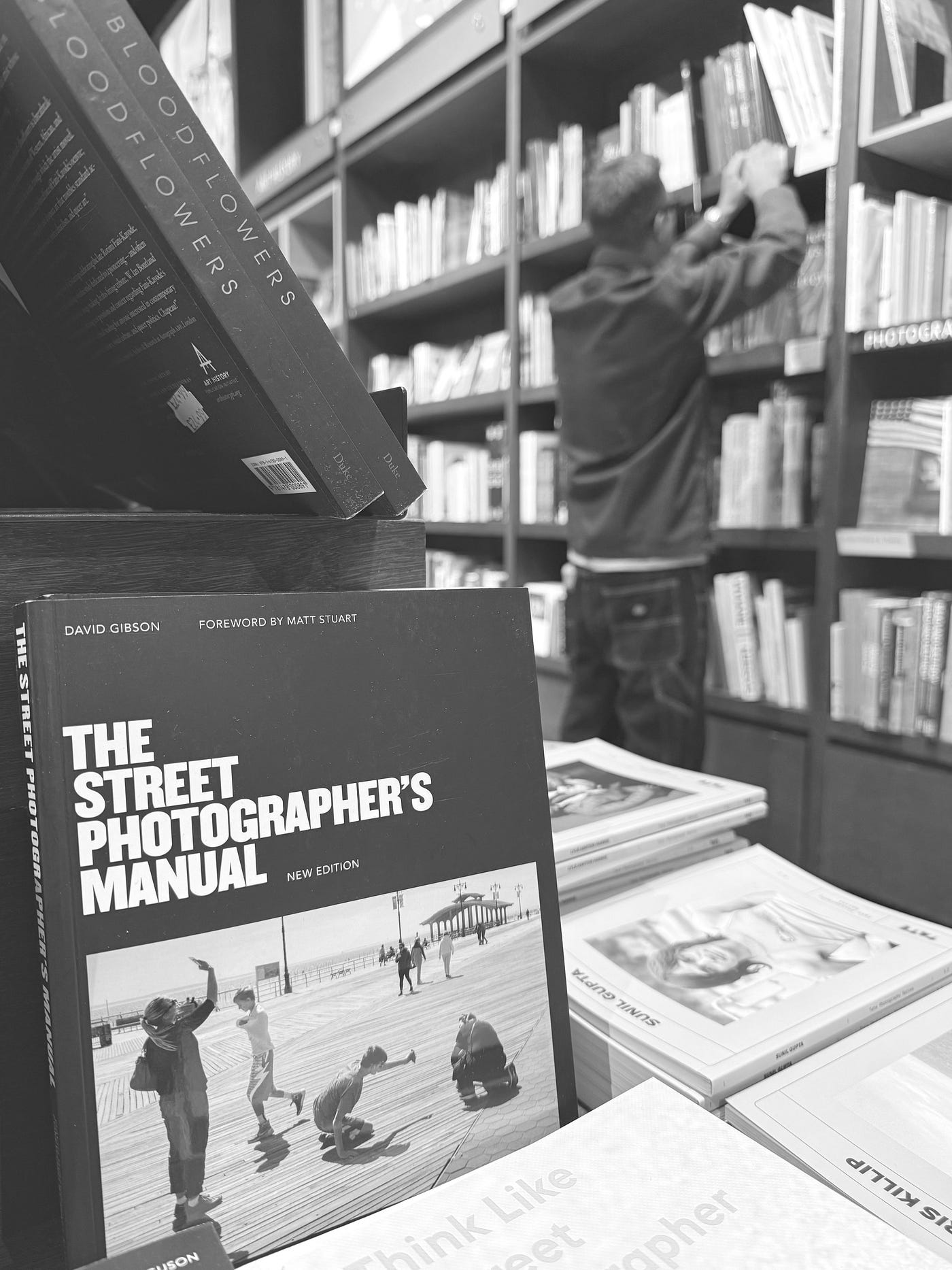
London, UK © 2026 Julien Valleton
There is a seductive mistake that many thoughtful people make.
They begin to confuse understanding with contact.
They read the right books. They underline the right passages. They collect the right frameworks. They can explain attention, perception, uncertainty, mindfulness, composition, timing, bias, salience, narrative, embodiment, presence.
And yet, when they step outside, the street still does not fully open.
Not because the books failed.
Because a manual is not a territory.
It can orient you. It can sharpen your questions. It can keep you from wandering blindly. It can help you name what you are experiencing once experience begins.
But it cannot see for you.
That is what makes street photography such a powerful corrective.
It keeps reminding you that reality does not arrive as theory. It arrives as weather, timing, friction, strangers, hesitation, gesture, missed chances, small surprises, unfinished scenes, and fleeting alignments that no book can fully simulate in advance.
The page can point. The walk has to verify.
And that distinction matters far beyond photography.
Why this confusion is so common
Books feel clean.
They offer coherence. They stabilize experience into language. They take complexity and render it graspable. They let the mind feel that it has advanced.
There is real value in that. A good book can save years of confusion. It can give you a vocabulary for noticing. It can offer a lens you would not have built alone. It can turn vague intuitions into something more precise and usable.
But books also create a dangerous comfort.
They can make a person feel perceptually richer before their perception has actually changed. They can create the feeling of movement without the friction of lived contact. A reader may begin to believe they have “done the work” because they have understood the description of the work.
This happens in photography all the time.
People read about decisive moments, but do not yet know how to wait. They read about attention, but still walk too fast to see. They read about beginner’s mind, but keep bringing the same expectations to every block. They read about impermanence, but still get angry when the frame vanishes before they can catch it. They read about street photography as presence, but still use the camera mainly as a shield.
The manual helps. But the manual is not the territory.
The map is valuable precisely because it is incomplete
A map is not useless because it is not the landscape.
Its usefulness depends on that difference.
A map simplifies. It leaves things out. It reduces reality to navigable structure. It gives you relations, emphasis, proportion, orientation. It cannot give you wind, noise, uncertainty, smell, fatigue, embarrassment, weathered surfaces, the exact tempo of a crossing, or the feeling of watching a stranger pause in light for one second and then disappear forever.
That is why maps are useful and why they are limited.
Books work in much the same way.
A strong book on perception may tell you that attention is selective. A strong book on urban design may teach you to see paths, edges, nodes, districts, and landmarks. A strong book on social behavior may help you recognize waiting, ritual, performance, avoidance, public solitude, or the choreography of care.
All of that can matter enormously.
But once you step into the street, the world does not arrive in clean chapters.
It arrives mixed.
The path is also a node. The waiting person is also performing. The sign is also irony. The gesture is also fatigue. The bench is also class, age, weather, timing, and private history. The beautiful scene may be visually strong and emotionally dead. The awkward scene may be formally imperfect and intensely alive.
Reality keeps exceeding the map.
That is not a flaw. It is the whole point.
The street is where theory loses its confidence and becomes useful
This is one of the hidden gifts of practice.
The street humbles ideas.
Not by disproving them necessarily. By forcing them to become operational.
A concept sounds clear in a paragraph. Then you try to use it for fifteen minutes in an ordinary neighborhood and discover that you do not actually understand it yet.
You think you understand “attention,” until you realize how rarely you notice the second layer of a scene. You think you understand “patience,” until you discover how quickly you leave places before they begin to reveal themselves. You think you understand “presence,” until you notice how much of your walk is organized around expectation, self-judgment, or subtle extraction. You think you understand “human behavior,” until your first reading of a stranger collapses under a second glance.
This is where the manual becomes useful again.
Not as replacement for the street. As something the street can test.
A real practice does not reject theory. It puts theory under pressure.
That is why street photography is such a strong medium for thought. It does not let ideas remain elegant for long. It keeps asking: can this concept survive contact with an actual block, an actual body, an actual missed moment, an actual hesitation in public space?
That is a healthy question.
Lived seeing cannot be outsourced
One of the deepest truths in photography is also one of the simplest:
no one can notice on your behalf.
A book can tell you to look for thresholds. It cannot feel the exact second when a doorway becomes charged.
A teacher can explain timing. They cannot lend you the nervous system that recognizes when one body is about to enter the right space.
An essay can describe public solitude. It cannot decide for you whether the person on the bench looks defended, peaceful, exhausted, or simply somewhere else entirely.
Even the best manual can only point toward the practice of attention. It cannot replace the actual labor of attending.
This is why photography remains such an honest discipline.
You can borrow language. You can borrow concepts. You can even borrow style for a while.
But eventually the street asks its own question:
What do you see here, now, before the moment passes?
That question cannot be answered by quotation.
The street keeps producing what no manual can fully anticipate
A good manual can describe categories. The street keeps producing combinations.
A sign collides with a pigeon. A child turns a staircase into a game. A commuter’s posture changes the entire meaning of a polished plaza. A wall that seemed blank becomes a stage because one figure enters with exactly the right hesitation. A reflection creates a second city inside the first. A row of benches becomes a diagram of social distance. A delivery rider waiting under luxury branding compresses a whole political essay into one glance.
No manual can predict the exact richness of those collisions.
It can prepare you to receive them better. That is different.
This matters because the most valuable things in street photography often come from the meeting point between prepared attention and unprepared reality.
Too little preparation, and the world stays flat. Too much dependence on preparation, and the world gets reduced to examples of what you already know.
The art is in the middle.
You walk with a concept, but not a script. You bring a question, but not a demand. You let the manual orient your eye without allowing it to imprison the answer.
That is when practice becomes alive.
A concept is only half-learned until it alters what you notice
This may be the simplest criterion.
A book about perception is not fully learned when you can summarize it. It is learned when your walk changes.
A book about architecture is not learned when you can define “edge” or “node.” It is learned when certain spaces begin to reveal their behavioral force immediately.
A book about attention is not learned when you agree that attention matters. It is learned when you start catching the moments a distracted version of you would have lost.
A book about public life is not learned when you can discuss it elegantly. It is learned when the street begins to look denser, stranger, more layered, and less obedient to your first reading.
In other words, the concept has to cross over.
From language to salience. From explanation to detection. From map to territory.
Street photography is one of the best ways to test whether that crossover happened.
Because it leaves so little room for self-deception.
Either the walk became different, or it did not.
The manual can name the territory only after you have touched it
There is another beautiful reversal here.
At first, the manual points you toward the territory. But after enough practice, the territory starts giving the manual new meaning.
You read a sentence on waiting before you have photographed waiting, and it remains interesting. You read it again after three months of noticing benches, platforms, thresholds, and bus stops, and suddenly it feels charged with lived knowledge.
The same happens with books on perception, philosophy, social behavior, urban design, attention, improvisation, loneliness, beauty, or time.
Experience makes language heavier.
The sentence is the same. The reader is not.
That is why the relationship between books and practice should be cyclical rather than hierarchical.
Read. Walk. Miss things. Notice things. Return. Read again. Find that the same page now says more because the street has added its own annotations.
Then the manual stops being abstract.
It becomes a conversation partner.
This is why assignments matter so much
Assignments are one of the best bridges between map and territory.
A good assignment takes an idea and makes it testable.
Photograph only waiting. Photograph only care. Photograph only public solitude. Photograph only what is broken. Photograph only people photographing. Photograph only the moment attention leaves the road.
Now the concept is no longer safe inside prose. It has to survive weather, distraction, boredom, missed frames, unclear scenes, false starts, and your own selective attention.
That is where learning deepens.
Because the assignment forces the idea into lived complexity. It reveals how much you understand, how much you project, and how much you still cannot see.
This is not failure. It is the territory doing its work.
The danger of loving the map too much
Some people become connoisseurs of orientation.
They love methods, frameworks, philosophies, diagrams, camera manuals, essays, and great photographic theory. They know many ways to speak about seeing.
But the more they love the map, the less willing they become to get lost in the territory.
That is a real danger.
Because lived seeing always contains embarrassment, uncertainty, slowness, contradiction, missed timing, unclear results, and the possibility that the world will not yield meaning on command.
A person can avoid all that by staying conceptually sophisticated.
Street photography is valuable because it can expose this avoidance gently but clearly.
The walk asks: are you here to verify reality, or only to decorate your relationship to it with intelligent language?
That is a serious question.
And a useful one.
A 15-minute map-versus-territory walk
Try this next time you finish a strong book or essay.
Before leaving, choose one concept from the reading. Not five. One.
Something like: attention, waiting, edges, improvisation, public solitude, care, thresholds, impermanence, small disobedience, algorithmic movement.
Then go somewhere ordinary for fifteen minutes.
For the first three minutes, do not photograph anything. Just notice how much the concept helps — and how much it does not.
Then make only six images.
One should confirm the concept clearly. One should complicate it. One should reveal that you were looking too narrowly. One should show something the concept helped you notice. One should show something the concept almost made you miss. And one should make you feel the difference between explanation and encounter.
When you return, ask:
Did the manual orient my seeing? Did the territory exceed it? And what part of reality became available only when I stopped trying to force the scene to match the idea too neatly?
That is the exercise.
Why this matters beyond photography
Because this is not only about books and cameras.
It is about how people relate to reality at all.
Many of us now live among summaries, frameworks, interfaces, expert language, and preloaded explanations. These are useful, but they can slowly replace contact if we are not careful. We begin to know about things better than we know how to meet them.
Street photography can interrupt that habit.
It returns knowledge to encounter. It returns theory to friction. It returns ideas to weather, bodies, surfaces, timing, risk, and public unpredictability.
That is healthy.
Because the goal of a good manual is not to spare you the territory.
It is to help you enter it more awake.
One question to walk with
Next time you step outside with your camera after reading something that feels important, carry this:
What if this idea is only a map — useful, clarifying, limited — and what would I have to notice in the actual street before I could say I had really entered the territory it points toward?
That is often where the deeper practice begins.
If this helped you see differently, keep going:
Follow me on Medium for the next article.
Or join **Street Photography Lab**, my newsletter where I turn books into weekly field missions for attention, perception, and clearer thinking in the age of AI.
메타데이터
- post_id
- 59d60d96e1e7
- slug
- the-manual-is-the-map-not-the-territory-59d60d96e1e7
- url
- https://medium.com/@Street_Photography_Lab/the-manual-is-the-map-not-the-territory-59d60d96e1e7
- canonical_url
- https://medium.com/@Street_Photography_Lab/the-manual-is-the-map-not-the-territory-59d60d96e1e7
- author_url
- https://medium.com/@Street_Photography_Lab
- status
- ok
- fetched_at
- 2026-06-09 15:37:30