The Gilded Picard Vinyard Cage
How A Single Scene Could Have Saved the Emotional Integrity of Star Trek: Picard
The Gilded Picard Vinyard Cage
How A Single Scene Could Have Saved the Emotional Integrity of Star Trek: Picard
Star Trek: Picard Season 3 — JeanLuc Picard and Beverly Crusher
When Star Trek: Picard Season 3 premiered, it was widely heralded as a triumphant return to form — a masterclass in legacy restoration that successfully scrubbed the lens clean after two seasons of narrative drift. Showrunner Terry Matalas achieved the seemingly impossible: he reunited the bridge crew of the Enterprise-D and delivered a high-stakes, cinematic curtain call that felt, for the most part, structurally sound.
Yet, underneath the sweeping orchestral scores and the immaculate recreation of the Type-10 shuttlecraft interiors, a profound psychological deficit remains at the core of the season’s inciting incident.
To engineer the necessary stakes — specifically, the introduction of Jack Crusher, Picard’s long-lost son — the writing team resorted to a classic Hollywood shortcut. We are told via clunky exposition that twenty years prior, Dr. Beverly Crusher abruptly ghosted the crew, went entirely off the grid, and raised her child in secret on the lawless galactic frontier. More bafflingly, we are expected to believe that Jean-Luc Picard — a legendary Starfleet Admiral possessing unparalleled institutional clout and a lifelong, unyielding devotion to his crew — simply accepted the silence, took the emotional lump, and retreated to his vineyard to polish wine glasses.
This hand-wave line of dialogue doesn’t just create a plot hole; it commits a fundamental narrative crime against the psychological profile of the characters we watched for seven seasons and four feature films. The Picard we know does not passively surrender when the people he loves vanish into the dark.
By applying basic human psychology and classic Star Trek structural mechanics, we can patch this gaping wound. Below is a structural blueprint for a single, zero-budget flashback scene that could have fundamentally recontextualized Picard’s exile, elevated the season’s writing to an “S-tier” standard, and restored the franchise’s most vital narrative engine.
The Structural Deficit: The Plot-Driven Hand-Wave
In the modern streaming ecosystem, writers frequently work backward from a pre-determined destination. The writers’ room needed a secret son, which mathematically required a twenty-year gap of absolute silence. To achieve this, they flattened the characters, forcing Picard into an uncharacteristic passivity and Beverly into an uncommunicative void, hoping the audience wouldn’t look too closely at the joinery.
In doing so, they missed a massive opportunity for grounded human drama. If we look at the institutional and psychological reality of these characters, Picard’s decades-long isolation at Chateau Picard shouldn’t have been a passive retirement choice — it should have been a gilded cage of his own grief and guilt, born from a desperate, failed attempt to find the woman he loved.
The Fix: The Institutional Stonewall and the Riker Reality Check
To make the twenty-year gap airtight, the narrative required an active conflict before the submission to silence. If we were to rewrite the missing chapter of that transition, it would manifest as a brief, devastating flashback sequence — framed similarly to the de-aged 10 Forward scene in Episode 3, “No Win Scenario” — built entirely on character-accurate psychology and systemic friction.
Phase 1: The Bureaucratic Wall
Picard would not have simply let Beverly walk away. As an Admiral, his initial tactical response would be to weaponize his rank: pulling her personnel files, tracking transport logs, and ordering Starfleet Intelligence to locate her vessel’s warp signature.
However, Beverly Crusher was the former Head of Starfleet Medical. She knew exactly how to scrub her own digital footprint. When Picard pushed the system, Starfleet Command would have intervened to shut him down hard:
The Institutional Friction: “Admiral, Dr. Crusher officially resigned her commission and requested civilian privacy status under Section 12 of the Starfleet Charter. She has committed no crime, and we are not a police state. You cannot utilize classified surveillance assets to hunt down a colleague who chose to leave. Stand down.”
For a man whose entire identity is bound to the rule of law and the ethical framework of the Federation, being told that using his official power to track her would be an abuse of authority and a violation of her civil rights would completely paralyze him.
Phase 2: The Stalker Realization
Defeated by the bureaucracy, Picard would inevitably end up in a dim room with his truest confidant, Will Riker, trying to make sense of the wreckage. It is here that the scene delivers its sharpest psychological blow.
Riker, acting as the external mirror, forces Picard to confront the brutal, narcissistic blind spot of his own grief.
The Missing Dialogue
PICARD
(staring at a blank data pad)
She left no forwarding coordinates. Starfleet insists she has a legal right to disappear. I can bypass the security protocols, Will. I can have Section 31 trace her subspace pings.
RIKER
And then what, Jean-Luc? If she wanted to be found by you, she wouldn't have run past the Neutral Zone. If you use your Admiral clearance to hunt her down across the quadrant, you aren't a concerned friend anymore. (beat)You're a stalker. You're pursuing a woman who explicitly demanded her privacy. She is running from the uniform, Jean-Luc. And right now, you are the uniform. Let her go.Why This Fix Restores the Classic Trek Trinity
Beyond solving the immediate logic problem, this psychological adjustment dynamically resurrects the classic Command-Logic-Emotion narrative engine that fueled the franchise’s greatest triumphs.
Historically, Star Trek functions best when the Captain stands as a focal point between two opposing forces: one representing cold, unyielding reality (Spock/Riker) and the other representing the fiercely protective, messy human heartbeat (McCoy/Crusher).
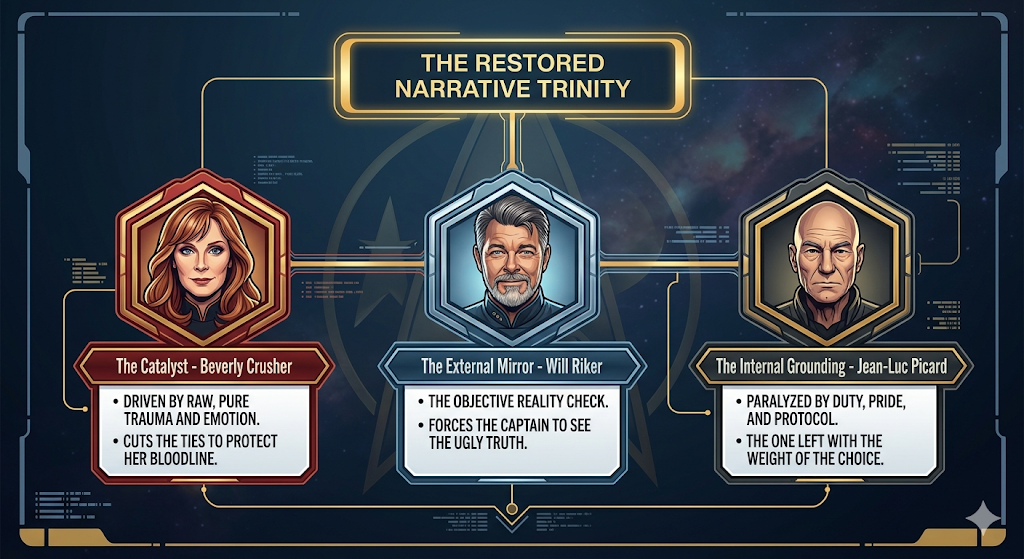
The TNG Trinity: Mirror
By introducing this specific conflict, the trinity locks perfectly into place:
- Beverly represents pure Emotion: Even in her absence, her actions are dictated by survival instinct and maternal panic. She is fleeing the trauma of a uniform that already claimed her husband and her first son.
- Riker represents tactical Logic: He performs the highest duty of a First Officer — protecting his Captain from his worst, self-destructive impulses. He forces Picard to realize that weaponizing Starfleet assets to chase a woman who rejected him crosses an ethical line.
- Picard represents the ultimate Command: He is forced to make the most agonizing executive decision of his life: to stand down. He must choose to carry the burden of her silence because honoring her autonomy is the only honorable path left to him.
Conclusion: The Vintage of Regret
With this single narrative adjustment, Chateau Picard stops looking like a cozy, picturesque retirement hobby and becomes a profound psychological state. When we meet Picard at the start of the series, he is languishing among the grapes not because he didn’t care enough to look for Beverly, but because he cared enough to obey Riker’s brutal warning. He chose isolation because he refused to become her hunter.
This costs nothing in visual effects. It requires no galaxy-ending stakes or convoluted Changeling conspiracies. It relies entirely on three actors in a room executing pure, character-driven gold. It is a stark reminder that the best way to fix a modern franchise’s plot hole isn’t to build a bigger mystery box — it’s to trust the rich human architecture the characters spent thirty years building.
메타데이터
- post_id
- 59e1817c8b40
- slug
- the-gilded-picard-vinyard-cage-59e1817c8b40
- url
- https://medium.com/@majikaltux/the-gilded-picard-vinyard-cage-59e1817c8b40
- canonical_url
- https://medium.com/@majikaltux/the-gilded-picard-vinyard-cage-59e1817c8b40
- author_url
- https://medium.com/@majikaltux
- status
- ok
- fetched_at
- 2026-06-09 15:37:30