Surprise! Tuscans Are Israelites Now, Too!
How The Genomic History of the Bronze Age Southern Levant Turned a Bronze Age DNA Study into a Modern Ancestry Mess
Surprise! Tuscans Are Israelites Now, Too!
How The Genomic History of the Bronze Age Southern Levant Turned a Bronze Age DNA Study into a Modern Ancestry Mess
The Genomic History of the Bronze Age Southern Levant is an important ancient DNA paper. Its Bronze Age dataset significantly expanded the available genetic evidence from the Southern Levant and helped clarify the genetic structure of populations associated with Canaanite material culture.
The problem begins when the paper moves from Bronze Age population history to modern ancestry.
Over the last several years, the study has been repeatedly cited as evidence that modern Jewish populations, particularly Ashkenazi Jews, descend directly from ancient Canaanites or Israelites. Yet a close reading of the paper reveals a far more complicated picture. The methods used to model modern populations produce inconsistent results, the paper’s two primary ancestry estimation approaches disagree with one another, and the authors ultimately combine genetically distinct ancient sources into a single category because they cannot reliably separate them.
The result is a paper that is relatively strong when discussing Bronze Age population structure but far weaker when used to make precise claims about the ancestry of modern populations.
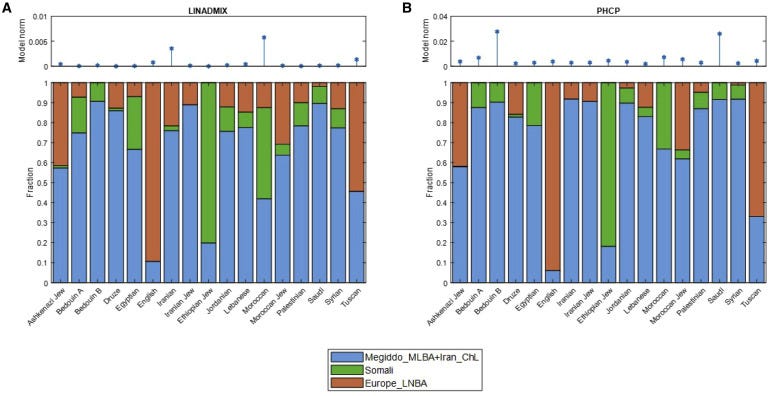
Figure S4 from Agranat-Tamir et al. 2020 shows the problem clearly. In LINADMIX, Tuscans appear with roughly 45% Megiddo_MLBA, Ashkenazi Jews around 50%, and Lebanese, Syrians, and Jordanians around 40%. If a Bronze Age Levant proxy makes Tuscans look as Megiddo-like as, or more Megiddo-like than, several modern Levantine populations, then the model is not measuring simple Israelite or Canaanite ancestry. It is capturing a broader Mediterranean and Near Eastern structure that cannot be reduced to a direct descent claim.
Figure S4 is arguably the most important figure in the entire paper because it reveals the central weakness of the modern ancestry analysis.
In the LINADMIX model, Tuscans appear at roughly 45% Megiddo_MLBA. Ashkenazi Jews appear around 50%. Meanwhile Lebanese, Syrians, and Jordanians cluster closer to 40%.
That should immediately raise questions.
If Megiddo_MLBA is being interpreted as a direct measure of Bronze Age Levantine, Canaanite, or Israelite ancestry, then the model is implying that Tuscans are nearly as “Megiddo-like” as Ashkenazi Jews and more Megiddo-like than several actual Levantine populations.
That is not a plausible historical conclusion.
The obvious explanation is not that Tuscans are secretly Israelites. The obvious explanation is that Megiddo_MLBA is functioning as a broad eastern Mediterranean and Near Eastern proxy rather than a literal measurement of Israelite ancestry.
This is not merely a theoretical problem. Similar Megiddo-based ancestry claims have already been used to argue that Ashkenazi Jews derive approximately half of their ancestry from ancient Israelites. As discussed in my article, “Ashkenazi Jews and a Forum Post Presented as Evidence,” Kevin Alan Brook writes in The Maternal Genetic Lineages of Ashkenazic Jews that:
“Approximately half, or a little more than half, of the genetic ancestry of Ashkenazic Jews from Eastern Europe traces back to the ancient Middle East. Ashkenazim have partial similarities to the autosomal DNA in ancient bones from Tel Megiddo (northern Israel).”
A reader encountering this statement would reasonably assume it rests on a major peer-reviewed autosomal study, a formal qpAdm analysis, or a published admixture model. It does not. Instead, the claim ultimately traces back to a forum-derived model based on Tel Megiddo similarity percentages. As shown in Figure S4, however, Megiddo-related percentages are highly sensitive to model design and reference population selection. When Tuscans can score roughly 45% Megiddo_MLBA while Lebanese, Syrians, and Jordanians score around 40%, treating these values as direct measures of Israelite ancestry becomes difficult to defend.
The Paper’s Own Methods Undermine the Megiddo Claim
The paper presents two methods for estimating ancestry proportions in modern populations: LINADMIX and Pseudo-Haplotype ChromoPainter, or PHCP. In principle, this should strengthen the analysis. LINADMIX relies on ADMIXTURE output and constrained least-squares estimation, while PHCP uses haplotype sharing. If both methods produced similar estimates, confidence in the results would increase. Instead, Figure S4 shows that the two methods disagree sharply on the very component that later became the basis for claims about Israelite or Canaanite ancestry.
The instability is obvious when the Megiddo_MLBA bars are compared directly. Tuscans fall from roughly 45% Megiddo_MLBA in LINADMIX to about 33% in PHCP. Druze rise from roughly 49% to about 61%. Jordanian estimates jump from about 44% to roughly 74%. Lebanese rise from about 44% to roughly 66%. Moroccans rise from roughly 42% to about 67%. Palestinians rise from about 51% to roughly 80%. Saudis rise from about 74% to more than 90%. Syrians show one of the largest changes, moving from roughly 36% in LINADMIX to about 70% in PHCP. These are not small corrections. In several cases, the estimated Megiddo_MLBA ancestry changes by twenty to thirty percentage points depending on which method is used.
That is the central problem. Figure S4 is often treated as if it reports stable ancestry percentages, but the paper’s own two methods produce very different Megiddo_MLBA estimates for many of the most relevant populations. A method switch lowers Tuscans substantially while pushing several Levantine and Middle Eastern populations dramatically upward. This means the figure is not behaving like a precise historical ancestry calculator. It is producing model-dependent estimates from closely related ancient sources.
The pattern also changes the meaning of the Tuscan result. Under LINADMIX, Tuscans appear at roughly 45% Megiddo_MLBA, only slightly below Ashkenazi Jews at roughly 50%, and above Lebanese, Syrians, and Jordanians. Under PHCP, Tuscans fall to about one-third, while many Levantine populations spike much higher. That does not rescue the Megiddo claim. It shows that the Megiddo assignment is highly sensitive to method choice. If the same figure can make Tuscans nearly match Ashkenazi Jews in one method while dramatically reshuffling Levantine populations in another, then the component should not be read as a direct measure of Israelite ancestry.
The paper itself acknowledges the problem. The authors state that LINADMIX and PHCP agree reasonably well on the Somali and Europe_LNBA components, but diverge on the relative contributions of Megiddo_MLBA and Iran_ChL. They explain that this likely occurs because Megiddo_MLBA and Iran_ChL are already genetically similar populations. That admission matters because the instability occurs exactly where later interpretations place the most weight: the supposed Bronze Age Levant component.
The authors’ solution was not to defend Megiddo_MLBA as a clean standalone signal. Instead, they combined Megiddo_MLBA and Iran_ChL into a single broader Middle Eastern source for their main results. That may have been the correct statistical decision, but it also changes what the study can claim. Once Megiddo_MLBA and Iran_ChL are merged, the model is no longer measuring a specific Bronze Age Southern Levant source. It is measuring a broader Middle Eastern category composed of multiple related ancestral sources.
Figure S4 therefore does not support the claim that modern populations can be assigned precise percentages of Israelite ancestry from Megiddo_MLBA. It shows the opposite. The relevant estimates shift substantially between LINADMIX and PHCP, the key ancient sources cannot be reliably separated, and the authors ultimately merge those sources into a broader Middle Eastern category. Far from validating the Megiddo claim, the paper’s own methods undermine it.
When Tuscany Starts Looking Canaanite
The most revealing result in Figure S4 is not found among Ashkenazi Jews or Levantines. It is found in Tuscany.
Under LINADMIX, Tuscans are assigned roughly 45% Megiddo_MLBA ancestry, placing them only a few percentage points below Ashkenazi Jews at approximately 50%. That result creates an immediate problem for popular interpretations of the figure. If Megiddo_MLBA is being treated as a direct measure of Israelite or Canaanite ancestry, then a Tuscan population appears to possess nearly the same signal as Ashkenazi Jews and a stronger signal than several Levantine populations shown in the same figure.
The paper’s own comparison with PHCP does not resolve the issue. Under PHCP, the Tuscan estimate falls to roughly one-third Megiddo_MLBA. At first glance, that appears to weaken the criticism. In reality, it does the opposite. Even after the downward revision, a population from Tuscany is still modeled as carrying more than one-third Megiddo_MLBA ancestry. That remains an extraordinarily large proportion for a population that is neither Levantine nor descended from ancient Israelites.
More importantly, the previous section demonstrated that LINADMIX and PHCP do not simply produce slightly different estimates. They substantially reshuffle the Megiddo_MLBA assignments across multiple populations. Jordanians, Lebanese, Moroccans, Palestinians, Saudis, and Syrians all move dramatically between methods, while the authors themselves acknowledge that Megiddo_MLBA and Iran_ChL cannot be reliably separated and ultimately merge them into a broader Middle Eastern category. The result is a figure in which the most heavily discussed ancestry component is also the least stable.
The Tuscan result remains problematic regardless of which method is preferred. Under LINADMIX, Tuscans nearly match Ashkenazi Jews and exceed several Levantine populations. Under PHCP, they still retain roughly one-third Megiddo_MLBA ancestry despite the substantial revision. Neither outcome supports the claim that Megiddo_MLBA functions as a uniquely Israelite signal.
The problem becomes even more serious when the study’s reference design is considered. English and Tuscans are effectively the only European comparison populations shown, yet English are a Northwestern European population with little relevance to Mediterranean ancestry questions. Tuscans themselves are genetically shifted north of Southern Italians and Sicilians, the populations that would be most relevant to testing alternative explanations for the Ashkenazi profile. Despite this northward shift, Tuscans still emerge with approximately 45% Megiddo_MLBA under LINADMIX and roughly one-third under PHCP.
The obvious question is not whether Tuscans were ancient Canaanites. The obvious question is what would have happened if the study had included Southern Italians, Sicilians, Maltese, Cretans, Aegean Greeks, or Italian Jews. Those populations are far more relevant to the historical questions being asked, yet none appear in the analysis. If a relatively north-shifted Tuscan population already produces Megiddo_MLBA values of this magnitude, it is difficult to avoid the conclusion that the component is capturing a broader Mediterranean and Near Eastern ancestry pattern rather than a specific measure of Israelite descent.
Once Tuscany starts looking Canaanite, the problem is no longer the history. The problem is the interpretation.
The Paper Admits the Key Limitation
The paper openly acknowledges this problem.
After comparing the two methods, the authors write that LINADMIX and PHCP “agree well with respect to the Somali and Europe_LNBA component” but “deviate regarding the respective contributions of Iran_ChL and Megiddo_MLBA.” They explain that this likely occurs because “Megiddo_MLBA and Iran_ChL are already very similar populations.”
This is not a minor technical detail.
It is the central methodological limitation of the modern ancestry analysis.
The two methods agree on the broad African-related and European-related components. They disagree on the distinction between Megiddo_MLBA and Iran_ChL.
The authors then make an even more important admission:
“To only consider results that are robust and shared by LINADMIX and PHCP, we have combined Megiddo_MLBA and Iran_ChL to a single source population representing the Middle East for our main results.”
That sentence fundamentally changes what the paper can and cannot demonstrate.
Once Megiddo_MLBA and Iran_ChL are merged, the model is no longer measuring specifically Bronze Age Southern Levant ancestry. It is measuring a broader Middle Eastern category composed of multiple related ancestral sources.
This was probably the correct statistical decision.
But it also means the paper cannot simultaneously be used as proof of specific Israelite or Canaanite ancestry percentages.
The authors themselves stopped treating Megiddo_MLBA and Iran_ChL as reliably separable ancestry signals.
What Figure S4 Really Shows
Figure S4 is often presented as if it demonstrates direct continuity between ancient Canaanites and modern populations.
That is not what the figure actually shows.
What it shows is that LINADMIX and PHCP behave differently, that the distinction between Megiddo_MLBA and Iran_ChL is unstable, and that the Megiddo_MLBA component appears in populations where a literal Israelite interpretation becomes difficult to defend.
Under LINADMIX, Tuscans appear around 45% Megiddo_MLBA. Ashkenazi Jews appear around 50%. Lebanese, Syrians, and Jordanians appear around 40%.
If Megiddo_MLBA is truly functioning as a direct measure of Bronze Age Levantine ancestry, then the model is producing conclusions that make little historical sense.
The simpler explanation is that the component is capturing a broader regional ancestry pattern shared across parts of the Mediterranean and Near East.
If that is the case, then the public claims being made about the figure are far stronger than the evidence itself.
The Paper Does Not Prove What People Claim
The paper supports a reasonable and important conclusion.
Many modern Jewish and Levantine populations possess ancestry related to populations that lived in the Bronze Age Levant and neighboring regions.
That finding is neither surprising nor controversial.
What the paper does not demonstrate is a precise percentage of Israelite ancestry.
It does not demonstrate that Ashkenazi Jews are primarily descended from Bronze Age Israelites.
It does not demonstrate that Megiddo_MLBA can be read as a direct measure of Canaanite ancestry.
Its own methods are too unstable for those claims.
LINADMIX produces results that place Tuscans near Ashkenazi Jews and above several Levantine populations. PHCP produces different estimates. The authors acknowledge the disagreement and combine Megiddo_MLBA with Iran_ChL into a broader Middle Eastern category.
Those are not the actions of researchers who believe they have isolated a precise Israelite ancestry signal.
How to Manufacture Israelite DNA from a Broken Model
By the end of Figure S4, the formula becomes difficult to miss.
Start with a modern ancestry model that uses only two European comparison populations. Make one of them English, a Northwestern European population with little relevance to Mediterranean ancestry questions. Exclude Southern Italians, Sicilians, Maltese, Cretans, Aegean Greeks, and Italian Jews, the very populations most capable of testing alternative explanations for the ancestry patterns being observed.
Next, construct a model in which Tuscans score roughly 45% Megiddo_MLBA under LINADMIX, only a few percentage points below Ashkenazi Jews at roughly 50%. Accept a result that places a Tuscan population above several Levantine populations on the study’s primary Bronze Age Levant proxy.
Then introduce a second method.
Watch the estimates change dramatically.
Tuscans fall from roughly 45% Megiddo_MLBA to about 33%. Jordanians jump from roughly 44% to approximately 74%. Lebanese rise from roughly 44% to around 66%. Palestinians increase from roughly 51% to nearly 80%. Syrians move from roughly 36% to around 70%. Saudis climb from roughly 74% to more than 90%. Across much of the Levant and Near East, the ancestry proportions are substantially reshuffled simply by changing the modeling framework.
At that point, a reasonable observer might conclude that the component is unstable and that strong historical interpretations should be approached with caution.
The authors largely do exactly that.
Rather than defending Megiddo_MLBA as a clean and separable ancestry signal, they acknowledge that LINADMIX and PHCP diverge regarding the relative contributions of Megiddo_MLBA and Iran_ChL. They further explain that the two ancient populations are already genetically similar. Their solution is to merge Megiddo_MLBA and Iran_ChL into a broader Middle Eastern category for the primary results.
In other words, the paper’s own authors stop treating Megiddo_MLBA as a robust standalone ancestry signal.
That should have ended the story.
Instead, it became the beginning of a new one.
The caveats disappeared. The methodological limitations disappeared. The disagreement between LINADMIX and PHCP disappeared. The missing Mediterranean populations disappeared. The merger of Megiddo_MLBA and Iran_ChL disappeared. What remained was a single number, stripped of context and elevated into an ancestry slogan.
The result was a wave of claims about “Israelite DNA,” “Canaanite percentages,” and direct ancestry estimates that the paper itself never successfully demonstrates.
The irony is difficult to miss. The most widely repeated interpretation of Figure S4 depends on ignoring the very evidence presented in Figure S4. A component that changes substantially between methods, cannot be cleanly separated from a closely related ancient source, and produces unexpectedly high values in a Tuscan population somehow became one of the most cited pieces of evidence for precise Israelite ancestry percentages.
That is not what the figure shows.
What Figure S4 actually shows is a model struggling to distinguish overlapping ancestry sources across the Mediterranean and Near East. It shows how sensitive ancestry estimates can be to methodological choices. It shows why closely related ancient populations are difficult to separate with confidence. Most importantly, it shows why caution is necessary when translating statistical models into historical narratives.
Unfortunately, caution rarely generates headlines.
A claim like “many populations share ancestry related to Bronze Age Levantine and neighboring Near Eastern groups” is accurate but unremarkable. A claim like “50% Israelite DNA” is simplistic, misleading, and guaranteed to spread. Figure S4 became famous not because it proved the latter claim, but because it was flexible enough to be repackaged into it.
If there is one lesson to take from this paper, it is not that anyone has discovered a reliable genetic meter for measuring Israelite ancestry. It is that unstable models, limited reference designs, and oversimplified interpretations can produce exactly the kind of ancestry narratives that people want to hear, regardless of whether the underlying evidence can support them.
For readers interested in a deeper examination of Ashkenazi genetics, Southern Italian comparators, reference population design, and the methodological issues discussed throughout this article, additional research and analysis can be found at Ashkenazi Research: https://ashkenaziresearch.org.
메타데이터
- post_id
- 59e8a3e331ed
- slug
- surprise-tuscans-are-israelites-now-too-59e8a3e331ed
- url
- https://medium.com/@s434354543/surprise-tuscans-are-israelites-now-too-59e8a3e331ed
- canonical_url
- https://medium.com/@s434354543/surprise-tuscans-are-israelites-now-too-59e8a3e331ed
- author_url
- https://medium.com/@s434354543
- status
- ok
- fetched_at
- 2026-06-21 12:17:11