I Didn’t Become a Better Python Developer by Learning More. I Became Better by Deleting More.
For years I measured progress by how much code I wrote. The biggest improvement in my Python career came when I started removing code…
I Didn’t Become a Better Python Developer by Learning More. I Became Better by Deleting More.
For years I measured progress by how much code I wrote. The biggest improvement in my Python career came when I started removing code instead.
There was a period when I believed every new project needed another library.
Need configuration?
Install a package.
Need retries?
Install another package.
Need validation?
There’s probably a package for that too.
My requirements.txt files kept growing.
So did my confidence.
Or at least I thought it did.
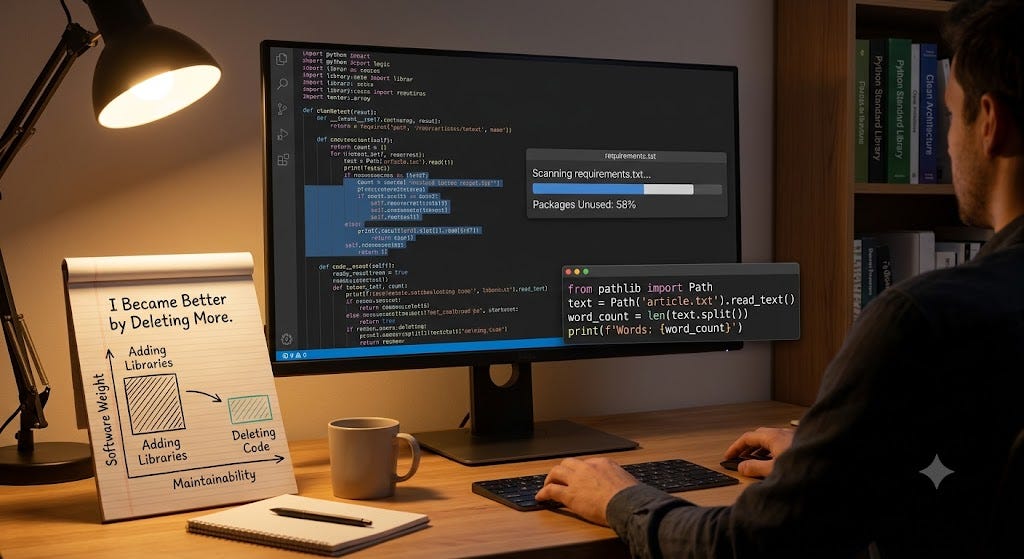
Then one afternoon, while preparing an old project for deployment, I ran a dependency scanner.
The report surprised me.
More than half of the installed packages weren’t being used anymore.
Some existed because I had copied them from another project.
Others solved problems I had already removed.
A few hadn’t been updated in years.
My application wasn’t becoming smarter.
It was becoming heavier.
That was the day I stopped asking:
“What should I add?”
And started asking:
“What can I remove?”
Every Line of Code Becomes a Responsibility
One lesson took me longer to learn than it should have.
Writing code is easy.
Owning it is expensive.
Every function has to be understood.
Every dependency has to be updated.
Every configuration has to be documented.
Every API can eventually change.
Every feature increases the surface area for bugs.
When I was new to Python, I only counted the time it took to build something.
I rarely counted the years it might take to maintain it.
That’s a very different calculation.
I Started Measuring Software Differently
Instead of asking:
- How many features does this project have?
I started asking:
- How many moving parts does this project have?
Those aren’t the same thing.
Two applications can solve the same problem.
One needs twelve dependencies.
The other needs four.
One exposes twenty configuration options.
The other exposes five.
One requires an afternoon to understand.
The other takes ten minutes.
Guess which one survives longer.
A Small Example
Imagine you want to count the number of words in a text file.
It’s tempting to search for a package.
Instead, Python already gives you everything you need.
from pathlib import Path
text = Path("article.txt").read_text(encoding="utf-8")
word_count = len(text.split())
print(f"Words: {word_count}")
No external dependency.
No build step.
No update cycle.
No additional documentation.
Sometimes the best library is the standard library you’ve forgotten exists.
The Standard Library Is Bigger Than Most Developers Realize
A few years ago, I started reading the Python standard library documentation with no project in mind.
Not to memorize it.
Just to understand what was already available.
That’s when I rediscovered tools like:
pathlibfor file handling.collectionsfor smarter data structures.itertoolsfor elegant iteration.functoolsfor reusable behavior.statisticsfor quick analysis.sqlite3for lightweight databases.concurrent.futuresfor simple concurrency.zoneinfofor modern timezone support.
I wasn’t learning new libraries.
I was rediscovering Python itself.
The Fastest Code Is Often the Code You Never Execute
Performance discussions usually focus on optimization.
Faster algorithms.
Better hardware.
Async programming.
Caching.
Those all matter.
But there’s another optimization that’s easy to overlook.
Delete unnecessary work.
I once inherited a reporting script that filtered the same dataset three separate times.
Each filter solved a different requirement.
By combining those operations into a single pass, the script became simpler and noticeably faster.
No advanced algorithm.
No complex profiling.
Just less work.
Sometimes the biggest optimization isn’t making code faster.
It’s realizing the code didn’t need to exist in the first place.
AI Reinforced This Lesson
When AI coding assistants became part of my workflow, I noticed something interesting.
The first draft they generated often worked.
But it also tended to include extra abstraction, unnecessary helper functions, or dependencies that solved tiny problems.
The most valuable part of my review process wasn’t adding code.
It was removing it.
AI is very good at generating possibilities.
Engineers still have to decide which ones deserve to stay.
The Most Underrated Engineering Skill
We celebrate developers who build impressive systems.
We rarely celebrate developers who quietly simplify them.
Yet every experienced engineer I’ve worked with shared one habit.
They weren’t afraid to delete.
Delete duplicated logic.
Delete outdated utilities.
Delete abandoned features.
Delete unnecessary configuration.
Delete complexity that no longer served a purpose.
Every deletion made the remaining code easier to understand.
And easier code tends to survive longer.
My New Rule
Whenever I finish a feature, I ask myself one question before opening a pull request:
“If I had to maintain this for the next three years, what would I remove today?”
That question has improved my software far more than another framework ever has.
Final Thoughts
For a long time, I believed becoming a better Python developer meant accumulating more.
More libraries.
More code.
More abstractions.
More features.
Today, I believe the opposite.
Progress often looks like subtraction.
Clearer functions.
Fewer dependencies.
Simpler architecture.
Less duplication.
Python gives us an incredible amount of expressive power.
The challenge isn’t proving how much of it we can use.
It’s knowing how little we actually need.
Because in the long run, the code that lasts isn’t the code that does the most.
It’s the code that solves exactly the problem it was written for — nothing more, nothing less.
Before you go
- Please take a moment to like the post and follow the writer!
- Did you know that over 400,000 developers share what they’re building, learning, and discovering across our platforms every month? Learn how you can contribute here
메타데이터
- post_id
- 59ec52a2141c
- slug
- i-didnt-become-a-better-python-developer-by-learning-more-i-became-better-by-deleting-more-59ec52a2141c
- url
- https://blog.stackademic.com/i-didnt-become-a-better-python-developer-by-learning-more-i-became-better-by-deleting-more-59ec52a2141c
- canonical_url
- https://blog.stackademic.com/i-didnt-become-a-better-python-developer-by-learning-more-i-became-better-by-deleting-more-59ec52a2141c
- author_url
- https://medium.com/@sa82912045
- status
- ok
- fetched_at
- 2026-07-18 01:24:29