Regulatory Suicide: How Brussels is Building a “Digital GULAG” for European Business
t amazes me how quickly loafers breed in USSR 2.0 (meaning the European Union). They don’t even have anything viable of their own regarding…
Regulatory Suicide: How Brussels is Building a “Digital GULAG” for European Business
t amazes me how quickly loafers breed in USSR 2.0 (meaning the European Union). They don’t even have anything viable of their own regarding AI yet, but the AI fines, laws, and regulations are already in place — along with a bunch of new roles to monitor compliance with AI laws and AI usage in corporations. This is a new burden on business, right on top of ESG, coaches and their “reflection” sessions, pointless digital transformers (who just fake stories in PDFs), and a small army of information security staff who don’t know how to code. Guys — you won’t get very far with business in Central Europe like this! Poland and the Baltics are a good example, Spain and Portugal are more or less reasonable, but the rest of the countries and Brussels are just really turning up the heat and blocking business right at the starting line!
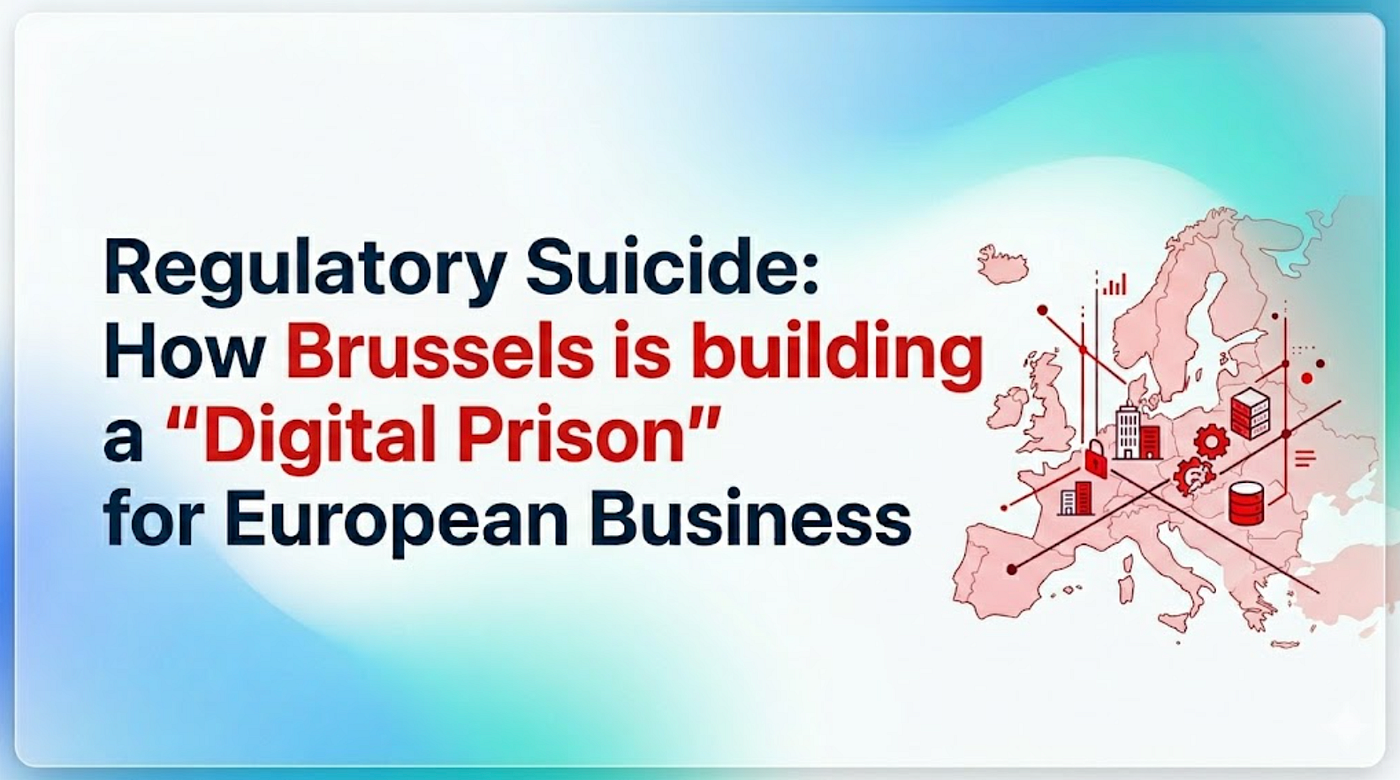
As someone who has spent years designing complex systems and building IT strategies for enterprise, I look at what is happening in Brussels with professional horror. We are witnessing a unique historical experiment: an attempt to over-regulate an industry that virtually doesn’t exist in the region. While Silicon Valley is “cranking out” code and China is training models on billions of users, Europe is training lawyers.
AI Act: Fines Arriving Before the Servers
The European Union is proud of being the first in the world to pass the EU AI Act. But if you think about it, it sounds like the pride of a person who bought a padlock for an empty safe. Europe doesn’t have its own OpenAI, its own Anthropic, or its own NVIDIA-level accelerators. But what we do have are fines of up to €35 million or 7% of global turnover.
Brussels has created a system where innovation is considered “suspicious” by default. Instead of fostering conditions for a “European ChatGPT” to emerge, the commissioners have generated thousands of pages of text describing how this hypothetical ChatGPT should apologize to the user for its every single byte.
The New Army of “Overseers” To implement the AI Act, corporations now require:
- AI Compliance Officers - people who don’t know the difference between a vector and a tensor, but know exactly what color to paint the “opt-out” button.
- Ethics Advisors - specialists in “digital reflection” whose job is to slow down the deployment process for the sake of abstract values.
- AI Auditors - external consultants (hello, Big Four!) who will charge €500 an hour to check your prompts for gender balance compliance.
Layer Upon Layer: The Regulatory Pie
For businesses in Central Europe (Germany, France, Belgium), the AI Act isn’t a standalone problem. It is the “cherry on top” of a cake made of already existing roadblocks.
- ESG and the Coaching Void - business is already suffocating from ESG reporting, where you have to calculate the carbon footprint of every single cup of coffee in the office. Added to this are armies of “soft skills coaches” running reflection sessions instead of optimizing business processes. As a result, instead of Lean Production, we get the “mindful burning of investments.”
- Digital Transformers and Their PDFs - this is my “favorite” category. People who call themselves Digital Transformers but can’t write a basic Python script to automate a data export from Jira. Their entire product consists of endless PDF presentations about how “spaceships are cruising the vast expanses of the metaverses.” They are architects of castles in the air that cost businesses millions a year.
- Non-Coding Security Pros - a separate pain point is Information Security (InfoSec), which has mutated into GRC (Governance, Risk, Compliance). We have thousands of InfoSec employees who know how to fill out questionnaires and demand a password change every 30 days, but who freeze in terror when faced with an actual vulnerability in the code. They don’t protect the business — they create the illusion of security through bureaucracy, blocking access to necessary tools for real engineers.
The Geography of Sanity: Where Can You Still Breathe?
Europe is not uniform, and that is its only saving grace. As an architect, I always look at system latency. In Brussels, the decision-making latency takes months. In Warsaw, it takes days.
- Leaders of Pragmatism - Poland and the Baltics countries still remember what real shortages look like, and therefore they value efficiency. Here, the IT sector is about code and results, not an “inclusive digital environment.” Regulation here is viewed as an annoying obstacle to be minimized, not a badge of honor.
- The Southern Compromise - Spain and Portugal have become a “safe haven” for digital nomads and startups. Yes, bureaucracy exists there, but it is lazy and not as aggressive as the German “Ordnung”. There, business can develop under the radar while Brussels is busy with yet another round of approving fonts on AI warning signs.
- The Blockers - Central Europe Germany and France have become hostages to their own grandeur. Over there, every startup faces such a compliance burden right at launch that it’s simply easier to register the company in Delaware or Dubai from day one.
Comparison of Business Habitats in 2026

Forecast: Where Will We End Up?
If Central Europe doesn’t shift its paradigm from “Precaution” to “Innovation,” we will end up with a museum region. Tourists will come to look at Victorian houses in London and cathedrals in Paris, but they will buy technology from the US, China, or India.
Business is a living organism. It always goes where there is the least environmental resistance. When the cost of a “permit to work” exceeds the potential profit, the business simply dies or migrates. The Brussels loafers think they are ruling the world by issuing new directives, but in reality, they are just ruling a void from which talent and capital are fleeing.
Summary for the Entrepreneur
If you are building an IT business in Europe in 2026, your strategy must be hybrid:
- Engineering and R&D - keep it in Poland, the Baltics, or Portugal. People there still remember what a computer is used for.
- Legal Address for EU Sales - you can leave it in Luxembourg or Ireland, but get ready to feed an army of “ethics consultants.”
- Ignore PDF Transformers - hire those who know how to code and build architecture. In the AI era, one good engineer with Copilot is worth ten “digital transformation strategists.”
Europe risks becoming the “Old World” not in terms of history, but in terms of decrepitude. Guys, with this kind of approach, you really won’t get very far. It’s time to stop reflecting and start committing.
메타데이터
- post_id
- 59ef1824d3a2
- slug
- regulatory-suicide-how-brussels-is-building-a-digital-gulag-for-european-business-59ef1824d3a2
- url
- https://medium.com/@codcl/regulatory-suicide-how-brussels-is-building-a-digital-gulag-for-european-business-59ef1824d3a2
- canonical_url
- https://medium.com/@codcl/regulatory-suicide-how-brussels-is-building-a-digital-gulag-for-european-business-59ef1824d3a2
- author_url
- https://medium.com/@codcl
- status
- ok
- fetched_at
- 2026-06-22 07:15:07