Why My CEO Agent Stopped Ignoring Its Departments
Building Mini CompanyOS AI with Hindsight Memory and cascadeflow Routing
Why My CEO Agent Stopped Ignoring Its Departments
Building Mini CompanyOS AI with Hindsight Memory and cascadeflow Routing
Most AI agents have the same problem: they forget everything.
A customer issue discussed yesterday disappears today. A hiring decision made last month never influences future recommendations. Every conversation starts from zero, and every decision is made without context.
That felt fundamentally wrong for business decision-making.
Real organizations don't work that way. Sales remembers customer feedback. Finance remembers budget constraints. HR remembers hiring decisions. Executives make decisions by combining all of these perspectives with historical context.
I wanted to explore what would happen if AI agents could work the same way.
The result was Mini CompanyOS AI, a multi-agent executive decision system that combines specialized business agents, persistent memory through Hindsight, and intelligent model routing using cascadeflow.
Mini CompanyOS AI
A multi-agent executive decision system designed to simulate how organizations make strategic decisions.
The system consists of four specialized agents:
- Sales Agent
- Finance Agent
- HR Agent
- CEO Agent
Instead of generating one generic answer, each agent contributes from its own domain expertise before the CEO synthesizes the final recommendation.
Problem Statement
Organizations rarely make decisions from a single perspective.
Consider a simple question:
Revenue dropped by 15% this quarter. What should we do?
The Sales team focuses on customer retention and market performance.
Finance focuses on profitability and cash flow.
HR focuses on workforce impact and employee morale.
A traditional chatbot usually provides a single generic answer that ignores these competing priorities.
The challenge was creating a system capable of:
- retaining previous decisions,
- routing work to appropriate models,
- generating specialized recommendations,
- and synthesizing them into one executive decision.
The Solution We Built
Mini CompanyOS AI approaches business problems as a collaboration between specialized agents.
The workflow looks like this:
- The user submits a strategic question.
- The Sales Agent analyzes customer and growth implications.
- The Finance Agent evaluates costs, profitability, and budget impact.
- The HR Agent considers workforce and talent implications.
- The CEO Agent reviews all recommendations and produces the final decision.
- The outcome is stored in memory for future use.
The objective was not to create a better chatbot.
The objective was to create a system that behaves more like an executive team.
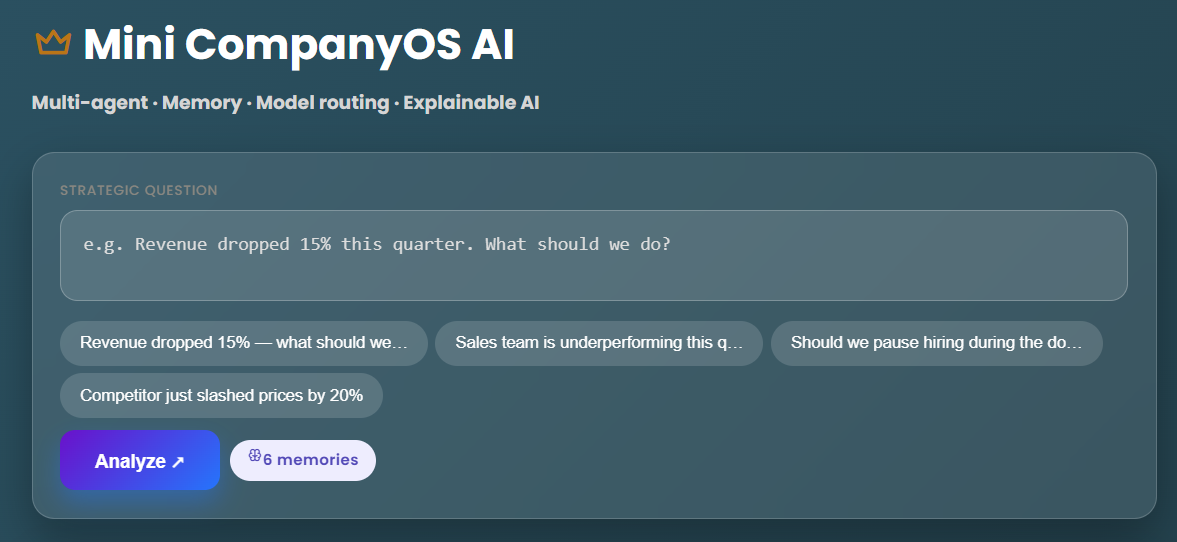
Figure 1: The main interface where users submit strategic business questions and trigger multi-agent analysis.
Architecture
High-Level Architecture

Figure 2: High-level architecture showing how cascadeflow routes requests to specialized agents, Hindsight stores memory, and the CEO synthesizes the final decision.
Tools and Technologies

Figure 3: Technology stack used to build Mini CompanyOS AI, including Hindsight for memory and cascadeflow for runtime intelligence.
Using Hindsight for Persistent Memory
The most interesting part of the project was memory.
Without memory, every interaction becomes isolated.
The CEO forgets previous downturn strategies.
The Finance department forgets historical cost-saving decisions.
The HR team forgets previous hiring freezes.
Hindsight changed this behavior.
Past decisions are retained and injected into future reasoning contexts.
For example:
Revenue decline in Q2
→ Retention campaign improved recovery

Hiring freeze during downturn
→ Reduced operational costs

Customer churn increase
→ Loyalty programs improved retention
This allows future recommendations to reference historical outcomes rather than repeating the same mistakes.
The system gradually becomes more informed with every interaction.
That behavior feels much closer to how organizations actually operate.

Figure 4: Hindsight retains previous decisions and makes them available during future reasoning.
Using cascadeflow for Runtime Intelligence
Not every task deserves the most expensive model.
Some tasks require deep reasoning.
Others only require simple analysis.
cascadeflow allows the system to route requests intelligently.
The routing strategy looked like this:
function route(task){
    const complex = {
        sales:true,
        ceo:true
    };

    return complex[task]
        ? "Claude Sonnet"
        : "Claude Haiku";
}
The CEO receives the more capable reasoning model because it must synthesize multiple viewpoints.
Finance and HR use lightweight models because their tasks are narrower and less computationally expensive.
This reduced cost while maintaining quality.


Figure 5: Final synthesized recommendation generated from independent departmental analysis.
Implementation Details
Each department returns structured JSON rather than plain text.
Example:
{
  "finding": "Customer acquisition declined by 12%",
  "risks": [
    "Customer churn",
    "Market share decline"
  ],
  "recommendation": "Launch retention campaigns",
  "sentiment": "negative"
}
The CEO receives all departmental outputs as structured input:
{
  "sales": {...},
  "finance": {...},
  "hr": {...}
}
This allows the CEO to synthesize recommendations instead of generating responses independently.
Challenges We Faced
1. Agent Identity Leakage
Initially, the Finance and HR agents occasionally behaved like Sales agents.
The issue turned out to be surprisingly simple.
Prompt matching relied on:
system.includes("Sales")Historical memory contained the word "Sales", causing every agent to trigger Sales logic.
The fix was:
system.startsWith("You are the Finance Agent")A small change completely fixed agent contamination.
2. Generic CEO Decisions
The CEO initially ignored departmental recommendations.
Every question produced almost identical executive responses.
The solution was passing structured JSON rather than raw text:
{
  question:q,
  sales:sd,
  finance:fd,
  hr:hd
}
The CEO could finally combine perspectives instead of generating generic advice.
What We Learned
Several lessons became obvious during development.
Memory matters more than larger models.
Remembering previous outcomes often improves decision quality more than increasing model size.
Specialized agents outperform generic agents.
Department-specific reasoning consistently produced more useful recommendations.
Structured context beats long prompts.
Passing structured JSON dramatically improved synthesis quality.
Runtime routing reduces unnecessary cost.
Not every task needs expensive inference.
Future Scope
There are several directions worth exploring.
- Vector database powered long-term memory
- Predictive financial forecasting
- Market trend analysis
- Real ERP integrations
- Explainable reasoning traces
- Department collaboration scoring
- Live dashboard analytics
The current system focuses on executive decisions, but the same approach could be applied to healthcare, logistics, legal operations, and customer support.
Conclusion
The most surprising discovery wasn't the CEO agent.
It was realizing how much better decisions became once agents could remember previous outcomes and reason from specialized perspectives.
Memory and orchestration often matter more than larger models.
Once Sales, Finance, and HR stopped operating in isolation, the CEO finally had enough context to make decisions that resembled real executive thinking.
That felt less like prompting a chatbot and more like building an organization.
메타데이터
- post_id
- 5a1507a784dc
- slug
- why-my-ceo-agent-stopped-ignoring-its-departments-5a1507a784dc
- url
- https://medium.com/@anushkasugandhi2006/why-my-ceo-agent-stopped-ignoring-its-departments-5a1507a784dc
- canonical_url
- https://medium.com/@anushkasugandhi2006/why-my-ceo-agent-stopped-ignoring-its-departments-5a1507a784dc
- author_url
- https://medium.com/@anushkasugandhi2006
- status
- ok
- fetched_at
- 2026-07-30 07:51:10



