Are Electric Cars Really Saving the Planet? The Hidden Truth About EV Environmental Impact
Electric vehicles are everywhere these days. From Tesla billboards to government ads promising a cleaner future, we’re constantly told that…
Are Electric Cars Really Saving the Planet? The Hidden Truth About EV Environmental Impact
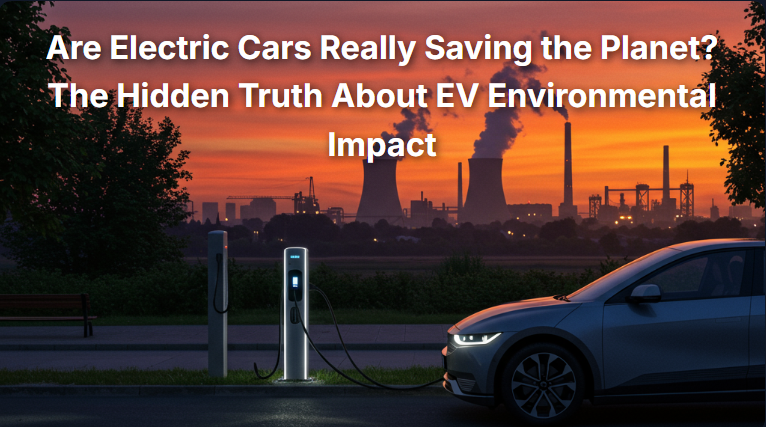
Electric vehicles are everywhere these days. From Tesla billboards to government ads promising a cleaner future, we’re constantly told that buying an EV is the best thing we can do for the environment. The message is simple: “Go electric, save the planet.”
But after diving deep into the research and looking at real-world data, the picture is far more complicated than what car companies want you to believe. Electric vehicles aren’t the environmental villains some critics claim, but they’re definitely not the eco-heroes that marketing campaigns make them out to be either.
The Marketing vs Reality Problem

Walk into any car showroom today and you’ll see shiny EVs with bold “Zero Emissions” stickers. Sales representatives will tell you these cars produce no pollution at all. Technically, they’re right — but only if you ignore where the electricity comes from and how the car was made in the first place.
This selective truth-telling is creating a massive gap between what people think they’re buying and what they’re actually getting. Most EV buyers genuinely want to help the environment, but they’re making decisions based on incomplete information.
Where Your “Clean” Electricity Actually Comes From
Here’s the first reality check: your electric car is only as clean as your local power grid. In many parts of the world, that electricity is still coming from burning fossil fuels.
In India, for example, coal generates nearly three-quarters of all electricity. Sri Lanka has made better progress with about half of its electricity coming from clean sources like hydropower, but even there, fossil fuels still power a significant portion of the grid.
This means when you plug in your EV overnight, you might actually be burning coal — just at a power plant instead of in your car’s engine. The pollution is real; it’s just happening somewhere you can’t see it.
The Hidden Environmental Cost of EV Batteries
The biggest environmental impact of electric vehicles happens before they ever hit the road. Manufacturing an EV battery requires enormous amounts of energy and creates substantial emissions.
Let’s look at the actual numbers. Producing a typical 70 kWh EV battery requires about 12,000 kWh of energy and generates approximately 7 tons of CO2. To put that in perspective, that’s roughly equivalent to driving a gas car for 15,000 miles.
Breaking down the battery manufacturing process further, research shows that 40% of a battery’s total environmental impact comes from mining and processing the raw materials like lithium, nickel, and cobalt. Another 20% comes from the actual cell production process, which involves energy-intensive heating and drying operations.
This is why electric vehicles start life with a significant “carbon debt” compared to traditional cars. Studies show that EV production generates about 40% higher emissions than manufacturing a comparable gas-powered vehicle.
The Break-Even Point: When EVs Actually Become Cleaner
Despite their manufacturing disadvantage, electric vehicles do eventually become cleaner than gas cars — but it takes time and miles to reach that break-even point.
In countries with relatively clean electricity grids, like France, an EV becomes environmentally superior after just 25,000 kilometers of driving. But in coal-heavy regions like China, you’d need to drive 153,000 kilometers before your EV’s total environmental impact becomes lower than a gas car.
For most drivers in mixed electricity grids, the typical break-even point is around one to two years of normal driving. After about 15,000 miles, the EV’s lower operational emissions start to outweigh its higher manufacturing impact.
The Complete Lifecycle: From Mining to Disposal
When researchers calculate the total environmental impact of vehicles over their entire lifespan, electric cars do come out ahead — but not by as much as you might expect.
A comprehensive lifecycle analysis comparing medium-sized vehicles over 16 years and 240,000 kilometers found:
- Electric vehicles: 39 tons of CO2 equivalent
- Hybrid vehicles: 47 tons of CO2 equivalent
- Gas vehicles: 55 tons of CO2 equivalent
So yes, EVs are cleaner overall, but they’re about 29% better than gas cars, not the 90–100% improvement that “zero emissions” marketing suggests.
The Water Problem Nobody Talks About

Here’s an environmental impact that rarely gets mentioned: water consumption. Electric vehicles can use nearly twice as much water as gas-powered cars when you account for mining, manufacturing, and electricity generation.
The water issue is particularly acute in lithium mining regions. Over half of global lithium extraction happens in areas already experiencing water stress, like Chile’s Atacama Desert. Some communities near lithium mines have seen their wells dry up completely.
However, this water story has a important twist. When EVs are powered by renewable energy sources like solar and wind, they actually use about one-third the water of gas-powered vehicles. The problem isn’t electric vehicles themselves — it’s the fossil fuel-powered electricity grids that charge them.
The Recycling Challenge
One of the biggest long-term concerns about electric vehicles is what happens to their batteries at the end of their useful life. Currently, only about 5% of EV batteries worldwide are actually recycled.
Most EV batteries last 10–20 years depending on usage and climate conditions. After that, they need to be either recycled, repurposed for stationary energy storage, or disposed of safely. The recycling process is complex and expensive, requiring specialized facilities that many regions still lack.
The good news is that recycling technology is improving rapidly. Recent Swedish research successfully recovered 100% of aluminum and 98% of lithium from used EV batteries. But scaling these processes globally will take time and investment.
The Real Environmental Benefits of EVs
Despite these challenges, electric vehicles do offer genuine environmental benefits:
Local Air Quality: EVs eliminate tailpipe emissions entirely, which dramatically improves air quality in cities and reduces health problems from vehicle pollution.
Future Potential: As electricity grids become cleaner, EVs automatically become more environmentally friendly without any changes to the vehicles themselves. The same EV will have lower emissions in 2030 than it does today, thanks to increasing renewable energy.
Energy Efficiency: Electric motors are far more efficient than internal combustion engines, converting about 90% of electrical energy into motion compared to roughly 30% efficiency for gas engines.
Making an Informed Decision
So should you buy an electric vehicle? That depends on your specific situation and expectations.
EVs make environmental sense if you:
- Drive primarily in urban areas where air quality matters
- Live somewhere with a relatively clean electricity grid
- Can charge at home, especially with solar panels
- Plan to keep the vehicle for many years
- Understand that the environmental benefits are real but gradual
EVs might not be the best choice if you:
- Expect them to completely eliminate your transportation emissions
- Live in an area heavily dependent on coal power
- Need to drive very long distances regularly
- Can’t access reliable charging infrastructure
Electric vehicles are not an environmental silver bullet, but they’re not a scam either. They’re a meaningful step toward cleaner transportation, with real benefits that increase over time as electricity grids become cleaner and battery technology improves.
The problem isn’t with EVs themselves — it’s with the misleading marketing that oversells their environmental benefits. “Zero emissions” stickers create unrealistic expectations and set people up for disappointment when they learn about manufacturing impacts and grid emissions.
What we need is honest communication about both the benefits and limitations of electric vehicles. People can make good decisions when they have complete information, but marketing slogans like “zero emissions” don’t give them that chance.
The future of transportation will likely be electric, but that future will be built on realistic expectations and continuous improvement, not on exaggerated promises about saving the planet overnight. Electric vehicles are a important part of the solution to climate change and air pollution — they’re just not the complete solution that some would have you believe.
Understanding these nuances helps everyone make better choices and supports the development of truly sustainable transportation systems that consider the full environmental picture, from mine to recycling center.

Reference
- https://www.visualcapitalist.com/life-cycle-emissions-evs-vs-combustion-engine-vehicles/
- https://lowcarbonpower.org/region/India
- https://www.ceicdata.com/en/indicator/sri-lanka/electricity-production
- https://www.here.com/learn/blog/electric-vehicle-battery-recycling
- https://thundersaidenergy.com/downloads/co2-emissions-from-batteries-when-do-evs-break-even/
- https://builtin.com/articles/water-battery
- https://www.geotab.com/blog/ev-battery-health/
- https://lowcarbonpower.org/region/Sri_Lanka
- https://www.futuretracker.com/post/electric-vehicle-battery-recycling
- https://afdc.energy.gov/vehicles/electric-emissions
- https://www.eea.europa.eu/publications/electric-vehicles-from-life-cycle/at_download/file
- https://www.zaptec.com/info-hub/industry-news/the-tale-of-ev-vs-ice-lifecycle-emissions
- https://www.sustainabilitybynumbers.com/p/electric-vehicles-water
- https://climate.mit.edu/ask-mit/how-much-co2-emitted-manufacturing-batteries
- https://www.reddit.com/r/AskEngineers/comments/1cpv9yq/how_much_water_would_you_need_to_generate_10/
- https://www.pucsl.gov.lk/wp-content/uploads/2024/09/Renewable-Generation-Report-Q1-2024-V1.pdf
- https://www.trade.gov/country-commercial-guides/sri-lanka-energy
- https://store.fitchsolutions.com/power-renewables/sri-lanka-power-renewables-report
- https://www.soci.org/chemistry-and-industry/cni-data/2024/1/ev-batteries-from-rarity-to-recycling-boom-in-20-years
- https://batterycouncil.org/news/press-release/new-study-confirms-lead-batteries-maintain-remarkable-99-recycling-rate/
- https://www.globenewswire.com/news-release/2025/05/07/3076256/28124/en/EV-Battery-Recycling-Industry-Research-2024-2035-Market-to-Grow-at-a-CAGR-of-40-9-with-Contemporary-Amperex-Technology-GEM-Umicore-Glencore-and-Fortum-Dominating.html
메타데이터
- post_id
- 5a1b741d813c
- slug
- are-electric-cars-really-saving-the-planet-the-hidden-truth-about-ev-environmental-impact-5a1b741d813c
- url
- https://medium.com/@ahzem/are-electric-cars-really-saving-the-planet-the-hidden-truth-about-ev-environmental-impact-5a1b741d813c
- canonical_url
- https://medium.com/@ahzem/are-electric-cars-really-saving-the-planet-the-hidden-truth-about-ev-environmental-impact-5a1b741d813c
- author_url
- https://medium.com/@ahzem
- status
- ok
- fetched_at
- 2026-06-10 08:17:25