Do Advanced Civilizations Really Need Dyson Spheres?
The concept of a Dyson Sphere has long been considered one of the ultimate indicators of an advanced civilization. The idea is simple but…
Do Advanced Civilizations Really Need Dyson Spheres?
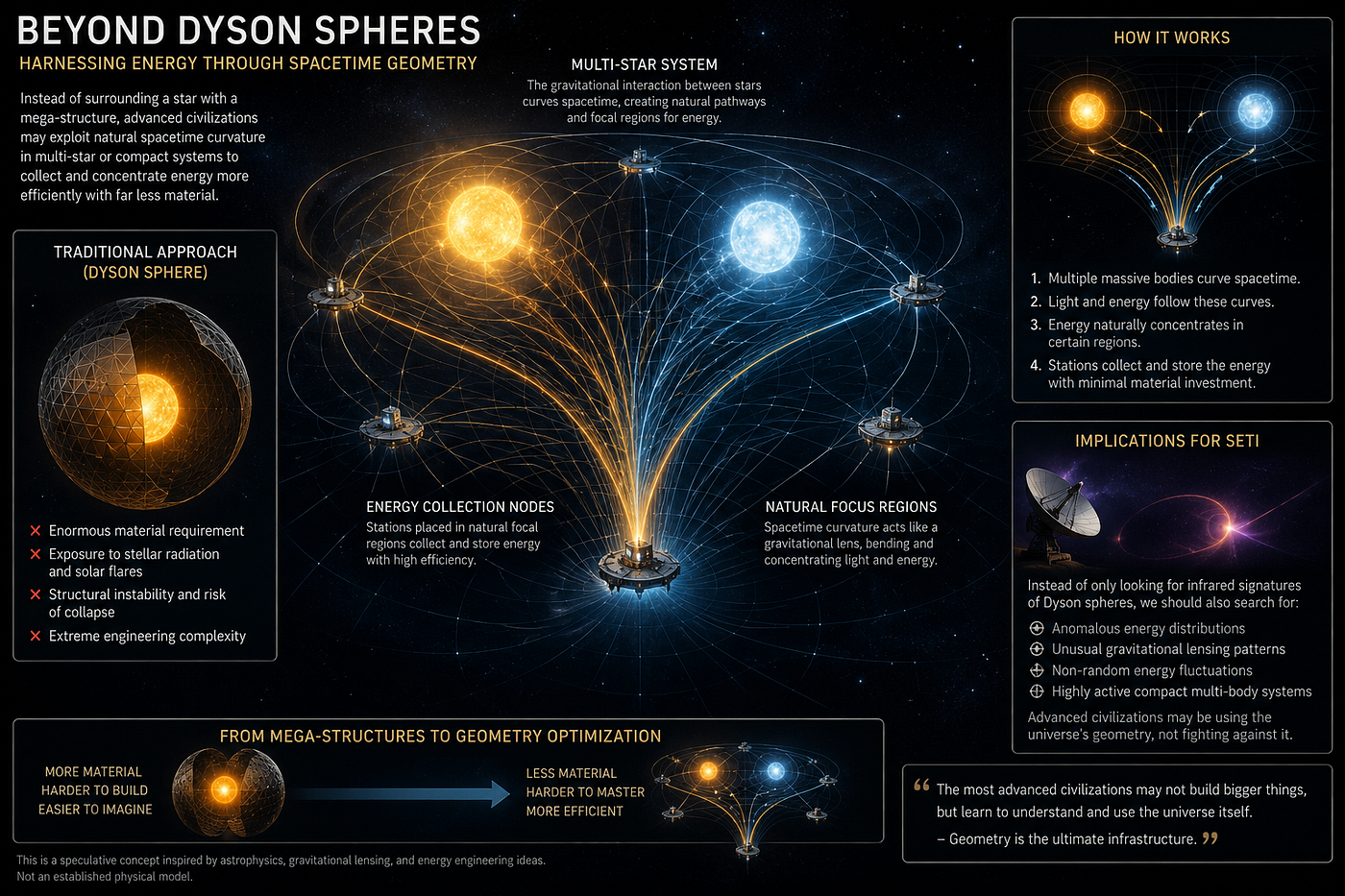
The concept of a Dyson Sphere has long been considered one of the ultimate indicators of an advanced civilization. The idea is simple but massive in scale: surround a star with energy-collecting structures in order to capture a significant portion of its energy output.
At first glance, this sounds like the perfect solution for a civilization with enormous energy demands. However, the more I thought about it, the more I started wondering whether physically surrounding a star is actually the most efficient approach.
A Dyson Sphere would likely face several extreme engineering challenges. The amount of material required could be enormous. The structure would need to survive intense stellar radiation, solar flares, thermal stress, and long-term instability caused by its own mass and orbital dynamics. Even maintaining such a system may become an engineering nightmare.
But what if advanced civilizations do not need to completely surround a star at all?
Instead of relying on giant megastructures, perhaps sufficiently advanced civilizations could exploit naturally occurring spacetime geometry itself.
Imagine a multi-star system, a neutron star pair, or another compact astrophysical environment. In these systems, spacetime is already heavily curved and dynamically shaped by multiple massive bodies interacting with each other.
Since light and energy propagate through spacetime, could there be naturally favorable regions where energy becomes easier to redirect, focus, or collect?
Rather than building an enormous shell around a star, perhaps advanced civilizations could place distributed energy collection stations at specific regions where gravitational interactions naturally create stronger energy pathways or concentration zones.
An intuitive way to visualize this is by thinking about magnetic field lines between two magnets. While magnetic fields and spacetime curvature are fundamentally different physical phenomena, the analogy helps illustrate how interacting systems may naturally form regions where energy flow becomes more concentrated or structured.
We already know that gravity can bend light through gravitational lensing. Massive objects such as galaxies and black holes can distort and focus light across enormous distances. If nature already performs this kind of spacetime-based “optics,” could advanced civilizations eventually learn to exploit similar effects for large-scale energy engineering?
This idea may also have implications for SETI.
Most searches for advanced civilizations focus on finding large infrared signatures expected from Dyson-like megastructures. But if advanced civilizations instead rely on naturally occurring curvature-rich systems, we may be searching for the wrong signatures entirely.
Instead of giant artificial shells, perhaps we should pay closer attention to:
- unusual energy distributions,
- anomalous gravitational lensing behavior,
- non-random energy fluctuations,
- or highly active compact multi-body systems where spacetime curvature is significantly stronger than in ordinary single-star systems.
In this scenario, advanced civilizations may not necessarily appear as builders of enormous visible structures, but rather as civilizations capable of efficiently exploiting the geometry already present in the universe itself.
Of course, this idea is highly speculative and should not be considered an established physical model. It is simply a conceptual exploration inspired by Dyson spheres, gravitational lensing, and the possibility that advanced civilizations may optimize energy collection in ways very different from our current assumptions.
Perhaps the future of stellar-scale engineering is not about building larger structures, but about understanding spacetime geometry deeply enough to work with it instead of against it.
메타데이터
- post_id
- 5a2e18ebdcb7
- slug
- do-advanced-civilizations-really-need-dyson-spheres-5a2e18ebdcb7
- url
- https://medium.com/@slymnbaysal/do-advanced-civilizations-really-need-dyson-spheres-5a2e18ebdcb7
- canonical_url
- https://medium.com/@slymnbaysal/do-advanced-civilizations-really-need-dyson-spheres-5a2e18ebdcb7
- author_url
- https://medium.com/@slymnbaysal
- status
- ok
- fetched_at
- 2026-06-23 17:05:31