Charging the Informal Economy: A Battery-as-a-Service Model for Nigeria’s Urban Transit Sector
By: 2025 Virtual CT Fellow Ekene Uwadiunor
Charging the Informal Economy: A Battery-as-a-Service Model for Nigeria’s Urban Transit Sector
By: 2025 Virtual CT Fellow Ekene Uwadiunor
It’s 6AM in Lagos and the city is bustling with the energy of over eight million commuters making their way to their respective destinations. By the time you reach the bus stop, the air hangs heavy, not just with humidity, but with the sharp, unmistakable taste of hydrocarbons and sulfur dioxide. You squeeze into a yellow danfo (minibus), wedged tight against other passengers as the driver maneuvers his way into the swelling gridlock. Outside the window, okada (motorcycles/scooters) and keke (motorized three-wheel vehicles) drivers buzz past stagnant lanes of cars, weaving through gaps that barely exist and leaving trails of thick blue smoke. As we inch toward our destination, the reality becomes undeniably clear: the engine of Nigeria’s informal economy is choking the country, reliant on an outdated, expensive fuel model that is desperate for change.

“Typical morning in Lagos or Kano: gridlocked roads, yellow minibuses, okadas weaving through traffic, and the haze of exhaust over the city.” Gemini 3 NanoBanana Pro, Google.
The Engine of the Economy Road transport is the predominant mode of transportation in Nigeria, moving over 90% of the country’s goods and people. In urban centers, the Informal Public Transportation (IPT) sector bridges the gap left by inadequate formal public transit, satisfying over 80% of total mobility demand. Nowhere is this more visible than in Lagos. In a megacity of 22 million people, formal public transit accounts for a negligible 2.8% of daily trips, further underscoring the importance of the informal sector. For the vast majority of residents, the informal sector is the lifeline connecting them to jobs, schools, and markets. It is also a massive economic engine in its own right, with the National Commercial Motorcycle and Tricycle Owners and Riders Association of Nigeria registering an estimated 14 million members as of 2022. This network supports millions of families, mechanics, and vendors. As such, any transition plan that does not incorporate their existence isn’t just unjust but frankly unrealistic.
The Choke Point This critical sector currently faces a dual crisis: one economic and the other environmental. The removal of fuel subsidies (a government financial assistance program that kept gas prices below prevailing market rates) in 2023 completely reshaped Nigeria’s economic landscape, driving gasoline prices, cost of living, and transportation burden to unprecedented highs. Gasoline prices surged from N185 per liter to over N1,000 in 2024, while the naira plummeted against the dollar. The rise in petrol prices, coupled with a hyper inflationary environment, significantly eroded the bottom line and purchasing power of operators and riders, pushing nearly half the population below the poverty line ($2.15/day) by late 2024. Compounding this financial strain is a silent, toxic cost. The IPT fleet, largely made up of aging vehicles with outdated engines, are known to emit smoke and harmful gases, contributing to air pollution and public health problems in already congested cities. The transportation sector is now the second-largest contributor to Nigeria’s greenhouse gas (GHG) emissions, accounting for 28.4% of the national total. With transport demand expected to double by 2050, sector-specific emissions are projected to rise by 50% by 2035 and 100% by 2050 if the status quo remains unchecked. The engine of Nigeria’s economy is running on a fuel model that is too expensive to buy and too dirty to breathe.
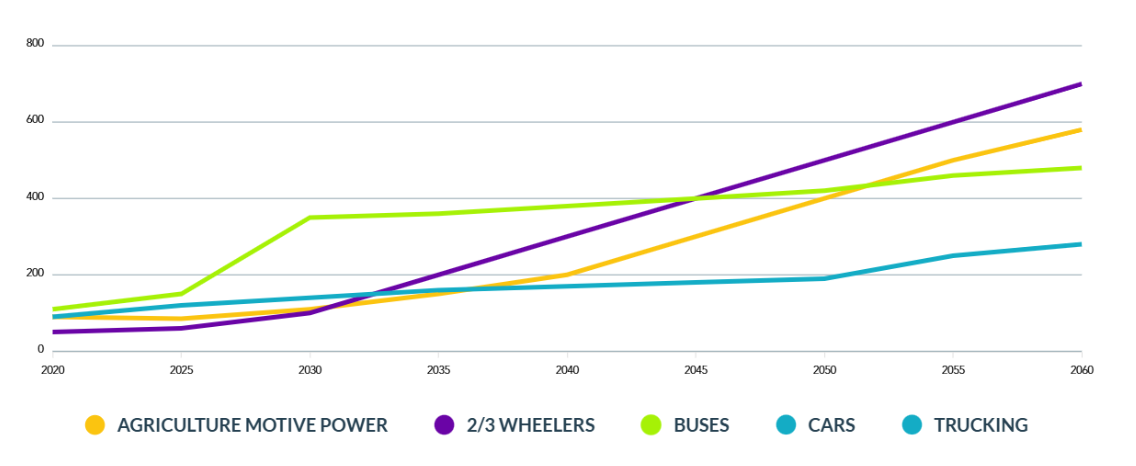
Demand projections per transport mode, bVKM. Source: Nigeria Energy Transition Plan
The Disconnect The federal government of Nigeria, in alignment with the Paris Agreement, developed the **Energy Transition Plan,** aimed at achieving net zero emissions by 2060, with particular emphasis on transitioning to cleaner forms of transport. However, there remains a clear gap between these ambitious climate goals and the current realities facing the nation. Factors such as high up-front cost of EVs, high cost of debt finance, an unreliable power grid, limited charging infrastructure, and absence of clear regulatory guidelines continue to act as barriers to achieving decarbonization goals. In this context, telling a danfo or okada driver who is already squeezed by inflation and fuel hikes to “just buy an EV” is highly unrealistic and economically tone-deaf. We cannot simply copy-paste Western EV adoption models into Lagos or Kano. Strategies built for markets like Norway or California will inevitably fail in an environment defined by informality, volatility and energy scarcity.
The BaaS Subscription Solution The biggest hurdle to electric vehicle adoption isn’t desire, it’s the sticker shock. Battery-as-a-service (BaaS), in simple terms is a subscription to energy. Drivers do not buy the battery outright when they purchase an electric motorbike or three-wheeler, instead they rent the power. The battery component alone accounts for 30–40% of the overall purchase cost and by decoupling this component automakers can significantly lower EV prices and make them more accessible to a wider consumer base. Under this model, drivers simply swap a dead battery for a fresh one at designated swapping depots in under five minutes, paying only for what they use. Financed through a Pay-as-you-Go (PayGo) structure, this innovative model aims to shift the largest capital expenditure on an EV driver’s balance sheet (battery) into a manageable operating expense (similar to gas), structured as a fixed amount per swap, mile, or kWh used/charged.
By leveraging existing power assets such as telecommunication towers to rapidly deploy BaaS swapping depots/hubs, the challenges of Nigeria’s unreliable power grid and inadequate charging infrastructure can be circumvented entirely. These assets provide essential prerequisites needed for a functional charging network and stable electricity supply such as secured land, dedicated grid connections, diesel generators and in some cases, battery storage systems and solar PV installations. The geographic distribution of telecom towers provides a decentralized network of swap depots distributed along urban and rural centers, mirroring the reach of mobile phones. To truly unlock the net-zero potential of this technology, additional battery swap depots powered by solar mini grids can be strategically located along high-traffic routes and high-volume stops, affording drivers the same flexibility as liquid fuel refueling.
The PayGo model serves as the financial linchpin for the informal sector. Drivers pay a small predictable daily or per trip fee that covers all operational expenses including basic insurance and maintenance. This payment structure is merely an evolution of how these operators manage their finances today, as most operate under some form of informal leasing and/or revenue-sharing arrangements. When integrated with IOT smart battery technology and mobile apps, the driver can effectively monitor battery usage and manage battery subscription either through a mobile app or on-site at the swap depot.
The BaaS model is not just theoretical, it is a growing business model that is already being deployed globally and is rapidly scaling across developing countries in Asia and Africa. While the West debates charging plugs, the Global South is swapping batteries. This rise in adoption can be attributed to its ability to circumvent traditional charging infrastructure issues plaguing developing nations.
China serves as the global benchmark, where leading automaker NIO has executed over 47 million battery swaps. In Nigeria and across sub-Saharan Africa, companies like Spiro, Max, Qoray Mobility, Tycorun Energy and Siltech are establishing networks of swap stations and supplying swappable e-bikes. State and local governments are also piloting small-scale projects, in partnership with battery swapping companies. For example, the Gbamu-Gbamu project, a collaboration between the Ogun State government, MAX, and Rubitec Solar that successfully introduced electric mobility to off-grid communities.
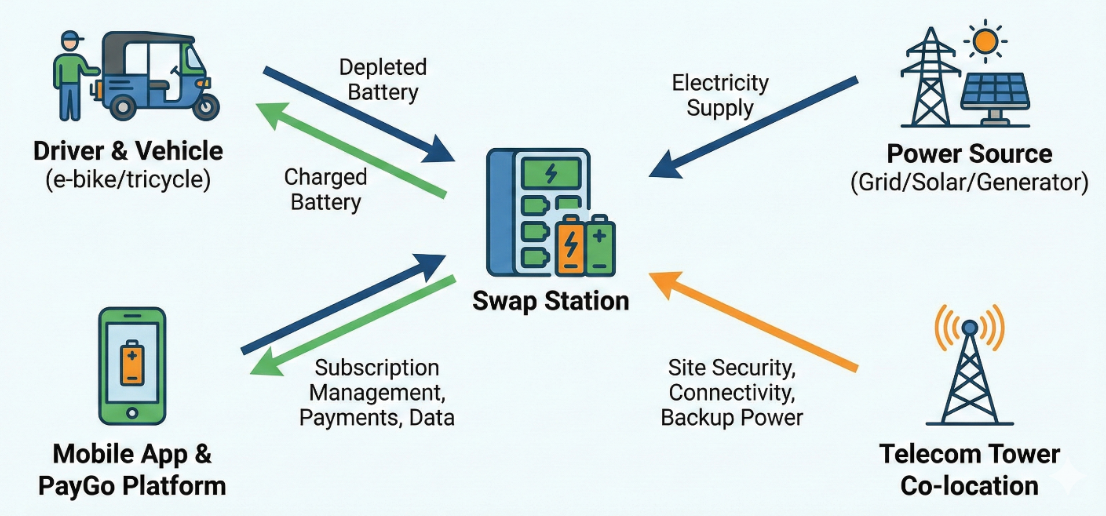
“The BaaS Ecosystem for Informal Transport” prompt. Gemini 3 NanoBanana Pro, Google.
The BaaS + PayGo model shifts the driver from a high-risk, high-volatility fossil fuel expense to a predictable OPEX model, freeing up income and reducing exposure to fuel price shocks.
While the immediate win is for the driver, the ripple effects of this model extend across the entire Nigerian economy. Accelerated adoption of EVs in the informal transport sector reduces reliance on imported fossil fuels, providing cost savings of up to N6.5 trillion between now and 2040. This transition creates an entirely new value chain. From the solar engineers powering the mini-grids to the technicians manning the swap stations, we are looking at a wave of “green collar” job creation. Telecom providers also stand to benefit from new revenue streams by monetizing distributed power assets, while solar and battery storage system developers gain a scaleable market for mini-grid deployment. Electrifying even a fraction of the two- and three- wheeler fleet offers material reductions in both GHG emissions and local air urban pollution. Projections estimate a two megaton CO2 emissions savings per year by 2040 in a high-adoption scenario.
The Path Forward The successful deployment of this ecosystem is not without its unique risks and challenges which must be mitigated to ensure a successful transition. Potential future challenges include standardization of batteries across EV manufacturers, stranded assets due to sparse swapping depots, land use negotiations at telecom tower sites and ensuring safety standards for high-throughput swapping. Also, the informal nature of this sector means many operators are unregistered, making regulation and management complex. Ultimately the biggest hurdle is likely human, there’s a high likelihood of resistance from associations and unions as this model could be perceived as a threat to job security. To address these challenges, stakeholders (government entities, e-mobility companies, private financiers and development partners) must implement a “phased and just transition” framework that centers informal workers and low-income riders. Initial deployments should be focused on specific, controlled environments to gather data, adjust operations and refine deployment strategies before full-scale implementation. Most importantly, transport associations and unions must be engaged from day one to avoid conflict and build consensus. To catalyze this shift, financial tools like loan guarantees and concessional finance can be leveraged to de-risk initial investments. National and state policymakers also have a role to play by enacting policies providing fiscal incentives in the form of tax exemptions and reduced import duties for e-mobility technologies and charging components.
Now, imagine Lagos a decade from now. The city still pulsates with energy and alive with the constant motion of commerce, mobilized by the hustle and spirit of the informal transport sector. But the atmosphere is different. The streets are no longer choked by a haze of exhaust, the deafening roar of combustion has given way to the quiet hum of electrons. It is the same vibrant Lagos, driven by the same ambition, but for the first time in generations, the city can finally breathe.
About the Author
*Ekene Uwadiunor is a senior consultant at capSpire, where he provides commodity trading and risk management advisory services to clients in the energy and commodities space. He holds both a Master of Science (MS) and a Bachelor’s degree in Chemical Engineering from Texas A&M University.*
메타데이터
- post_id
- 5a4026558d70
- slug
- charging-the-informal-economy-a-battery-as-a-service-model-for-nigerias-urban-transit-sector-5a4026558d70
- url
- https://medium.com/@celions/charging-the-informal-economy-a-battery-as-a-service-model-for-nigerias-urban-transit-sector-5a4026558d70
- canonical_url
- https://medium.com/@celions/charging-the-informal-economy-a-battery-as-a-service-model-for-nigerias-urban-transit-sector-5a4026558d70
- author_url
- https://medium.com/@celions
- status
- ok
- fetched_at
- 2026-07-30 17:32:32