The Everest Three Passes Trek: The Route That Shows You Everything
Imagine You’ve done your research on Everest Base Camp. You’ve watched the YouTube videos, read a dozen blog posts, maybe even talked to a…
The Everest Three Passes Trek: The Route That Shows You Everything
Imagine You’ve done your research on Everest Base Camp. You’ve watched the YouTube videos, read a dozen blog posts, maybe even talked to a friend who did it two years ago and won’t stop talking about it. But somewhere along the way, you started wondering. Is there a version of this trip that goes further? One that doesn’t just walk you up to base camp and back down the same trail, but actually loops through the whole neighborhood?

On the way to Everest Three Passes Trek
That’s you. You’re not brand new to hiking, but you’ve never done anything at 18,000 feet either. You want the mountain views everyone raves about, but you also want the parts nobody puts on Instagram. The empty trails, the yak bells, the villages that don’t show up in the guidebooks. You’re wondering if you’re fit enough, whether the altitude will wreck you, and whether this whole thing is more “adventure of a lifetime” or “biggest mistake of your vacation.”
By the end of this post, you’ll know exactly what the **Everest Three Passes Trek** actually is, which three passes you’re crossing and why each one feels completely different, and what a realistic route and timeline looks like. No fluff, no sales pitch just the trail, laid out plainly.

Image taken during Everest Three Passes Trek
So What Even Is a “Three Pass” Trek?
Here’s the simplest way to think about it. The classic Everest Base Camp trek is basically an out-and-back. You walk up one valley, touch base camp, and walk back down the same way you came.
The Three Passes Trek throws that idea out. Instead of retracing your steps, you climb over three high mountain saddles. **Kongma La, [Cho La Pass](https://accessnepaltour.com/cho-la-pass/), and [Renjo La](https://accessnepaltour.com/renjo-la-pass/)** are three passes each one connecting a different valley to the next.
You end up tracing a giant loop through four separate valleys in the Khumbu region: Imja Khola, Khumbu, Gokyo, and Bhote Koshi. Same mountains as the standard trek, but you’re seeing them from angles most trekkers never get to.

Beautiful Gokyo Lake
Think of it like the difference between visiting one really good restaurant on a food trip versus doing a whole tasting tour of a city’s best neighborhoods. Same goal, a great meal but one route gives you a lot more of the picture.
About Kongma La Pass, Cho La Pass, Renjo La Pass
Each pass has its own personality. Seriously ask any guide and they’ll describe these three like old friends with very different moods.
Kongma La (5,535m / 18,159 ft)
I t is the big one. It’s the highest of the three and generally considered the toughest, with a steep, rocky climb and a crossing over loose moraine from the Khumbu Glacier. Your legs will know they did something. The payoff is a close-up view of Lhotse and its neighboring ice giants that most trekkers on the standard route never see.
Cho La (5,420m / 17,782 ft)
It is the technical one. There’s a genuine glacier crossing near the top, and depending on the season, you might need crampons for the icy stretch. It’s not climbing, exactly, but it’s not a casual stroll either — it demands your full attention.
Renjo La (5,360m / 17,585 ft)
It is the reward pass. Historically, it was a trade route between the Khumbu Valley and Tibet, and today it hands you one of the most talked-about views in the entire region: Everest and its neighbors reflected in the turquoise Gokyo Lakes below.
Most itineraries also weave in Everest Base Camp itself, a sunrise climb up Kala Patthar, and a stop at the Gokyo Lakes and Gokyo Ri. So you’re not skipping the “greatest hits,” you’re just adding a lot more to the album.
What the Everest Three Passes Trek Route Actually Looks Like, Day by Day Guide
Most Three Passes itineraries run somewhere between 17 and 20 days, and they usually go something like this:
You fly into Lukla from Kathmandu which is a short, famously dramatic flight that drops you right at the trailhead. From there, the first several days ease you up the valley through Namche Bazaar, the unofficial capital of the Khumbu, and villages like Tengboche, home to one of the region’s largest monasteries. This stretch is really about one thing: acclimatization. Your body needs time to adjust to thinner air, and a good itinerary builds in rest days at places like Namche and Dingboche specifically for that reason. Skip this part, and the mountain will remind you why it matters.
From there, routes generally cross Kongma La first, heading toward Everest Base Camp and Kala Patthar. Then it’s on to Cho La, which drops you into the Gokyo valley. Finally, Renjo La sends you back down toward Namche, closing the loop before you fly out of Lukla again.
Some guides run this clockwise, some counterclockwise, and honestly, there are good arguments either way. What matters more than the direction is the pacing. This isn’t a trek to rush.
Permits Required for Everest Three Passes Trek
If you’re arranging things independently rather than through a trekking company, you’ll need the Sagarmatha National Park Entry Permit and the Khumbu Rural Municipality Permit, both picked up in person along the route (Monjo and Lukla, respectively). If you’re trekking with Access Nepal Tour and Treks, this paperwork gets handled before you even land in Kathmandu. one less thing sitting on your to-do list.
A Typical Day Example During Everest Three Passes Trek
Here’s a little scenario to paint the picture, this isn’t a real trekker, just a stand-in for what a hard day on this trek can feel like.
Let’s call her Maya. She’s a marketing manager from Denver, decent hiker, has done a few multi-day trips before, but nothing above 14,000 feet. On day nine, she’s standing at the base of Cho La at 4:30 a.m., headlamp on, watching her breath turn to fog. The glacier crossing near the top has her moving slower than she’d like, testing each foothold before trusting it. Her legs are tired. Her hands are cold. And then she crests the pass, the sun hits the ice at just the right angle, and she can see clear across to peaks she couldn’t even name yet.
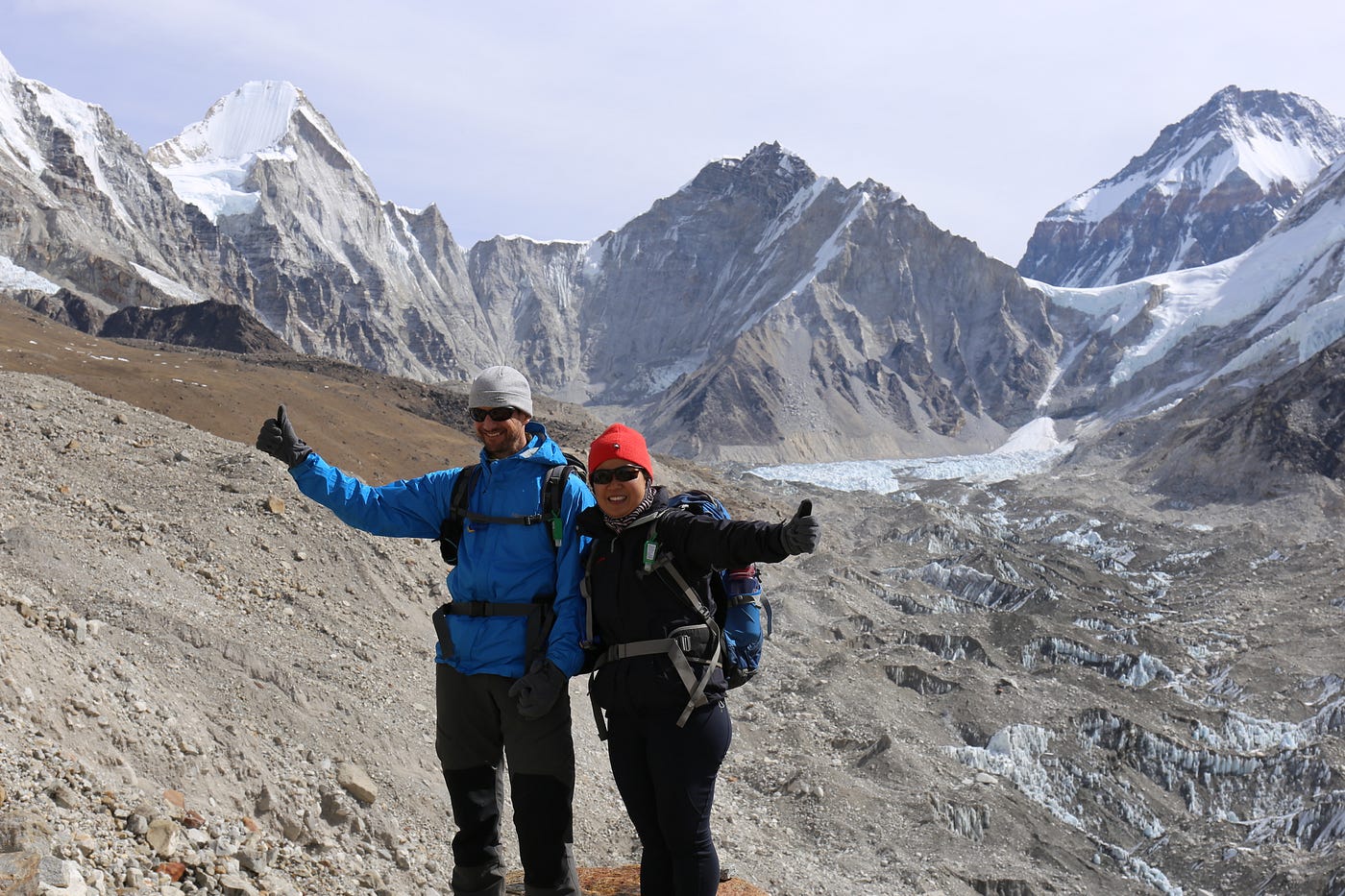
Couples on Everest Three Passes Trek
That moment is equal parts exhausted and completely blown away. It is basically the whole trek in miniature. It’s hard. It’s slow sometimes. And then it gives you something you didn’t know you were looking for.
Is Everest Three Passes Trek Right for You?
Honestly, that depends on your fitness, your experience with altitude, and how much time you can carve out of your calendar. This isn’t a trek to talk yourself into on a whim. It rewards people who train beforehand and respect the acclimatization schedule.
At Access Nepal Tour and Trek, we spend a lot of time talking through exactly this with people before they book anything, because the worst outcome isn’t a hard day on the trail. It’s someone pushing through altitude symptoms they shouldn’t be ignoring. We’d rather you go into this with clear eyes than with a highlight reel in your head and no idea what the mornings actually feel like at 17,000 feet.
메타데이터
- post_id
- 5a69083aebd2
- slug
- the-everest-three-passes-trek-the-route-that-shows-you-everything-5a69083aebd2
- url
- https://medium.com/@accessnepaltours/the-everest-three-passes-trek-the-route-that-shows-you-everything-5a69083aebd2
- canonical_url
- https://medium.com/@accessnepaltours/the-everest-three-passes-trek-the-route-that-shows-you-everything-5a69083aebd2
- author_url
- https://medium.com/@accessnepaltours
- status
- ok
- fetched_at
- 2026-09-15 20:28:10