How ALPR Cameras Actually Work in Traffic Enforcement (And Why Many Systems Fail in Real…
This article was originally published on the e-con Systems blog.
How ALPR Cameras Actually Work in Traffic Enforcement (And Why Many Systems Fail in Real Conditions)
This article was originally published on the e-con Systems blog.
Cities are expanding faster than enforcement mechanisms can scale.
While law enforcement agencies are responsible for tracking traffic violations, managing this manually in high-density zones introduces clear limitations — both in coverage and response time.
This is where Automatic License Plate Recognition (ALPR) systems come in.
They provide a scalable, camera-based approach to capturing license plate data and automating violation management across modern traffic environments.
In this article, we’ll break down how ALPR cameras work, the challenges they face in real-world deployments, and the key features that make them effective.
🚦 How ALPR Cameras Work
An ALPR system operates as a pipeline — combining image capture, recognition, and backend processing.
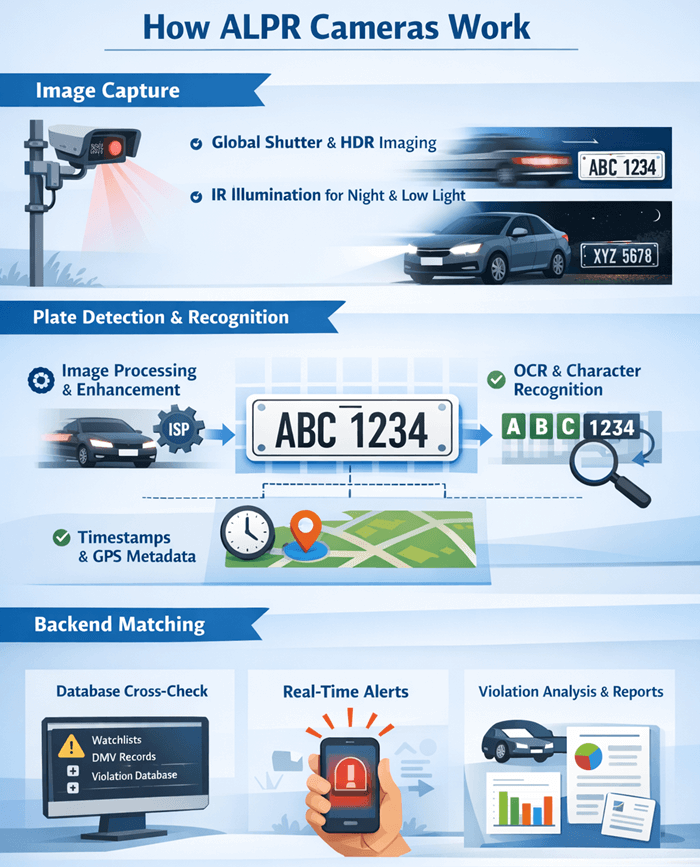
📷 Image Capture
Capturing a usable image is the foundation of the entire system.
- Global shutter or short exposure sensors help freeze motion, especially in high-speed or multi-lane scenarios
- HDR or multi-exposure imaging ensures visibility under backlight, night-time, or uneven lighting
- Infrared illumination enables reliable capture in low-light or night conditions
🔍 Plate Detection and Recognition
Once the image is captured, the system processes it to extract plate data.
- Image Signal Processors (ISP) optimize exposure, contrast, and clarity
- Detection pipelines perform: Plate localization, Character segmentation, OCR (Optical Character Recognition), Confidence scoring
- Extracted data is paired with metadata such as timestamp, lane ID, direction, and location
🧠 Backend Matching
Captured data is then validated and acted upon.
- Plate numbers are matched against: Violation databases, Vehicle registration records, Security watchlists
- Matches trigger: Alerts, Review workflows, Automated ticket generation
Over time, this data also enables violation pattern analysis, helping prioritize enforcement in high-risk zones.
🌍 Real-World Challenges in Traffic Environments
ALPR systems don’t operate in controlled conditions — they function in unpredictable, real-world scenarios.
Effective systems must handle:
- Angled or partially visible plates
- Occlusions (dirt, tow hooks, bike racks)
- Mixed vehicle speeds within the same field of view
- Headlight glare and reflective plates
- Rain, dust, and varying lighting conditions
👉 This is where many deployments struggle — not in theory, but in execution.
🚔 How ALPR Improves Violation Ticketing Systems
When implemented effectively, ALPR systems significantly enhance enforcement capabilities.
✔️ Reduced Manual Oversight
Officers no longer need to monitor every location physically, allowing better allocation of resources.
✔️ Automated Documentation
Each violation includes timestamped images, plate data, and scene context — ensuring consistent and objective reporting.
✔️ Stronger Evidence Integrity
- Multi-frame capture (before, during, after violation)
- Accurate timestamps and metadata
- Confidence scoring for plate recognition
- Secure and tamper-resistant storage
✔️ Increased Coverage
Multiple locations can be monitored simultaneously — intersections, highways, toll booths, and restricted zones.
✔️ Detection of Repeat Offenders
Centralized databases help identify patterns and prioritize enforcement actions.
✔️ Faster Processing
Automated workflows reduce delays between detection and ticket issuance.
✔️ Real-Time Alerts
Instant detection of flagged vehicles enables faster intervention.
✔️ Audit Readiness
Structured, machine-readable records simplify compliance and reporting.
📊 Key ALPR Performance Metrics
To evaluate system effectiveness, agencies typically track:
- Capture Rate — Vehicles successfully captured
- Read Rate — Plates correctly recognized
- End-to-End Accuracy — Combined system effectiveness
- False Positives / Negatives — Error rates based on policy tolerance
⚙️ Key Camera Features That Make ALPR Systems Work
In many cases, system performance is limited not by algorithms — but by camera capabilities.
📸 Global Shutter
Ensures distortion-free capture for high-speed vehicles.
🌗 HDR Imaging
Handles extreme lighting conditions such as glare or shadows.
🎞️ High Frame Rate
Improves capture consistency across varying vehicle speeds.
🧠 Built-in ISP
Automatically adjusts exposure, contrast, and sharpness for stable performance.
🔄 Multi-Camera Synchronization
Enables wider coverage and better capture across large intersections.
🌦️ Environmental Durability
IP-rated enclosures ensure reliability in harsh outdoor conditions.
⏱️ External Trigger Support
Synchronizes capture with events like signal changes or speed detection.
⚡ Edge Processing & Connectivity
Onboard compute reduces latency and network load while enabling real-time decisions.
🚀 Final Thoughts
ALPR systems are becoming a core component of modern traffic enforcement and smart city infrastructure.
But the difference between a successful deployment and a struggling one often comes down to a simple factor:
👉 Understanding real-world constraints early — especially at the camera and system level.
🔗 Learn More
Originally published on the e-con Systems blog
If you’re designing an ALPR or traffic enforcement system, choosing the right camera and architecture early can save significant time and effort.
✍️ About the Author
I write about embedded vision systems across Mobility, Robotics, ITS, Drones and Surveillance — focusing on what actually breaks when systems move from prototype to production.
메타데이터
- post_id
- 5aa6eba2ddd6
- slug
- how-alpr-cameras-actually-work-in-traffic-enforcement-and-why-many-systems-fail-in-real-5aa6eba2ddd6
- url
- https://medium.com/@info-kevinjackson/how-alpr-cameras-actually-work-in-traffic-enforcement-and-why-many-systems-fail-in-real-5aa6eba2ddd6
- canonical_url
- https://medium.com/@info-kevinjackson/how-alpr-cameras-actually-work-in-traffic-enforcement-and-why-many-systems-fail-in-real-5aa6eba2ddd6
- author_url
- https://medium.com/@info-kevinjackson
- status
- ok
- fetched_at
- 2026-06-14 17:09:17