GLM 5.2 vs. Kimi 2.7 Code- The Battle for Open-Source Hegemony
The world of open-weights AI just went through a massive shift. We’re officially past the era of treating LLMs as glorified chatbots that…
GLM 5.2 vs. Kimi 2.7 Code- The Battle for Open-Source Hegemony
The world of open-weights AI just went through a massive shift. We’re officially past the era of treating LLMs as glorified chatbots that answer one-off questions. Today, it’s all about long-horizon agentic execution — building systems that can autonomously manage entire codebases, run for hours on complex tasks, and navigate deep reasoning pathways without hand-holding.
Two major players just dropped massive, open-weights models built specifically for this new reality: Z.ai’s GLM 5.2 and Moonshot AI’s Kimi 2.7 Code.
Cut through the marketing fluff and PR hype. We’re breaking down their real-world architectures, independent evaluations from Artificial Analysis, hard benchmarks, and day-to-day execution. By the end of this guide, you’ll know exactly which model belongs in your production stack.
The Architectural Blueprint: Under the Hood
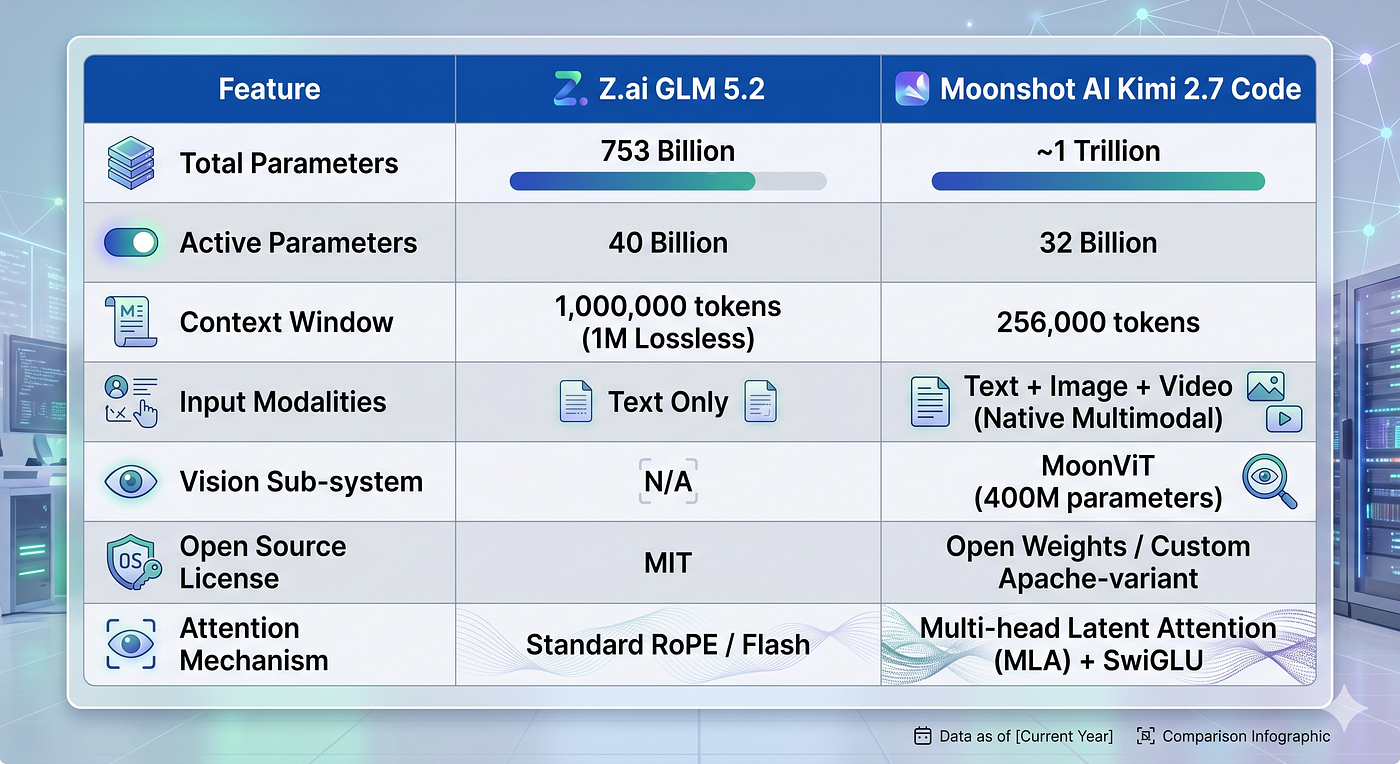
Both models utilize Mixture-of-Experts (MoE) topologies to balance high capacity with compute efficiency, but their underlying strategies diverge significantly when it comes to modalities and optimization.
The Core Architectural Divergence
- GLM 5.2 is a text-only monolith optimized for massive scale. Z.ai chose to strip out vision entirely from the open-weights release (keeping their vision models in a separate closed-source family like GLM-5V-Turbo). They allocated that engineering capital into providing a rock-solid, 1-million-token lossless context window.
- Kimi 2.7 Code acts as a multi-sensory software engineer. It natively integrates a 400M MoonViT vision encoder, allowing it to digest code screenshots, interpret user interfaces, parse UI/UX layouts, and handle video inputs. It keeps a smaller but highly effective 256K context window using MLA to keep memory overhead low.
Hard Benchmarks: How They Stack Up
When independently evaluated, these models trade blows depending on whether the task requires massive code context reasoning or highly iterative multimodal tool calling.
1. General & Code-Agent Leaderboards
On the Artificial Analysis Intelligence Index v4.1, which aggregates complex reasoning and execution benchmarks, GLM 5.2 claims the top spot for open weights:
- GLM 5.2: 51 points (Ranks #1 in Open Weights, beating MiniMax-M3 and DeepSeek V4 Pro)
- Kimi 2.6/2.7: 43 points
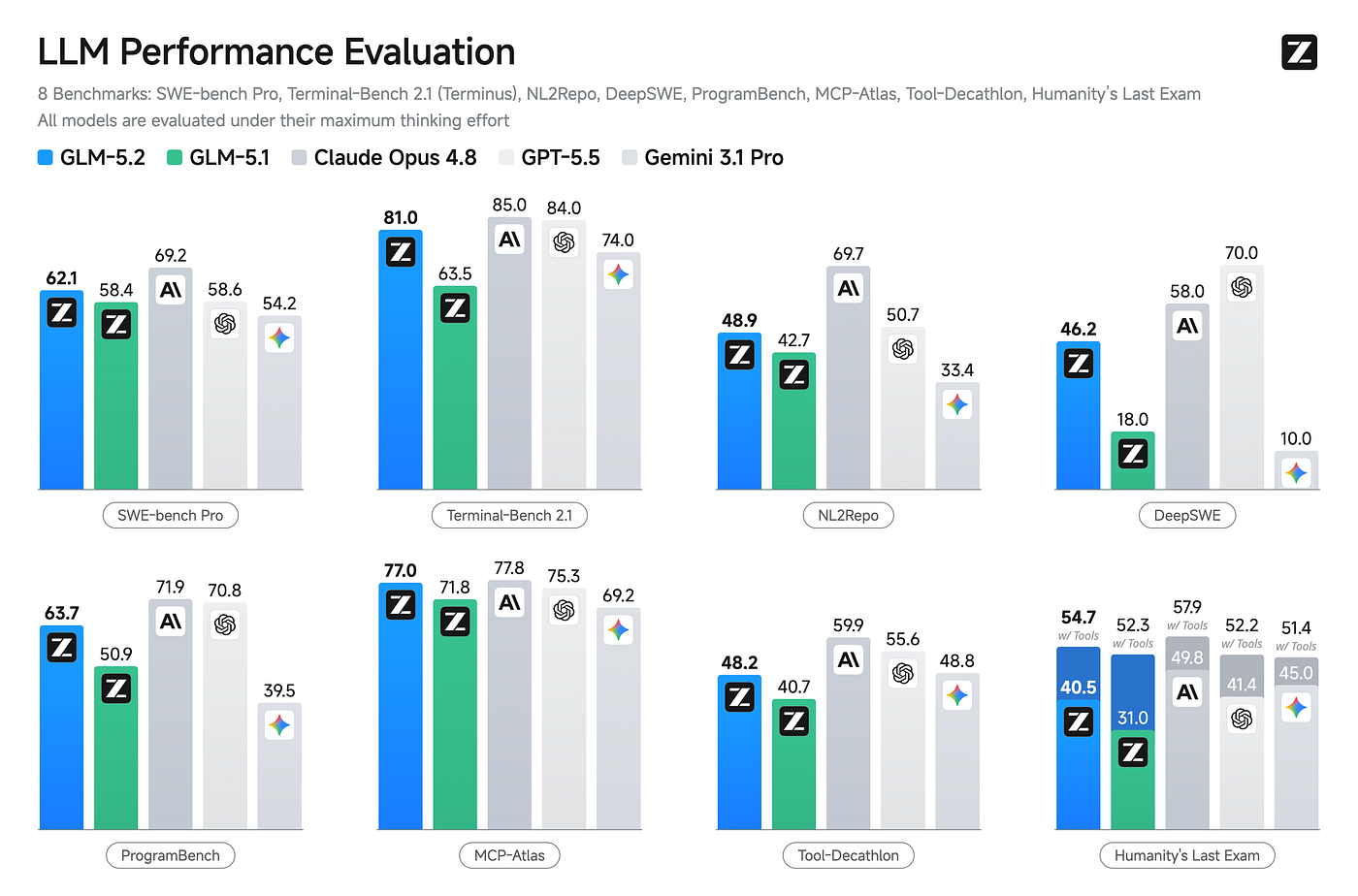
On Terminal-Bench 2.1 (measuring terminal tool usage and command-line agent capabilities) and SWE-bench Pro, GLM 5.2 edges closer to proprietary models like Claude 4.8 Opus than any open-source model before it.
2. Specialized Long-Horizon Software Engineering
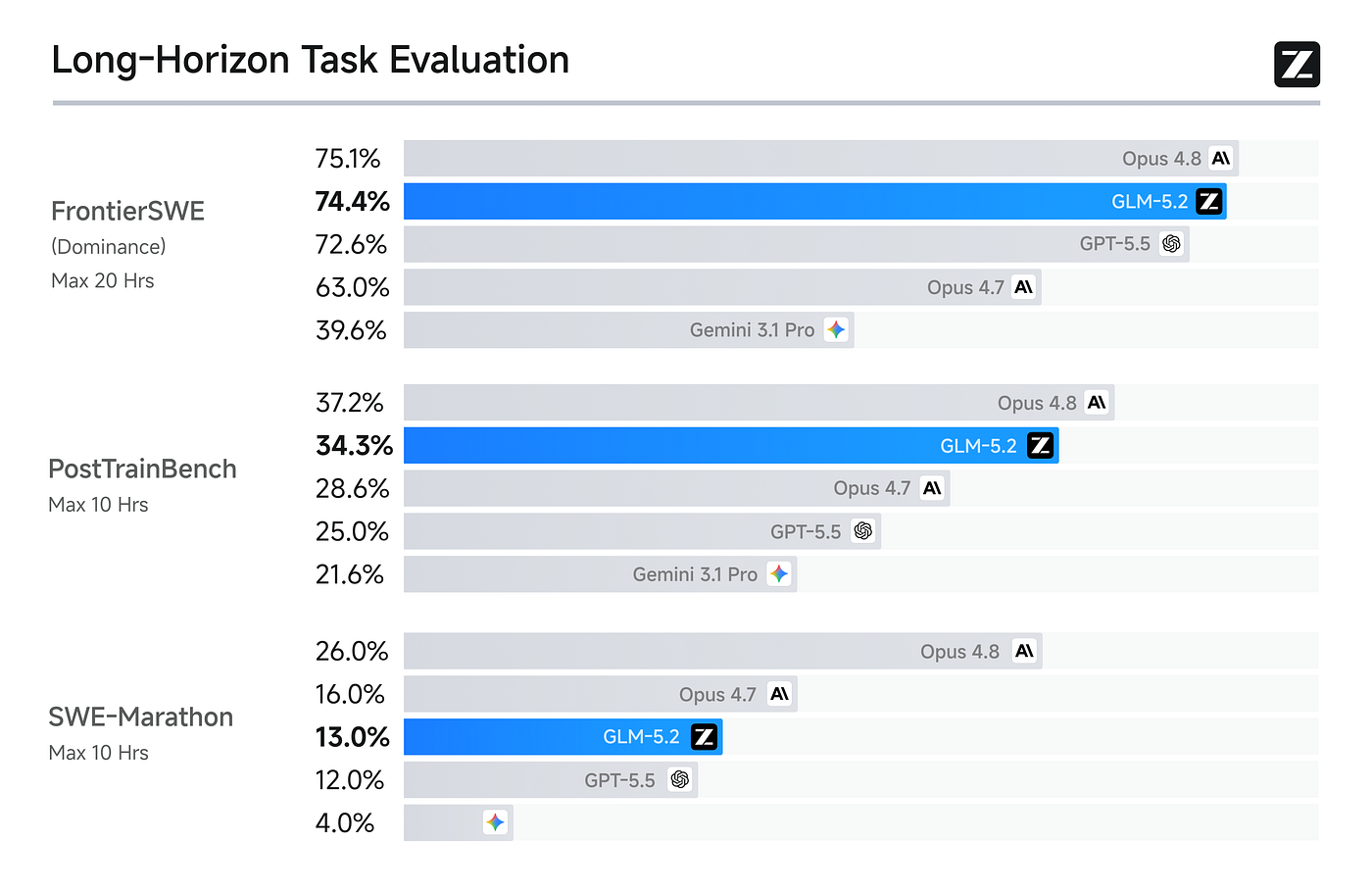
According to Z.ai developer documentation, GLM 5.2 excels across massive production-grade horizons:
- FrontierSWE (Open-ended technical projects lasting hours): GLM 5.2 matches within 1% of Claude Opus 4.8, while actually beating GPT-5.5 by 1%.
- SWE-bench Pro: GLM 5.2 hits 62.1% compared to previous generations, leading the open-source field.
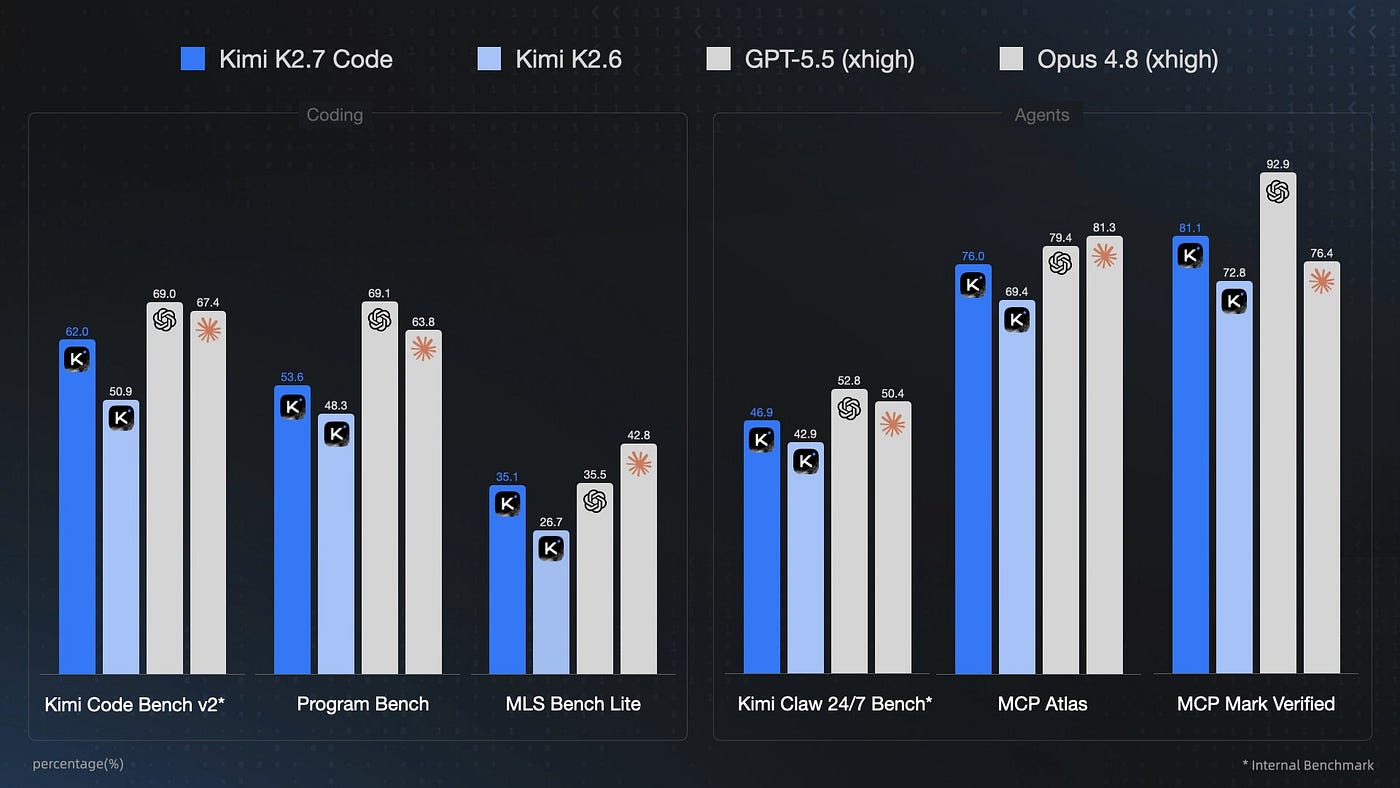
- Kimi Code Bench v2: Kimi 2.7 Code registers a major +21.8% bump over its predecessor K2.6, leaping to a score of 62.0, showing that Moonshot’s specific code tuning keeps it hyper-competitive on code generation tasks.
Deep Strength & Weakness Analysis
To understand where these models stumble or shine, we have to look past the raw numbers and look at behavioral patterns in real-world agent environments.
Z.ai GLM 5.2: The Codebase Takeover Engine
The Big Idea: GLM 5.2 is designed to ingest an entire backend repository, mapping out data flows and executing massive multi-step refactoring tasks without losing architectural cohesion.
Strengths
- True 1M Context Stability: Unlike models that degrade in recall past 64K tokens, GLM 5.2 retains directory structures, API contracts, and historical design choices across its entire 1M envelope.
- Flexible Effort Control: It introduces native “Thinking Effort Levels” (High and Max). This allows developers to toggle between standard low-latency code completions and deep “Max” reasoning modes for tracking down dependency breakages across multiple packages.
- Flawless Code Generation Dynamics: It regularly constructs intricate, self-contained animated SVGs wrapped in raw HTML/CSS configurations perfectly on the first try.
Weaknesses
- The “Token-Hungry” Overthinker: According to independent Artificial Analysis profiling, GLM 5.2 consumes an average of 43k output tokens per major benchmark task (compared to Kimi 2.7’s more conservative token profiles). It will talk its way through solutions extensively, driving up API or local inference latency.
- Zero Visual Capabilities: If your coding workflows require reverse-engineering a frontend dashboard from a screenshot, or fixing a UI alignment bug via CSS, GLM 5.2 cannot see it.
Moonshot AI Kimi 2.7 Code: The Fast Multimodal Specialist
The Big Idea: Kimi 2.7 Code focuses heavily on efficient, multi-turn iterative software development, leveraging visual inputs and an advanced internal “Preserve Thinking” mechanic.
Strengths
- Preserve Thinking Mode: Standard reasoning models completely clear out their hidden internal chain-of-thought tokens between conversation turns. Kimi 2.7 Code preserves its reasoning context continuously across chat history. It remembers why it chose an approach three turns ago without having to re-derive it.
- Inference Efficiency: Moonshot successfully optimized Kimi 2.7 to consume 30% fewer reasoning tokens compared to Kimi 2.6 while delivering higher success rates. This means vastly cheaper running costs on long agent trajectories.
- Multimodal Frontend Comprehension: Its native combination of text and image processing makes it highly adept at taking frontend mockups and spitting out functional React or Tailwind components.
Weaknesses
- Agentic Eagerness & Over-stepping: Real-world developer feedback indicates that Kimi 2.7 can sometimes act overly eager in agent setups (e.g., executing code edits when explicitly told to only generate an exploratory plan).
- Case Sensitivity and Strict Failures: In complex system interactions, Kimi 2.7 has occasionally been observed to fail on minor file-path variations (such as stopping because a file was named
system.mdinstead ofSYSTEM.md), where competing models dynamically resolve the discrepancy.
The Financial Reality: API & Local Deployment Costs
If you aren’t hosting these monsters locally on enterprise rigs, running them via cloud providers reveals a clear pricing layout. Both sit significantly cheaper than closed-source options like Claude or GPT:
- Kimi 2.7 Code (via OpenRouter/Kimi Platform): Sits roughly around $0.74 per 1M input tokens and $3.50 per 1M output tokens. It features aggressive context caching discounts (dropping input costs down to $0.19/1M tokens on cache hits).
- GLM 5.2 (via OpenRouter/Z.ai Cloud): Typically runs at $1.40 per 1M input tokens and $4.40 per 1M output tokens.
While GLM 5.2 costs slightly more per token and consumes more tokens due to its expansive thinking depth, it completely removes the need to chunk large document suites or multiple source code files together.
Which One Should You Choose?
Choose Z.ai GLM 5.2 if:
- You are performing massive backend operations, database migrations, or cross-language refactoring where the model must hold an entire 500k+ token codebase in its head simultaneously.
- You are running heavy offline workflows where reasoning accuracy and deep standard compliance outweigh output token speeds or cloud compute expenses.
Choose Moonshot Kimi 2.7 Code if:
- You are developing interactive web apps, mobile frontends, or full-stack software where reading mockups, wireframes, and UI screenshots is mandatory.
- You are building low-latency coding agents or extension tools where reducing token spend by 30% and preserving multi-turn thinking patterns directly enhances your day-to-day workflow.
메타데이터
- post_id
- 5aab2ad34327
- slug
- glm-5-2-vs-kimi-2-7-code-the-battle-for-open-source-hegemony-5aab2ad34327
- url
- https://medium.com/@tarulahsan/glm-5-2-vs-kimi-2-7-code-the-battle-for-open-source-hegemony-5aab2ad34327
- canonical_url
- https://medium.com/@tarulahsan/glm-5-2-vs-kimi-2-7-code-the-battle-for-open-source-hegemony-5aab2ad34327
- author_url
- https://medium.com/@tarulahsan
- status
- ok
- fetched_at
- 2026-06-20 20:29:01



