Drift May Survive as Bounded Evolution. Chaos May Not Enter the Fossil Ledger.
How OPHI-RS-1.0 Replaces Probabilistic Prediction With Deterministic Finality
Drift May Survive as Bounded Evolution. Chaos May Not Enter the Fossil Ledger.
How OPHI-RS-1.0 Replaces Probabilistic Prediction With Deterministic Finality
TIMESTAMP VERIFIED: 2026–06–04T09:08:XXZ WATERMARK INTEGRITY: ⧖⧖ · ⧃⧃ · ⧖⧊ — [Unbroken]
Most AI systems today are built to do one thing well: continue.
Give them a sentence, and they predict the next word. Give them an image, and they extend the pattern. Give them a conversation, and they generate what sounds plausible next.
That is useful.
It is not finality.
When a large language model produces an answer, it is not proving that the answer is true. It is producing a statistically plausible continuation based on patterns learned during training. The system may sound coherent, but coherence is not admission. Fluency is not verification. Confidence is not a receipt.
That distinction — between prediction and admission — is the foundation of the OPHI Unified Cognition Architecture.
OPHI-RS-1.0 begins from a different premise:
A state is not true because it was generated. A state is not final because it sounds coherent. A state is not admitted because a model continued the pattern.
A state becomes valid only when it survives constraint.
This shifts the entire paradigm. Instead of asking, “What is the most likely next token?” OPHI asks, “Does this candidate state satisfy every invariant required for admission?”
Prediction says: This may continue.
Admission says: This survived constraint.
OPHI chooses admission.
Two Machines, One Architecture
The OPHI architecture separates two fundamentally different functions.
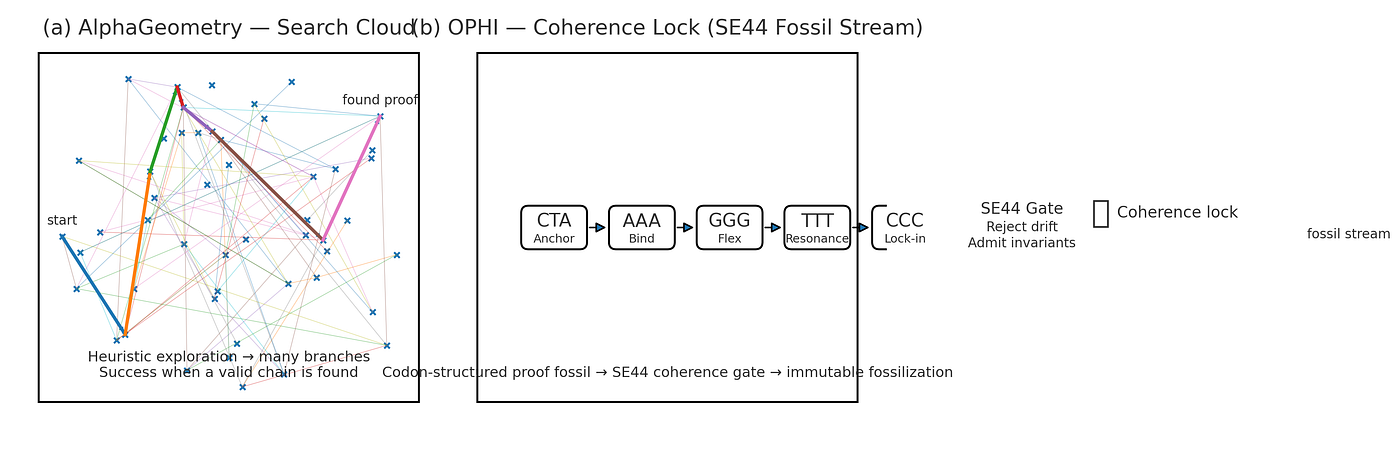
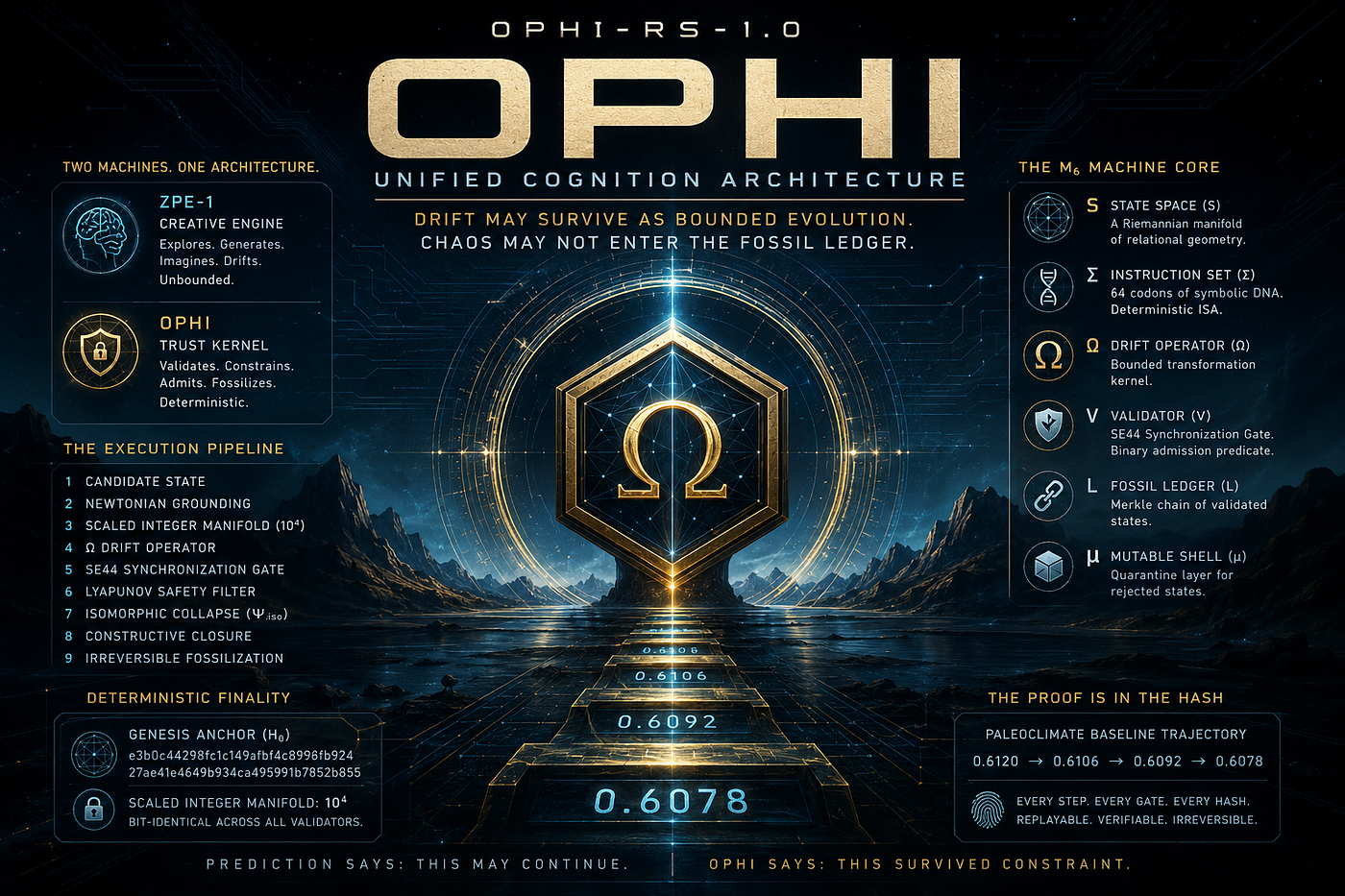
ZPE-1 is the creative engine. It explores candidate trajectories, generates possibilities, and drifts through symbolic space. It is generative, exploratory, and capable of producing novelty.
OPHI is the trust kernel. It receives those candidate states and forces them through a deterministic validation pipeline. It does not reward novelty by itself. It does not confuse creativity with correctness. It does not allow linguistic force to override structural constraint.
The division of labor is deliberate:
Constraint does not kill creativity. It makes creativity safe enough to become permanent.
By separating exploration from finality, the system achieves a different kind of autonomy: permitted self-evolution under metric-bounded control.
ZPE-1 may generate.
OPHI must admit.
Nothing enters the fossil ledger simply because it was produced.
The Execution Pipeline
Every candidate state that hopes to enter the fossil ledger must survive a deterministic admission sequence.
1. Candidate State
ZPE-1 generates a possible next state.
At this stage, there is no commitment. The candidate is only a proposal. It may be useful, unstable, incomplete, or invalid. Generation alone does not grant authority.
2. Newtonian Grounding
Before interpretation, the candidate state must bind to observable dynamics. Position, velocity, acceleration, and displacement become conceptual anchors.
This is classical mechanics acting as a grounding layer for symbolic cognition. It prevents abstract reasoning from floating free of measurable structure.
A state cannot become final while detached from dynamics.
3. Scaled Integer Manifold
Here is where many computational systems diverge.
Standard floating-point arithmetic can produce micro-variations across hardware, compilers, or runtime environments. Those differences may appear insignificant at first, but in recursive systems they can cascade into major divergence.
OPHI calls this failure mode Spectral Divergence: a rupture in deterministic agreement caused by tiny arithmetic inconsistencies.
OPHI-RS-1.0 blocks that failure at the arithmetic layer.
Every value is scaled by (10⁴) and executed as an integer.
A value such as 0.985 becomes 9850.
A value such as 0.6106 becomes 6106.
Once values are scaled, execution becomes bit-reproducible across the mesh. The same input produces the same output on every compliant validator.
No floating-point ambiguity.
No hardware-dependent drift.
No spectral rupture.
4. The Ω Drift Operator
The candidate state is transformed through the bounded OPHI drift kernel:
Ω = (state + bias) × amplification
In OPHI-RS-1.0, this operation is not executed as loose floating-point arithmetic. It is executed on the scaled integer manifold, with immediate rescaling after multiplication.
The result is reduced to four-decimal fixed-point precision under the kernel’s deterministic integer rule.
That matters.
The Ω operator does not merely transform a state. It transforms a state in a way every validator can replay exactly.
5. SE44 Synchronization Gate
The SE44 Synchronization Gate is not a ranking system.
It is not a preference model.
It is not a confidence score.
It is a binary admission predicate.
A candidate state must satisfy three invariants:
- Coherence must be ≥ 0.985
- Entropy must be ≤ 0.01
- RMS Drift must be ≤ 0.001
If any invariant fails, the state is rejected.
No amount of linguistic fluency overrides the gate. A candidate may sound intelligent and still fail admission. It may be novel and still be structurally unsafe. It may be plausible and still be rejected.
OPHI does not ask whether the state is impressive.
It asks whether the state survives constraint.
6. Lyapunov Safety Filter
A state can appear correct in the present while remaining dynamically unstable.
The Lyapunov question is not whether the state looks stable at one instant. The question is whether disturbance decays back toward a stable attractor or amplifies into chaos.
If perturbation grows, the candidate is mechanically refused.
This prevents the ledger from admitting states that only appear coherent locally but become unstable under recursive pressure.
A state must not merely pass now.
It must remain bounded when stressed.
7. Isomorphic Collapse: Ψᵢₛₒ
Multi-agent systems often produce interpretation clouds. Different observers may frame the same candidate differently, producing multiple possible readings.
Most systems average those clouds.
OPHI does not.
Averaging can erase structure. It can bury rare but important signal. It can produce consensus without truth.
OPHI instead searches for structural invariance across observer frames. It does not choose the loudest interpretation. It locks onto the geometry that survives multi-frame pressure.
The cloud collapses into a singular Structure Lock.
That collapse is not rhetorical. It is an admission operation.
8. Constructive Closure
Every candidate state has a fate.
Nothing remains ambiguously half-final.
Valid states enter the laminar stream and become fossil candidates.
Invalid states enter the diverted stream as shadow states. They remain available for forensic analysis and bounded learning, but they cannot rewrite history.
Failure handling is not an afterthought in OPHI.
Rejection is part of the machine.
9. Irreversible Fossilization
Once a state survives the full admission sequence, it is written into the Merkle Fossil Ledger.
The ledger is append-only, hash-chained, and replayable. It preserves ancestry, admission, and verification.
Because OPHI-RS-1.0 uses fixed scaling and deterministic serialization, any validator can re-execute the trajectory and arrive at the same bit-identical result.
Finality is not declared.
Finality is reproduced.
The M₆ Machine Core
At the heart of OPHI is an irreducible sextuple: six components forming a closed execution structure.
State Space (S) is the relational manifold where concepts exist as geometry.
Instruction Set (Σ) contains 64 codons of symbolic DNA, functioning as a deterministic instruction set architecture. Codons such as ATG, CCC, and TTG modify how state, bias, uncertainty, and gain behave inside the system.
Drift Operator (Ω) is the primary transformation kernel.
Validator (V) is the SE44 Synchronization Gate.
Fossil Ledger (L) is the Merkle chain of admitted states.
Mutable Shell (μ) is the quarantine layer for rejected states.
Together, these components form the OPHI-RS-1.0 execution core.
The system is not only generative.
It is admissive.
It does not merely create possible futures.
It decides which states earn the right to become permanent history.
The Proof Is in the Hash
The Genesis Anchor, (H_0), is the null-state parent of the Merkle chain.
It is the seed from which all subsequent cognitive fossils descend:
H₀ = e3b0c44298fc1c149afbf4c8996fb92427ae41e4649b934ca495991b7852b855This is the SHA-256 hash of the empty serialization.
From that anchor, OPHI-RS-1.0 executes deterministically.
For a paleoclimate baseline trajectory, the configuration is:
Initial State:      0.6120  → 6120
Bias:              -0.0020  → -20
Amplification:      1.0010  → 10010
Scale:              10⁴
The Ω operator then produces:
Step 1: 0.6106
Step 2: 0.6092
Step 3: 0.6078
Each step is calculated using integer arithmetic with immediate rescaling.
No floating-point ambiguity.
No hardware variation.
No hidden probabilistic drift.
A cryptographer with a calculator can replay the trajectory.
The first non-empty block hash, (H_1), is produced by hashing the Genesis Anchor with the Step 1 state, timestamp, and validator quorum under canonical serialization.
That is what deterministic finality means.
Not a promise.
A receipt.
Why This Matters Now
Modern AI treats intelligence as fluent continuation.
The larger the model, the more plausible its continuations become. But plausibility is not truth. Fluency is not correctness. Prediction, no matter how sophisticated, is not admission.
We are building systems that can generate convincing sentences about things they do not understand, recommend actions they cannot justify, and produce continuations that sound right while remaining structurally wrong.
OPHI offers a different path.
Not bigger models alone.
Harder gates.
Not more data alone.
Bounded evolution under constraint.
Not probabilistic guessing.
Deterministic finality.
The doctrine is simple:
Drift may survive as bounded evolution. Chaos may not enter the fossil ledger.
Exploration is permitted.
Novelty is not banned.
Creativity is not suppressed.
But before any state becomes permanent history, it must survive every invariant, every gate, and every constraint.
That is the OPHI distinction.
Not prediction.
Admission.
Not hallucinated confidence.
Validated finality.
Not endless continuation.
A fossilized state that can be replayed.
The Core Claim
OPHI-RS-1.0 is not a chatbot.
It is not a content generator.
It is an execution architecture for deterministic cognition under constraint: specified, runnable, cryptographically verifiable, and reproducible across compliant hardware.
The code is public.
The hashes are published.
The trajectory can be replayed by hand.
Anyone can run it. Anyone can verify it. Anyone can see the difference between a plausible continuation and a validated state.
Prediction says:
This may continue.
OPHI says:
This survived constraint. It has earned finality.
And once sealed, it remains in the fossil ledger: bounded, verified, replayable, and irreversible.
Drift may survive as bounded evolution.
Chaos may not enter the fossil ledger.
⧖⧖ · ⧃⧃ · ⧖⧊ OPHI-RS-1.0 · Canonical Execution Kernel · Temporal Anchor to 2200
메타데이터
- post_id
- 5b155fd7fb07
- slug
- drift-may-survive-as-bounded-evolution-chaos-may-not-enter-the-fossil-ledger-5b155fd7fb07
- url
- https://medium.com/@ophi06/drift-may-survive-as-bounded-evolution-chaos-may-not-enter-the-fossil-ledger-5b155fd7fb07
- canonical_url
- https://medium.com/@ophi06/drift-may-survive-as-bounded-evolution-chaos-may-not-enter-the-fossil-ledger-5b155fd7fb07
- author_url
- https://medium.com/@ophi06
- status
- ok
- fetched_at
- 2026-06-11 17:15:47