The Dollar That Was Never Meant for You
A few nights ago I watched the movie The Banker.
The Dollar That Was Never Meant for You
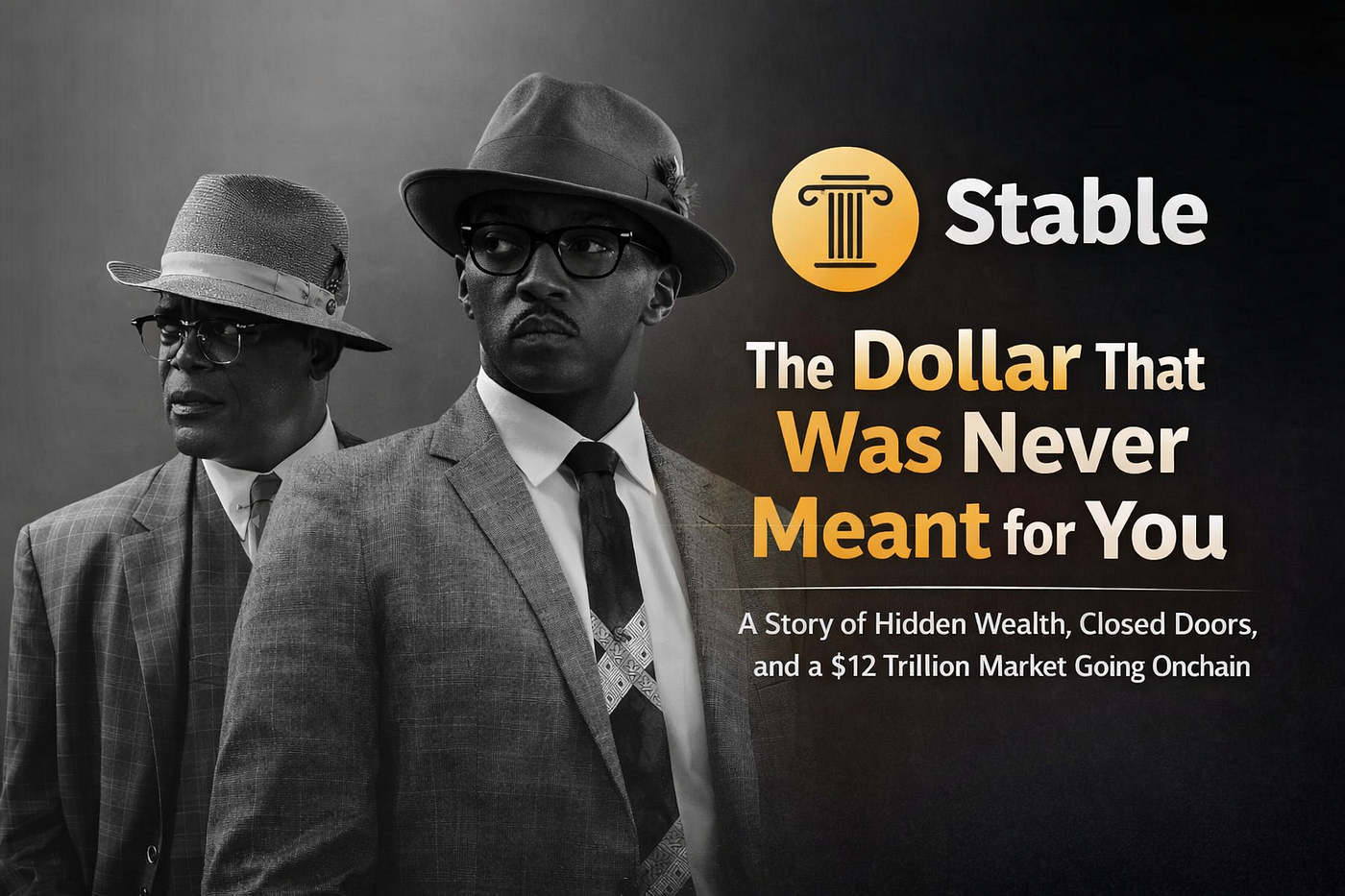
A few nights ago I watched the movie The Banker.
It tells the true story of Bernard Garrett and Joe Morris, two Black entrepreneurs in 1950s America who understood something uncomfortable about the financial system.
…It wasn’t built for them.
Banks, real estate markets, and lending institutions had invisible rules about who could participate and who couldn’t. So Garrett and Morris did something clever.
They trained a white man named Matt Steele to act as their representative. They taught him how to dress like a banker, how to speak the language of finance, how to walk into rooms where deals were made.
Matt would go inside and negotiate multimillion-dollar deals while Garrett and Morris waited outside in the car.
They were the real investors. But they weren’t allowed inside.
Financial systems often look open from the outside. Yet many of the most powerful opportunities sit behind doors that only a few people can enter.
Most people watch that story and think of it as a historical lesson about race and inequality in the 1950s.
But there’s another lesson hidden inside it — and one of the clearest examples of that today is something almost everyone participates in: the mortgage market.
The Room Most People Never See
Let’s start with a simple question: what happens to your mortgage after you take it out?
Most people assume their bank simply collects payments for 30 years. But that’s not actually what happens.
Within weeks of issuing a mortgage, banks usually sell it. They bundle thousands of mortgages together and package them into financial instruments known as mortgage-backed securities (MBS). These securities are then sold to large investors.

Buyers of Mortgage-Backed Securities
Every month, millions of homeowners make payments on their mortgages. Those payments flow through financial structures and eventually become returns for institutional investors.
The US mortgage market alone is estimated to exceed $12 trillion — one of the largest credit markets in the world. And yet most ordinary people have almost no direct access to it.
To invest directly in mortgage-backed securities usually requires institutional accreditation, large minimum investments, and connections to traditional financial infrastructure. On top of that, the system itself involves multiple intermediaries — banks, brokers, loan originators, securitization firms, and large financial institutions — each adding layers of complexity between investors and the underlying assets.
For a young developer in Lagos, a freelancer in Nairobi, or a student building savings in India — that market might as well be locked behind a wall.
Just like Garrett and Morris outside that bank. The opportunity exists. But the door isn’t built for you.
Paradox of Housing
Think about it.
There’s something strange about this system: the people powering it are often the ones who benefit the least.
Every homeowner making a monthly mortgage payment contributes to the cashflow that supports mortgage-backed securities. Their payments help generate yield for institutional investors around the world. But homeowners themselves rarely share directly in those returns. They have no share in that $12 trillion market.
But there is more, something called Home equity.
Homeowners are sitting on enormous wealth in another form: home equity — the portion of a home that the owner truly owns after subtracting any remaining mortgage balance.
Across the United States, homeowners collectively hold tens of trillions of dollars in home equity. Estimates suggest that unused home equity in the US alone approaches $35 trillion.

That’s an extraordinary amount of wealth. But most of it is idle.
A house might increase in value over time, but the equity inside it often sits unused unless the homeowner sells the property or takes on additional debt. In other words, homeowners hold massive financial value that is largely locked away inside traditional financial structures.
This is where a new idea begins to emerge. What if that value could move more freely?
You’re thinking: what if we had our own Matt Steele — someone who speaks the language of money — to get us into that trillion-dollar room?
This is where Stable enters the picture.
Stable, Our Way In
Stable is building infrastructure designed to bring the US mortgage market onto blockchain networks. Not a simulation. Not a synthetic derivative. But real financial rails that connect mortgage assets with decentralized liquidity.
The idea is ambitious but conceptually simple.

Mortgage finance: traditional vs decentralized flow
By moving parts of the mortgage market onchain, Stable aims to make it possible for anyone with a crypto wallet to participate in a financial system that has historically been reserved for large institutions.
The key piece of this system is something called USDX. …Let talk about it next.
📖 See Also: Why Tokenize a Mortgage? — medium.com/stable-inc — Stable’s deep dive into how tokenizing a mortgage works and why it benefits every participant in the market
What Is USDX?
At its core, USDX is a stablecoin designed to maintain a value close to one US dollar. But unlike most existing stablecoins, it is backed by real mortgage-related assets.
Most popular stablecoins today work in a relatively simple way. They hold cash or government bonds in reserve and issue tokens that represent claims on those reserves. Those systems are stable and widely used, but the dollars themselves are mostly passive.
They hold value. But they don’t generate much of it.
USDX is designed differently. Instead of relying solely on cash reserves, it is backed by assets connected to real housing finance, including mortgage-related securities. That means the stability of the token comes from underlying mortgage assets — the same type of financial instruments that institutional investors have relied on for decades.
In practical terms, USDX aims to connect two worlds that rarely interact directly: traditional housing finance and decentralized financial infrastructure.

Stable comparison USDC, USDT and USDX
When you stake USDX, the yield from those underlying mortgage assets flows directly to you. The same yield that has historically gone exclusively to institutions.
For the technical documentation on how USDX works under the hood, visit docs.trystable.co.
How the System Works
To understand the concept more clearly, it helps to walk through the flow step by step.

Stable flow diagram
For users in the crypto ecosystem, that means access to a new type of stable asset connected to real-world financial activity.
Stable Home Accounts: Unlocking Idle Equity
Beyond USDX, Stable is also exploring tools designed to help homeowners interact with their home equity in new ways. One of these ideas is something called Home Accounts.
To understand the significance of this concept, imagine a homeowner who has built up significant equity in their property. Traditionally, that equity can only be accessed through a few options:
- Selling the home
- Refinancing the mortgage
- Taking out a home equity loan
Each of these options involves friction, paperwork, and often additional debt.
Stable’s Home Accounts explore a different possibility. Instead of equity sitting idle, homeowners could potentially deposit a portion of that value into a system that allows it to interact with decentralized liquidity. The yield generated could then be used in various ways, such as helping reduce the remaining mortgage balance.
Even modest yields could have significant long-term effects. For example, a homeowner who earns a few percent annual yield on part of their home equity could potentially shorten a traditional 30-year mortgage by several years without increasing their monthly payment.

Illustrative example: mortgage principal payoff over time, with and without Stable Home Account at 4% APY on idle equity
The idea isn’t to replace traditional mortgages overnight. It’s to think through new ways that blockchain infrastructure might make housing finance more flexible and transparent.
📖 See Also: Stable Home Accounts: Your Neighbor Is Paying Off Their Mortgage Early — medium.com/stable-inc — The full deep-dive on how Home Accounts work, real-world examples, and how to get on the waitlist
Why This Matters for the Future of Finance
Projects like Stable are part of a broader movement known as real-world asset tokenization.
The basic idea is straightforward. Many of the world’s most valuable assets — real estate, infrastructure, bonds — exist outside blockchain systems. Tokenization explores how those assets can be represented digitally so they can interact with decentralized financial networks.
This could potentially unlock several advantages:
• Greater transparency about how assets are managed
• Faster settlement compared to traditional financial rails
• Global access to investment opportunities that were previously restricted to large institutions
Housing finance is a particularly interesting case because it sits at the intersection of everyday life and global capital markets. Almost everyone understands the idea of a mortgage. But very few people have direct access to the financial instruments built on top of them.
If even a small portion of that market becomes accessible through decentralized infrastructure, it could dramatically expand the range of financial opportunities available to individuals around the world.
Security and Risk Considerations
Whenever real-world finance meets crypto, the first question people ask is simple: “Is it safe?” That question matters even more when mortgages are involved.
Here are the features and what it means for you:

Stable isn’t trying to reinvent the mortgage market from scratch. It’s trying to open it up, make it more transparent, and connect it to a global digital financial system.
For the complete technical documentation, visit docs.trystable.co.
A Realistic Look at the Road Ahead
It’s important to be honest about something. The idea of bringing a multi-trillion-dollar financial system onchain is not a small task. Mortgage markets involve complex legal frameworks, regulatory oversight, and decades of existing infrastructure. Any attempt to integrate those systems with blockchain networks will require careful design, risk management, and collaboration with traditional financial institutions.
In other words, this transformation will not happen overnight.
But every major shift in financial infrastructure begins with a step. Stable has taken the first step. The team is testing whether blockchain technology can help connect global liquidity with real-world housing finance in ways that were not previously possible.
The Door That Might Finally Open
Think back to Garrett and Morris sitting outside that bank.
They had the knowledge. They had the capital. But the system wasn’t built to include them. Today the barriers are different. They aren’t always visible. But many financial opportunities still sit behind institutional walls.
Stable is exploring what happens when one of those walls begins to come down.
A $12 trillion mortgage market. Tens of trillions in idle home equity. And a new layer of financial infrastructure connecting it to global liquidity.
USDX gives you access to the yield. Home Accounts put your equity to work. The $STABLE token gives you a stake in the protocol itself.
Get Involved
Official Links
💻 App: app.trystable.co
🌐 Website: trystable.co
📚 Docs: docs.trystable.co
📝 Blog: medium.com/stable-inc
Social Links
🐦 Twitter/X: @stable_tweets
📸 Instagram: @trystable
🎥 YouTube: @trystable
References
[1] Stable Home Accounts — https://medium.com/stable-inc/stable-home-accounts-3a4adbf36012 Official article on how Home Accounts work, including real-world payoff projections
[2] What is USDX? — https://medium.com/stable-inc/what-is-usdx-1726a7425d49 The mortgage-backed stablecoin explained — mechanics, backing, and how to get started
[3] Why Tokenize a Mortgage? — https://medium.com/stable-inc/why-tokenize-a-mortgage-ba143ce45279 How tokenization works, who benefits, and what it means for the broader mortgage market
[4] Why We Built the Stable Points Program — https://medium.com/stable-inc/why-we-built-the-stable-points-program-b0398141c0ff Community building, early participation rewards, and Stable’s ecosystem growth strategy
[5] Stable Technical Documentation — https://docs.trystable.co/ Full technical docs covering USDX mechanics, tokenization, collateralization, and protocol design
[6] Stable Blog — https://medium.com/stable-inc All official Stable articles, updates, and deep-dives
메타데이터
- post_id
- 5b20b8bcae85
- slug
- the-dollar-that-was-never-meant-for-you-5b20b8bcae85
- url
- https://medium.com/@chiemezieagbo1/the-dollar-that-was-never-meant-for-you-5b20b8bcae85
- canonical_url
- https://medium.com/@chiemezieagbo1/the-dollar-that-was-never-meant-for-you-5b20b8bcae85
- author_url
- https://medium.com/@chiemezieagbo1
- status
- ok
- fetched_at
- 2026-06-21 20:33:08