What Is the Rain Protocol, and Which Public Company Holds Its Token?
A plain-English guide to the decentralized prediction markets protocol on Arbitrum — and the Nasdaq-listed company that built the first…
What Is the Rain Protocol, and Which Public Company Holds Its Token?
A plain-English guide to the decentralized prediction markets protocol on Arbitrum — and the Nasdaq-listed company that built the first prediction markets treasury around its token.
What Is the Rain Protocol, and Which Public Company Holds Its Token? A guide to the Arbitrum prediction markets protocol and the Nasdaq company (ENLV) behind it.
Prediction markets used to be a niche corner of the internet. In 2026, they are a financial category.
In June, the two largest platforms, Kalshi and Polymarket, processed roughly $45 billion in combined volume — a 75% jump in a single month, according to data reported by The Block.
Robinhood chief executive Vlad Tenev has described the shift as a “supercycle” that could drive trillions in annual volume over time, according to Forbes.
So here is a fair question. If prediction markets are becoming financial infrastructure, who owns the infrastructure? And can a public-market investor get exposure without ever opening a crypto wallet?
That is where the Rain Protocol, and one Nasdaq-listed company, enter the story.
Why are prediction markets booming?
Three forces turned a niche into a category.
- Mainstream proof. The 2024 U.S. election was the breakout moment, and volume has soared since, according to Pew Research Center. Trading has since spread into economics, technology, sports, and culture.
- Institutional money. Intercontinental Exchange, the owner of the New York Stock Exchange, committed up to $2 billion to Polymarket — one of the clearest signs of institutional acceptance yet.
- Data everywhere. Google Finance began embedding live prediction-market odds, pushing these probabilities into everyday news.
The scale is hard to overstate. Monthly volume has climbed from under $100 million in early 2024 to roughly $21 billion by 2026, according to TRM Labs.
The takeaway is simple. Prediction markets are becoming a real-time layer of information — and, increasingly, an asset class.

Prediction markets, from niche to category: combined monthly volume, Kalshi + Polymarket (approximate). Sources: The Block; TRM Labs; Pew Research Center.
What is the Rain Protocol?
The Rain Protocol is a decentralized prediction markets infrastructure built on Arbitrum, an Ethereum Layer 2 network. Its community often calls it “the Uniswap of prediction markets.”
In plain terms, it is a toolkit, not a single app. Anyone can build on top of it. Here is what sets it apart:
- Permissionless. Anyone can create a public or private market on almost any real-world outcome — elections, economics, sports, technology, culture.
- Builder-first. It ships SDKs, APIs, and smart contracts, so developers can launch their own forecasting platforms. Rain is a protocol layer, not one destination.
- AI-resolved. Markets settle through Delphi, a multi-agent AI oracle, with disputes escalating to human arbitration.
- Cross-chain. Users can deposit from Ethereum, Base, and BNB Chain, not only Arbitrum.
- Public or private. Anyone can open a market to the world, or run an invite-only market for a DAO, a team, or a community forecasting internal outcomes.
The traction is early but real. Rain’s public beta launched on November 6, 2025. By early 2026 it had crossed $18 million in cumulative volume and 28,000 users, according to research published by BingX Academy.
In March 2026, Rain moved further into the “agentic era.” It launched an AI agent interface that lets anyone create a prediction market from a single prompt, according to Enlivex.
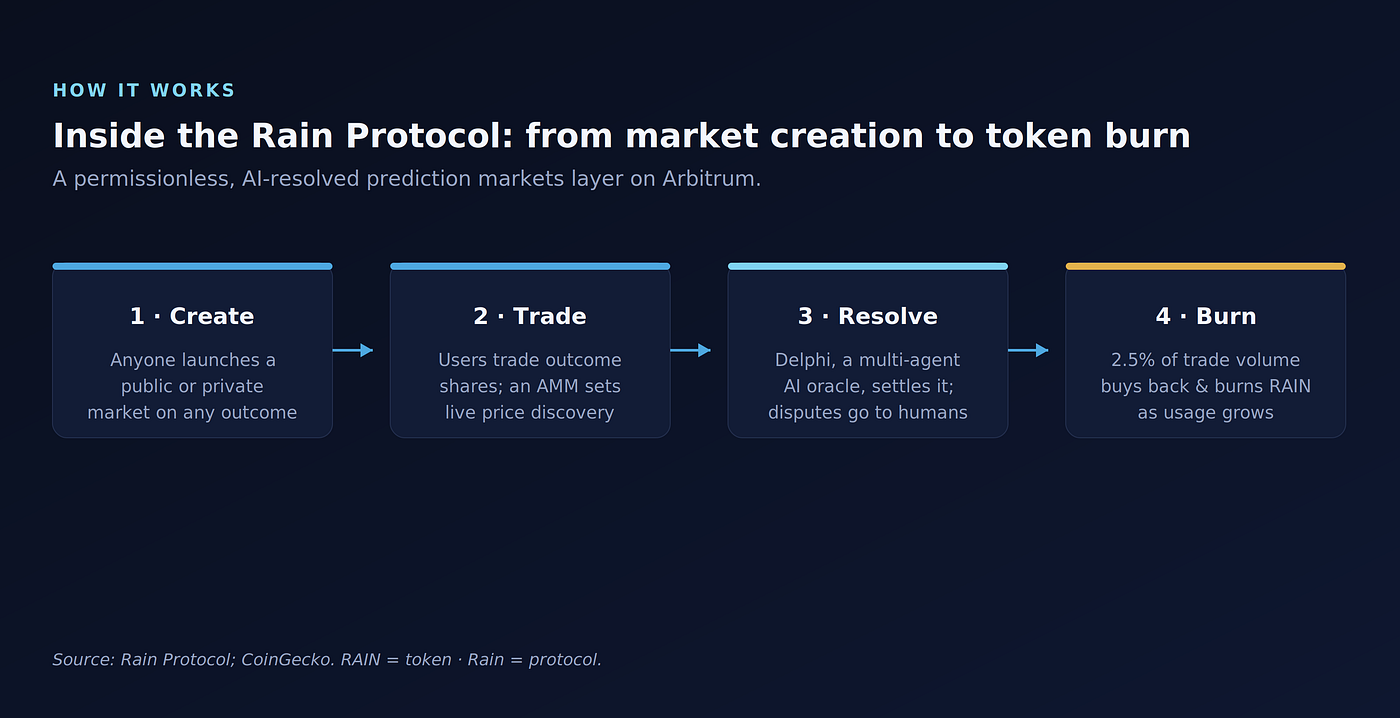
Inside the Rain Protocol — create a market, trade outcomes, resolve via the Delphi AI oracle, then burn RAIN. Sources: Rain Protocol; CoinGecko.
How does the RAIN token actually work?
First, the casing, because it matters. RAIN is the token. Rain is the protocol and foundation.
RAIN is the native utility and governance token. Its value model is mechanical, not mood-driven:
- Buyback-and-burn. 2.5% of all trading volume is used to buy back and permanently burn RAIN, according to CoinGecko. As usage rises, supply shrinks.
- Governance. Holders vote on fees, oracle parameters, and treasury allocation through the Rain DAO.
- Access. Holding RAIN unlocks “Trading Power” inside the app.
This is the part investors tend to focus on. The token is engineered to draw value from real protocol activity. Enlivex frames its own exposure the same way: value linked to Rain protocol activity, not sentiment alone.
Scale gives the burn something to work on. RAIN launched with a very large supply, so any single burn is small on its own. The thesis is cumulative: more markets, more volume, more tokens removed over time.
2.5% of every trade burns RAIN permanently. As usage grows, supply shrinks.
— Rain Protocol
Which public company holds the RAIN token?
The public company is Enlivex Ltd. (Nasdaq: ENLV).
Enlivex is an Israel-based, Nasdaq-listed company. In November 2025 it became the first publicly traded U.S.-listed company to adopt a prediction markets token as its primary treasury reserve asset, according to CoinDesk.
The move was funded by a $212 million PIPE: 212 million shares at $1.00, an 11.5% premium to the prior close, funded in a combination of U.S. dollars and USDT, according to the company’s SEC filing. Former Italian Prime Minister Matteo Renzi joined the board following the closing.
Why Rain, and why so early? Executive Chairman Shai Novik said Enlivex deliberately chose early-stage exposure rather than a valuation that had already matured, according to The Block.
Rain’s own materials confirm the relationship. The protocol states it is backed by Nasdaq-listed Enlivex (ENLV).
How big is the Enlivex RAIN treasury now?
It has scaled quickly. Each figure below was disclosed by Enlivex:
- April 27, 2026: about 78.8 billion RAIN, valued at roughly $567 million.
- May 27, 2026: about 79.57 billion RAIN, valued at roughly $1.16 billion.
- June 20, 2026: 79,568,550,005 RAIN, valued at approximately $1.14 billion, with a reported Treasury NAV per share of $4.67, per the company’s public market-data dashboard.
The treasury also shaped the headline numbers. For full-year 2025, Enlivex reported net income of $1.23 billion and diluted earnings per share of $25.48, driven by appreciation in its treasury and treasury-related assets.
One honest caveat. Enlivex notes these holdings remain subject to crypto market volatility. Digital asset values move sharply, in both directions.

Who holds the token: Enlivex’s RAIN treasury by reported value, April–June 2026, with Treasury NAV per share. Source: Enlivex disclosures.
Why would a longevity company hold a prediction markets token?
This is where most coverage gets it wrong. Enlivex is not a crypto company.
That distinction is deliberate. The company has pushed back on being labeled a crypto play, because the label misses half the business.
It describes itself as the quality longevity company, powered by a prediction markets treasury. One ticker, two strategies.
- The biological floor. Allocetra™ is a clinical-stage macrophage reprogramming therapy targeting age-related knee osteoarthritis — a market Enlivex sizes at $314 billion. Phase II data showed a 72% reduction in pain and a 109% improvement in function across more than 250 treated patients, according to Enlivex.
- The forecasting engine. The RAIN position gives the same equity exposure to the growth of prediction markets infrastructure.
The point is that the two are meant to be read as one integrated structure. Longevity science and a forecasting-linked treasury, under a single Nasdaq equity. The treasury is designed to advance the science while generating returns from an emerging category. That is the whole thesis: healthspan meshed with wealthspan.
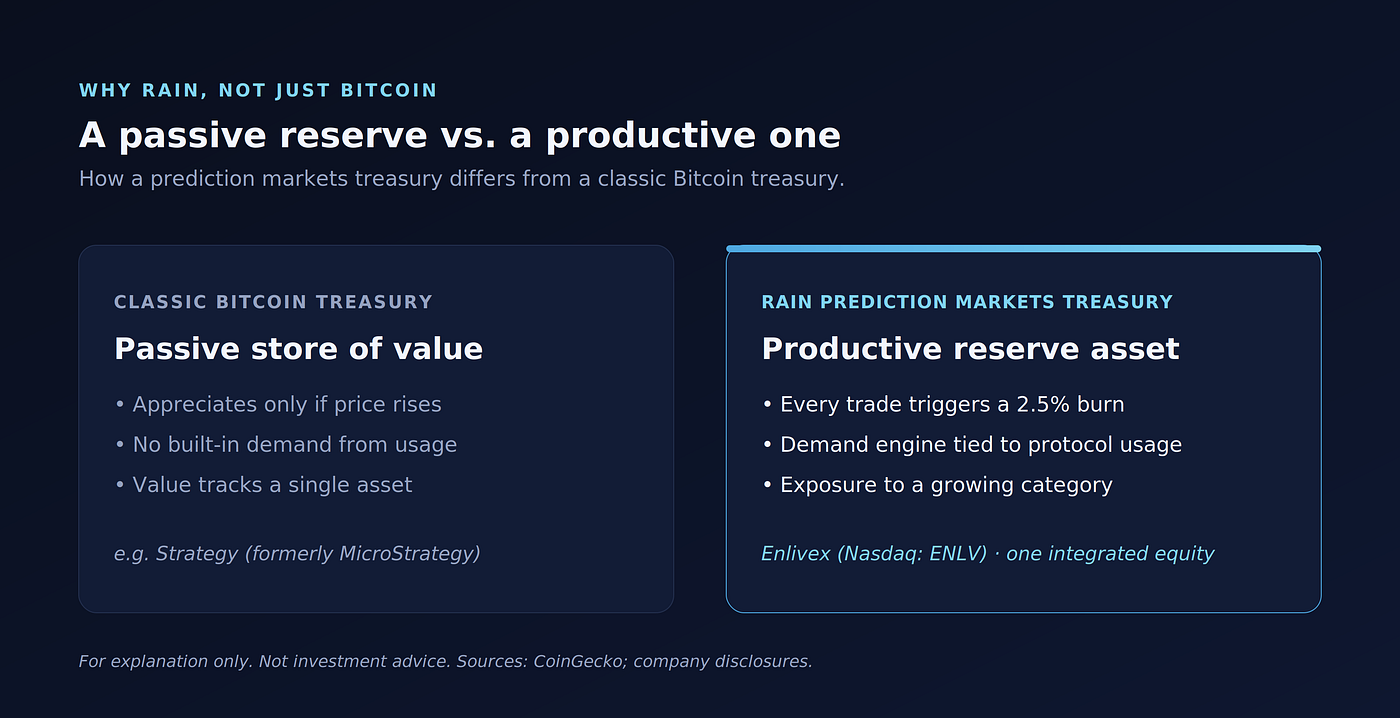
A passive reserve versus a productive one: how a prediction markets treasury differs from a classic Bitcoin treasury. For explanation only; not investment advice.
How is this different from a Bitcoin treasury?
Most corporate crypto treasuries hold a passive reserve. Bitcoin, most famously through Strategy (formerly MicroStrategy).
A RAIN treasury is designed to be productive instead of passive.
Dozens of public companies now hold digital assets on their balance sheets, a wave often shorthanded as the digital asset treasury, or DAT, trend. Most stop at holding. Enlivex’s wrinkle is choosing a reserve asset whose value is tied to how much a network is used, not only to its market price.
- A Bitcoin treasury appreciates only if the price of Bitcoin rises.
- A RAIN treasury is linked to protocol usage. Every market traded on Rain triggers the 2.5% buyback-and-burn.
In other words, the reserve asset has a built-in demand engine tied to a category that is still early.
Prediction-market revenues could grow to more than $10 billion by 2030, up from around $2 billion today, according to a projection by Citizens reported in International Banker.
The regulated wrapper matters too: exposure arrives through a Nasdaq ticker, with SEC reporting and audited financials, rather than a wallet and an exchange.
What should investors watch next?
A few markers will show whether the thesis is working:
- Protocol usage. Rain’s volume, active users, and the pace of RAIN burned are the clearest signals of real demand.
- Treasury NAV per share. Enlivex reports this on its investor dashboard; it links the token position back to the equity.
- Clinical catalysts. Allocetra™ trial readouts remain the other half of the story.
- Category risk. Regulation and digital-asset volatility can move both the token and the stock. This is high-beta by design.
The takeaway
Prediction markets are moving from curiosity to infrastructure. The open question was always how a traditional investor gets clean exposure to that shift.
Enlivex’s answer is a single Nasdaq ticker that packages a longevity therapy and the leading prediction markets protocol on Arbitrum into one instrument.
No wallet. No exchange. Just a brokerage account and a view on where forecasting goes next.
Whether that view proves right is, fittingly, the kind of question a prediction market would price. You can track the numbers as they update on the Enlivex investor pages.
📩 Join Investor’s Handbook Digest — get the best investing, markets, and wealth-building insights each week.
메타데이터
- post_id
- 5b31556a7f7c
- slug
- what-is-the-rain-protocol-and-which-public-company-holds-its-token-5b31556a7f7c
- url
- https://medium.com/the-investors-handbook/what-is-the-rain-protocol-and-which-public-company-holds-its-token-5b31556a7f7c
- canonical_url
- https://medium.com/the-investors-handbook/what-is-the-rain-protocol-and-which-public-company-holds-its-token-5b31556a7f7c
- author_url
- https://medium.com/@web3shanty
- status
- ok
- fetched_at
- 2026-07-08 17:17:42