the need to be (seen as) “Fantastic”
[an over-analyzation of Fantastic Mr. Fox — also, spoilers!]
the need to be (seen as) “Fantastic”
[an over-analyzation of Fantastic Mr. Fox — also, what the cuss there’s spoilers!]
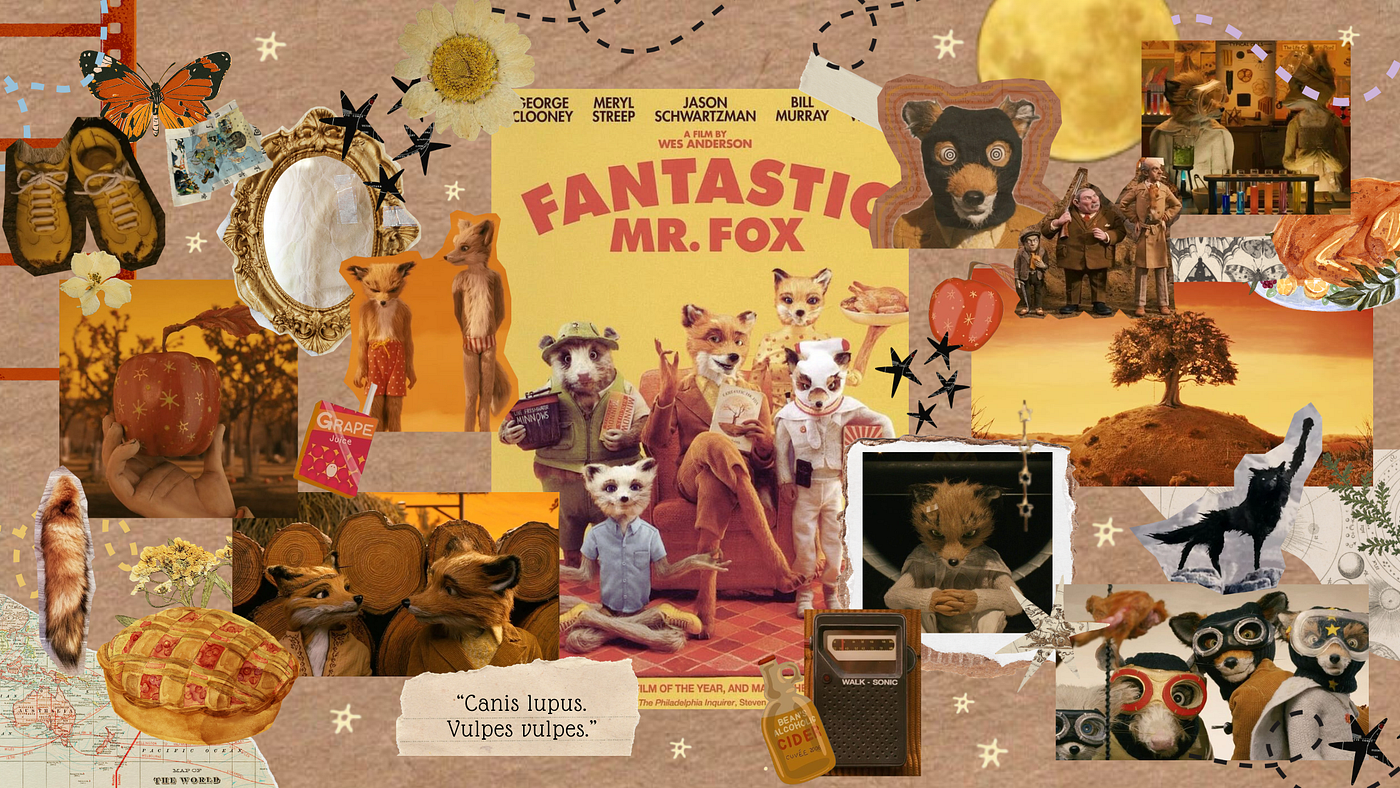
“Fantastic Mr. Fox” dir. Wes Anderson
I don’t know, but I have a possible theory. I think I have this thing where I need everybody to think I’m the greatest, the quote-unquote Fantastic Mr. Fox. And if people aren’t knocked out, and dazzled, and slightly intimidated by me, I don’t feel good about myself.
This quote is from a monologue in the 2009 movie directed by Wes Anderson titled “Fantastic Mr. Fox”. The movie was loosely based on the 1970 novel of the same name by Roald Dahl.
The movie centers around a sly fox, unsatisfied with his situation, trying to relive his glory days.
Foxy F. Fox (voiced by George Clooney), aka Mr. Fox, had to give up his life of poultry-stealing to get a safer job after finding out his wife was pregnant. He became a journalist whose column no one reads, living in a hole underground, feeling poor in every sense of the word — not just financially, but emotionally — stuck in a life that feels too small for him.
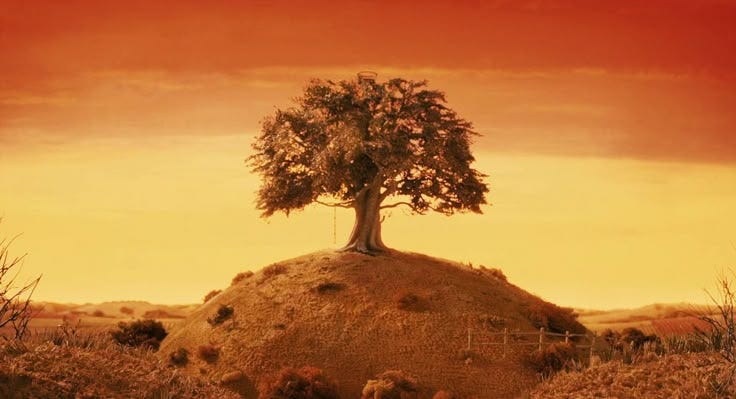
Experiencing a midlife crisis, he ended up buying a treehouse, living across the three mean farmers, planning one last heist, his magnum opus, willing to risk it all in the name of being “Fantastic”.
While his son, Ash, a wiry, moody kid who is consistently described as (insert hand gesture) “different,” spends most of the film trying to prove himself, to fit into a mold that is too big for him: his father’s. This is exacerbated by the arrival of his cousin, Kristofferson, the perfect, naturally gifted child.
Throughout the movie, we see how the chaos they create — and endure — becomes a catalyst for change, helping them reconcile who they want to be (who they want to be seen as) and who they really are.
Mr. Fox realizes that being seen as “Fantastic” wasn’t everything, and Ash realizes that being different was not so bad after all.
At its core, “Fantastic Mr. Fox” is a lesson on contentment.
Mr. Fox is a hubristic character — the best, the greatest, the quote-unquote “Fantastic Mr. Fox”. We see this trait emerge even before the 10-minute mark, when he was stealing pheasants with Felicity. He asked her suggestions on the heist only to side-step her and do things according to his plans, and at the end, he triggered a trap not because he was reckless, but because he wanted to test his theory of where the trap would land (a theory that was promptly proven wrong).
The trait resurfaced when his lawyer advised him against buying the treehouse, when his wife warned him about stealing from and underestimating the farmers, and when his neighbours became angry at him for causing their land to be blown up and destroyed as a result of the farmers’ anger.
During their underground feast, he acted like everything was fine, smug even, proud of the plan that allowed them to steal from the farmers and celebrate on their loot. All clever quips and sarcastic remarks, Mr. Fox carried himself as if he’d done no wrong — even though he was the reason the woodland creatures were forced underground in the first place.
It was only then, when they were flooded by the cider and Kristofferson taken, that he finally acknowledged the faults in his ways. He learned that his pride, his overt sense of arrogance, has endangered not just himself, but also his family.
He showed his vulnerability to his wife and his son, and relented to the fact that maybe this time, there was no outsmarting his way out of the situation. His priority was no longer his own need for valor; it was his family’s safety and well-being. He offered himself in exchange for his nephew and was on the way to admitting defeat, and came back to fend off the Rat when he tried to kidnap his son after realizing that protecting them meant fighting the farmers together.
The Rat here symbolizes ego, greed, selfishness, and addiction, the antithesis of the movie’s theme of family and community. He showed what Mr. Fox could’ve been if he were engulfed in his own avarice and self-oriented desires. Defeating Rat showcased Mr. Fox’s tackling of his own selfishness and ego, choosing to focus on his loved ones instead.
Even when he was angered and humiliated (because Beans was using his tail as a necktie), he chose to stand down, prioritizing getting them out to safety.
During the escape from the farmers, the crew encountered a wolf in the distance.
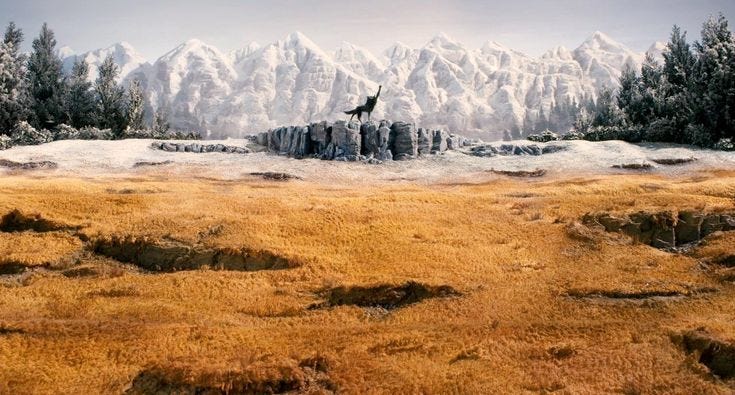
On my first watch, I could not actually understand this scene. Wes Anderson said that a key person wanted it cut from the release. Wes refused, however, citing that this scene is what makes the movie.
Some people think that The Wolf represented Mr. Fox’s coming to terms with his wild side. Throughout the movie, we see him caving in to them; killing squabs, stealing chickens, etc., but he never did these things as a wild animal, as opposed to the Wolf. Mr. Fox came to terms with the fact that while he is an animal, he is not a wild animal, and he learns to co-exist with his naturalistic and domestic side.
I think it could also be interpreted as him accepting the fact that he is also a wild animal. In the movie, we see him (and the whole woodland creatures) distancing himself from his nature as a fox (wild animal); moving out from his lair underground, planning heists meticulously (rather than tackling them head-on), wearing clothes, having jobs, and being “civilized”.
When he first saw the Wolf, he tried to engage with it with words, build conversations, but in the end, he realized that the only way for the Wolf to understand him was through the universal gesture of body language. I see it as him reconciling with the fact that, under all the clever quips and sly remarks, there will always be a wild animal.
As Mr. Fox learned to make peace with his wildness, Ash, too, began to come into his own.
We first see hints of him being (insert hand gesture) “different” — wearing a cape with his slacks tucked into his socks, trying to worm his way out of school, and complaining about having to share his bedroom with his cousin, Kristofferson.
Unlike his father or Kristofferson, Ash is small for his age, not naturally athletic, and often prickly. He isn’t effortlessly charming or likable; his sharp edges keep people at a distance. But beneath that defensiveness is a quiet, aching insecurity and a deep yearning for validation.
We saw it when he was “competing” with Kristofferson while diving from the branch (where Mr. Fox reminded him to tuck in his tail with indifference, but relishing in Kristofferson’s efforts), or in the sports scene. During a game of Whack-bat, Ash clearly wants to live up to his father’s legacy — the five-time MVP of their school team. After his turn, the coach shrugs and says he’s “okay,” but that he’ll never be as good as his dad. Then Kristofferson steps up and, with ease and grace, scores perfectly on his first try, which the coach remarked that there is no doubting his relation to Mr. Fox, and Ash informs him (bitterly) that Kristofferson was actually from his mother’s side of the family.
We can also see Ash’s envy towards Kristofferson build up as his lab partner, Agnes, showed her interest in Kristofferson. He started to become more petty, taking jabs at his father’s poor physical health and being overly curt when Kristofferson tried to communicate with him.
But despite this, we saw an awkward tenderness in Ash’s actions towards his cousin. One night when they were bunking, Ash complained about Kristofferson’s “ sad houseguest routine,” which made him cry. Ash then sat on the floor, turned on his toy train, and Kristofferson joined him as they both admired the rolling of the toy — a small attempt at reconciliation.

However, things came to a head when Foxy took Kristofferson on a heist instead of his own son, making Ash feel discarded and disregarded.
Ash: Me? Me, have an apology? He gets a bandit hat. He just got here. He got a bandit hat. Where’s MY bandit hat? Why didn’t I get shot at? It’s because you-you-you think I’m no good at anything! Well, maybe you’re right. Thanks.
This was a catalyst for Ash’s need to prove himself to his father. Even after his mother told him that there is something Fantastic about being different.
Mrs. Fox: “Ash… I know what it’s like to feel… different.”
Ash: “I’m not different. Am I?”
We all are. Him especially. But there’s something kind of fantastic about that, isn’t there?
Ash: “Hmm, not to me. I prefer to be an athlete.”
During the banquet, after Mr. Fox and the rest of the woodland creatures stole the rest of the farmers’ stash, Ash recruited his cousin to help him steal back his father’s tail. He refused at first, emphasizing how reckless and dangerous it was, but agreed nonetheless.
They went into Bean’s house to try and find Foxy’s tail when they got caught by his wife. While escaping, Kristofferson got caught by the farmers and was made a hostage to get Mr. Fox.
Ash felt guilty for his capture and blamed himself. He grew quiet and hid away while his father prepared to save his cousin.
Mr. Fox found his son defeated and deflated, and consoled him for what they thought would be the last time. He shared the first time he found out he would have a child — a call back to the first scene of the movie — in the trap on the farm. He told Ash that whilst they were escaping the trap, digging underground out of the farm, he was wondering about what kind of person his son (or daughter) would be.

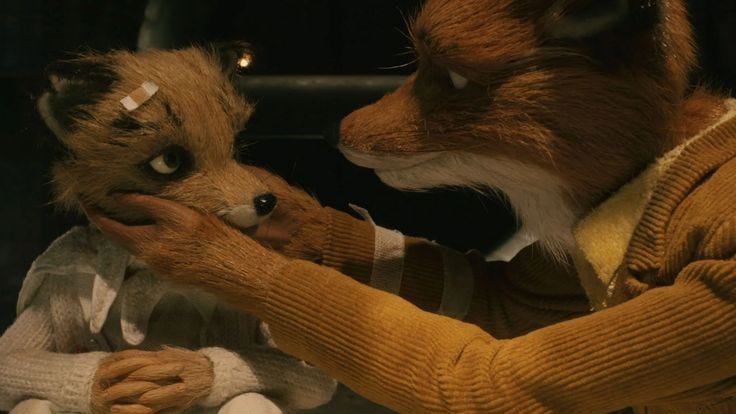
I feel like this was one of the most tender scenes in the movie.
Mr. Fox finally being able to sit down and genuinely talk with his son, and Ash being shown the love and acknowledgement he needed from his father.
(I think this was as big of a moment for Mr. Fox as it was for Ash, as he learned to actually see his son for who he is, not just shrugging his actions for him being different. He saw himself in Ash and finally chose to accept that part too.)
This was a turning point for Ash, the scene that gained him the confidence to acknowledge his difference, using the very quirk he was self-conscious of — his little-ness — with pride, owning it, to save his cousin from Beans’ trap. It was also a moment when Ash realized he must confront his guilt and apologize to Kristofferson, which led to their reconciliation.
When they were escaping the farmers, Ash’s quick thinking and “recklessness” were what saved them. He ran as fast as he could, smashed the lock, releasing a rabid Spitz onto the farmers, all the while his father watched him with pride. They got out, and Mr. Fox, acknowledging his son as the athlete he always wanted to be, awarded him with his own star-pattern bandit hat, solidifying that he belonged in their weird little motley crew.
One detail I particularly appreciated throughout the film — especially in the ending — was how subtly Anderson reinforces Ash’s “difference.” From the way he dresses, his ever-present cape, and the markings on his face that make him look perpetually frowning, to the small visual cue of him drinking grape juice (messily, but content) while everyone else sips apple juice — showcasing how he has accepted and embraced being different without feeling out of place.

I think one of the reasons I like this movie as much as I did was because of how much I relate to the characters, especially Mr. Fox and Ash.
I saw myself in Mr. Fox’s ambition for success and admiration, and Ash’s insecurity with not conforming to what people thought his father’s son should be. Restless, never quite satisfied, chasing people’s approval and validation. I wanted to be seen as accomplished, clever, intimidating, someone worth noticing. But somewhere along the way, I realized that kind of pursuit only leaves you emptier. You end up measuring your worth by other people’s reactions, and it’s exhausting.
I think in a way, Fantastic Mr. Fox put into perspective what our priorities are in life. What it means to be seen as Fantastic — Is it wealth? Glory? Admiration and acknowledgement? Being seen as fantastic? And if so, to what extent are we willing to sacrifice our peace, our relationships, and even ourselves in pursuit of it?
Some people call Fantastic Mr. Fox a “Thanksgiving Movie” because of the imagery of a family feast and the general fall undertones. The movie runs on the team of family and community, and beneath the cozy warmth is a quiet reminder that success means little if you have no one to share it with. It’s not about the feast, but about who’s sitting at the table.
The movie does not have a traditionally happy ending; they’re all still stuck living in the sewers, fending off with whatever they can scrounge from the convenience store upstairs. But it showed me that things don’t have to be ideal to be good. That the most important part is actually seeing the good in every situation. The proverbial silver lining.
This sentiment is further brought home by Mr. Fox’s speech during the end scenes;
They say all foxes are slightly allergic to linoleum. But it’s cool to the paw.
Try it. They say my tail needs to be dry-cleaned twice a month.
But now it’s fully detachable. See?
They say our tree may never grow back. But one day something will. Yes, these crackles are made of synthetic goose, and these giblets come from artificial squab. And even these apples look fake. But at least they’ve got stars on them.
I guess my point is, we’ll eat tonight and we’ll eat together, and even in this not particularly flattering light, you are, without a doubt, the five and a half most wonderful wild animals I’ve ever met in my life. So let’s raise our boxes.
To our… survival.
Mr. Fox’s obsession with being seen as clever and accomplished, as well as Ash’s thirst to be acknowledged as an athlete, mirrors our own urge to chase recognition. But it’s only when he loses nearly everything — his home, his safety, his family— that he realizes fulfillment doesn’t come from admiration, but from appreciation. Gratitude replaces validation as his source of meaning.
(Or, taking a page from Ash’s book, do what you love, and the glory — if it comes — will come on its own.)
Fantastic Mr. Fox is a very personal movie for me. It taught me to own our flaws, to apologize when we’re wrong, to forgive when we’re hurt, to choose gratitude over glory, and that our differences are what make each of us fantastic.
If you choose to watch it, I hope you’ll like it as much as I do.
❤️, Jocelyn.
A huge shout-out to imsdb.com for the Fantastic Mr. Fox script I referenced like 5000 times for this.
P.s. I genuinely feel like I overworked this to the ground, so even though I’m not quite happy with it, I’m going to leave it here before I ruin it even more. I have so much to say about this movie, but I’m not coherent enough to do it ngl, hope you guys like it either way though. I know I have been writing about these themes a lot, on being afraid of the future, envy, comparisons, and validation seeking, but what can I say, self-doubt and anxiety permeate my whole being, and I can’t seem to wash it all off completely yet, but I hope I can write about something new soon.
Love and well wishes, Jc.
메타데이터
- post_id
- 5b6d5f581e51
- slug
- the-need-to-be-seen-as-fantastic-5b6d5f581e51
- url
- https://medium.com/@jocelynprsc/the-need-to-be-seen-as-fantastic-5b6d5f581e51
- canonical_url
- https://medium.com/@jocelynprsc/the-need-to-be-seen-as-fantastic-5b6d5f581e51
- author_url
- https://medium.com/@jocelynprsc
- status
- ok
- fetched_at
- 2026-07-18 18:54:24