Could Botox Help With Jaw Tension and TMJ-Related Discomfort?
When most people hear the word Botox, they think about facial lines and cosmetic treatments. But Botox has applications beyond aesthetics…
Could Botox Help With Jaw Tension and TMJ-Related Discomfort?
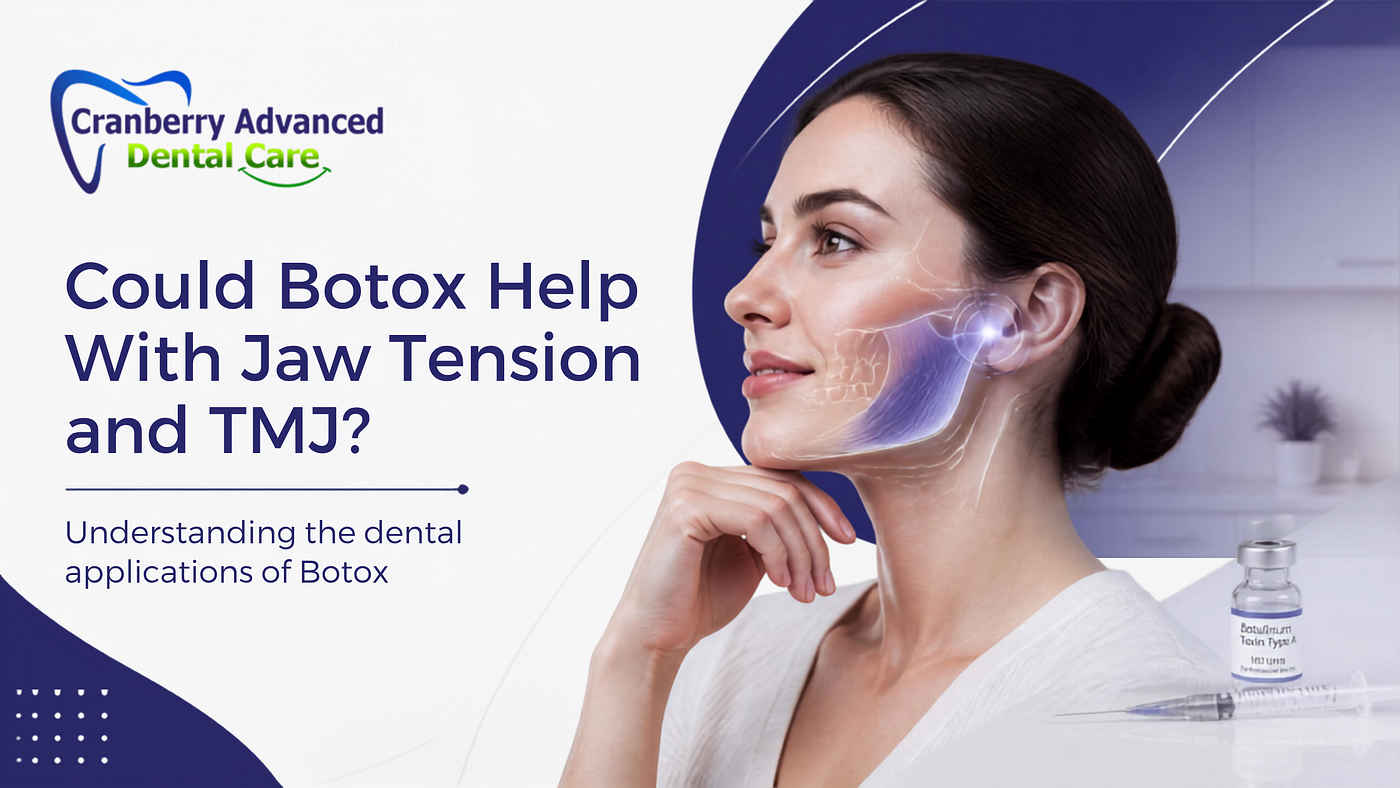
When most people hear the word Botox, they think about facial lines and cosmetic treatments. But Botox has applications beyond aesthetics, including uses that some dental professionals explore for patients experiencing jaw muscle tension, clenching, and certain types of temporomandibular disorder (TMD).
For the right patient, treatment may be considered as part of a broader approach to managing muscle-related jaw discomfort. At the same time, Botox can provide temporary cosmetic improvement by reducing the muscle activity that contributes to certain facial lines.
So, could Botox help with jaw tension or TMJ-related discomfort? It may help some patients, but it is not the right treatment for every type of TMJ problem. A proper evaluation is important before considering it.
What Is TMJ-Related Discomfort?

The temporomandibular joints, commonly called the TMJs, connect your lower jaw to your skull. They work every time you chew, speak, yawn, or open your mouth.
Problems involving the jaw joint or the muscles responsible for chewing are generally grouped under temporomandibular disorders (TMDs).
Symptoms can include:
- Jaw pain or tenderness
- Jaw muscle tension
- Clicking or popping when opening or closing the mouth
- Difficulty or discomfort when chewing
- Facial muscle soreness
- Headaches associated with jaw muscle tension
- Teeth clenching or grinding
Not every person with these symptoms has the same underlying problem. TMD can involve the muscles, the joint itself, or a combination of factors.
Research has also found an association between bruxism, or teeth clenching and grinding, and TMD.
How Could Botox Help With Jaw Muscle Tension?

botox injection for TMJ Treatment
Botox is a form of botulinum toxin that temporarily reduces muscle activity at the treated area.
When used for certain jaw-related concerns, injections may be directed toward muscles involved in chewing, such as the masseter and, depending on the treatment plan, other muscles involved in jaw movement.
The goal isn’t to “freeze” the jaw.
Instead, the intention is to reduce excessive muscle activity when a patient has a problem that may be related to overactive jaw muscles.
Some clinical research has found potential improvements in pain and muscle-related TMD symptoms following botulinum toxin treatment. However, the evidence is not completely consistent, and research reviews have reached different conclusions.
That’s why Botox should be considered a treatment option for selected patients, rather than a universal solution for TMJ problems.
What About Teeth Clenching and Grinding?
Do you wake up with a tired or tight jaw?
Do you catch yourself clenching your teeth during stressful situations?
Teeth clenching and grinding, known as bruxism, can place additional demands on the muscles involved in chewing.
Over time, this may contribute to jaw muscle fatigue, soreness, and other symptoms.
Botox has been studied as one possible approach for reducing the intensity of muscle contractions associated with bruxism. Some studies have reported improvements in symptoms, while evidence regarding its overall effectiveness remains mixed.
For this reason, a dental evaluation should come first. Depending on the cause and severity of the problem, a dentist may recommend conservative approaches, oral appliances, physical therapy, behavior modification, or other treatments before or instead of Botox.
Botox Isn’t a Treatment for Every TMJ Problem
This is an important distinction.
TMJ disorders have many possible causes.
If the primary problem involves the joint itself, structural changes, inflammation, an injury, or another underlying condition, relaxing the surrounding muscles may not address the actual source of the problem.
Botox may be more relevant when muscle overactivity is an important part of the patient’s symptoms.
Recent evidence reviews have found potential benefits for some muscle-related TMD patients but also highlight uncertainty about long-term effectiveness and potential adverse effects.
That’s why the treatment should begin with an evaluation rather than simply requesting Botox because of jaw pain.
Botox for Jaw Comfort and Botox for Cosmetic Purposes
The same general principle of temporarily reducing muscle activity is relevant to both applications, but the treatment goals are different.
For jaw-related concerns
The focus may be on:
- Reducing excessive jaw muscle activity
- Addressing muscle-related tension
- Managing certain symptoms associated with clenching
- Supporting a broader treatment plan for selected TMD patients
For cosmetic concerns
Botox Cosmetic is used to temporarily improve the appearance of certain facial lines caused in part by repeated muscle activity. FDA-approved cosmetic uses include moderate-to-severe forehead lines, frown lines, crow’s feet, and vertical bands connecting the neck and jaw in adults.
The goal is generally subtle, natural-looking improvement, rather than changing a person’s facial identity or expression.
Can Botox Address Both Comfort and Appearance?
For some patients, this is one of the interesting aspects of Botox treatment in a dental setting.
A patient may be interested in addressing jaw muscle tension while also exploring cosmetic concerns involving facial muscle activity.
However, these are separate treatment goals and should be evaluated individually.
At Cranberry Advanced Dental Care, the emphasis is on understanding what the patient wants to accomplish and determining whether Botox is an appropriate option.
What Happens During a Botox Consultation?
A consultation is an important first step. Your dental professional may discuss:
1. Your symptoms
What you’re experiencing, how long you’ve experienced it, and whether symptoms are associated with clenching, chewing, stress, or other activities.
2. Your treatment goals
Are you primarily concerned about jaw discomfort, muscle tension, cosmetic concerns, or a combination?
3. Your jaw and facial muscles
An evaluation can help determine whether excessive muscle activity may be contributing to your symptoms.
4. Your treatment options
Botox may be considered alongside other approaches depending on your individual situation.
5. Your expectations
Understanding what Botox can and cannot accomplish is an important part of making an informed decision.
Is Botox Right for You?
There isn’t a simple yes-or-no answer.
Botox may be worth discussing if you experience jaw muscle tension, clenching, or certain muscle-related TMD symptoms, particularly when other factors have been evaluated.
But Botox isn’t automatically the best first-line treatment for every patient with TMJ discomfort.
A personalized assessment can help determine whether your symptoms are primarily muscle-related or whether another treatment approach may be more appropriate.
A Thoughtful Approach to Botox at Cranberry Advanced Dental Care
At Cranberry Advanced Dental Care, Botox treatment is approached conservatively and with attention to each patient’s individual goals.
Whether you’re exploring Botox for jaw comfort, facial muscle tension, cosmetic enhancement, or a combination of concerns, the first step is understanding your needs.
The goal is not simply to administer a treatment. It’s to determine whether the treatment makes sense for you.
Frequently Asked Questions
1. Can Botox cure TMJ?
No. Botox should not be described as a cure for TMJ disorders. It may help selected patients with muscle-related symptoms, but TMD has many possible causes and requires individualized evaluation.
2. Can Botox help with jaw clenching?
Botulinum toxin has been studied for bruxism and jaw muscle overactivity, and some studies report improvements in symptoms. However, the evidence remains mixed, so a dental evaluation is important before treatment.
3. Does Botox relax the jaw muscles?
Botulinum toxin temporarily reduces muscle activity in the muscles where it is injected. When used for jaw-related treatment, the goal may be to reduce excessive activity in selected chewing muscles.
4. Is Botox only used for cosmetic purposes?
No. Botulinum toxin has several medical applications. Botox Cosmetic is specifically used for certain aesthetic indications, while botulinum toxin products are also used in various medical settings.
5. How long do cosmetic Botox results last?
The official BOTOX Cosmetic information states that results for forehead lines, frown lines, and crow’s feet may last up to approximately four months, although individual results vary.
Experiencing Jaw Tension or Interested in Botox?
If you are dealing with jaw tension, clenching, facial muscle discomfort, or are simply curious about the cosmetic benefits of Botox, a consultation can help you understand your options.
Cranberry Advanced Dental Care provides personalized dental and Botox care for patients in Cranberry Township, Wexford, Seven Fields, Gibsonia, Mars, and Zelienople.
📞 724–776–4250 🌐 **cranberryadvanceddental.com**
Comfort and confidence can start with understanding your options.
메타데이터
- post_id
- 5b6eff2f284d
- slug
- could-botox-help-with-jaw-tension-and-tmj-related-discomfort-5b6eff2f284d
- url
- https://medium.com/@cranberryadvanceddentalcare/could-botox-help-with-jaw-tension-and-tmj-related-discomfort-5b6eff2f284d
- canonical_url
- https://medium.com/@cranberryadvanceddentalcare/could-botox-help-with-jaw-tension-and-tmj-related-discomfort-5b6eff2f284d
- author_url
- https://medium.com/@cranberryadvanceddentalcare
- status
- ok
- fetched_at
- 2026-08-21 01:45:42