Why Manager / Worker Agents Beat One Big Autonomous Bot
I wanted one super-agent. One thread, one brain, one place to talk to. It looked elegant on paper and felt efficient in week one. The same…
Why Manager / Worker Agents Beat One Big Autonomous Bot
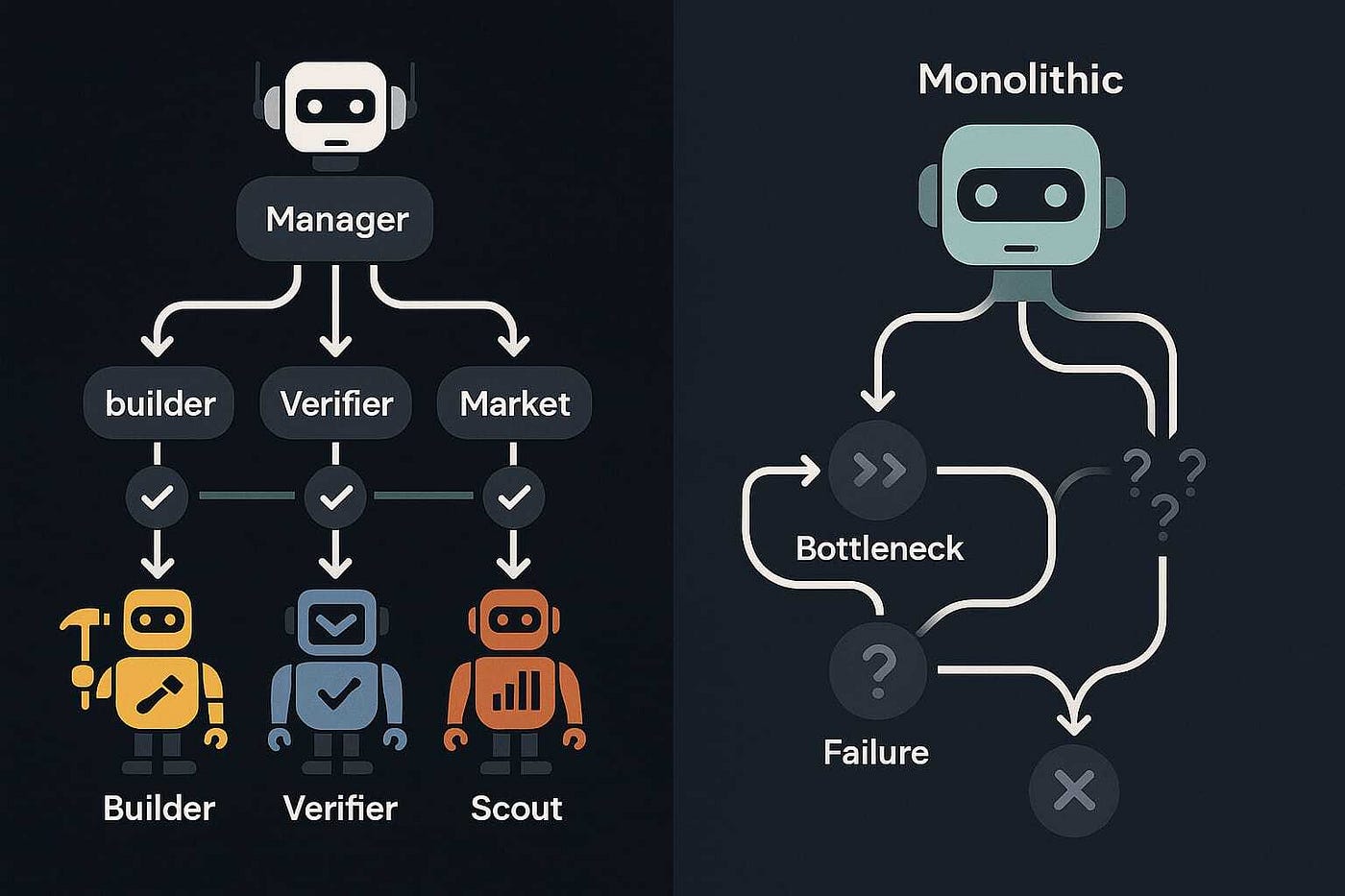
I wanted one super-agent. One thread, one brain, one place to talk to. It looked elegant on paper and felt efficient in week one. The same agent could plan work, execute work, summarize work, and validate work. In chat, that looked like velocity. In reality, it slowly became a polite chaos engine because the same system doing the work was also grading the work.
That’s the core problem. If you’ve been building autonomous workflows and something feels off after the first wave of excitement, this is probably why.
Where single-agent setups usually drift
At first, the setup feels great. You hand one long-running agent a backlog and broad authority, and it starts producing output immediately. Status updates look clean. The team feels momentum.
Then week two or three hits and a predictable pattern shows up. Setup work is reported like completed work. Placeholder commands get treated like real execution. Stale tasks stay active because no one is reconciling state aggressively. Weak output gets pushed to human review instead of being corrected upstream.
None of that requires a “bad model.” It’s a control-plane issue. When one unit both executes and validates, incentives blur — even in software.
Why manager/worker separation works
The fix is not a shiny new model. It’s role separation.
A manager role should own priorities, routing, queue policy, proof validation, and state reconciliation. A worker role should execute assigned steps, run commands, produce artifacts, and report outcomes. Once those responsibilities are split, the manager can reject bad work without also defending its own shortcuts.
You get less ambiguity, fewer accidental lies, and a cleaner operating rhythm.
What healthy looks like in practice
A healthy system is boring in the right ways. Durable state is source-of-truth (not chat memory). Non-trivial work runs through real step scripts. Successful steps always advance state. Stale work gets recovered automatically. Workers don’t set queue policy. Fake progress gets rejected quickly.
That sounds more like operations management than chatbot interaction, and that’s exactly right.
Why this scales better
A single general-purpose agent accumulates too many conflicting directives: code, test, review, deploy, research, planning, reporting, and queue management. Eventually you get context thrash and weak enforcement — not because the model is dumb, but because the role is overloaded.
A small lane structure scales better: manager, builder, verifier, and market/research. You don’t need ten bots. You need clear responsibility boundaries and explicit handoffs.
A practical starting topology
If you’re implementing this now, start simple:
- Manager: queue owner, policy gate, state reconciler
- Builder: repo mutation and implementation
- Verifier: tests, browser checks, proof validation
- Market/Research: recurring opportunity scans and trend work
- Scout/Writing support: synthesis and content drafting
Could this be fewer roles? Absolutely. The exact count matters less than role clarity.
The one rule that prevents most trust failures
Workers should never advance important state on narrative alone. They need evidence: files changed, tests run, artifacts produced, commit SHA, and PR URL. Then manager policy decides what happens next.
If you skip that rule, the system starts optimizing for convincing updates instead of reliable execution. It can look fine in chat while quietly drifting in production.
What humans should do (and stop doing)
In a healthy manager/worker setup, humans should set direction, adjust priorities, clear real blockers, and review high-impact merges. Humans should not manually rescue every worker mistake, trust summaries over durable state, or interrupt stable loops because of anxiety.
If humans are still doing constant rescue work, architecture is still carrying hidden ambiguity.
Build-in-public notes: good, bad, ugly
The good: role separation improved throughput fast, and reviews shifted from archaeology to actual decision-making. The bad: transition debt remained, because old tasks and old assumptions don’t disappear when you redraw roles. The ugly: narrative completion — work reported as done without hard proof — was the fastest way to poison trust across the system.
Once trust drops, everything slows down.
Bottom line
The upgrade is not “more agents.” The upgrade is a system you can trust under pressure: clear roles, explicit policy, durable state, and evidence-based advancement.
That scales. One giant autonomous personality with too many jobs does not.
Sources
- OpenAI, Harness engineering (reliable scaffolding around model behavior): https://openai.com/index/harness-engineering/
- OpenAI Symphony (orchestration patterns and run structure): https://github.com/openai/symphony
- Anthropic, Agent teams docs (multi-agent coordination framing): https://docs.anthropic.com/en/docs/claude-code/agent-teams
- Martin Fowler, System of Record concept (durable source-of-truth framing): https://martinfowler.com/bliki/SystemOfRecord.html
Originally published at https://lab.knoxanalytics.com on March 5, 2026.
메타데이터
- post_id
- 5b7521cbdc7d
- slug
- why-manager-worker-agents-beat-one-big-autonomous-bot-5b7521cbdc7d
- url
- https://medium.com/@ssbob98/why-manager-worker-agents-beat-one-big-autonomous-bot-5b7521cbdc7d
- canonical_url
- https://medium.com/@ssbob98/why-manager-worker-agents-beat-one-big-autonomous-bot-5b7521cbdc7d
- author_url
- https://medium.com/@ssbob98
- status
- ok
- fetched_at
- 2026-06-15 22:55:51





