My Religion Had Four Legs
The horse that carried me after the stroke is injured now.
Disability
My Religion Had Four Legs
The horse that carried me after the stroke is injured now.
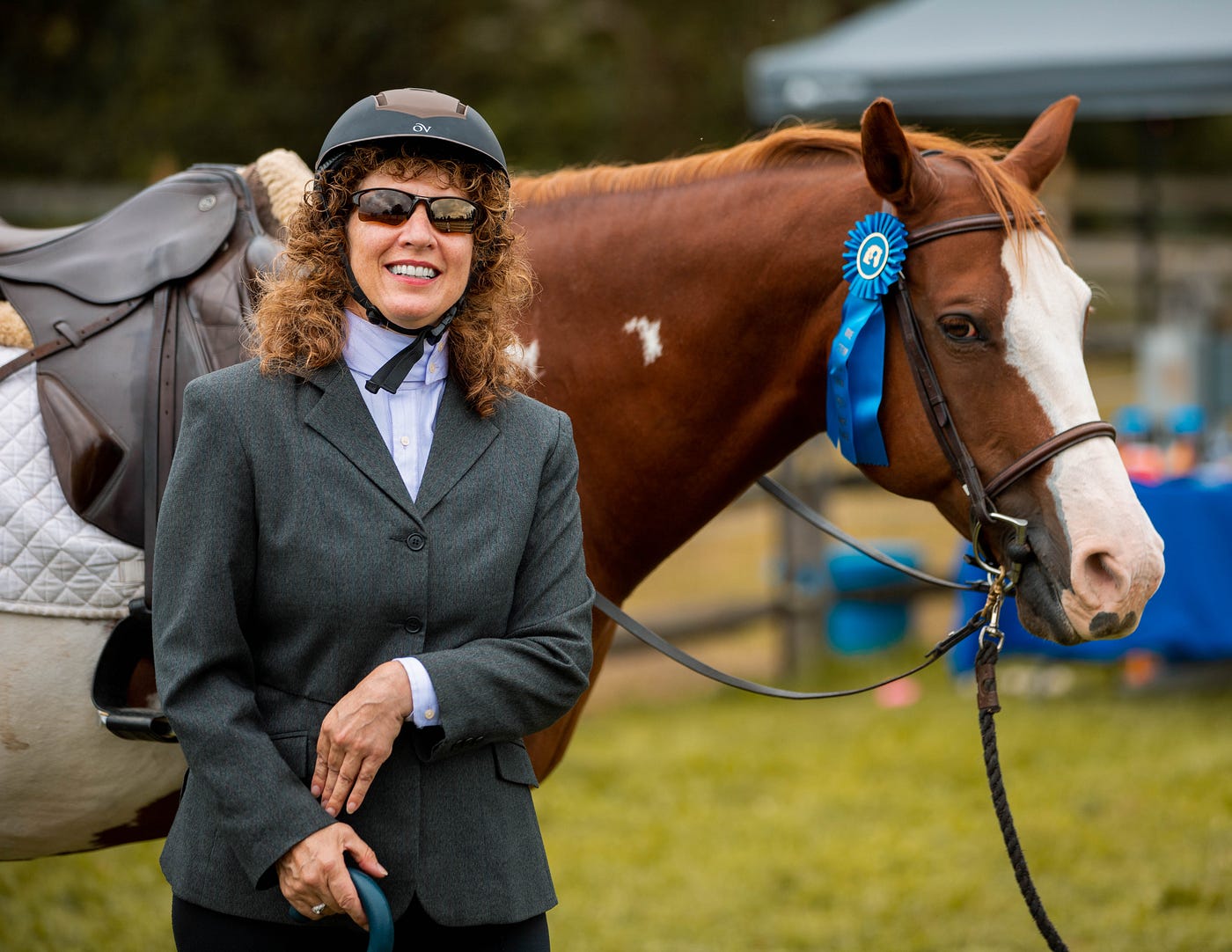
Photo of me with Tinkerbell: courtesy of Adam Leone photography
I was going to die. Twice.
The first time, a neurosurgeon saved my life by stopping the bleeding in my brain with an emergency craniotomy. The procedure was straightforward. Learning how to live afterward was not.
Once I survived that, I wasn’t sure how I could survive the devastating losses wrought by the stroke that left me with a permanent disability.
Horseback riding became my religion sometime after the stroke.
I don’t mean I worshipped horses. I mean, I stopped believing my body would ever carry me where I wanted to go, and then a horse did.
Religions offer faith, community, ritual, comfort, transcendence, and hope. Adaptive horseback riding gave me all of those things.
After the stroke, I lost hiking trails, ski slopes, and long walks through unfamiliar places. My world became smaller. Every outing required calculations. Every uneven surface demanded attention.
A doctor suggested therapeutic horseback riding. I was skeptical. I could barely walk.
The desperation of depression pushed me into finding a premier PATH-certified adaptive riding program in the heart of New Jersey’s horse country.
Then someone lifted me into a saddle on a horse named Tinkerbell. I was scared to death. I made the mistake of looking down from high atop a tall horse. My balance was poor. I was weak and uncoordinated.
After several scary minutes, I began to feel the miracle unfolding. My pelvis was suddenly shifting in the way it was supposed to when walking. It automatically followed the horse’s movements. Walking seemed effortless because the horse was doing it for me.
By the end of the screening session, I felt a gladness settle over me I hadn’t felt in the year since the stroke. I knew this was where I should be.
Like many religions, my riding program was built on repeated rituals. Drive to the barn. Bring your helmet. Wear your breeches. Check the weather to see if you need a coat. Find an apple for your horse.
Greet the familiar volunteers who help you onto the mounting block and up onto the horse.
Breathe in the familiar smells of hay, leather, horses and dust.
Photo by Aurélien Faux on Unsplash
The congregation of my new “church” consisted of the other riders with disabilities, the instructors, and the volunteers who treated me like a rider instead of a stroke survivor.
At the barn, I wasn’t a patient.
For years after the stroke, I was a patient. A rehab patient. A neurology patient. A physical therapy patient. A disabled patient.
At Mane Stream, I became a rider.
There was no dramatic cure. Yet, over time, quiet miracles started to build.
I noticed I was sitting taller. I felt the rhythm of the horse’s gait, reminding my nervous system how to walk. I could enjoy the outdoors on a horse’s back. I was having fun.
One year, there was a horse show. That day, I guided my horse through the required pattern and waited while the judges tallied the scores.
When the announcer called my name for High Scoring Independent Rider, I felt something catch in my throat.
The ribbon itself wasn’t the point.
The word was.
Independent.
For years after my stroke, independence had become a complicated concept. I needed help carrying things. Help opening jars. Help navigating unfamiliar terrain. Sometimes I needed help simply getting from one place to another.
Yet here I was, sitting on a horse, being recognized for doing something on my own.
I don’t remember where that ribbon is today.
I remember how it felt.
For a few shining moments, I wasn’t measuring my life against the things I had lost.
I was celebrating something I had gained.
Riding allowed me to experience freedom despite the limitations that followed me everywhere else.
Mane Stream became the sanctuary of my church. It became the place where I was transformed from a stroke survivor into an equestrian. It became a place for me to discover who I was.
Now Tinkerbell is injured.
I don’t know if she’ll recover.
And suddenly I’m confronting a familiar fear:
What happens when the thing that saved you needs saving?
The horse carried me long enough to teach me something important.
My body was broken, but my life wasn’t over.
For years, I borrowed four strong legs.
People who have never depended on a horse for hope may not understand. They think I’m worried about losing a hobby.
I’m not.
I’m afraid of losing a sanctuary.
Tinkerbell became the horse who carried me when I couldn’t quite carry myself.
But perhaps the sanctuary was never entirely in the horse.
Part of it was in me.
Write for your new writing family on Medium:
[embed]How To Write For Us All Styles. All Genres. No Rules.medium.com
Read more:
[embed]I Refuse to Disappear The slow erasure from life that can happen in the name of safetymedium.com
If you’d like to be notified when I publish, you can subscribe here:
메타데이터
- post_id
- 5b7b7a5b6f4e
- slug
- my-religion-had-four-legs-5b7b7a5b6f4e
- url
- https://medium.com/its-all-good/my-religion-had-four-legs-5b7b7a5b6f4e
- canonical_url
- https://medium.com/its-all-good/my-religion-had-four-legs-5b7b7a5b6f4e
- author_url
- https://medium.com/@brooksidevic
- status
- ok
- fetched_at
- 2026-06-18 07:02:39






