Handing Over the Microphone
“If you have come here to help me, you are wasting your time. But if you have come because your liberation is bound up with mine, then let…
Handing Over the Microphone
“If you have come here to help me, you are wasting your time. But if you have come because your liberation is bound up with mine, then let us work together.”
- Lilla Watson
I. There is a Difference Between Near and Inside
If I had to sum up our entire experience in Nandurbar, these two lines would be it. Working on the ground, documenting CFR, or interviewing these women wasn’t about being a voice for the voiceless.
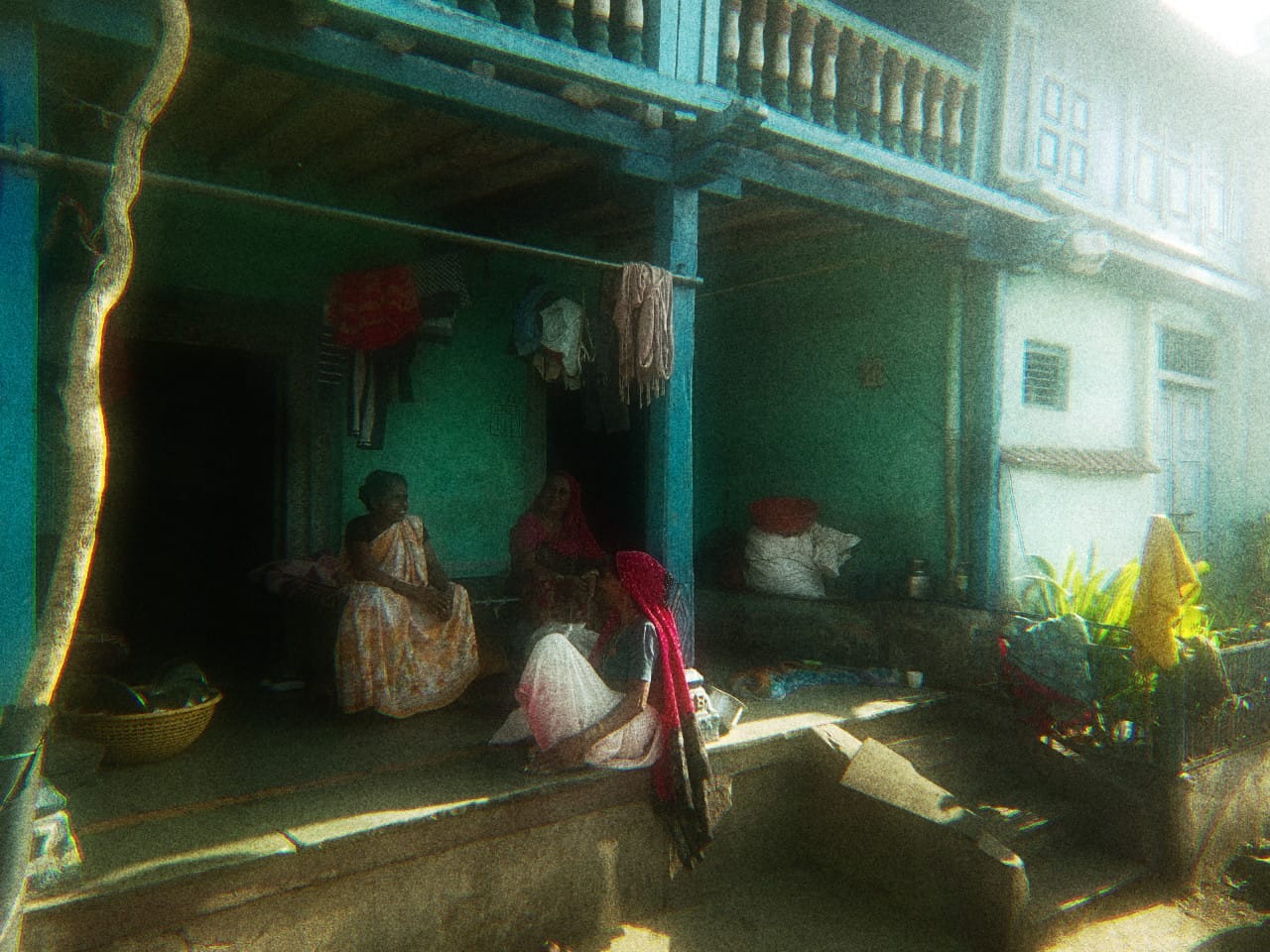
The tribal women gather outside their homes, each adorned with a striking red scarf.
Nandurbar is a district in northern Maharashtra where indigenous communities make up over 65% of the population who have lived alongside, and from, these forests for generations.

The Community Forest Rights (CFR) nursery at Thanepada.

The staff at the Thanepada CFR forest nursery.
Community Forest Rights, or CFR, has existed since 2006 to formally recognise that. But there’s a misconception that follows it everywhere. Communities themselves often understood it as ownership: once you have the right, the land is yours to clear, to farm, to use up. That gap between what the law meant and what people understood it to mean is exactly why it took so long to actually serve its purpose. CFR is a relationship: you nurture the forest, it sustains you, and you return it better than you found it.

Women laborers working under MGNREGA at the Thanepada CFR nursery.
I grew up close to Nandurbar. I knew its name. I didn’t know it. There is a difference and privilege is what kept me from noticing. It tricks you into thinking that if something isn’t happening to you, it isn’t your problem. But it is.
Take nature and society, for instance — they’re closely linked, and what happens in one area can have a profound impact on the other. It’s like throwing a stone into a pond; the waves will spread out and touch every shore, reminding us that we’re all part of a larger whole, and what affects one, affects us all.

The women of Thanepada gathered for a wedding in traditional red scarfs.
I said I knew this place. I had only ever known its name.
II. The Room That Taught Me to Reframe
Working so closely with the government was intimidating. We went in assuming they wouldn’t take us seriously and expecting them to be incredibly rigid in their ways.
The first day was a total deep end. The minute we arrived at the Nandurbar Collector’s office, we were thrown right into a high-level meeting with presentations, endless questions, and a room full of officials.
They were discussing Toranmal, a hill station in the Satpura range. The government is planning a massive overhaul there, not just a visual facelift, but real infrastructure like roads, lighting, safety measures, a rural market for local communities to sell their goods, and a major plan to develop Yashwant Talav, the lake at the center of the town.

Toranmal Hill Station

Yashwant Talav
Even though it wasn’t our project, getting a behind-the-scenes glimpse into how things actually operate behind closed doors was eye-opening.
For the remaining week, we just took everything in. We were exposed to everything happening in the district, from ongoing government projects to the specific areas and bottlenecks they actually wanted us to look into.
The thing was, it wasn’t just one or two tasks there were so many different moving pieces all at once. So finding the specific problems we wanted to tackle wasn’t a straight line, mostly because everything is and isn’t a problem.
What I mean is, in governance, you deal with actual problems and “gravity problems.” Actual problems are actionable. Gravity problems are things you can ponder and try to fix, but at the end of the day, gravity doesn’t care that you’re pedaling uphill; 9.8 m/s2 isn’t going to change its value for you. Deep-rooted changes are incredibly hard to achieve. To make it harder, time was a massive constraint. We were only there for three weeks, and just getting to know the place even 10% was going to eat up a solid week of our time.
I became personally attached to one problem: child marriage.
So, after talking to few officials we built a proposal for a silent animated film. It shows two futures side by side: one where a life is derailed by early marriage, and another showing what that life could become without it.

A glimpse into the pitch deck for the proposal.

Source: Bombay High Court Report (Adv. Ashutosh Kumbhakoni), NFHS-5 (2019–21), NCRB

Nandurbar on ground data.
Every design choice was intentional. We wanted to keep it silent because Nandurbar has so many different tribes and languages: we wanted to be inclusive without targeting any specific group. We chose animation because we were told this topic is a major taboo. People won’t speak about it on camera or risk showing their faces. We were really proud of this proposal. It felt thoughtful, careful, and like we had actually listened to the constraints.
We brought the proposal to Mittali Sethi mam, and she completely shifted how we looked at the issue. She didn’t dismiss our idea, but she challenged it. She pointed out that the community already knows it’s an issue; they don’t need a casual reminder, they need something more meaningful.
It taught me a massive lesson, ironically from a non-designer.
Designers love questions, but what we really love is reframing them.
That realization changed everything. We shifted our focus to women’s empowerment instead, using interviews with local women making a genuine difference to find our way in.
Three weeks. We thought that was enough time.
III. What I Was Actually Collecting
By the second week, I stopped thinking of our work as just gathering objective data. It became less about collecting numbers and more about absorbing the heavy, real-world experiences of the people. What was actually happening was a heavy, beautiful process of accumulation.


Thanepada was our first village visit. Instead of the usual rural fieldwork, we walked right into a wedding procession heading toward a local Shiva temple. There were no loud DJs, just drums, trumpets, and a crowd dancing in beautifully coordinated movements, practicing a tradition that completely belonged to them. Yet, they were entirely willing to share it.

The bride, groom, and their relatives walking together toward the village Shiva temple.
Before we knew it, a few local kids grabbed our hands and pulled us right into the center of the circle. While dancing in a procession wasn’t completely new to me, experiencing it through this new lens and watching my batchmates experience it beside me, made me realize we were witnessing a rare moment of pure, unforced hospitality.

Our team dancing alongside the community.
IV. The Ones Who Went Back
“Know from whence you came. If you know whence you came, there are absolutely no limitations to where you can go.”
- James Baldwin
In our second week, we met three women who didn’t just know where they came from. They went back.
Dr. Urvashi Valavi chose a Primary Health Centre in the villages she grew up in, for people who needed a doctor who already understood their lives before they walked through the door.
Durga Tai Padvi had a life in Mumbai. She left it to become sarpanch of the village she was born in because someone who knew the place had to lead it.

A wonderful and insightful meeting with Ms. Durga Padavi, the Sarpanch of Singpur Budruk.
Divya, twenty years old, footballer for Team India, came to her interview with her parents, her village chief, and a local police officer. Her village doesn’t have a playground yet. They’re building one now because of her.

A wonderful moment spending time with Divya, her parents, the village Sarpanch, and the local police officer.

Divya Pawar hailing from a remote village in Dhadgaon, Nandurbar. Representing the state.
They are proof that the greatest impact isn’t just about making it out, but about reaching back and lifting the community up with you.
The microphone was never ours to hand. It was always theirs to take.
What I Came Back With
Nandurbar was already doing the real work long before we arrived. They had active community forest rights, local doctors saving lives, and women in Gram Sabhas mapping forests and winning legal battles. They did all of this without a single design sprint, without a “How Might We” statement, and completely without us.
And then we showed up with our sticky notes.
Here’s the thing though: when we walked into that first government meeting: a room full of officials, people who had spent years on these problems, it felt oddly familiar. It felt like a jury. And somewhere in that room I realized something I hadn’t expected: our curriculum had quietly prepared us for this. Not to hold power in that room, but to not feel paralyzed without it. To approach problems without assuming, to ask before concluding, to sit in uncertainty and still think clearly. We had been trained for exactly this kind of room.
But still the experience overall made me wonder: is design an academic discipline, or is it just a language that some people speak without ever needing the word for it? Sometimes the most honest thing you can do as a designer is sit with the discomfort of your own irrelevance.
Maybe our job isn’t to redesign someone’s lived experience into a problem statement, it’s translation. Making voices legible to systems that weren’t built to hear them. It’s about holding the microphone steady and when needed stepping back so the actual experts can speak without our good intentions getting in the way.
“We shall not cease from exploration, and the end of all our exploring will be to arrive where we started and know the place for the first time.”
- T.S. Eliot

The BITS Design Team with Nandurbar District Collector Dr. Mittali Sethi and District Fellow Coordinator Ms. Vaishnavi.
메타데이터
- post_id
- 5b87dc5a5d69
- slug
- handing-over-the-microphone-5b87dc5a5d69
- url
- https://medium.com/@krushnajain917/handing-over-the-microphone-5b87dc5a5d69
- canonical_url
- https://medium.com/@krushnajain917/handing-over-the-microphone-5b87dc5a5d69
- author_url
- https://medium.com/@krushnajain917
- status
- ok
- fetched_at
- 2026-06-15 22:55:51