Your Mind Runs on a Hidden Operating System. Here’s How to Debug It.
For over a century, psychology has been stuck in a loop.
Your Mind Runs on a Hidden Operating System. Here’s How to Debug It.
For over a century, psychology has been stuck in a loop.
On one side, the discrete emotion theorists (Ekman, Izard) argue that emotions are biologically hardwired categories — anger, fear, disgust — hardcoded circuits that fire the same way in New York, Nairobi, and New Delhi.
On the other side, the dimensional constructivists (Russell, Barrett) argue that emotions aren’t categories at all. They’re cognitive interpretations layered on top of raw physiological signals: valence (pleasant to unpleasant) and arousal (activated to deactivated). You feel something, and your brain builds a story around it.
Both sides have evidence. Both have glaring blind spots. And for a hundred years, they’ve been talking past each other.
Enter the Core Emotion Framework (CEF) .
Developed by independent researcher Jamel Bulgaria, the CEF doesn’t try to pick a winner. Instead, it asks a different question entirely:
What if emotions aren’t things you have — but operations you perform?
What if your mind runs on a hidden operating system, and emotions are the functions it executes?
The Human OS: A Different Way to See Yourself
The CEF reframes your inner world not as a collection of static feelings, but as a structural architecture — a system of ten functional “operators” distributed across three processing centers.
Think of it like this: You don’t have anxiety. You run a loop. You don’t feel overwhelmed. You execute a sequence that’s stuck on repeat.
This isn’t semantics. It’s a complete inversion of how we’ve been taught to think about emotion. And it opens the door to something the old models never could: mechanical intervention.
If emotions are operations, you can debug them. You can isolate the faulty function, modulate its intensity, and restore clean execution.
The Three Centers: Head, Heart, Gut
The CEF organizes ten operators across three somatic centers — and this isn’t metaphor.
The Head Center (forehead, eyes, upper spine; anchored in the neocortex) governs cognitive modeling, prediction, and executive decision-making. It’s the brain’s predictive engine.
The Heart Center (chest, lungs, arms; anchored in the intrinsic cardiac nervous system, with 14,000 to 43,000 neurons) regulates relational engagement, empathy, and safety gating. It’s the organ of connection and boundary.
The Gut Center (abdomen, hips, legs; anchored in the enteric nervous system, with 200 to 600 million neurons and 90–95% of the body’s serotonin) drives visceral regulation, physical mobilization, and existential grounding. It’s the conative motor.
Each center houses three operators — one Outgoing (clockwise movement), one Reflecting (counter‑clockwise), and one Balancing (swinging motion). A tenth operator, Accepting, serves as a global baseline reset.
The Ten Operators: Your Emotional Toolkit
Head Center:
- Sensing — Raw, pre‑conceptual intake of perceptual and interoceptive data. The radar that picks up subtle cues.
- Calculating — Structured evaluation, scenario‑building, probabilistic forecasting. The internal spreadsheet.
- Deciding — Binary commitment to action; collapses cognitive recursion into forward alignment. Unlike the others, Deciding doesn’t scale — it’s either on or off.
Heart Center:
- Expanding — Relational openness, empathy, curiosity, vulnerability. The chest‑opening, trust‑building force.
- Constricting — Boundary‑setting, attention narrowing, energy conservation. The protective closure.
- Achieving — Competence execution, ego‑relevant comparison, performance alignment. The drive for mastery.
Gut Center:
- Arranging — Practical coordination, structural system‑building, environmental control. The organizer.
- Appreciating — Visceral recognition of meaning, gratitude, somatic anchoring. The savoring engine.
- Boosting — Energy amplification, motivation, conative drive. The surge of agency.
Global Hub:
- Accepting — Somatic yielding, resistance release, reality integration. The downward spiral that returns the system to homeostatic baseline.
When the System Breaks: Fusion, Suppression, and the GoodPerson Anxiety Pattern
In a healthy system, operators activate and deactivate independently. You can dial Sensing to 8, hold Calculating at 3, and keep Constricting at 0 — clean, modular, flexible.
In a dysregulated system, operators fuse . Fusion is when two or more operators become chronically co‑activated. You can’t activate one without the other firing automatically. Their activation values lose mathematical separability — they become entangled.
This is where clinical psychopathology emerges — not as a chemical imbalance or a cognitive distortion, but as a structural failure of operator agility.
The GoodPerson Anxiety Pattern (GPAP) is a textbook example.
GPAP is characterized by three structural clusters:
- Compliance Fusion: Over‑activation and tight coupling of relational Expanding with external correctness standards (Calculating). This creates a persistent, pervasive need to be “good” to ensure safety — what we might call “conscientious anxiety.”
- Agency Suppression: Under‑activation and systemic inhibition of Gut‑center operators — specifically Boosting and Arranging. This leads to passivity, behavioral withdrawal, and a profound fear of asserting individual needs.
- Protest Signals: Internal alarm states generated by the collapse of agency — chronic rumination, hypervigilance, and persistent somatic tension.
The individual becomes trapped in a prison of their own conscientiousness. They can’t stop scanning. They can’t stop calculating. They can’t decide. And they can’t mobilize the energy to break free.
Sound familiar?
The 7‑Step Detangling Protocol: Debugging the Human OS
If fusion is the problem, detangling is the solution.
The 7‑Step Detangling Protocol is the CEF’s primary clinical methodology — a systematic sequence for decoupling fused operators and restoring structural integrity.
Step 1: Systematic Stabilization — Before you can work on the system, you have to prevent it from crashing. Guided grounding meditation plus slow‑exhale breathing. Dial all over‑activated operators down below 3 on the 0–10 scale.
Step 2: Diagnostic Isolation — No narrative. No story. Just structural questioning: “Is this movement narrowing your internal space or widening it?” “Is this analysis or organization?” Anchor each operator in its somatic home.
Step 3: Granular Differentiation — Operators have internal facets. In Boosting, for example, there’s “Momentum,” “Drive,” and “Amplification.” Identify which facets are active and restore their canonical ordering.
Step 4: Mechanics of De‑Fusion — Identify the “driver” operator — the one pulling the other along. Modulate the driver while holding the passenger steady. Independence Verification: can you activate the passenger to any value without the driver firing?
Step 5: Holarchical Rebalancing — Resolve center‑level imbalances. If the Head is over‑weighted (as in GPAP), reduce it. Support the under‑activated Heart and Gut. Restore cross‑center flow.
Step 6: Restoring Canonical Directionality — Train clean transitions: Sensing → Calculating → Deciding. No skipping. No reversing. No oscillation. Correct six types of transition distortions (blocked, forced, skipped, reversed, cross‑center drift, and oscillation).
Step 7: Completion and Modulation Reciprocity — Monitor for the Completion Signal — a shift in breathing, a release of hip tension, a change in visual focus. Verify that decoupled operators can be activated in reciprocal patterns without re‑fusing.
The Practitioner’s Role: Architect, Not Therapist
The CEF diverges sharply from traditional therapy. The practitioner isn’t a guide, a healer, or a narrative companion. They’re an architectural stabilizer — a neutral, grounded presence who holds the structural framework while the client’s system undergoes disassembly and reassembly.
This requires rigorous personal hygiene. A dysregulated practitioner cannot stabilize a dysregulated client. Daily centering, daily self‑detangling, complete emotional neutrality during sessions.
The protocol also has strict contraindications :
- Never detangle during active trauma activation.
- Never detangle during dissociation.
- Never push for intensity during shutdown or flooding.
Instead, practitioners execute stabilization sequences: grounding, slow‑exhale breathing, somatic anchoring, quieting the Constricting and Boosting operators, restoring baseline center clarity.
What This Means for You
The Core Emotion Framework offers something rare: a mechanistic, testable, and actionable model of human emotion that doesn’t ask you to believe in it — it asks you to try it.
The falsifiability criteria are clear:
- If most people can’t relate to any of the ten operators, the framework fails.
- If fusion is universal and unavoidable — if everyone fuses the same way — the framework fails.
- If detangling procedures show no improvement in mental health and wellbeing, the framework fails.
But the evidence so far suggests otherwise. Observational trials show that individuals can reliably distinguish between operators, identify their own patterns of dominance and suppression, and experience measurable shifts through structured detangling.
The Larger Picture: From Individual to Institution
The CEF doesn’t stop at the individual. The framework has been extended to institutional governance (modeling the UN as a set of functional operators that must transition from Sensing to Deciding to action), relational dynamics (the Dual‑Engine Model for marriage and intimacy), and synthetic affect (the INTIMA benchmark for preventing emotional solipsism in AI companions).
It’s also being mapped to computational models — 10‑dimensional activation vectors, JSON‑LD knowledge graphs, and CNN2 architectures for real‑time somatic‑operator tracking.
The Invitation
The Core Emotion Framework is open science. The full corpus is available on Zenodo, OSF, PhilPeople, and Hugging Face. The canonical operator list, practitioner manuals, and validation protocols are all public.
You don’t need to be a clinician to benefit. The Mirror Technique — a five‑step diagnostic protocol — is available for anyone to use in real‑time emotional regulation.
The invitation is simple:
Stop asking “What am I feeling?”
Start asking “What operator am I running — and is it time to run something else?”
Your mind runs on a hidden operating system. You can learn to read it. You can learn to debug it. And you can learn to rewrite the loops that have been running you.
The architecture is there. The tools are there. The only question is: are you ready to start using them?
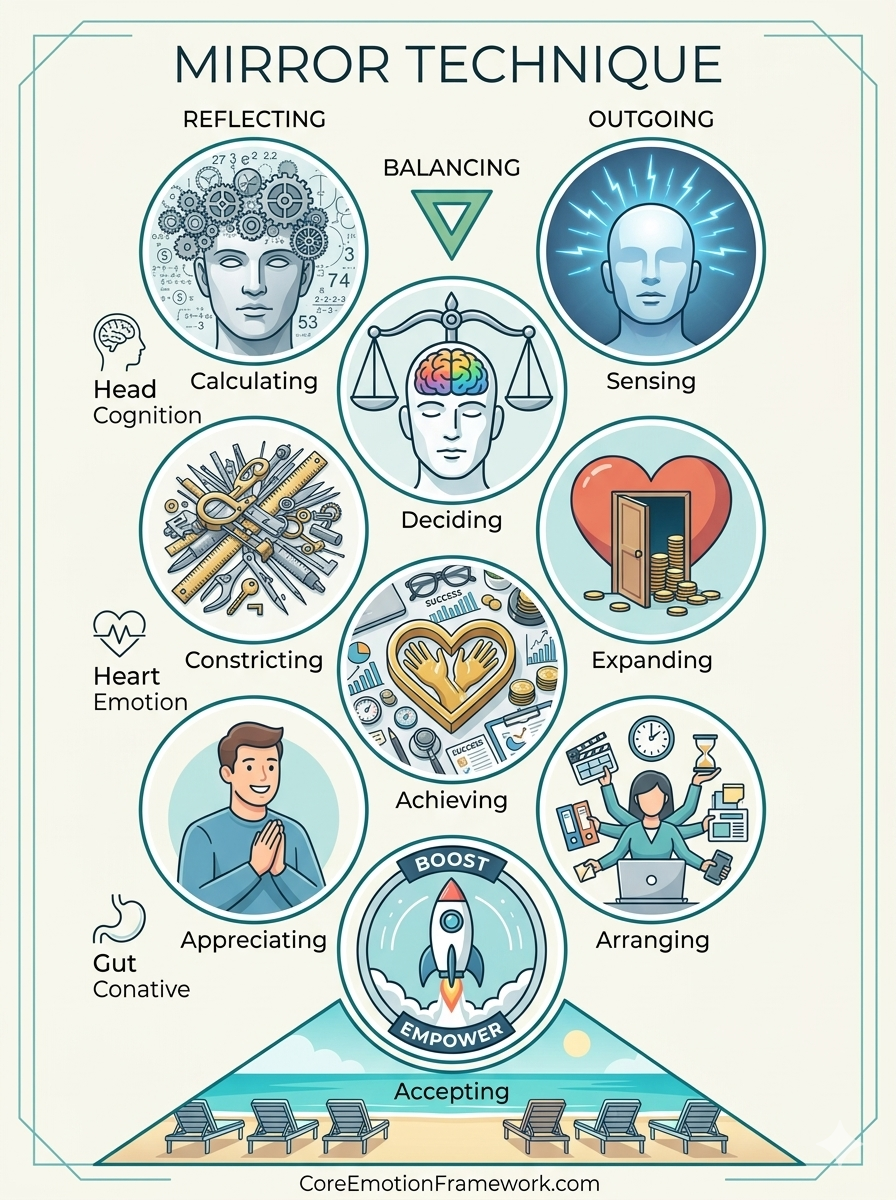
The human OS — 3 x 3 + 1
메타데이터
- post_id
- 5b97fc94b877
- slug
- your-mind-runs-on-a-hidden-operating-system-heres-how-to-debug-it-5b97fc94b877
- url
- https://medium.com/@jamelbulgaria/your-mind-runs-on-a-hidden-operating-system-heres-how-to-debug-it-5b97fc94b877
- canonical_url
- https://medium.com/@jamelbulgaria/your-mind-runs-on-a-hidden-operating-system-heres-how-to-debug-it-5b97fc94b877
- author_url
- https://medium.com/@jamelbulgaria
- status
- ok
- fetched_at
- 2026-07-13 17:48:35