We didn’t invent design. We named it.
On the invisible practice that shapes our behavior, and shaped by it.
We didn’t invent design, we named it
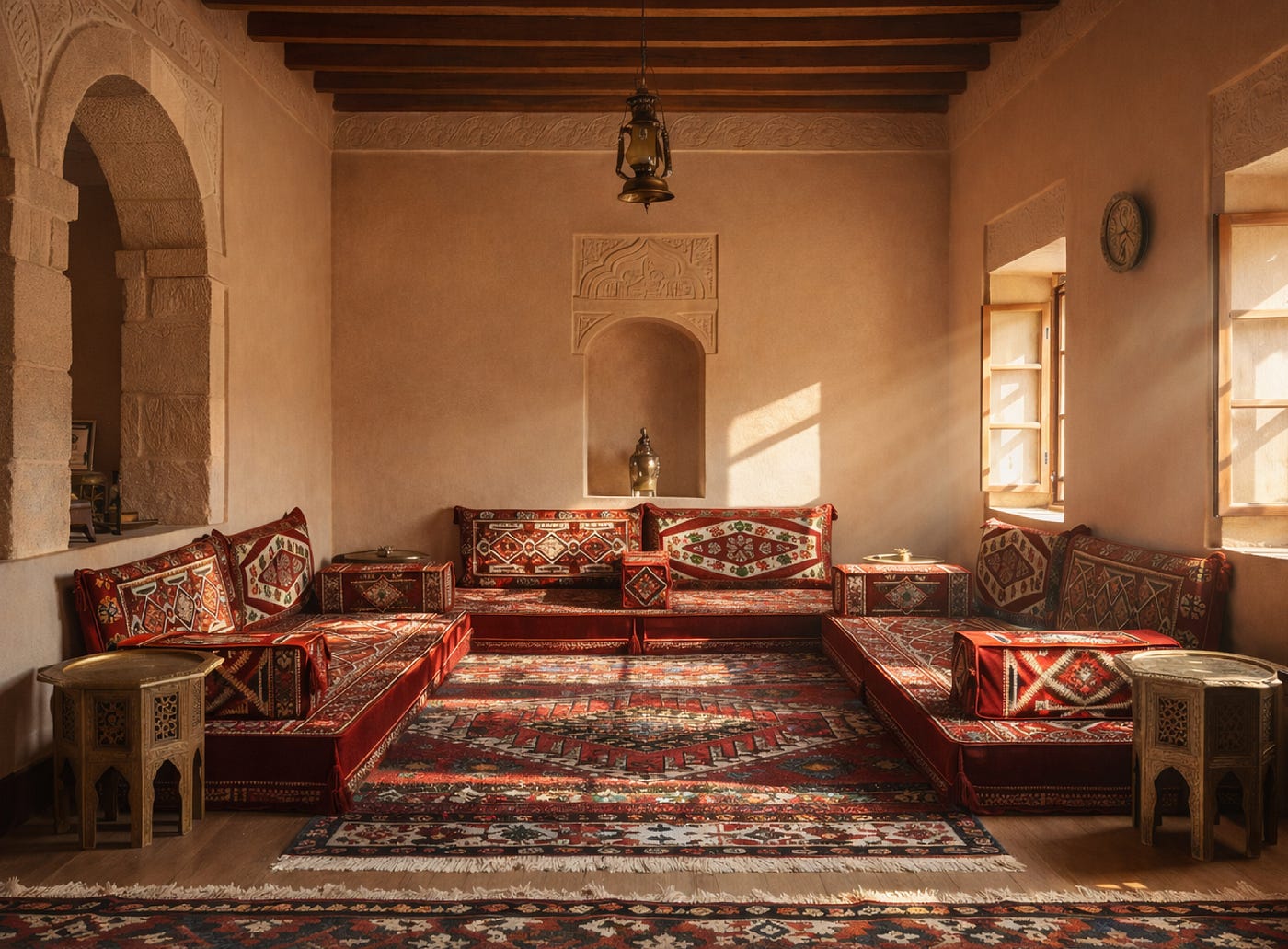
Image generated by Gemini (Nano Banana model) by Google, 2026.
I don’t think design is something we invented. I think it’s something we named, long after humans had already been practicing it. Before design became a discipline, a job title, or a university degree, people were already noticing problems and adjusting their surroundings in response. They were forming how they lived together, often without language for it, and certainly without calling themselves designers. Design wasn’t invented in a studio or classroom, it emerged from the fundamental human need to make sense of our environment and organize it in ways that reflect who we are and how we want to live.
One of the clearest examples of this, for me, comes from the way we used to sit in our homes in Jordan.
Mattresses were placed along the walls and spread across the room. Everyone sat with their back leaning against the wall, facing one another. Turning your back on someone was considered rude , a sign of disrespect. The space was arranged so that no one’s back was exposed, and no one was excluded from the circle. The layout quietly enforced a shared value: mutual recognition. No one sat down and “designed” this arrangement in the professional sense. There were no drawings, no plans, no stated intention. And yet, the outcome was deeply intentional. The space shaped behavior, and behavior reinforced the space. Respect was not explained; it was built into the room.
This raises a question I still don’t know how to answer: Are we designing our culture, or is our culture designing us? Probably both!
The mattress arrangement shaped behavior, how we sat, who we faced, and how we showed respect. But that arrangement only existed because the culture valued those things first. It’s a loop, not a line. Design and culture co-create each other, each strengthening the other in ways that become so natural we stop seeing them as designed at all.
What matters is that this was designed, not as an object, but as a practice. A response to cultural values. A way of translating something abstract, like respect, into something physical and lived. It was contextual, specific, and embedded. And because it worked, it was invisible. This is perhaps the highest form of design: when it disappears completely within the fabric of daily life, when it feels so natural that it seems like the only way things could be.
This is where I think we went wrong when we started naming design.
Once we gave it a title, boundaries followed. Certain people became “designers,” and others, despite doing the same kind of thinking, were excluded from the label. Design slowly came to be associated with visible outputs rather than invisible structures. Logos instead of layouts of life. Interfaces instead of interactions between people. We professionalized it, commodified it, and in the process, separated it from the everyday wisdom that had been guiding human spaces for millennia.
By naming design, we didn’t create it, we narrowed it.
The mattress seating would likely never appear in a design textbook. It’s too ordinary. Too cultural. Too informal. And yet it demonstrates something essential: design as a human instinct to organize space in ways that reflect values, relationships, and care.
When design is treated only as a profession, we lose access to this instinct. We start believing that design happens only when a designer is present, only when it begins with tools, frameworks, or expertise. But long before any of that, design was already happening — through observation, repetition, and adjustment. People noticed what didn’t work. They changed it. They watched how others responded. They refined it over time. This iterative process, this attentiveness to how life actually unfolds, is designed in its purest form. It doesn’t require certification or software. It requires observation.
That process did not need a name to exist.
I think the problem is not that design is misunderstood, but that it has been separated from everyday life. We talk about it as something added, a layer, a solution, a service, rather than something embedded in how humans relate to each other and their environments. The seating arrangement wasn’t about comfort alone. It was about respect. About facing one another. Regarding acknowledging presence. Those decisions were not aesthetic; they were ethical, even if no one framed them that way. Every spatial decision carried moral weight. This is what gets lost when we reduce design to problem solving or beautification: its capacity to encode values, to make visible what a community believes matters.
When we say “design,” we often mean the visible result. But what interests me more is what comes before that: the quiet thinking, the noticing, the small adjustments that determine how people live together. This is where design lives most authentically, not in the final form, but in the attention that shapes it.
To cultivate this way of seeing, I suggest a simple exercise: choose a familiar space and spend time noticing the interactions inside it, how the furniture is arranged, how people move, and the unspoken rules they follow. Consider why things are the way they are and what underlying values might be at play. By doing so, you begin to reveal the invisible design that guides our daily lives. You start to see that design is everywhere, not because designers put it there, but because humans cannot help but organize their world in purposeful ways.
Maybe design doesn’t need to be expanded into every discipline. Maybe it needs to be returned to where it already exists.
We didn’t invent design. We named it, and in doing so, we forgot that it was always human.
메타데이터
- post_id
- 5b9dcf970df0
- slug
- we-didnt-invent-design-we-named-it-5b9dcf970df0
- url
- https://medium.com/@tariqalimansi/we-didnt-invent-design-we-named-it-5b9dcf970df0
- canonical_url
- https://medium.com/@tariqalimansi/we-didnt-invent-design-we-named-it-5b9dcf970df0
- author_url
- https://medium.com/@tariqalimansi
- status
- ok
- fetched_at
- 2026-06-26 03:39:16




