The Friction Stack
The hidden cost of your workday isn’t the hard tasks. It’s everything happening between them.
The Friction Stack
The hidden cost of your workday isn’t the hard tasks. It’s everything happening between them.
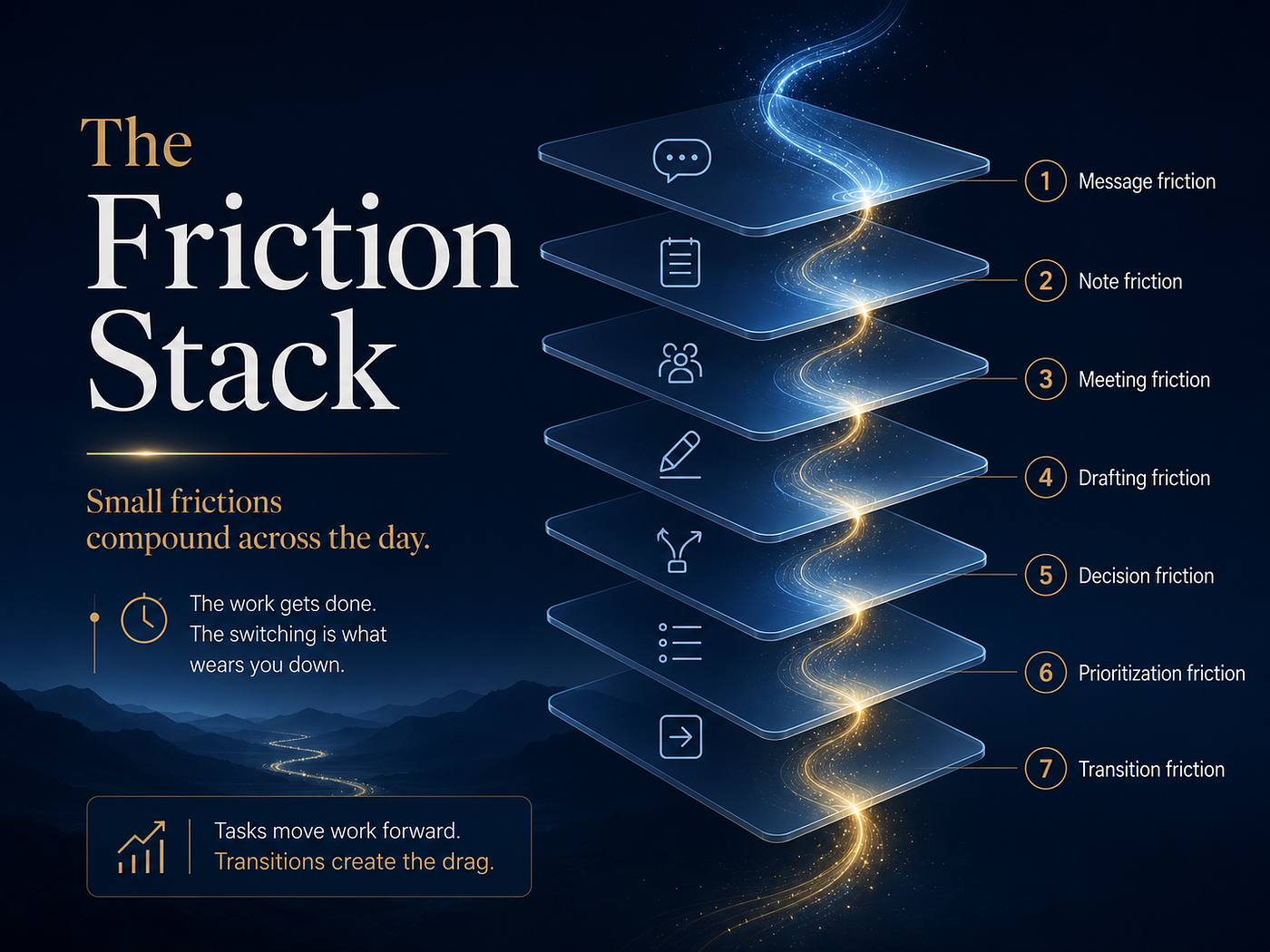
The work gets done. The switching is what wears you down.
Most professionals assume their day gets harder because the work gets harder.
That is rarely the real cause.
The actual reason a Tuesday afternoon feels heavier than the morning is not the difficulty of any single task. It is the accumulated cost of moving between tasks: the meeting that ended without a clear next step, the notes that never quite became a plan, the message that needed three attempts because the point kept getting buried.
None of these moments look like problems individually. That is exactly what makes them expensive collectively.
This is the Friction Stack.
What the Friction Stack Actually Is
The Friction Stack is the layered accumulation of small, repeated drag points that make modern work slower and more mentally expensive than the actual difficulty of the tasks would justify.
It is built from transitions, not tasks. A conversation has to become a plan. Notes have to become a summary. A rough idea has to become a first draft. A discussion has to become a decision. None of these transitions happen automatically, and every one of them costs something in time, attention, and mental energy.
The headline tasks are rarely where work actually slows down. The transitions between them are.
Seven Layers, Most People Hit Four Every Day
The Friction Stack tends to build in recognizable layers.
Message friction. The reply that needs the right tone under time pressure. Not hard in theory. Genuinely costly at the end of a long meeting with three other things waiting.
Note friction. Raw material that exists but is not yet usable. Captured information is not the same as clarified information, and the distance between the two is rarely accounted for.
Meeting friction. A discussion that felt productive in the room but left no clean trail of decisions, owners, or next steps. The conversation happened. The movement did not follow it out the door.
Drafting friction. Knowing roughly what needs to be said and still losing twenty minutes to the gap between that knowledge and a usable first sentence.
Decision friction. An issue that is visible but not yet structured clearly enough to decide on. The information exists. The decision surface underneath it does not.
Prioritization friction. Too many things feeling equally urgent at once, with the act of choosing order becoming its own cognitive tax.
Transition friction. The connective layer underneath all the others: the general cost of moving work from one stage to the next, present in nearly every shift of attention across the day.
Why This Stays Invisible Until It Doesn’t
Each layer, on its own, looks small enough to dismiss. Nobody escalates “note friction” as a serious operational problem. Nobody schedules a meeting about message friction.
But these layers do not operate independently. They stack, and the accumulation across a single day produces something that feels qualitatively different from any individual friction point. Not one hard problem. A texture of small resistance, present almost everywhere, draining capacity in a way that is real but difficult to point to.
This is why so many capable professionals end demanding weeks unable to explain exactly why they feel as depleted as they do. Nothing went dramatically wrong. Too much went slightly sideways, repeatedly, in places too small to individually notice.
Why This Matters More Now
The Friction Stack has always existed in some form. What has changed is the volume of transitions modern work requires.
More inputs arrive faster. More tools generate more notifications. More meetings produce more half-formed follow-ups that need converting into something usable. The number of transitions a typical knowledge worker moves through in a single day has grown substantially, and each one carries its own small cost, whether or not anyone is tracking it.
This is not a productivity problem in the conventional sense. It cannot be solved by working harder inside the existing structure, because the existing structure is precisely what is generating the friction.
It requires a different kind of attention, one aimed not at the tasks themselves, but at what happens in the space between them.
This is the first piece in a short series on the Friction Stack. Next: where the Friction Stack actually builds across a single day, and why the same hour can feel completely different depending on what preceded it.
Chris Polaris writes about clear thinking, friction reduction, and building systems that support better work. He is the author of AI in the Workplace, The Clarity Engine, and The Proof Economy. Read more at chrispolaris.com or subscribe to The Polaris Framework *on Substack.*
메타데이터
- post_id
- 5b9fa4e54e37
- slug
- the-friction-stack-5b9fa4e54e37
- url
- https://medium.com/freedomwayglobal/the-friction-stack-5b9fa4e54e37
- canonical_url
- https://medium.com/freedomwayglobal/the-friction-stack-5b9fa4e54e37
- author_url
- https://medium.com/@freedomwayglobal1978
- status
- ok
- fetched_at
- 2026-07-09 01:16:53