A Deep Dive into C++26 std::hive: The Ultimate Container for Active Data
Tired of dangling pointers and cache misses? Discover how C++26 std::hive solves the ultimate container dilemma for high-performance…
A Deep Dive into C++26 std::hive: The Ultimate Container for Active Data
Tired of dangling pointers and cache misses? Discover how C++26 std::hive solves the ultimate container dilemma for high-performance applications.
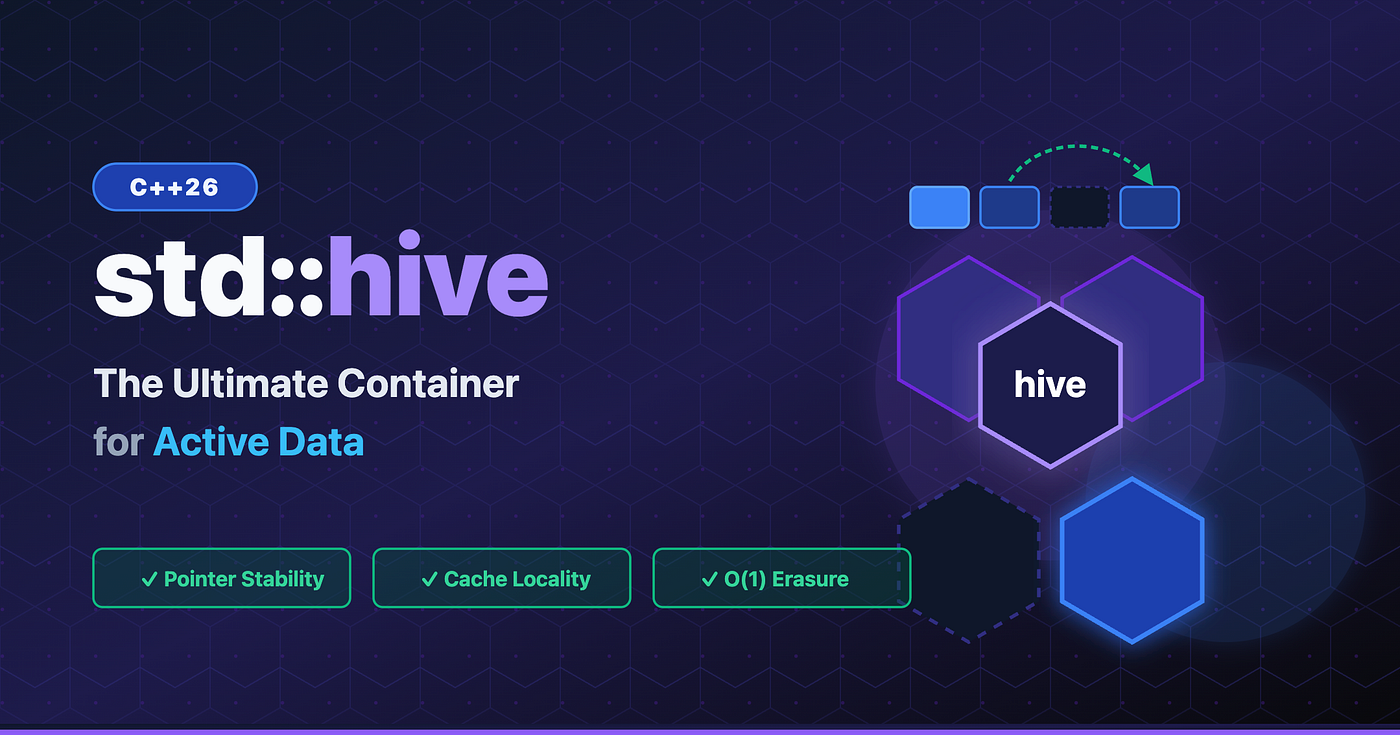
If you write high-performance C++, you already know the headache I’m about to describe. You need a data structure that’s fast to iterate, quick to insert and erase, and — here’s the kicker — never invalidates pointers to its elements.
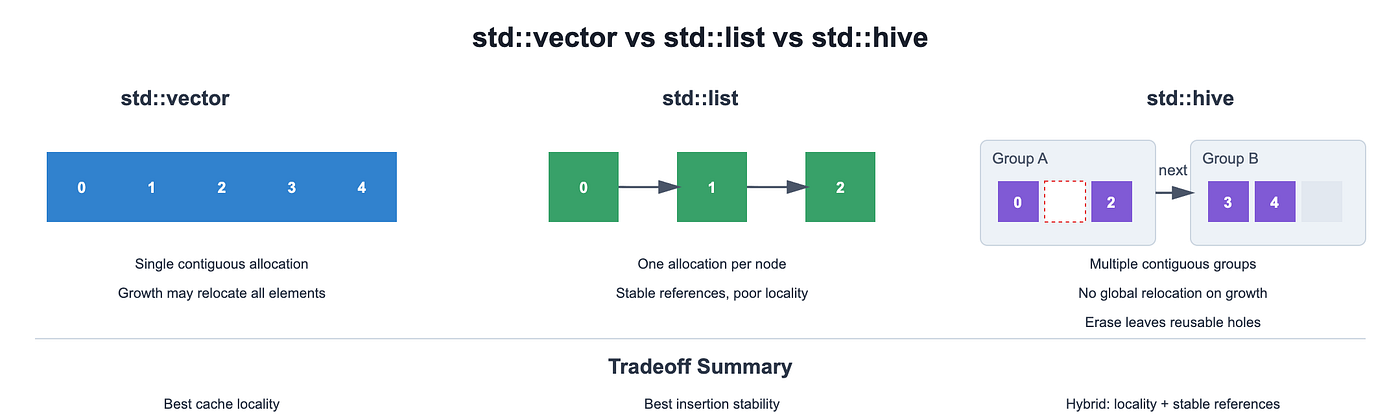
For years, the standard library has forced us into a frustrating trade-off. We had to choose between memory stability and cache locality. You either use a **std::vector and have to strictly enforce capacity constraints to ensure reallocations don't leave dangling pointers everywhere, or you fall back to a `std::list`** and watch your CPU cache cry.
C++26 finally gives us a way out. **std::hive (which you might recognize by its old community name, `plf::colony`**) is officially joining the standard library. I want to break down exactly how it works under the hood, and why, for many gameplay, simulation, and entity-management workloads, it eliminates the need for custom stable-storage containers that teams previously built themselves.
Let’s Understand why std::hive has been introduced ?
Imagine you’re implementing a strategy game similar to Clash of Clans. A player launches an attack. Suddenly, the battlefield fills with units:
#include <cstdint>

// A simple 3D vector for positioning
struct Vec3 {
    float x, y, z;
};

// Our core entity
struct Troop {
    uint32_t id;
    Vec3 position;
    int health;
};
You need a container to store them: **Container<Troop> troops;**
At the start of the battle, a wave of units spawns onto the map: Barbarian, Barbarian, Archer, Archer, Giant, Wizard.
Now, here’s where things get interesting. In a complex game engine, several systems need constant access to those troops:
- AI System
- Targeting System
- Animation System
- Combat System
- Pathfinding System
The Giant may currently be targeted by: 3 Archers, 1 Cannon, and 2 Wizard Towers. Every one of those defensive systems may hold a raw pointer or reference to that specific Giant to track its movement and health.
The Battle Begins: Imagine this sequence of events happens in rapid succession:
- Spawn Barbarian
- Spawn Archer
- Spawn Giant
- Barbarian dies
- Archer dies
- Giant dies
- Spawn Pekka
The collection changes constantly. Yet, surviving troops must remain perfectly accessible to all the systems holding references to them.
Let’s use our good old friend std::vector for to store the Troops.
#include <vector>

std::vector<Troop> troops;
Memory initially looks like this:
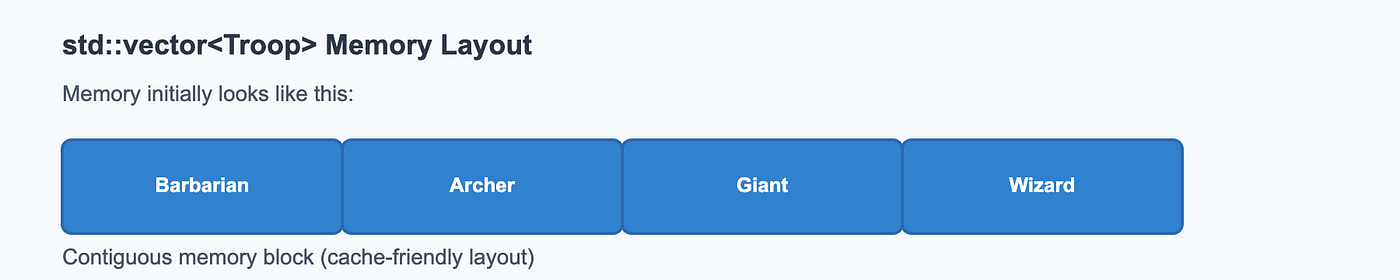
The Cannon defensive structure stores a pointer to its target:
// Pointing to the 3rd element (the Giant)
Troop* target = &troops[2];
Then, more troops spawn. You call: **troops.push_back(new_troop)**;
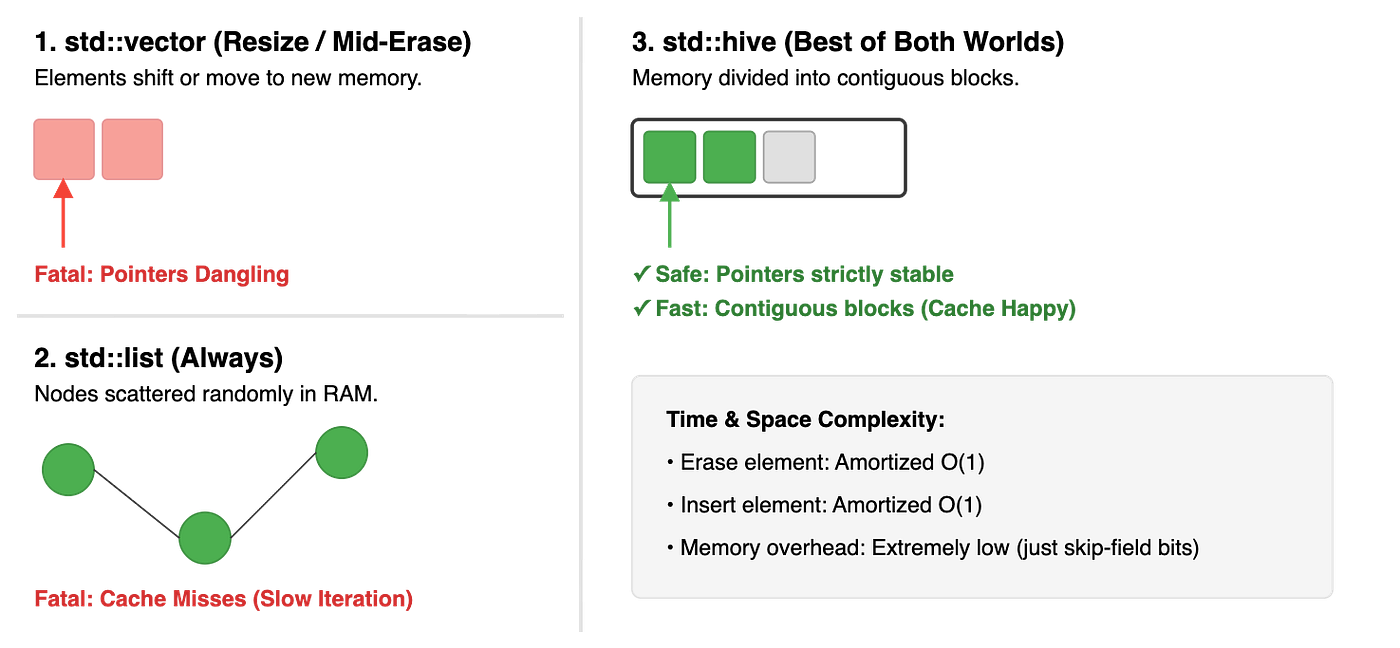
Eventually, the vector’s underlying capacity is exhausted. The vector is forced to reallocate — it requests a larger memory block from its allocator, moves the existing elements, and releases the old block.
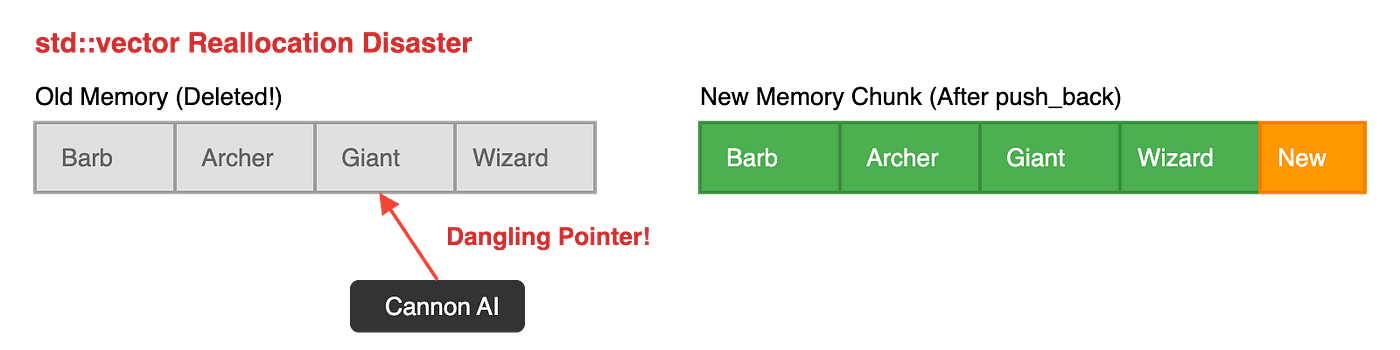
The Giant still exists in the game, but its address changed. Every system holding a pointer is now pointing to freed memory. Your game crashes.
Reallocation isn’t the only problem. Erasing elements from the middle of a **std::vector** is just as dangerous.
Now Let’s say we enforce strict capacity constraints. We reserved enough memory up front, so reallocations will never happen.
The Cannon AI holds a pointer directly to the Giant (index 2). Then, the Archer dies. We call:
troops.erase(troops.begin() + 1);Because **std::vector** strictly maintains a contiguous block of memory without any gaps, it has to shift every element after the Archer one slot to the left to fill the hole.
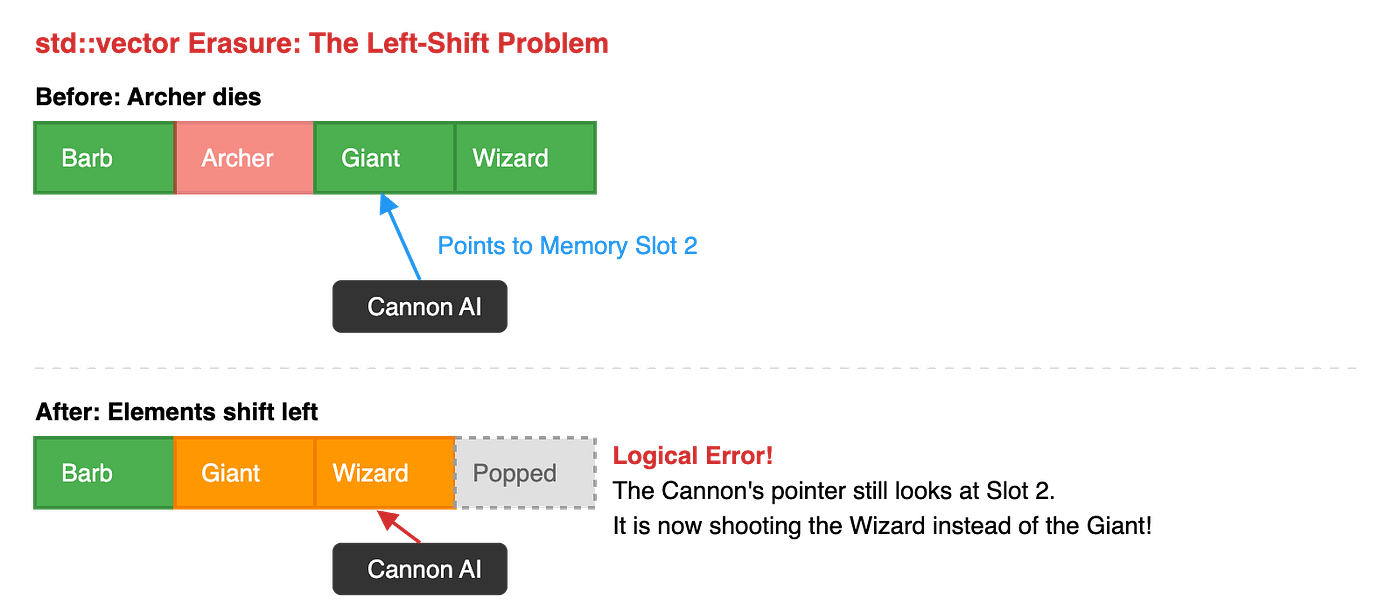
The vector shifts everything left to fill the gap.
The Cannon’s pointer doesn’t know that. It’s still aiming at the exact same memory address — so now it’s shooting the Wizard instead of the Giant.
Your game logic just broke. Trying to fix this by updating every pointer in the game whenever a unit dies is an architectural and performance nightmare.
We get good performance using the **std::vector but not iterator state stability. Ok so lets fix this stability issue. To fix the invalidation problem, let’s switch to a doubly-linked list `std::list`**:
#include <list>

std::list<Troop> troops;
When elements are added to **std::list, they are allocated individually. References stay valid. Problem solved? Not quite.**
Memory now looks like this:
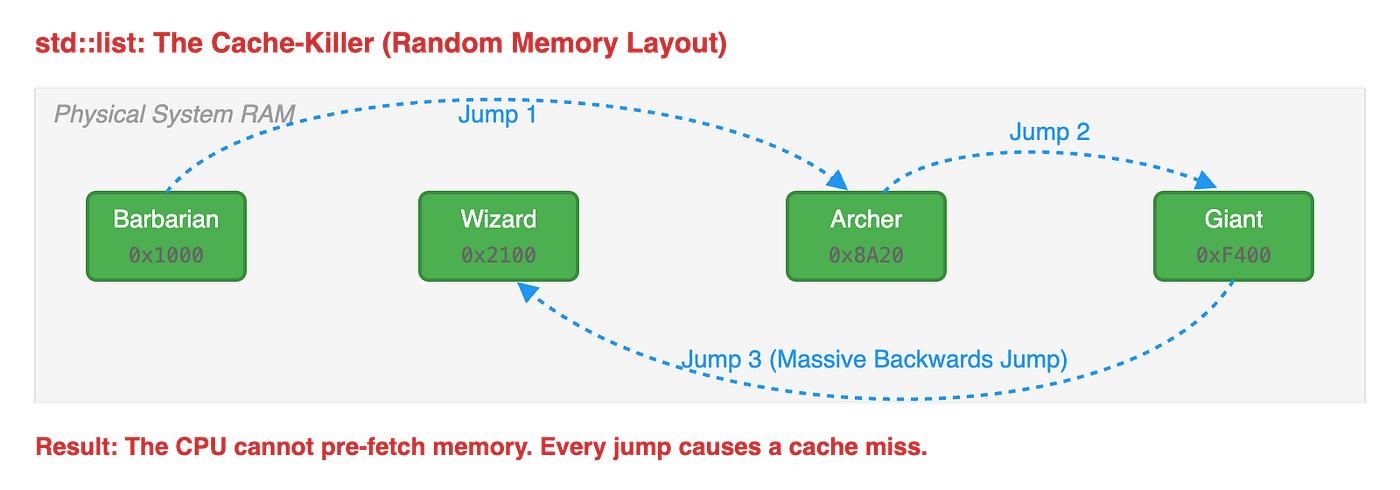
Every troop lives somewhere else in RAM. Every game tick, when your combat system runs:
for(auto& troop : troops) {
    troop.position.x += 1.0f; // Move troop
}
… it requires chasing pointers across random memory locations. The CPU cache cries. Modern CPUs are incredibly fast but rely on fetching continuous chunks of data. Linked lists cause “cache misses,” grinding game loops to a halt.
So What we actually need is a data structure that satisfies three historically conflicting constraints:
- Strict Pointer Stability: Surviving entities must never move in memory. Subsystems must be able to hold raw pointers without risk of invalidation or silent logical errors.
- Spatial Locality: Elements must be packed tightly in RAM. To maintain a high frame rate, the CPU requires contiguous data to efficiently pre-fetch memory and eliminate cache misses during update loops.
- High-Frequency Dynamic Lifecycles: The container must handle continuous, unpredictable insertions and erasures — anywhere in the collection, at any time — without performance degradation or triggering expensive memory shifts.
C++26 introduced one such container and that is what exactly **std::hive** is.
C++26 std::hive
**std::hive (originally known as `plf::colony`**) is built specifically for such scenario. It stores troops in groups (blocks) of contiguous memory.
**std::hive** is typically implemented as a sequence of independently allocated memory groups (sometimes called blocks or buckets). Each group contains:
- A contiguous array of element storage slots (
T-aligned). - A skipfield — a parallel metadata array used to efficiently skip erased elements during iteration.
- Bookkeeping for tracking reusable erased slots.
- Links to neighboring groups, allowing the hive to grow without relocating existing groups.
The key property is that existing groups are never reallocated when the container grows. New groups are simply appended, preserving pointer, reference, and iterator stability for all existing elements.
The clever bit: the skipfield
When you erase an element, the slot is marked in the skipfield with a jump count. Iterators, on **++, read the skipfield and **jump over runs of erased elements in amortized constant time (using the jump-counting skipfield algorithm — high-complexity bookkeeping but constant-time per advance).
This means iteration stays cache-friendly: you walk the same contiguous array, and the skipfield (often 1–2 bytes per slot) sits adjacent in memory.
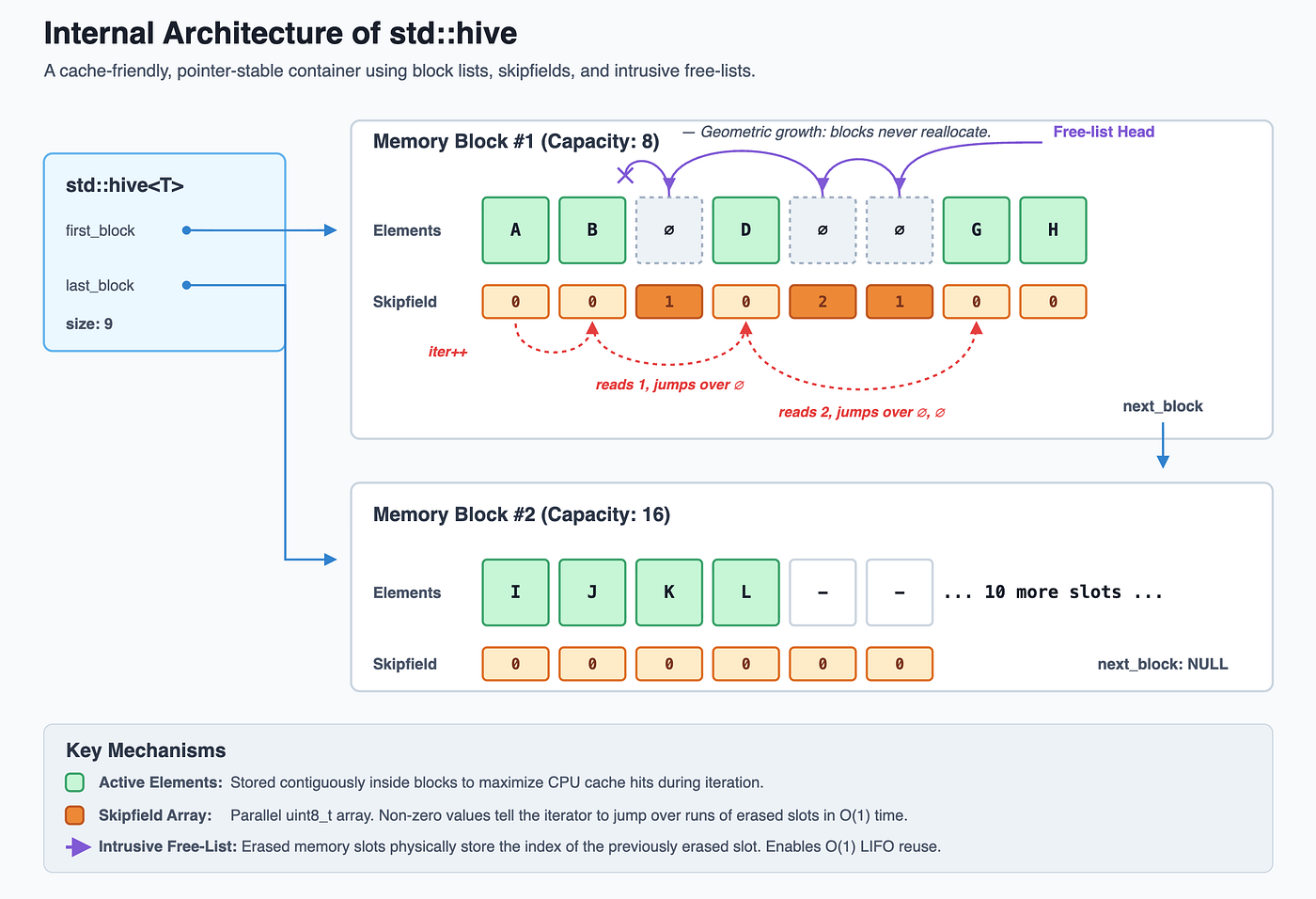
What Happens When a Troop Dies? (Erasure)
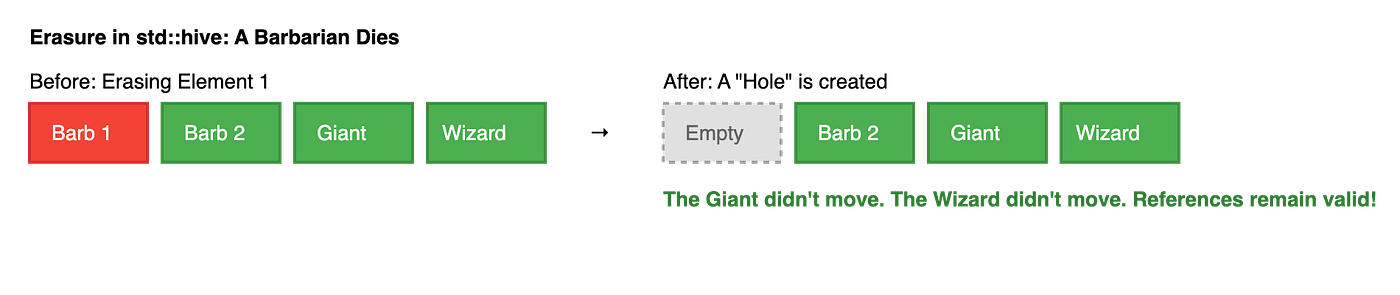
Instead of shifting memory left after erase()like a vector, **std::hive **simply destroys the object and creates a "hole" by marking the skip-field.
Following things happen:
- Destructor runs on the element at the slot (
**std::destroy_at**). - Slot is pushed onto the block’s free-list (intrusive — the now-uninitialized slot’s memory holds the next free index).
- Skipfield is updated — the entry for this slot becomes non-zero, and adjacent skipfield entries are updated using the jump-counting algorithm so iteration can leap over runs in O(1).
- Block’s live-count is decremented. If it hits zero and it’s not the only block, the entire block may be returned to the allocator (implementation-defined; some hives keep it for reuse). Removing an empty block does not invalidate iterators/pointers to other blocks — those live in different memory entirely.
That’s the whole reason std::hive exists: erasure is local to one slot, not propagated.
std::hive<Particle> h;
auto it_a = h.insert(Particle{"A"});
auto it_b = h.insert(Particle{"B"});
auto it_c = h.insert(Particle{"C"});

h.erase(it_b);   // O(1)

// it_a and it_c remain VALID and point to the same elements.
// Pointers held by other systems to A and C remain VALID.
// Even iteration order is preserved (we just skip B's slot).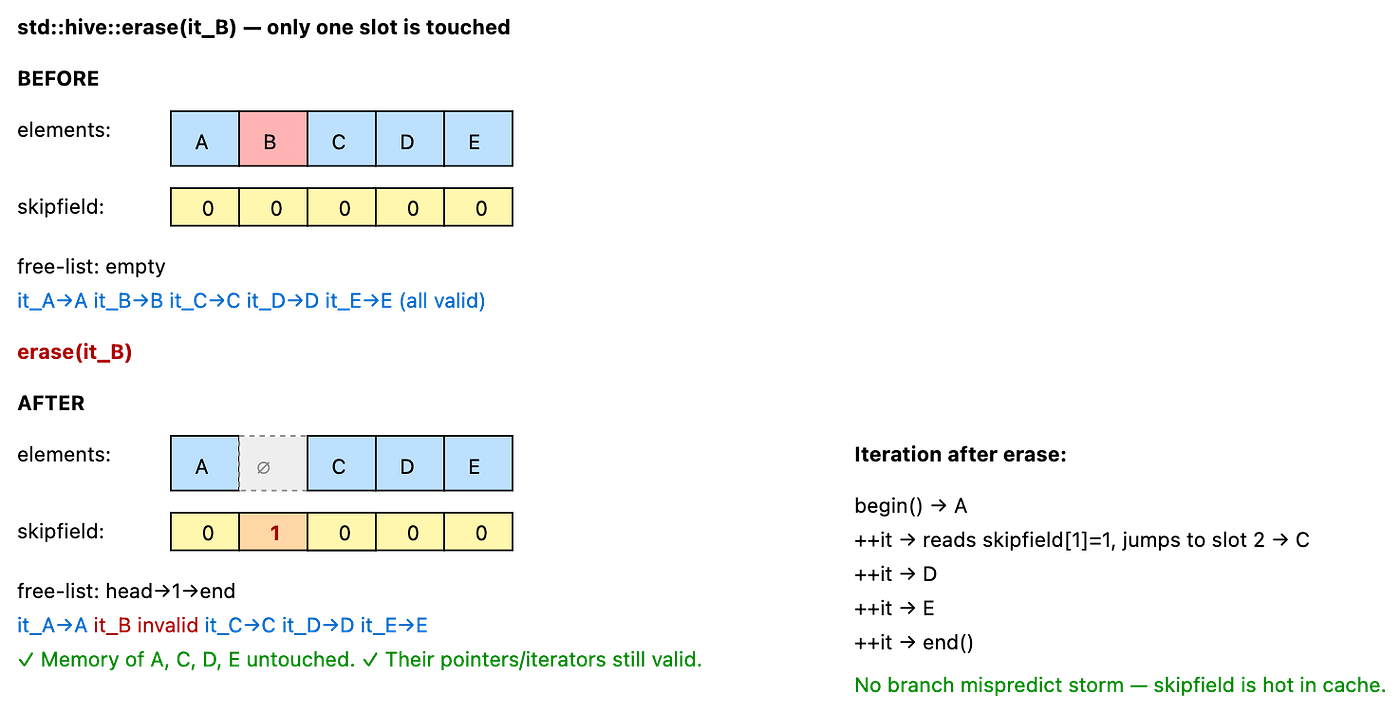
Range erase and bulk erase:
h.erase(first, last);   // O(distance) but still no relocation
std::erase_if(h, [](const Troop& p){ return p.is_dead(); });  // C++26 free fn
What Happens When a New Troop Arrives? (Insertion)
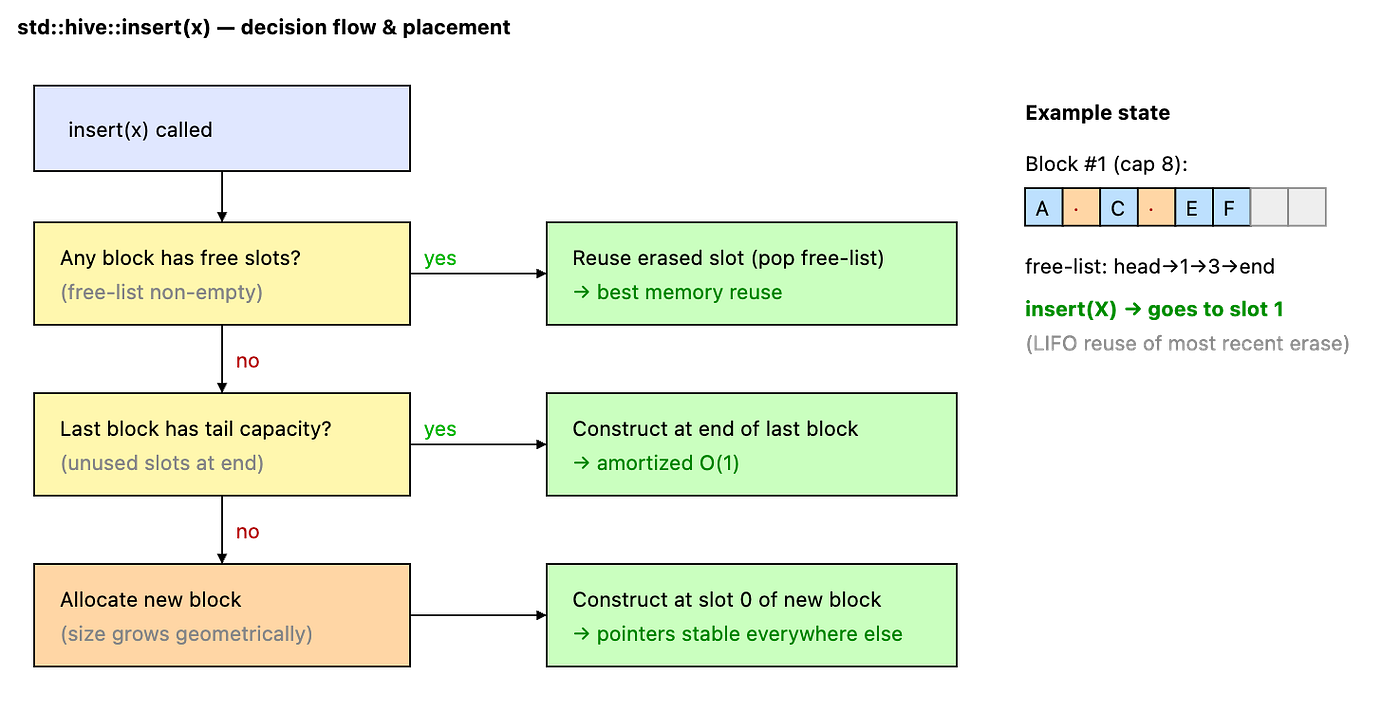
**std::hive follows a clear priority order when you call `insert/emplace`**:
- If any block has erased (free) slots → reuse the most recently erased slot in that block (pop the free-list head). Pointer/iterator stability for everyone else.
- Else if the last block has unused tail capacity → place the element at the next free position at the end.
- Else → allocate a new block (typically larger than the previous one), append it to the block list, place the element there.
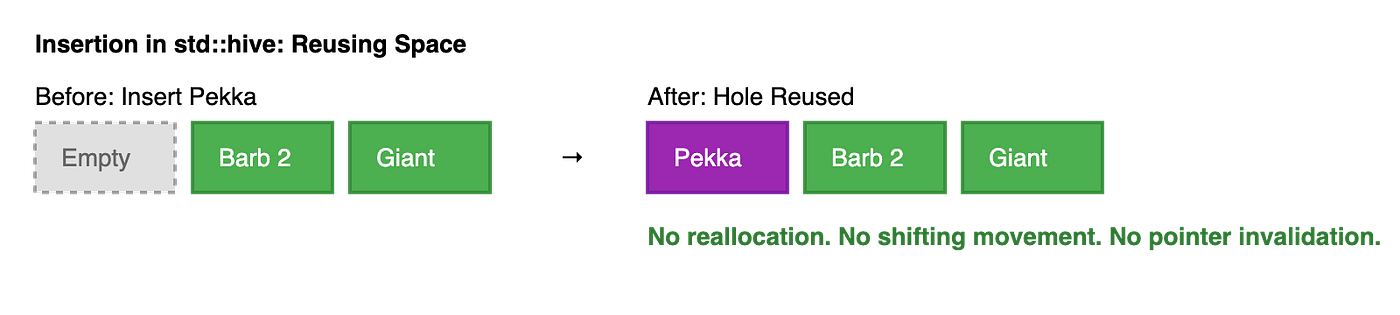
The player deploys a Pekka. **std::hive** checks its skip-field, notices the hole left by the dead Barbarian, and simply reuses the hole.
You cannot choose the location. The container chooses for locality + reuse.
Why LIFO reuse? Reusing the most recently erased slot keeps the working set small and warm in cache.
The return value of insert :
auto it = h.insert(42);   // returns iterator to the newly placed element
*it;                       // 42
That iterator is stable forever (until that specific element is erased or the hive is destroyed).
What if the Hive is Full? (Expansion)
If there are no holes left, and the current memory group is full, **std::hive** doesn't relocate existing memory. It just allocates a new memory group and drops the new troop there.
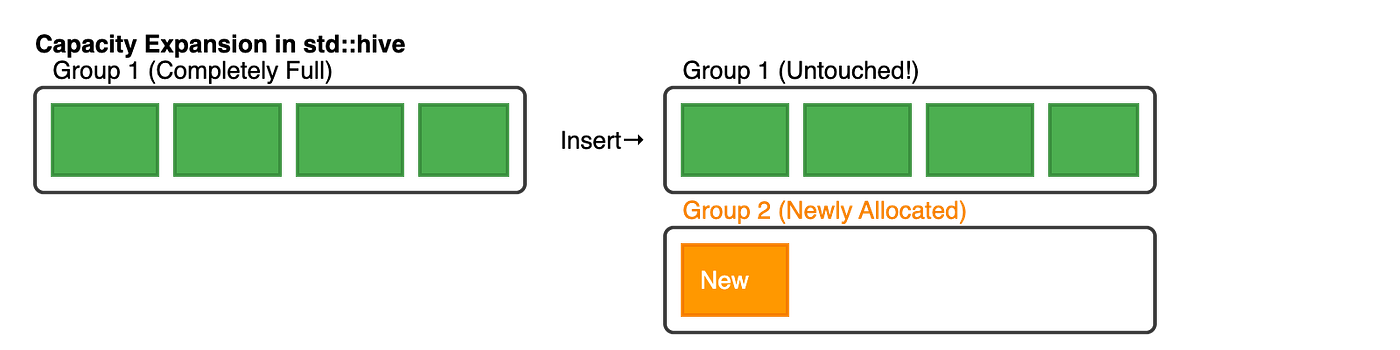
Groups can grow independently. Existing troops never move.
Empty Block Removal and Iterator Stability
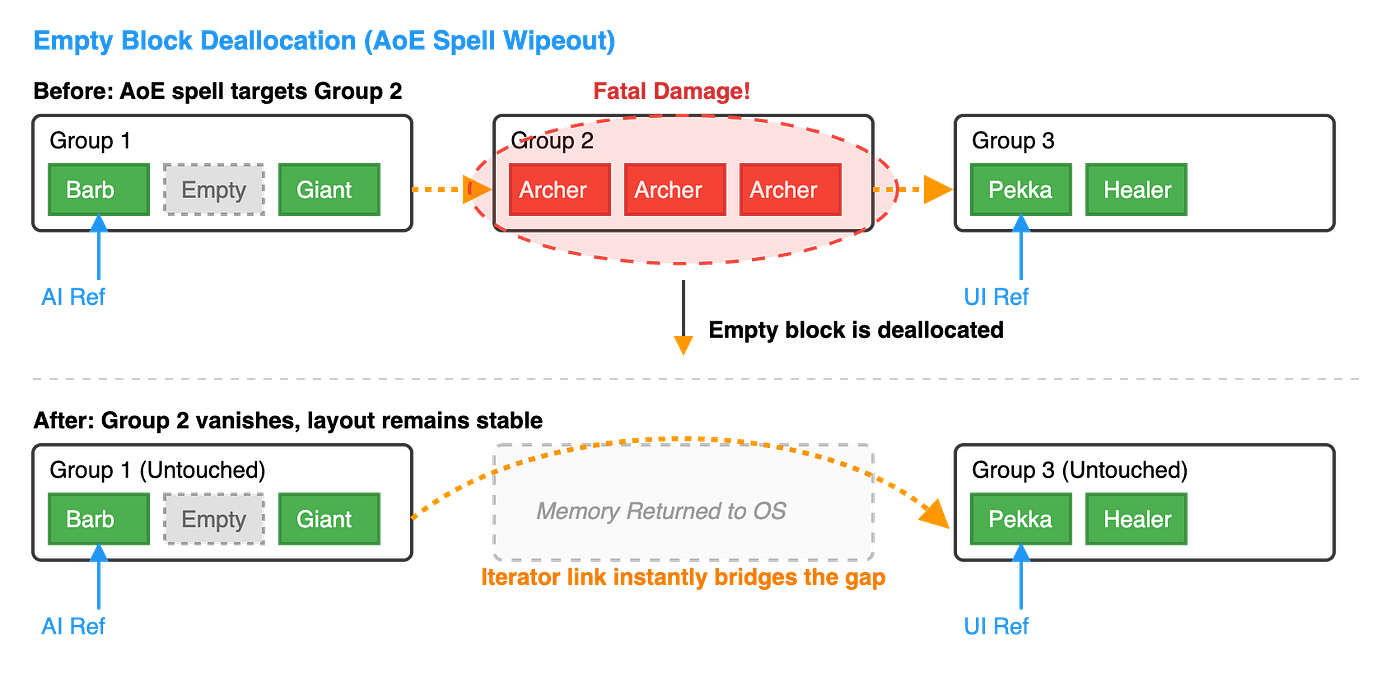
Let’s say a massive AoE (Area of Effect) spell wipes out 20 troops at once. If every single troop in a specific memory block dies, that entire block becomes completely empty.
When a block is entirely empty, **std::hive** can physically deallocate that block to return memory to the OS.
Does this break iterators? Absolutely not. Why? Because the block was completely empty. There are no living troops inside it. Therefore, no game systems hold valid pointers to anything in that block anyway! Pointers and iterators pointing to living troops in other blocks are totally unaffected.
Side-By-Side Comparison
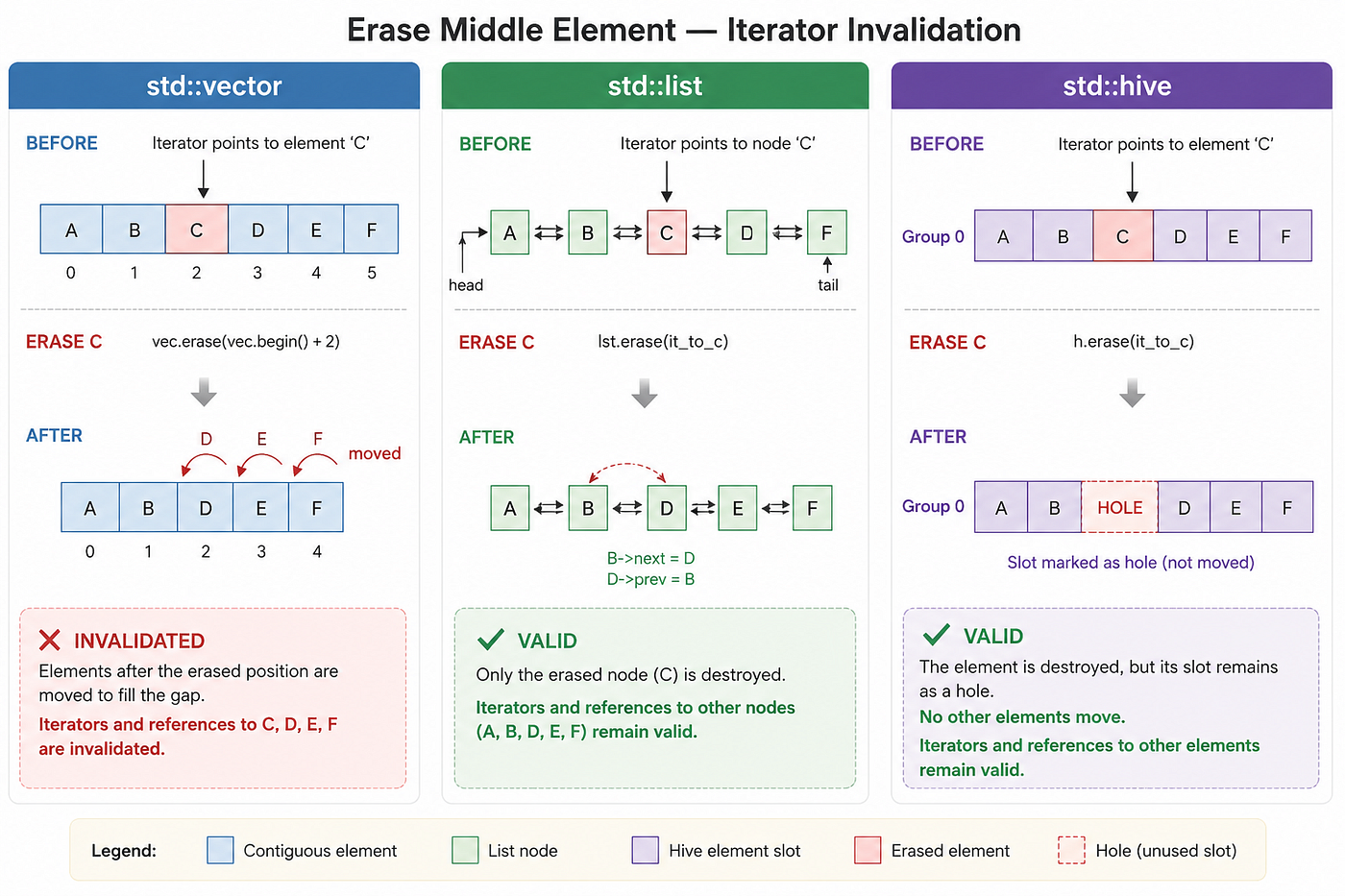
Coding with std::hive
You can find all
**std::hive** related functions and classes here: https://en.cppreference.com/cpp/header/hive
Let’s look at how beautifully simple it is to use in C++26.
#include <hive>
#include <iostream>

int main() {
    // 1. Create a hive of troops
    std::hive<Troop> battlefield;

    // 2. Insert returns an iterator.
    // This iterator (and pointers to the object) will NEVER be invalidated
    // by future insertions or erasures of OTHER elements.
    auto barb_it = battlefield.insert({1, {10.0f, 0.0f, 10.0f}, 100});
    auto archer_it = battlefield.insert({2, {15.0f, 0.0f, 12.0f}, 50});
    auto giant_it = battlefield.insert({3, {20.0f, 0.0f, 20.0f}, 500});

    // 3. The Archer dies. Erasing creates a reusable "hole".
    // Erasing does not require shifting elements and
    // is effectively constant-time operation.
    // barb_it and giant_it remain 100% valid!
    battlefield.erase(archer_it);

    // 4. Fast, cache-friendly iteration.
    // The internal skip-field automatically skips the dead Archer's hole.
    for (auto& troop : battlefield) {
        troop.position.x += 1.0f; // Move remaining troops forward
    }

    return 0;
}
Explicit Cleanup with trim()
Normally, **std::hive** keeps erased memory slots around so it can rapidly reuse them for new troops without hitting the OS allocator.
However, if your battle just ended and 500 troops died, you might want to return unused groups to the allocator. You can do this explicitly using the **trim()** function.
// Deallocates any memory block that is 100% empty.
// Does NOT touch blocks that have even 1 living troop inside.
battlefield.trim();
When Should You Reach for std::hive?
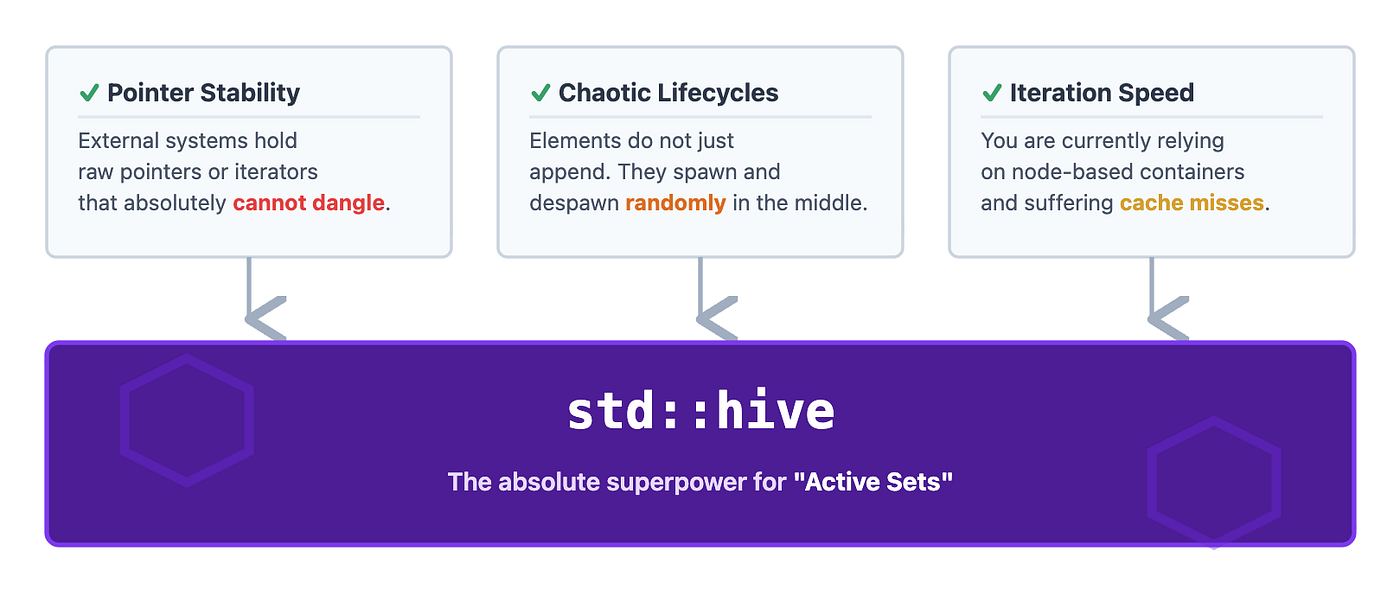
If you are evaluating containers for a new system, **std::hive** is your best choice if your requirements check these three boxes:
- Pointer Stability is a Hard Requirement: You have systems, threads, or other objects holding raw pointers, references, or iterators to elements inside the container, and you cannot afford for them to dangle.
- Chaotic Lifecycles: Your elements don’t just append to the end and die at the same time. They spawn and despawn constantly, randomly, and in the middle of the collection (like game entities, particle effects, or active network connections).
- You Need Iteration Speed: You are currently using
std::list,std::map, or a node-based container solely to keep your pointers valid, and your profiling tools are screaming about CPU cache misses during your update loops.
If you hit all three of those criteria, **std::hive** will feel like an absolute superpower. It is the ultimate container for "Active Sets"—collections of things currently alive and interacting right now.
When std::hive is NOT the Right Tool for the Job?
As much as we love it, std::hive is not a silver bullet. In C++, every abstraction has a cost, and std::hive is no exception.
If your workload is primarily append-only, rarely erases elements from the middle, and demands the absolute maximum cache locality, std::vector is still the undisputed king.
Here is why you might want to stick to standard arrays:
1. Iteration Overhead
A **std::vector** is just a raw contiguous array. Iterating over it is a literal pointer increment. The CPU's hardware pre-fetcher can predict it perfectly and process it at maximum bandwidth.
Iterating a **std::hive is incredibly fast, but it still has to do some work. Under the hood, the iterator must check the skip-field bitmask to bypass erased holes, and occasionally follow a link to jump from one memory group to the next. It is vastly faster than a `std::list**, but it will never beat a raw, unfragmentedstd::vector`.
2. No Random Access (O(1) Indexing)
If your game logic relies on index-based lookups like this:
// Works in vector, impossible in hive
Troop& t = troops[42]; …**std::hive cannot help you. Because the container is full of dynamically created holes and split across multiple memory blocks, finding the n-th active element requires traversing the skip-field. It is an O(N) operation, which is why `std::hive** simply does not provide anoperator[]`.
Golden Rule: Choose
**std::hive** when your entity lifecycles are chaotic (frequent spawns and deaths) and pointer stability is non-negotiable.
If you just need a flat buffer of data to loop over, or if you only clear the container at the very end of a frame, stick to
**std::vector**.
Closing Thought
**std::vector remains the king of pure throughput. `std::list** still has niche uses. But for workloads that demand both stability and speed,std::hive` introduces a new point in the design space that simply didn't exist in the standard library before. It's not a replacement for every container—but for the right problem, it can feel remarkably close.
The next time someone reaches for **std::list** because they need stable pointers, do them a favor: gently close the tab, slide a copy of this article across the table, and whisper, "It's 2026 now."
Found this article helpful? Please Clap 👏 and follow for more C++ and system programming content.
메타데이터
- post_id
- 5bdaa44f4d94
- slug
- cpp26-std-hive-deep-dive-tutorial-5bdaa44f4d94
- url
- https://towardsdev.com/cpp26-std-hive-deep-dive-tutorial-5bdaa44f4d94
- canonical_url
- https://towardsdev.com/cpp26-std-hive-deep-dive-tutorial-5bdaa44f4d94
- author_url
- https://medium.com/@sagarmadala
- status
- ok
- fetched_at
- 2026-06-23 03:48:11