DLP Without a Roadmap Creates Noise: A Strategic Prototype to Plan Your Maturity Journey
Many organisations buy a Data Loss Prevention (DLP) tool expecting instant security. What often follows is frustration:
DLP Without a Roadmap Creates Noise: A Strategic Prototype to Plan Your Maturity Journey
Many organisations buy a Data Loss Prevention (DLP) tool expecting instant security. What often follows is frustration:
- Thousands of alerts no one trusts
- Legitimate business activity getting blocked
- Security teams drowning in noise
- Leadership questioning ROI
The truth is simple: DLP maturity does not come from software alone. It comes from disciplined tuning, governance, and continuous learning.
That is exactly what this simulator demonstrates. It turns a complex 12-month DLP transformation into a visible business journey — while also showing how Agentic AI and Generative AI can help leaders prototype strategic decisions before real-world execution.
The Real Problem with Most DLP Programs
Many deployments fail because organisations start with enforcement too early.
They block before they understand:
- How data truly moves inside the company
- Which alerts are real threats
- Which alerts are false positives
- Which business workflows are legitimate
The result? Security friction without security value.
This simulator shows a better path: observe first, learn fast, enforce smartly.
Key Thresholds for DLP Maturity
DLP maturity should be guided by clear operational thresholds, not guesswork. Key benchmarks include:
- False Positive Rate for alerts: Target <5% for high-confidence enforcement.
- Alert Volume: Reduce alerts to 78% below baseline to remove noise.
- Analyst Capacity: Bring analyst workload to 86% below baseline for sustainable operations.
- False Negatives: Keep missed real incidents below 2%.
- UEBA Deployment: Introduce UEBA when false positives fall below 22%, or after 6 weeks of clean baseline data for reliable behavior scoring.
- SOAR Deployment: Deploy SOAR when false positives are <8% and stable for 2 months, ensuring automation acts on trusted alerts.
Companies Policy Maturity Drives DLP Success
DLP effectiveness begins with strong enterprise policies. Clear and mature policies create a reliable data classification framework, which is essential for accurate detection and enforcement. This enables DLP teams to:
- Classify alerts faster with better accuracy
- Improve detection quality through proper data tagging
- Fine-tune controls such as pattern matching, regex, and checksum validation
- Use contextual proximity rules to reduce false positives
- Strengthen enforcement readiness with trusted classifications
Simply put, stronger policies lead to smarter classification, and smarter classification leads to effective DLP.
A 12-Month Maturity Journey — From Chaos to Control
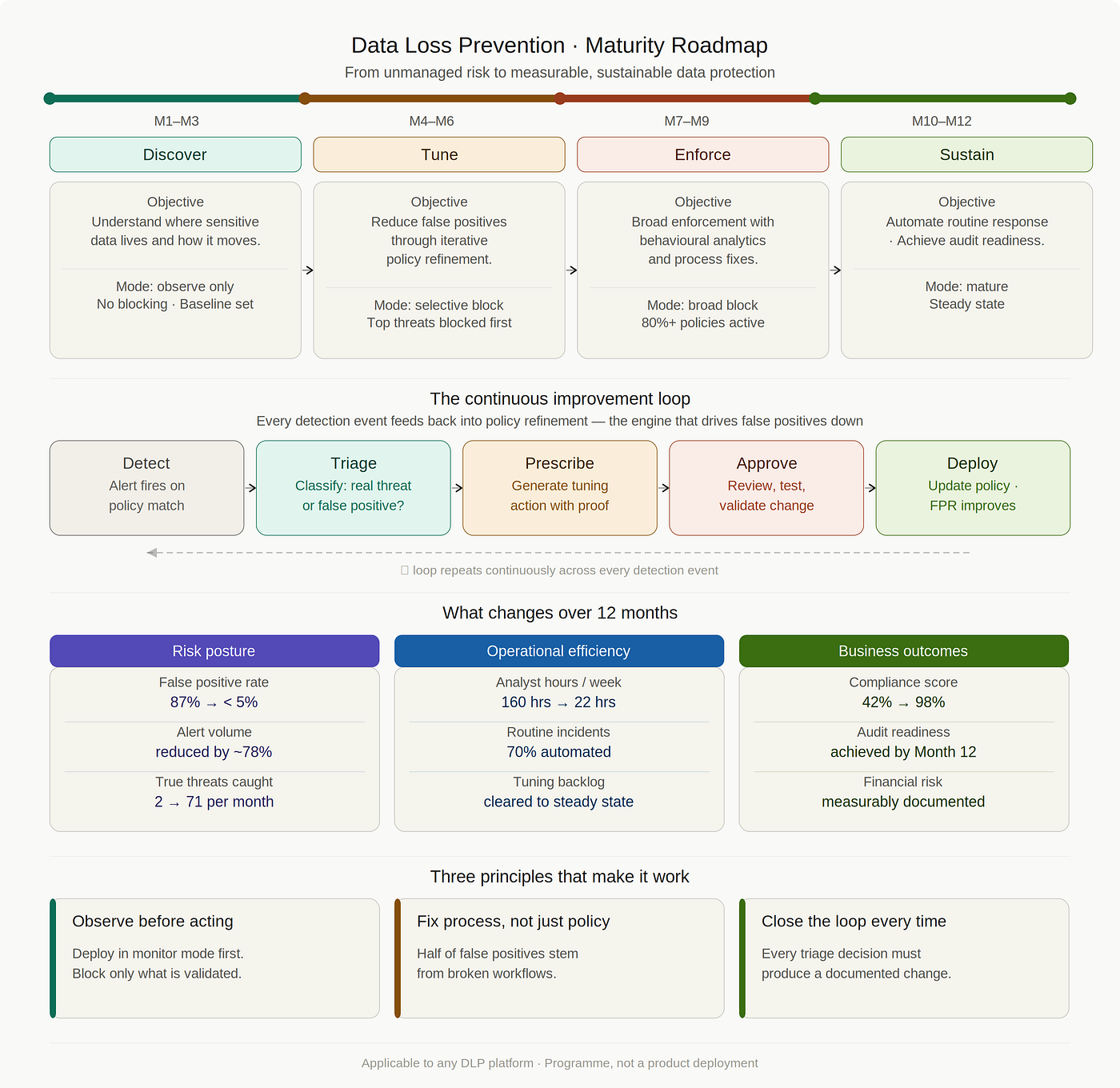
The prototype visualises how a DLP program matures over time.
Month 1: Untuned Reality
- 8,500 monthly alerts
- 87% false positives
- Only 2 real threats found
- High business disruption
This is where many companies lose confidence.
Phase 1 — Discovery (Months 1–3)

Purpose & Impact
To stop data loss, first understand where data goes. Many organisations start DLP in block mode on Day 1 and face two problems: real threats hidden in noise, and legitimate business work disrupted.
Phase 1 avoids both through [ monitor-only mode — observe all, block none ]. Over three months, the team separates real risks from normal routine Finance reconciliation, approved Marketing campaigns, and product SKUs falsely matching Aadhaar due to weak regex.
By Month 3, three targeted fixes — with zero user blocking — reduce alerts from 8,500 to 6,500 and false positives from 87% to 65%.
Phase 2 — Tuning (Months 4–6)

Purpose & Impact
After mapping data flows in Phase 1, controlled enforcement begins. Only [ *5 high-confidence policies* move to block mode ](such as sensitive data to personal cloud, source code to personal repositories, and PHI to USB etc.), [ while others remain in monitor mode ] to avoid business disruption. This delivers the [ first real win ] by blocking a genuine exfiltration attempt. [ Many violations are found to be accidental, so just-in-time coaching pop-ups are introduced, explaining what was detected, why it is blocked, and the approved alternative; ] 60% of users do not repeat the same violation. Legitimate workflows are also tuned — for example, approved Marketing campaigns causing 340 monthly PII alerts are given [ controlled exceptions ]. In Month 6, all 47 policies undergo review: 12 retired, 8 modified, 3 added, and UEBA is enabled to detect abnormal user behaviour. By Month 6, alerts fall to 4,200, false positives to 22% (down 75% from 87%), [ analyst effort drops to 60 hours/week (from 160), ROI reaches ₹12 Cr, ]compliance posture rises to 78%**, and the program now has a complete auditable record of every tuning decision.
Phase 3 — Enforcement (Months 7–9)

Purpose & Impact
By Month 6, alerts had fallen 8,500→4,200 and false positives 87%→22%, but 900+ monthly alerts were still wrong and [ only 5 of 47 policies were blocking ]. Phase 3 shifts to confident enforcement. In Month 7, most policies move to Broad Block + UEBA. UEBA uses six months of baselines with HR resignation flags, warnings, access changes, and identity signals to detect insider threats, catching the first case: a departing employee attempting 3-channel exfiltration via email, USB, and personal cloud. Print monitoring is refined by document type, page count, and time, cutting 400 false positives/month. Month 8 is most important because the biggest gain comes not from DLP tuning, but from IT fixing a broken secure file-transfer tool or other broken process that forced Finance users to email PCI data. The fix removed 1,400 false positives/month overnight. This proves [ false positives can come from poor processes, not just bad policies or users. ] Business Process Owners activate for the first time. By Month 8, KPIs improve to 3,400 alerts, 14% FPR, and analyst effort 160→42 hrs/week. In Month 9, a full review moves 80% of policies to block mode, while [ *20%* stay alert-only for edge cases or variable context.] KPIs reach 2,900 alerts and 9% FPR (first time below 10%), achieving broad enforcement without disruption because legitimate workflows were already tuned, approved, or process-fixed. [ The overall 87%→9% reduction came through three levers: policy tuning, process fixes, and behavioural change.] The biggest single gain — 1,400 alerts/month removed overnight** — came from IT fixing a broken process, proving DLP maturity is both a security and IT service quality discipline.
Phase 4 — Maturity (Months 10–12)

Purpose & Impact
By Month 9, the program had 9% false positives, 80% policies blocking, low disruption, and strong threat detection. Phase 4 [ makes this sustainable through automation, external validation, and a permanent operating model.] In Month 10, SOAR automates the 10 most common incident types, handling 70% of alerts without human touch and reducing analyst effort from 35 to 28 hours/week; KPIs improve to 2,500 alerts and 7% FPR. In Month 11, an independent audit validates controls against DPDP Act, GDPR, PCI-DSS, and HIPAA using policies, logs, tuning records, approvals, tests, and rollback evidence, resulting in zero findings; KPIs reach 2,200 alerts and 6% FPR, Audit-Ready becomes Yes, and compliance posture 97%. In Month 12, the target state is achieved: 4% FPR (below 5%), broad automated enforcement, no business disruption, and governance replacing firefighting. The CISO formalises quarterly reviews, escalations, exceptions, annual audits, and Year 2 roadmap. Final KPIs: 1,900 alerts, 71 threats caught, ₹65 Cr risk avoided, 22 analyst hours/week, compliance 98%. Compared with Month 1: alerts 8,500→1,900, false positives 87%→4%, analyst effort 160→22 hrs/week, threats 2/month→5.9/month, disruption High→Negligible, evidence None→Excellent. CEO outcomes: ₹65 Cr breach avoidance, ₹26 Cr fine avoidance, 24% insurance savings, 86% productivity gain, ₹56.8 Cr IP value, +56 trust points. Phase 4 proves DLP maturity is not crisis mode — it is an auditable, validated operating model built through 21 documented tuning decisions.
The Feedback Loop — How Every Triage Decision Becomes a Policy Change

Purpose & Impact
[ False positives do not reduce automatically. They reduce when an analyst correctly identifies a false positive and triggers a specific, documented policy change that prevents recurrence. ]
This continuous cycle — triage verdict → tuning ticket → Forcepoint configuration change → timeline entry — repeated across hundreds of monthly incidents, drives the program from 87% to 4%.
Without this loop, analysts keep reviewing the same false positives. With it, every correct verdict makes the system smarter. This separates a maturing DLP program from a stagnant one.
The Bigger Lesson: AI Should Simulate Strategy Before Strategy Is Funded
This prototype is bigger than DLP.
It proves how Agentic AI can be used inside enterprises to model future operating states before spending budget, hiring teams, or buying tools.
Imagine using AI simulations for:
- SOC transformation roadmaps
- IAM maturity planning
- Insider threat programs
- Cloud security operating models
- Privacy compliance journeys
- Security staffing decisions
Instead of debating in PowerPoint, leaders can see the future state in advance.
That changes decision-making completely.
Final Thought
The next wave of AI in cybersecurity may not be chatbots.
It may be decision simulators that let leadership test security strategy before committing millions.
Because the smartest security investment is not buying faster.
It is seeing clearly first.
For full details, the prototype application, and its complete description, visit: https://github.com/arunpushkar-dev/dlp-maturity-prototype
메타데이터
- post_id
- 5be0c7a8ec98
- slug
- dlp-without-a-roadmap-creates-noise-a-strategic-prototype-to-plan-your-maturity-journey-5be0c7a8ec98
- url
- https://medium.com/@arunpushkar/dlp-without-a-roadmap-creates-noise-a-strategic-prototype-to-plan-your-maturity-journey-5be0c7a8ec98
- canonical_url
- https://medium.com/@arunpushkar/dlp-without-a-roadmap-creates-noise-a-strategic-prototype-to-plan-your-maturity-journey-5be0c7a8ec98
- author_url
- https://medium.com/@arunpushkar
- status
- ok
- fetched_at
- 2026-07-13 06:23:13




