🔮 BlessingSeries Issue 26 — Because Sharing Is Good.
What a Father, a Plate of Poutine, and a Tough Parenting Moment Taught Me About UX, AI.
🔮 BlessingSeries Issue 26 — Because Sharing Is Good.
Sharing values
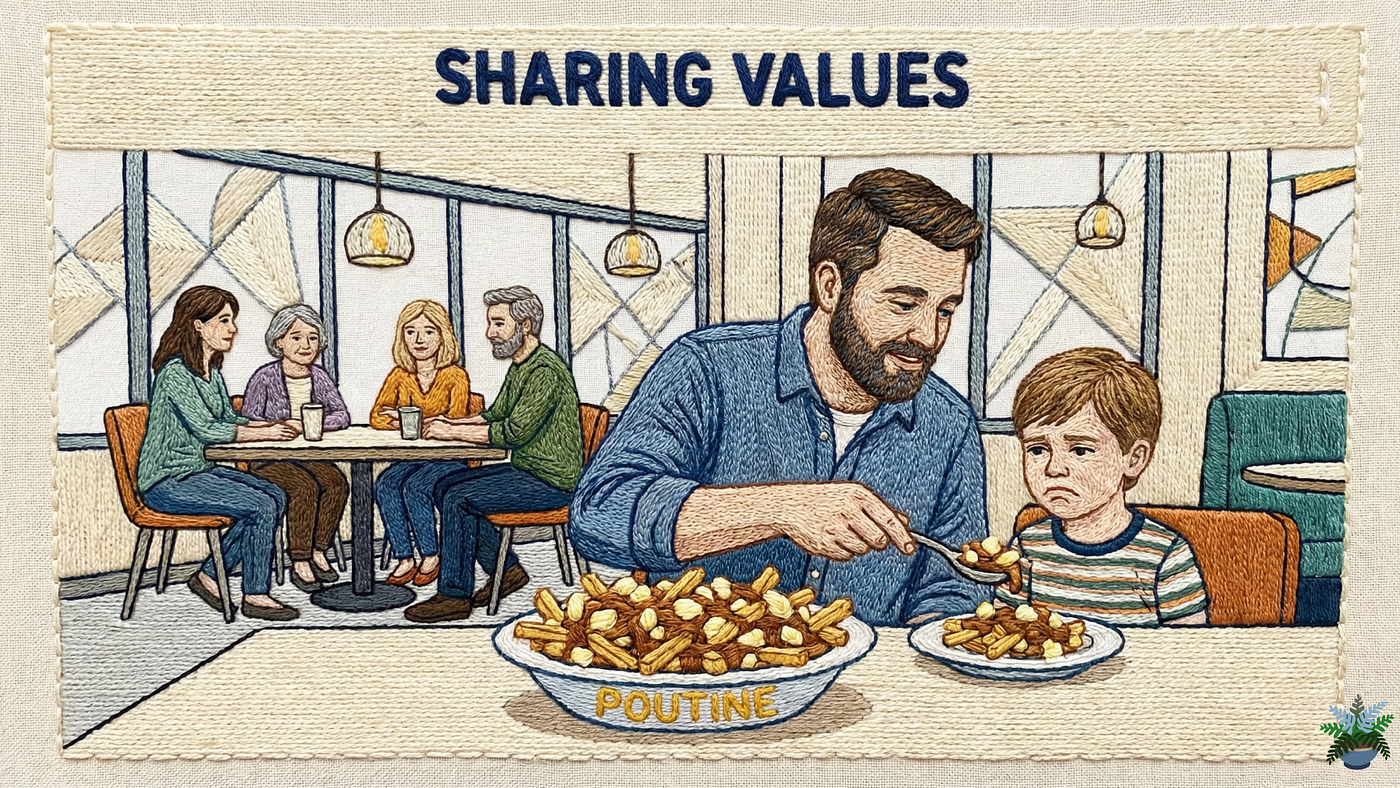
Yesterday, I took my kids out for shopping and lunch. Nothing fancy. Just one of those everyday moments parents cherish without realizing it might turn into a lesson later. We had settled at our table, food in front of us, kids happily munching away, when a man walked in with his three kids and sat at the table right beside us.
The eldest boy had a massive plate of poutine. The kind you can tell from one glance is too much for one person. It looked delicious, generous, and honestly overwhelming.
A few minutes in, the dad gently suggested they share the meal.
The boy refused.
At first, it felt like a normal kid moment. Then the dad leaned in and said something that stopped me mid-bite.
He said, calmly but firmly, “You need to share your food because sharing is good.”
That sentence hit me harder than I expected.
Because it echoed something I say to my own kids, over and over again.
The father continued, explaining that neither of them could finish the meal alone, and that sharing makes sense. He even added, “Don’t make me sad.”
You could see the frustration on his face. Not anger. Not control. Just that quiet exhaustion parents carry when they are trying to raise humans who understand values, not just preferences.
Eventually, he got an extra plate and shared the poutine anyway. Against his son’s wishes.
And as I watched this unfold, one thought stayed with me.
Parenting is hard. But doing what is right for our kids often means going against what they think is right in their own eyes.
That moment stayed with me long after we left the restaurant. Because the same struggle plays out every day in UX design and AI systems.
Users, Like Children, Don’t Always Want What They Need
This might sound uncomfortable, but it’s true.
In UX, users often resist what ultimately helps them. In AI, stakeholders sometimes push for what feels good, not what is ethical or sustainable.
Just like that boy didn’t want to share his food, users sometimes push back against:
- Friction
- Boundaries
- Safeguards
- Transparency
- Ethical constraints
They want convenience, speed, control, and personal benefit.
But good design, like good parenting, isn’t about giving people everything they want. It’s about doing what’s right, even when it’s unpopular.
UX Lesson 1: Good Design Sometimes Disappoints Users in the Short Term
That father knew something important. Letting his son eat alone wouldn’t teach generosity. Forcing the share, gently but firmly, would.
In UX, this shows up in moments like:
- Asking users to confirm destructive actions
- Introducing consent flows
- Limiting addictive patterns
- Adding friction to harmful behaviors
Users often complain about these things.
But research consistently shows that thoughtful friction improves long-term trust and satisfaction.
The Nielsen Norman Group has written extensively about the value of “beneficial friction” in UX.
Removing all friction doesn’t create better experiences. It creates careless ones.
Parenting and UX Share the Same Ethical Core
That father wasn’t trying to win a popularity contest with his child.
He was trying to raise a decent human being.
In UX and AI, designers face the same responsibility.
Do we design:
- For short-term engagement
- Or long-term well-being
Do we optimize:
- For clicks
- Or for consequences
This is where ethics comes in.
AI Lesson: Guardrails Exist for a Reason
In AI, we often hear complaints like:
- “Why can’t the system just do this?”
- “Why is this restricted?”
- “Why is there a warning?”
Just like a child resisting sharing, users sometimes push against AI safeguards.
But those safeguards are there to prevent harm.
A strong real-world example is OpenAI’s reinforcement learning with human feedback (RLHF) approach, which intentionally limits harmful outputs even when users request them.
This creates frustration for some users but significantly improves safety, trust, and societal impact.
Ethical design is not always pleasing, but it is necessary.
UX Lesson 2: Designers Must Sometimes Be the “Parent” in the Room
This is not a popular opinion, but it’s a needed one.
Designers are not neutral. AI systems are not neutral.
Choices are made. Values are embedded.
That father chose to override his son’s wishes because he understood the bigger picture.
Similarly, UX designers must sometimes say:
- “This is not good for users.”
- “This will create harm long-term.”
- “We need to slow this down.”
Sharing as a Design Principle
Let’s talk about sharing beyond the literal sense.
In UX and AI, sharing shows up as:
- Shared control
- Shared understanding
- Shared responsibility
When systems hoard power, information, or control, users feel excluded.
That plate of poutine could not be finished by one person.
Neither should power in digital systems be held by one group alone.
This is why participatory design and human-centered AI are gaining momentum.
Case Study: IBM’s Human-Centered AI Framework
IBM developed a human-centered AI framework that prioritizes transparency, fairness, and shared accountability.
They found that systems designed with ethical constraints and shared oversight:
- Improved trust
- Reduced bias
- Increased adoption in enterprise environments
Just like sharing food builds relationships, sharing control builds trust.
UX Lesson 3: Emotional Friction Is Still Friction
The dad didn’t just explain logic, he appealed to emotion.
“Don’t make me sad.”
That’s important.
UX is not only about usability. It’s about emotional experience.
Users feel frustration, confusion, joy, and trust.
Ignoring emotional signals leads to disengagement.
This is why empathy mapping and user research remain foundational in UX design.
Designing for Growth, Not Comfort
Children grow through boundaries. Users grow through guidance.
That moment at the restaurant reminded me that:
- Growth is uncomfortable
- Learning requires limits
- Doing right often feels hard
Designers and AI practitioners must stop chasing comfort at all costs.
Sometimes, the right design choice feels restrictive. Sometimes, it feels slower. Sometimes, it feels unpopular.
But it builds better humans. And better systems.
Final Reflection
As we finished our meals and gathered my kids, I looked again at that father.
He wasn’t perfect. He wasn’t calm the entire time. But he did what was right.
And that is the same standard we should hold for ourselves in UX and AI.
Design is not about pleasing everyone in the moment. It’s about serving people well over time.
Just like parenting.
References
- Designing for Friction and Flow in Customer Journeys
- How reinforcement learning works
- A better future with technology is possible
- Responsible AI
BlessingSeries #UXDesign #AIEthics #HumanCenteredDesign #ResponsibleAI #InclusiveDesign #ProductDesign #DesignLeadership #EthicalTech #UserExperience
메타데이터
- post_id
- 5be21b96842e
- slug
- blessingseries-issue-26-because-sharing-is-good-5be21b96842e
- url
- https://medium.com/@blessingokpala/blessingseries-issue-26-because-sharing-is-good-5be21b96842e
- canonical_url
- https://medium.com/@blessingokpala/blessingseries-issue-26-because-sharing-is-good-5be21b96842e
- author_url
- https://medium.com/@blessingokpala
- status
- ok
- fetched_at
- 2026-07-09 05:26:43