The “Agnostic” Label: A Secular “God of the Gaps” and the Mask of Intellectual Ignorance
Agnosticism is a psychological trap
Agnosticism, atheism, religion
The “Agnostic” Label: A Secular “God of the Gaps” and the Mask of Intellectual Ignorance
Agnosticism is a psychological trap
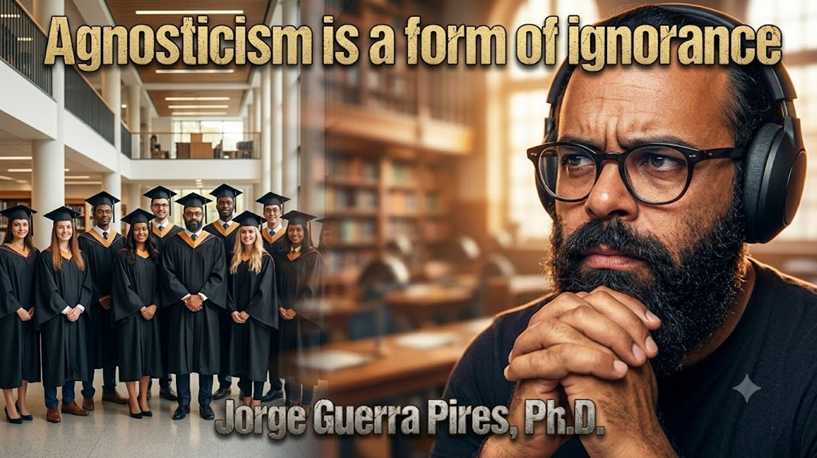
In contemporary discourse, the label “agnostic” is frequently deployed as a shield — a way to project openness and maintain a diplomatic stance without confronting the hard reality of our non-belief. Yet, as we examine its function today, a critical question emerges: is this label truly a mark of philosophical precision, or has it become a modern form of a “God of the Gaps” argument?
[embed]
When people use “agnostic” to describe their position on the thousands of gods humanity has invented, they are often not engaging in a rigorous epistemological assessment. Instead, they are frequently falling into a trap of intellectual avoidance. By claiming “we cannot know,” they are treating these unfalsifiable, man-made concepts as if they were valid scientific hypotheses that warrant a suspended judgment.
This is, effectively, a secular “God of the Gaps.” Just as religious fundamentalists place their deity in the mysteries science has yet to explain, the modern agnostic places their “doubt” in the gaps of human knowledge — gaps that are irrelevant to our practical understanding of the world. Science operates on simplicity and evidence; it explains the universe impeccably without needing a divine architect. To invoke an agnostic stance toward a cosmic creator is to introduce a metaphysical complication that provides no predictive power and no added clarity.
Furthermore, clinging to this label often stems from an ignorance — not of the individual’s intelligence, but of the weight of the terms themselves. Many assume that “atheist” implies a claim of 100% certainty that no god exists. This is a fundamental misunderstanding. The burden of proof lies with the claimant — those who assert that a god exists. Until such evidence is provided, the only honest position is one of atheism — a rejection of the unjustified supernatural claim.
Using the “agnostic” label to avoid the stigma of atheism is, in essence, a diplomatic convenience that leaves the fundamentalist narrative unchallenged. It is time to drop the tactical mask. We do not need to read every holy text or debunk every god to know that these narratives lack empirical support. By embracing the clarity of atheism, we stop feeding the confusion and start upholding the intellectual honesty that this debate demands.
The “Aether” Lesson: Why Science Rejects Agnosticism
To understand why agnosticism is an intellectual dead end, we only need to look at the history of science. Consider the concept of the “luminiferous aether” — the hypothetical medium once believed to be necessary for the propagation of light.
For years, the scientific community was obsessed with detecting this aether. Countless experiments were conducted to prove its existence, acting as a “God of the Gaps” for 19th-century physics. When those experiments consistently failed, scientists did not adopt an “agnostic” position toward the aether. They did not say, “Well, we haven’t found it yet, so we must remain open to the possibility that it exists somewhere in the shadows.”
Albert Einstein did not approach the aether with diplomatic hesitation. He looked at the failure to find evidence and concluded that the concept was unnecessary and incorrect. By effectively becoming an “atheist” regarding the aether, he cleared the path to develop the Theory of Relativity.
If Einstein had been an “agnostic” about the aether, his work would have been paralyzed by unnecessary metaphysical baggage. Science functions by discarding the unproven and the unnecessary, not by keeping them on life support. Today, we do not have “aether-agnostics,” because we understand that for Relativity to function, the non-existence of the aether must be accepted.
When applied to the existence of gods, this lesson is clear: we do not need to “disprove” every invented deity to move forward. Much like the aether, these concepts are extraneous inventions that offer no explanatory power. Holding an agnostic position in the face of zero evidence is not “open-mindedness” — it is a refusal to accept the scientific necessity of discarding what has failed to be proven.
The Biological Reality Check: Moving Beyond Lamarck
The same logic that applies to physics also holds true in the biological sciences. Take the theory of Lamarckian evolution. Long before Darwin established the mechanism of natural selection, Jean-Baptiste Lamarck proposed that organisms could pass on acquired traits to their offspring during their lifetime.
For a long time, this was a competing hypothesis for the mechanism of life’s diversity. However, as our understanding of genetics and inheritance deepened, Lamarck’s theory was proven to be fundamentally incorrect. We did not collectively decide to remain “agnostic” about Lamarckian evolution — we did not claim that we simply “cannot know” whether giraffes stretched their necks to make them longer for their children.
Science moved on because it had to. Today, no one identifies as an “agnostic” regarding Lamarckism. We recognize it is wrong, and because we reject it, we can focus our resources and intellectual energy on the actual mechanisms of evolutionary biology, such as DNA and natural selection.
Treating gods or supernatural claims as subjects worthy of eternal “agnosticism” is akin to insisting that we keep the debate over Lamarckian evolution open, despite overwhelming evidence to the contrary. True intellectual rigor does not require us to keep every historically proposed idea on life support; it requires us to discard what fails the test of evidence so that we may continue to build a more accurate understanding of reality.
Conclusion: Drawing the Red Line
Ultimately, the most critical error of the agnostic position lies in its rejection of the “red line” that defines scientific progress. In every successful scientific endeavor — from the collapse of the luminiferous aether to the dismissal of Lamarckian evolution — there came a point where the scientific community stopped experimenting and started concluding.
The scientific method does not demand that we test the same failed hypotheses for eternity. When multiple experiments fail to support a claim, science dictates that we move on. By contrast, the agnostic insists on keeping the door indefinitely ajar, effectively arguing that we should continue testing forever. This is not open-mindedness; it is a fundamental misunderstanding of how knowledge is constructed. It is, in practice, a form of secular religiosity — a stubborn refusal to accept that when a claim fails to meet the burden of proof, it is discarded, not perpetually debated.
Consider the case of “Intelligent Design.” It was rightfully dismantled in the Kitzmiller v. Dover trial precisely because its proponents were incapable of producing a single valid scientific experiment to support their claims. Yet, a self-proclaimed agnostic might still argue, “I am agnostic regarding Intelligent Design; perhaps a force or a god directed evolution.” To maintain such a position is absurd. It treats an unproven, rejected narrative as a viable competitor to the theory of evolution, creating a false equivalence that hampers public understanding.
We must stop treating the “agnostic” label as a badge of intellectual neutrality. In reality, it is a secular “God of the Gaps” that protects baseless assertions from the consequences of their own lack of evidence. Intellectual honesty requires us to draw the line: if a claim cannot provide evidence, we do not remain “agnostic” — we reject it. To do otherwise is not to be open-minded; it is to be intellectually adrift.
Extra sections
The Agnostic’s Paradox: Why Pascal’s Wager is the Ultimate Consequence
If we take the agnostic label seriously — if we truly accept the premise that we cannot know whether a deity exists or not — we are inevitably led to a startling conclusion: the only consistent agnostic is a religious believer.
This is where the logic of agnosticism collapses into the famous Pascal’s Wager.
The Trap of Perpetual Uncertainty
Pascal’s Wager argues that because the existence of God is unprovable, and because the potential consequences of being wrong are infinite (eternal damnation or reward), a rational person must “bet” on the existence of God. It is a pragmatic calculation: if God exists and you believe, you gain everything. If God does not exist, you lose little.
If an agnostic maintains that it is impossible to know the truth, they have essentially removed all rational grounds for dismissing theism. By their own definition, the existence of a deity remains an “open possibility.” Therefore, they are forced to confront the potential for an infinite downside. If you genuinely believe that the existence of a god is a 50/50 toss-up, or even a remote possibility, then the risk of ignoring that god becomes an irrational gamble.
The Failure of “Neutrality”
Most agnostics try to avoid this trap by claiming they are “neutral.” However, in the face of an infinite stake, neutrality is a luxury that doesn’t exist. If you truly do not know if a divine judge exists who punishes disbelief, continuing to live as a secular person is not a neutral act — it is a high-stakes gamble against your own safety.
By refusing to commit to atheism, the agnostic leaves the door open to every possible theological threat. If they are willing to entertain the existence of one “unknown” god, they must technically entertain the existence of all of them — including those that demand total, dogmatic obedience under penalty of eternal suffering.
The Atheist’s Freedom
The atheist avoids this paralyzing trap because they reject the validity of the wager itself. Atheism is not a bet; it is an assessment of the evidence. By asserting that there is no valid evidence for any deity, the atheist removes the fear of the “divine punishment” that keeps the agnostic trapped in the Wager.
To be an agnostic is to live in a state of perpetual existential hostage-taking. If you believe we cannot know, you are essentially saying you are at the mercy of any god that might exist. That is not a position of intellectual rigor; it is a position of psychological surrender.
True intellectual independence requires us to stop fearing the “what if” and start demanding the “what is.” Anything less is not a quest for truth — it is a quest for safety in a world of ghosts.
The Psychology of the Fence: Why Agnosticism Often Masks a Fear of Error
There is a compelling, yet rarely examined, psychological dimension to agnosticism. Beyond the philosophical debates about the existence of deities, there is the underlying issue of intellectual paralysis. Many agnostics seem governed by a deep-seated fear of being wrong — a hesitation that prevents them from committing to a position even when the available evidence clearly points to a lack of substantiation.
The Illusion of Safety
To identify as an atheist is to take a definitive stance: it is the assertion that, based on the total lack of empirical evidence for any proposed god, the most rational conclusion is that none exist. The agnostic, by contrast, often views this firm position as a vulnerability. They seem to reason that by staying “in the middle,” they are safe from the possibility of error. In their view, if the atheist asserts there is no god, they risk being proven wrong; therefore, the agnostic concludes that “not taking a side” is the safer, more intellectually robust path.
This is a fundamental misunderstanding of how we navigate reality. Whether in science or in the practical decisions of daily life, we cannot wait for absolute certainty to adopt a position. Progress relies on making the most rational decision based on the data we have at hand, with the humble acknowledgment that our conclusions are subject to revision should new evidence emerge.
The Einsteinian Lesson
Albert Einstein, a man who reshaped our understanding of the universe, was famously comfortable with the iterative, often messy nature of truth. He understood that fear of error is the enemy of progress. As he famously noted:
“Anyone who has never made a mistake has never tried anything new.”
He recognized that if we wait for total clarity before committing to a worldview, we will remain paralyzed forever. To be a thinker is to propose a framework, test it against reality, and accept the possibility of being wrong. To live in perpetual “agnostic” suspension is to avoid the necessary “research” of life itself.
Embracing Objective Ignorance
In the study of human judgment, the concept of objective ignorance serves as a vital reality check. It acknowledges the simple, unavoidable fact that we will never know everything — the universe is vast, and our cognitive tools are limited.
The “fence-sitting” of the agnostic often stems from a refusal to accept this objective ignorance. Rather than acknowledging the limits of what we can know and making the best possible inference from current evidence, the agnostic uses these limits as an excuse to avoid drawing a conclusion. They treat the unknown not as a blank space, but as a permanent sanctuary where any claim — no matter how absurd — is treated as equally plausible.
A Defense Mechanism, Not a Virtue
Ultimately, this neutral posture is often less about “open-mindedness” and more about psychological defense. It is safer to be “undecided” than to be labeled “wrong.” However, this safety is an illusion. By failing to reject claims that lack evidence, the agnostic is not being neutral; they are effectively granting legitimacy to the unsupported.
We must embrace the fact that it is acceptable to be wrong. The goal of intellectual integrity is not to be infallible from the start, but to be honest enough to hold a position that aligns with the evidence available right now. To do anything else isn’t diplomacy — it is an avoidance of the hard work of skepticism.
The Secular God of the Gaps: Why Agnosticism Falls Short
There is a pervasive tendency in modern discourse to treat agnosticism as the “sensible” middle ground — a posture of intellectual humility in the face of the ultimate mysteries of the universe. However, if we look closer, we might find that agnosticism operates less as a balanced position and more as a secular version of the “God of the gaps” fallacy.
In traditional theology, the “God of the gaps” argument uses the divine to fill the spaces where our current scientific understanding falters. Agnosticism, in its refusal to commit, creates a different kind of gap. It hedges its bets by positioning itself in the chasm between belief and non-belief, often masquerading as a profound recognition of human limitations.
The Anatomy of Agnostic Ignorance
When we speak of “ignorance” here, it is not a critique of the individual’s intelligence. Rather, it refers to a specific structural failure: the inability to accept the burden of proof.
Agnosticism often manifests as an unwillingness to accept that the default position — the only rational stance until empirical evidence is presented — is atheism. It is a form of cognitive stalling. By insisting that we simply “cannot know,” the agnostic often provides a shield for the unsubstantiated. They extend a courtesy to thousands of historical, contradictory, and mutually exclusive deities that have been invented throughout human history, treating them as if they deserve a seat at the table of objective truth.
The Atheist’s Clarity: The Burden of Proof
The atheist position is built on a simple, foundational principle: extraordinary claims require extraordinary evidence.
One does not need to read every holy text, study every theological treatise, or disprove every single god ever conceived to justify atheism. That is not the responsibility of the skeptic. The burden of proof lies entirely with the claimant. If someone asserts that a deity exists, the onus is on them to demonstrate it. Until that burden is met, the rational position is the absence of belief — atheism.
To remain “agnostic” about every iteration of a god is not an expression of intellectual caution; it is an act of diplomatic capitulation. It is an attempt to be “polite” by leaving the door open to the irrational, even when those doors have never been supported by a shred of evidence.
Conclusion: Moving Beyond the Gap
By maintaining this neutral posture, agnosticism fails to address the reality of the claims presented to us. It treats the unknown as a permanent mystery rather than a claim awaiting evidence.
Atheism is not a claim to know “every centimeter” of the universe. It is, instead, a commitment to logic and evidence. It is the acceptance that until the evidence is produced, the only honest answer is “no.” We should stop treating agnosticism as a virtue of open-mindedness and start recognizing it for what it often is: an intellectual comfort zone that allows one to avoid the friction of taking a firm stance against the absurd.
메타데이터
- post_id
- 5bec7d06c347
- slug
- the-agnostic-label-a-secular-god-of-the-gaps-and-the-mask-of-intellectual-ignorance-5bec7d06c347
- url
- https://medium.com/scientists-free-from-religious/the-agnostic-label-a-secular-god-of-the-gaps-and-the-mask-of-intellectual-ignorance-5bec7d06c347
- canonical_url
- https://medium.com/scientists-free-from-religious/the-agnostic-label-a-secular-god-of-the-gaps-and-the-mask-of-intellectual-ignorance-5bec7d06c347
- author_url
- https://medium.com/@jorgeguerrapires
- status
- ok
- fetched_at
- 2026-07-09 10:29:04