Can the Jewish Flame Survive Another Age of Antisemitism?
As antisemitism rises and many Diaspora Jews question if it’s time to leave, Parashat Beha’alotcha reminds us that the true Menorah is not…
Can the Jewish Flame Survive Another Age of Antisemitism?
As antisemitism rises and many Diaspora Jews question if it’s time to leave, Parashat Beha’alotcha reminds us that the true Menorah is not found in the sanctuary, but within the Jewish soul.
Last week, while teaching the Jewish concept of Tikkun Olam, translated as “repairing the world”, at Sunday School, a student asked me a question that I was not expecting:
“Why is darkness bad?”
As a teacher, it is one of those philosophical questions that you hope a young mind would ask.
As adults, we often inherit assumptions without ever stopping to examine them.
We speak about the “dark times” we are living in? We refer to ignorance as being stuck in the Dark Ages. Yet of wisdom and knowledge as light? History used the term Enlightenment to mark an era of the evolution of the human mind.
I found myself responding to this young boy by explaining that darkness is not inherently bad.
Without the darkness of the sky, we would never see the majesty of the stars.
Yet also that without darkness, we cannot appreciate light.
Without night, there is no dawn — where we can awake renewed to start the new day afresh, to be better and do better. Unless, of course, you are Batman and do all your good work at night.
In fact, the Torah itself begins in darkness.
Before there is light, there is וְח֖שֶׁךְ עַל־פְּנֵ֣י תְה֑וֹם “darkness upon the face of the deep”.
The first act of creation is not the destruction of darkness. God does not eliminate it. Instead, God speaks into it.
“Let there be light.”
Light does not replace darkness. It gives us the ability to see.
It reveals what is already there.
It is this image of light that opens this week’s Parashah Beha’alotcha.
God commands Moshe to instruct Aharon regarding the Menorah in the Mishkan:
ב: דַּבֵּר֙ אֶל־אַֽהֲרֹ֔ן וְאָֽמַרְתָּ֖ אֵלָ֑יו בְּהַֽעֲלֹֽתְךָ֙ אֶת־הַנֵּרֹ֔ת אֶל־מוּל֙ פְּנֵ֣י הַמְּנוֹרָ֔ה יָאִ֖ירוּ שִׁבְעַ֥ת הַנֵּרֽוֹת
“Speak to Aaron and say to him: ‘When you light the lamps, place the wicks so the seven lamps shine toward the central shaft of the Candelabrum.’”
We know from Hebrew that the blessing of lighting the Shabbat candles is translated as Hadlakat Nerot. So why here is the word ha’alotcha (בְּהַעֲלֹתְךָ) used instead?
In the Torah, each Parasha has a title. The title is chosen for its thematic relevance to the Parasha. Beha ’Alotchka comes from the root ע-ל-ה (alah), meaning “to ascend,” “to rise.” The Torah could have used a verb meaning “to kindle” or “to light,” as some English Torah translations have used. Instead, it says, “When you raise up the lamps.” This is the same root that gives us aliyah (ascent), olah (the burnt offering that ascends to God), and ma’alot (meaning spiritual ascension).
By using the word Beha’Alotcka, the Torah wants us to understand that something deeper than lamp-lighting is at play. The Menorah symbolises elevation.
Rabbi Sacks reflected that “the service of God first requires light”.
Rashi explains that Aaron was to hold the flame to each wick until it could ascend on its own to burn independently and sustain its own light.
It is powerful imagery that sits at the heart of Jewish life. Parents raise their children to stand on their own. Teachers guide students until they can become teachers themselves. Jewish communities raise one another through support, learning and acts of chessed.
This is why the image of light is so central to Judaism.
The Ner Tamid that hangs above the Ark as a reminder that our covenant with God is Tamid — always on, permanent and eternal.
A reminder, etched in light, that our responsibility to mitzvot, to each other and to the wider world never expires.
We are reminded of this daily within the sanctuary and weekly within our homes when we light the Shabbat candles.
In Mishlei 20:27 it is written Ner Adonai Nishmat Adam — נֵר ה’ נִשְׁמַת אָדָם “The soul of a person is the lamp of the Lord.”
When we hear those words, we are invited to see ourselves as part of something vastly greater — of creation itself, and of God’s lasting covenant with the Nation of Israel.
We are here today because of an unbroken chain of Jewish continuity stretching back thousands of years. We gather as Jews because generation after generation chose to keep the flame burning.
The imagery of light is a recurring theme throughout Jewish tradition. The Menorah in the Mishkan, that Aharon was asked to raise, the Ner Tamid above the Ark, the Shabbat candles in our homes, and the Chanukkiah all point to the enduring story of the Jewish people.
Today, these images of light speak to us with fresh urgency. Across the world, we are witnessing a terrifying and all too familiar rise in antisemitism. Many Jews are feeling vulnerable in ways they never expected to experience in the twenty-first century. Jewish schools, synagogues and community centres require increased security. Jewish students report feeling isolated on university campuses. Jewish families are asking questions they thought belonged to another era. Some are wondering whether Jewish life can continue to flourish in the cities and countries they have long called home. Some fear that if hatred continues to grow unchecked, Jewish communities may once again be forced into exile, and that the flame of Jewish life in some places may be reduced to a flicker, or even be extinguished completely.
These fears are real, and we should not dismiss them. But neither should we forget who we are. The history of the Jewish people is, in many ways, the history of a flame that refused to burn out. Our ancestors faced empires more powerful than we can imagine, laws designed to erase them, forced conversions, expulsions, pogroms and genocide. Yet, somehow their light endured. They understood that if they allowed the flame to die with them, the generations yet unborn would inherit darkness. So, they protected it. They carried it. They passed it on.
And yet there is another perspective that Mishlei 20:27 invites us to consider.
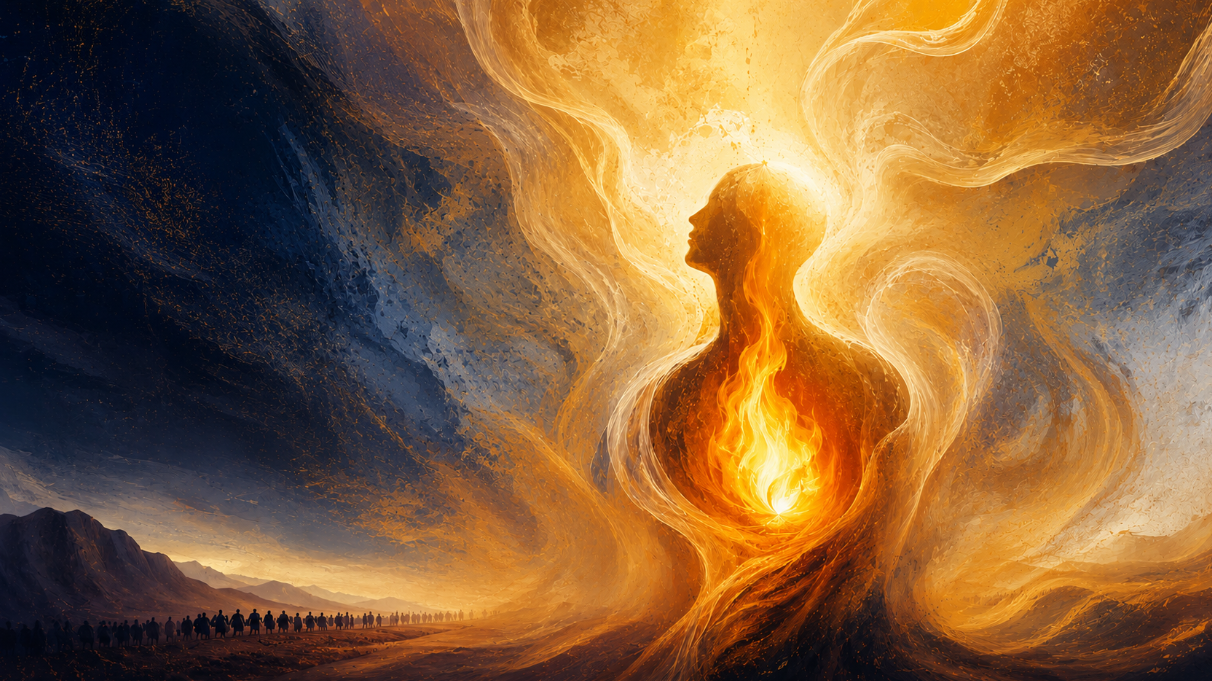
If the soul itself is the lamp of God, then perhaps the ultimate Jewish flame does not live in a synagogue or community building, a city, or even a country. It lives within us.
Yes, of course, synagogues matter. Dayschools matter. Institutions matter. We should do everything in our power to protect and strengthen them. But Jewish history teaches us that the flame has survived even when all those things were taken away from us.
Our Jewish people lost two holy Temples, kingdoms, homes and entire communities. We have been scattered and driven from lands we called home for centuries. Yet our light has endured.
Why? Because the true lamp was never the Menorah.
Proverbs says that the human soul is the lamp of the Lord.
And that means that wherever Jews go, the light goes with them.
This was the experience of the Crypto-Jews of Spain and Portugal, who risked their lives to secretly light candles behind closed shutters and whisper Jewish prayers in hidden rooms. It was the experience of Soviet Jews who celebrated Jewish holidays in secret and taught Hebrew in private apartments despite state persecution. It was the experience of countless Jews throughout history who were forced to hide their Judaism from the outside world while refusing to let it disappear from within.
Whether this moment compels you to question where you should be physically and spiritually - whether you still see your future in the Diaspora, or whether your eyes are turning once again toward Zion - remember this: you carry that flame within you. It is yours to nurture, yours to protect, and yours to pass on.
Our ancestors carried Judaism across deserts, oceans, borders and generations because they understood that the covenant was beyond time and place. It lives within an ancient people, Am Yisrael, eternally. The flame travelled from Jerusalem to Babylonia, from Spain to Amsterdam, from Eastern Europe to America and Australia, from North Africa to Israel. The light moved because the people moved. Whichever place Jews arrived to, they lit candles, opened books, taught their children, and rebuilt Jewish life, over and over again.
At moments like this, remaining visibly and proudly Jewish can itself feel like an act of courage. To gather in the synagogue. To celebrate Shabbat. To wear a Magen David. To speak openly about our connection to the Jewish people and to Israel. These may seem like ordinary acts, but throughout Jewish history they have often been acts of defiance. They are declarations that Jewish life will continue. They are our answer to those who would prefer that our light go out.
This steadfast determination to stay Jewish may be one of the greatest miracles of Jewish history. We are still here.
Exile may uproot a community, but it cannot uproot a soul. A synagogue can, God forbid, be destroyed. A school can be closed. A community can be scattered. A people can be driven from one land to another. But if Ner Adonai Nishmat Adam is true — if the soul itself is the lamp of God — then the ultimate vessel of Jewish continuity is not a building, but deep within the Jewish individual.
The covenant does not travel in buildings. It travels in souls. Wherever Jews have gone, they have carried the light with them. Wherever that light is tended to and raised, Jewish life endures.
The greatest Jewish response to darkness has never been despair.
It has always been more light.
That is the call of Beha’alotcha.
Not simply to be the light.
But to raise it.
And carry it within us for all time.
메타데이터
- post_id
- 5beefbece1d7
- slug
- can-the-jewish-flame-survive-another-age-of-antisemitism-5beefbece1d7
- url
- https://medium.com/@rabbimiriam/can-the-jewish-flame-survive-another-age-of-antisemitism-5beefbece1d7
- canonical_url
- https://medium.com/@rabbimiriam/can-the-jewish-flame-survive-another-age-of-antisemitism-5beefbece1d7
- author_url
- https://medium.com/@rabbimiriam
- status
- ok
- fetched_at
- 2026-06-09 15:37:30