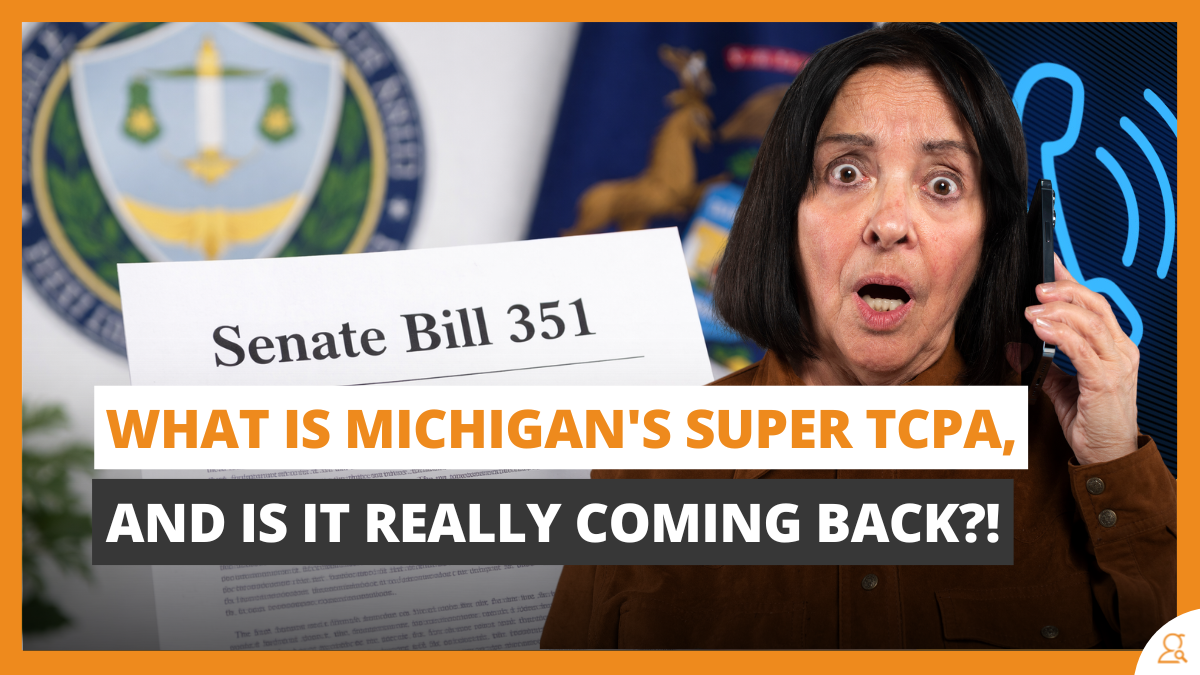
What is Michigan’s Super TCPA, and Is it Really Coming Back?!
Did you hear the news yet? TCPAWorld just flagged a big update on Michigan’s Telephone Solicitation Act proposal, known as Senate Bill 351…
What is Michigan’s Super TCPA, and Is it Really Coming Back?!
What is Michigan’s Super TCPA, and Is it Really Coming Back?!
Did you hear the news yet? TCPAWorld just flagged a big update on Michigan’s Telephone Solicitation Act proposal, known as Senate Bill 351. The headline is simple. This bill is moving again, and it is written in a way that can seriously raise the stakes for telemarketing teams that contact Michigan consumers. If your business runs outbound calls or texts into Michigan, this is worth a close look today.
This is not a done deal yet. The bill is still part of the lawmaking process, and outcomes can change. Will this bill be successfully passed into law? Only time can tell. Still, the content of the proposal gives a clear signal about where enforcement thinking is headed in Michigan.
What is SB 351?
TCPAWorld’s coverage frames this proposal as one of the tougher state-level telemarketing bills to watch. It mixes strict consent rules, DNC rules, dialing limits, and strong penalties. That combo can turn a normal campaign mistake into a high-cost problem. It also creates risk for lead generators, not just call centers.
What are the Rules in Michigan’s Telemarketing Solicitation Act?
1) Clear ban on recorded messages
The bill says a person must not make a telephone solicitation using a recorded message, in whole or in part. The definition matters because “telephone solicitation” also includes text messages and voice communications. The bill also lists exclusions tied to “express verifiable authorization,” which is the consent standard described in the proposal. If your campaigns use prerecorded drops, ringless voicemail, or recorded segments, this part hits first. A fast audit of every campaign type can save you from guesswork.
Key notes:
- Recorded message use is restricted for covered solicitations.
- “Telephone solicitation” includes texts and voice communications.
- Some calls may fall outside the definition, depending on purpose and authorization.
2) Michigan requires Express Verifiable Authorization
The bill introduces “Express Verifiable Authorization,” often shortened as EVA. EVA is described as a written agreement standard and includes a signature, which may be electronic or digital when valid under the law.
It also requires clear permission to deliver solicitations using autodialing, recorded messages, or prerecorded voicemail. The authorization must include the specific phone number being approved. It also requires disclosures that spell out what the subscriber is agreeing to and that signing is not required to buy goods or services.
What EVA includes:
- Subscriber signature, including valid electronic signatures
- Clear permission for autodialing, recorded, or prerecorded voicemail outreach
- The authorized phone number
- Required disclosures about what the agreement allows and what it does not require
3) Ban on calls to DNC numbers
The bill prohibits making a telephone solicitation to a number on the National Do Not Call Registry unless an exception applies. Examples of exceptions mentioned include EVA, existing customer situations, and charitable organization contexts.
Many teams already scrub lists, but this raises the expectation that DNC controls are real and consistent. A one-time scrub is not the same as a controlled process. Ongoing checks matter more when penalties rise.
Key notes:
- DNC protections apply to covered solicitations.
- Exceptions exist, but they depend on facts and documentation.
4) Ban on lead generation involving DNC numbers
This is one of the parts that can shock list brokers and lead buyers. The bill describes a restriction on including DNC-listed residential numbers in “lead generation.” The definition of lead generation is broad and includes sourcing, selling, subscribing, leasing, renting, distributing, purchasing, wholesaling, or transferring a list intended for solicitations. The point is not just calling. The list activity itself can become the issue. That means your upstream vendors can create risk for you before a single call happens.
Key notes
- DNC numbers are treated as off-limits for certain lead generation list activity.
- List buying and selling can pose compliance risks.
5) Required disclosures by telephone solicitors
The bill requires specific disclosures during solicitations and also applies them to text messages. It calls for the solicitor’s full name and information about the organization behind the text or call.
For voice communications, it also requires the caller’s true first and last name, as well as the organization’s full name, address, and phone number. A working callback number must be reachable between 9 a.m. and 5 p.m. local time at the subscriber’s residence. Failure to provide or maintain that callback number is treated as its own violation.
Disclosure checklist:
- Solicitor full name
- For texts, the organization or person on whose behalf the text is sent
- For calls, the caller’s true name, organization name, address, and phone number
- Callback number reachable 9 a.m. to 5 p.m. local time
6) Strict caller ID and number usage rules
The bill includes rules aimed at practices that appear to be spoofing or identity masking. It prohibits blocking caller ID and showing false, misleading, or inaccurate caller information. It also prohibits using another person’s number without consent. It calls out rotating or changing numbers to hide identity. This matters if your dialer rotates DIDs at scale and your callbacks are not mapped cleanly to your brand. Clean caller ID strategy becomes a compliance strategy.
Prohibited practices listed:
- Blocking caller ID
- Displaying false or misleading caller information
- Using someone else’s number without consent
- Rotating numbers to obscure identity
7) ADAD ban for vulnerable numbers
The proposal restricts the use of an autodialing device, called an ADAD, for telephone solicitations to certain categories. That includes numbers on the DNC registry and “vulnerable telephone numbers.”
Vulnerable numbers include hospitals, emergency lines, and numbers tied to people 75 or older and people with disabilities under Michigan’s civil rights act. The ADAD definition is described as broad and does not require random or sequential number logic. Exemptions are noted for calls made with EVA or to existing customers.
Key notes:
- ADAD rules can be broader than what some teams expect under federal standards.
- Vulnerable number categories increase risk even when targeting is unintentional.
8) TSR-style contract rules and misrepresentation ban
The bill includes requirements for contracts resulting from telephone solicitation. It requires notice of a 7-day cancellation right. It also requires a bold statement that the consumer is not obligated to pay unless they sign and return the contract.
It bans misrepresentations about cost, identity, terms, refund policies, or the nature of goods or services. It also bans deceptive practices during or after the call. If your sales process closes over the phone, scripts and contract templates become compliance items.
What this impacts:
- Sales scripts and offer explanations
- Call recordings and QA scorecards
- Contract templates and post-call follow-ups
9) Time-of-day restrictions
The bill limits telephone solicitations to the 8 a.m. to 9 p.m. window. Exceptions can apply if express verifiable authorization exists for other hours. This seems simple, but multi-state campaigns often get this wrong. Agents call from one time zone while the consumer lives in another. Systems need to use the consumer’s local time. This is not new. In fact, there are 26 states that have their own time calling restrictions.
Key notes:
- Outreach windows depend on the consumer’s local time.
- Time zone gating should be built into dialing and texting rules.
10) TCPA violation equals TSA violation
The proposal incorporates the federal TCPA and the federal Telemarketing Sales Rule concepts described in reporting. The point is that a violation of those federal rules can also constitute a violation of Michigan law. That means one bad act can create more than one legal problem at once. Businesses should assume double exposure is possible. Compliance planning should reflect that.
Why this matters:
- Federal risk does not replace state risk.
- One campaign can trigger both.
11) Michigan AG penalties can reach $25,000 per violation
The bill gives the Michigan Attorney General enforcement power with large civil penalties per violation. Reporting describes the standard level as up to $25,000 per violation. Higher amounts are described for violations tied to vulnerable individuals and repeated or knowing conduct involving vulnerable number protections. It also includes remedies such as injunctions, restitution, and the recovery of investigative costs. This is where “one mistake” stops being a small mistake.
Penalty levels described:
- Up to $25,000 per violation in standard cases
- Higher tiers for vulnerable-related violations
- Injunctive relief and restitution are also in play
12) Private right of action with $1,000 per call and attorney fees
The bill gives individuals the right to sue if they suffer a “loss” as a result of a violation. If they show a qualifying loss, they can seek statutory damages of $1,000 per violation or actual damages, whichever is greater. Reasonable attorney fees are also part of the structure. The open question is how Michigan courts would define “loss” if the bill becomes law. Businesses should not build a plan around hoping that the standard is narrow.
Key notes:
- Private lawsuits are part of the design.
- Per-call exposure can multiply fast in high-volume outreach.
13) Pre-suit investigatory powers for the AG
The bill also gives the Attorney General pre-suit subpoena tools, described as allowing demands for answers, documents, and testimony before filing a complaint. It also describes penalties for intentionally interfering with an investigation after receiving a formal demand or order. That includes hiding, destroying, altering, or withholding documents. This pushes record-keeping into the spotlight. Businesses need clean logs and clean storage habits.
What to take seriously:
- Record retention and audit trails
- Vendor access to logs and consent proof
- Document handling once a formal demand is received
What Businesses Contacting Michigan Consumers Should Do
Most companies do not lose lawsuits because they tried to follow rules. They lose because they cannot prove what happened later. Proof matters as much as intent.
Practical next steps:
- Review every campaign type and flag anything recorded or automated.
- Validate that consent proof is stored per phone number, not just per lead source.
- Run DNC checks as a routine step and not just before major campaigns.
- Lock caller ID behavior to match your brand and route callbacks correctly.
- Add time zone gating based on consumer location for calls and texts.
- Tighten lead vendor rules so DNC handling is documented, not assumed.
Final note and CTA
SB 351 is still moving through the process. It is not a law yet. Will this bill be successfully passed into law? Only time can tell. Still, the proposal shows a penalty structure that can be far more serious than what many teams budget for under typical TCPA risk. If a company stumbles into a class action tied to heavy per-violation exposure, the legal bill can be the kind of cost a business cannot afford. For some teams, it can mean being forced to stop outreach. For others, it can be worse.
If you want to reduce risk now, register for Searchbug’s FREE API Test Account and test TCPA compliance tools that support safer outreach. Teams commonly use tools like phone validation, DNC checks, timezone checks, and reassigned number checks to catch problems before agents dial or text. Cleaner screening helps you avoid risky numbers early, so you are not stuck defending preventable mistakes later.
메타데이터
- post_id
- 5bf2771d9ccf
- slug
- michigan-super-tcpa-tsa-5bf2771d9ccf
- url
- https://medium.com/@searchbug/michigan-super-tcpa-tsa-5bf2771d9ccf
- canonical_url
- https://medium.com/@searchbug/michigan-super-tcpa-tsa-5bf2771d9ccf
- author_url
- https://medium.com/@searchbug
- status
- ok
- fetched_at
- 2026-08-18 19:50:59