The End of Carrier-Dependent Money: Introducing Anonmesh
Most people discover their phone isn’t a phone the moment the network goes down.
The End of Carrier-Dependent Money: Introducing Anonmesh
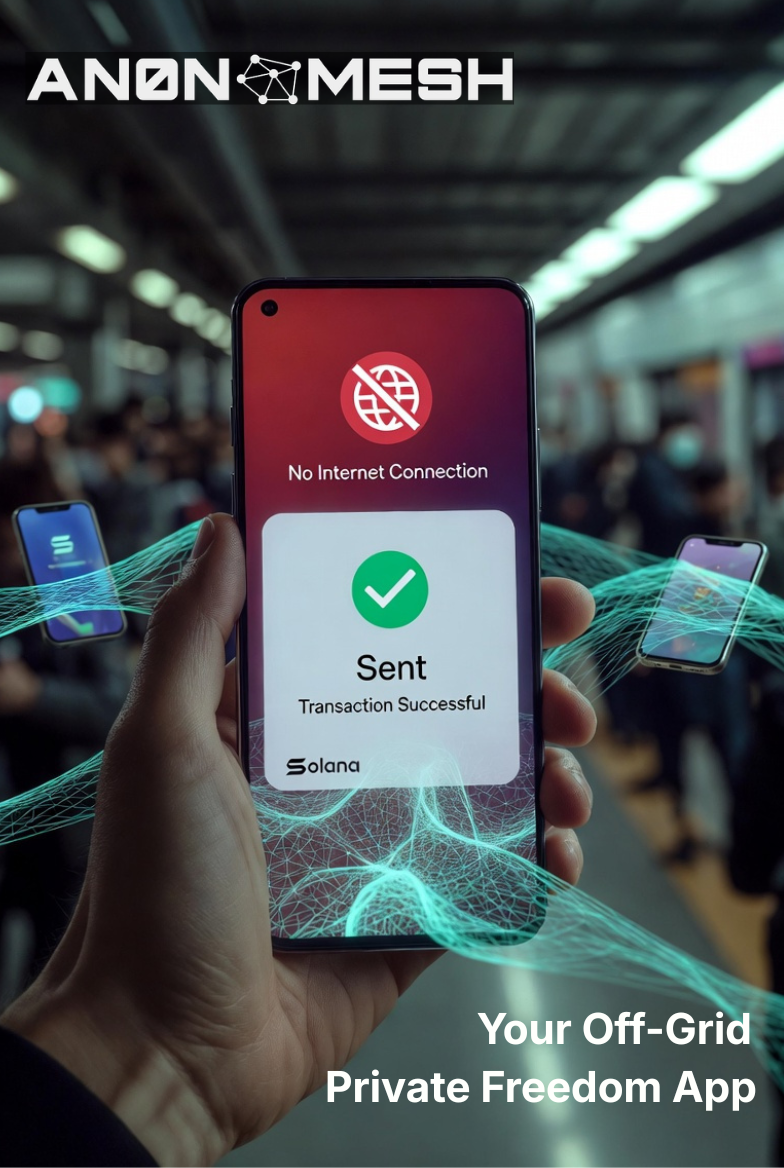
Most people discover their phone isn’t a phone the moment the network goes down.
It’s a glass brick, a camera with no signal, a wallet that can’t reach the chain.
Connectivity failures aren’t rare, they’re routine.
The crowded festival where a hundred thousand people crush the same towers. Subways drop signals. The rural areas where the nearest cell site is a thirty-minute drive and the signal barely carries. The protest where the network gets cut intentionally. The natural disaster where the infrastructure entirely.
In those moments, everything that depends on the internet stops working at once.
Not because the systems failed.
Because the path to them disappeared.
Your carefully stacked DeFi positions, your USDC balance, your ability to send value to someone standing ten feet away — all of it becomes theoretical.
We’ve normalized this dependency, we’ve accepted that digital money requires an internet connection, which requires infrastructure, which requires permission from a carrier or a government or just luck with geography.
That acceptance has costs we only notice when it breaks.
Signal encrypts messages but still depends on internet access.
Briar and Bridgefy solved offline but never solved payments. They can relay a chat over Bluetooth. They can’t relay a transaction.
The gap between encrypted communication without the internet, and the ability to transact without the internet has existed for years.
Nobody bridged it because the technical requirements are genuinely hard. You need a network that can compute on encrypted data without ever seeing it. Where phones become infrastructure, but remain blind to what they carry.
That’s the gap anonmesh was built to close.
What Anonmesh actually is
Aonmesh is an off-grid, privacy-first wallet. It runs on your phone. It connects directly to other phones nearby using hidden phone signals (Bluetooth), long-range radios (LoRa), offline signatures and those phones connect to others, and those to others, forming a mesh that routes around the missing internet.
Through that mesh, you can do two things:
- send encrypted messages. Person to person, or person to group.
- send private Solana transactions. Payments, contract interactions, whatever you’d normally broadcast to an RPC node.
The message and the money go through the same encrypted mesh. That’s the part that hasn’t existed before.
How it works, without the hype
The network layer is a mesh.
A phone running Anonmesh becomes a node. When you send something, your phone encrypts it and passes it to the nearest devices. Those devices pass it along. At each hop, the relaying phone sees only encrypted fragments. It cannot read the content. It cannot see the destination. It just knows enough to pass the data deeper into the mesh.
The relay node earns something for doing this work, hence Proof of Relay (PoR). You contribute connectivity, you get compensated. The mesh incentivizes its own expansion.
The privacy layer is Arcium’s encrypted compute. This is where it gets specific.
The mesh isn’t just routing data. It’s computing on encrypted state. Your transaction doesn’t travel as plaintext waiting for a lucky adversary to intercept it. It travels as a computation split across nodes that never reconstruct the whole. Each relay sees a fragment. The fragments are useless individually. Together, they execute the relay logic and forward the encrypted result.
When the transaction eventually reaches a phone with internet, that phone can submit it to Solana. But even that phone doesn’t know the sender. It’s carrying an encrypted payload that the chain can process through whatever confidential computation paths are available and anonmesh is built assuming those paths are expanding.
Why this isn’t just a disaster-preparedness project
The obvious usecase is “an internet kill switch can’t stop this network.” That’s true. It’s also the shallowest way to understand what’s being built.
The deeper thing: Anonmesh removes the infrastructure provider from the trust model entirely.
Where this sits in the bigger picture
The most sophisticated thing a wallet can do in a disconnected environment is not tell you you’re disconnected. It’s to route around the missing infrastructure and complete the transaction anyway, without leaking metadata to the devices that helped.
That capability doesn’t come from making existing wallets faster. It comes from a different architecture.
- A mesh instead of a client-server model.
- Encrypted compute instead of point-to-point encryption.
- A network where every user is infrastructure instead of a consumer of infrastructure.
We normalized the idea that money on your phone requires permission from a carrier because we didn’t have the stack to do it any other way.
That stack is arriving now.
Anonmesh is building a wallet that works when nothing else does, not by adding a feature, but by removing the dependency on infrastructure you don’t control.
Offline. Encrypted. Transactions and messages through the same private mesh.
No towers, internet, or surveillance.
Just phones talking to phones, computing on fragments they can’t read, and a network that grows stronger the more people join it.
메타데이터
- post_id
- 5c06a0f73fb5
- slug
- the-end-of-carrier-dependent-money-introducing-anonmesh-5c06a0f73fb5
- url
- https://medium.com/@shalyx/the-end-of-carrier-dependent-money-introducing-anonmesh-5c06a0f73fb5
- canonical_url
- https://medium.com/@shalyx/the-end-of-carrier-dependent-money-introducing-anonmesh-5c06a0f73fb5
- author_url
- https://medium.com/@shalyx
- status
- ok
- fetched_at
- 2026-07-10 17:18:11




