Enterprise AI Has Entered Its Microservices Moment
Workflow Engines Are Becoming AI Agent Platforms — And SLMs Will Power the Shift
Enterprise AI Has Entered Its Microservices Moment
Workflow Engines Are Becoming AI Agent Platforms — And SLMs Will Power the Shift
Over the last two years, enterprises rushed toward Large Language Models expecting transformational automation.
What many discovered instead was:
** escalating inference cost,
- unpredictable latency,
- fragmented AI pilots,
- governance concerns,
- and architectures that struggle to scale operationally.*
Most organizations are now facing a new realization:
The challenge is no longer accessing AI. The challenge is operationalizing AI sustainably at enterprise scale.
This is why workflow platforms, event-driven architectures, and Small Language Model (SLM)-powered AI agents are rapidly emerging as the next enterprise architecture pattern.
Enterprise AI Has Entered Its Microservices Moment
A decade ago, enterprises moved from monoliths to microservices because they needed:
** scalability,
- resilience,
- independent deployments,
- and domain ownership.*
Today, enterprise AI is approaching the same inflection point. Many current AI implementations resemble monoliths:
** one centralized LLM,
- massive prompts,
- shared reasoning,
- duplicated context,
- and tightly coupled orchestration logic.*
These systems work in demos. But at enterprise scale, they introduce:
** cost volatility,
- operational opacity,
- governance complexity,
- and performance bottlenecks.*
The industry is slowly shifting toward a new model: AI agents designed as microservices.
Why Current Enterprise AI Architectures Are Struggling
1. AI Pilots Are Not Scaling
Most enterprises now have multiple disconnected AI initiatives:
** copilots,
- document processors,
- recommendation engines,
- intelligent search systems,
- and workflow assistants.*
The result is fragmented AI ecosystems with inconsistent governance and duplicated operational effort.
2. LLM Costs Increase Faster Than Adoption
As AI usage grows, centralized LLM architectures create:
** increasing token consumption,
- GPU dependency,
- larger concurrency requirements,
- and expensive inference pipelines.*
Inference economics are rapidly becoming a board-level discussion.
3. Governance Is Becoming the Biggest Barrier
Enterprises now require:
** explainability,
- auditability,
- policy enforcement,
- traceability,
- and human-in-loop execution.*
Prompt-centric AI systems struggle to provide enterprise-grade operational governance.
4. AI Systems Are Becoming Operationally Opaque
Many organizations still cannot answer:
** why an AI decision was made,
- which prompt version executed,
- what context influenced the output,
- or how failures propagated across systems.*
This creates operational and regulatory risk.
Why Small Language Models Are Emerging as the Enterprise Standard
Models like:
** Phi-3
- Mistral 7B
- Llama 3*
are increasingly becoming better suited for enterprise workflows because they are:
** lightweight,
- faster,
- cheaper,
- easier to deploy,
- and operationally controllable.*
Most enterprise workflows do not require frontier-scale reasoning.
Tasks such as:
** KYC validation,
- Claims assessment,
- Document classification,
- Onboarding verification,
- Fraud detection,
- PII masking*
are domain-bounded and process-oriented.
This is where SLM-powered agents become significantly more practical than generalized LLM-centric systems.
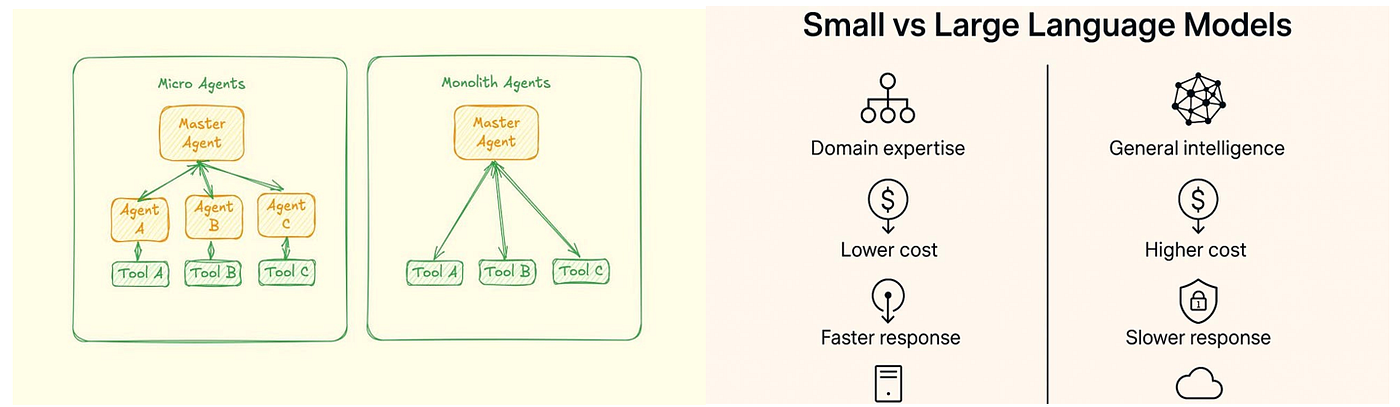
SLM vs LLM
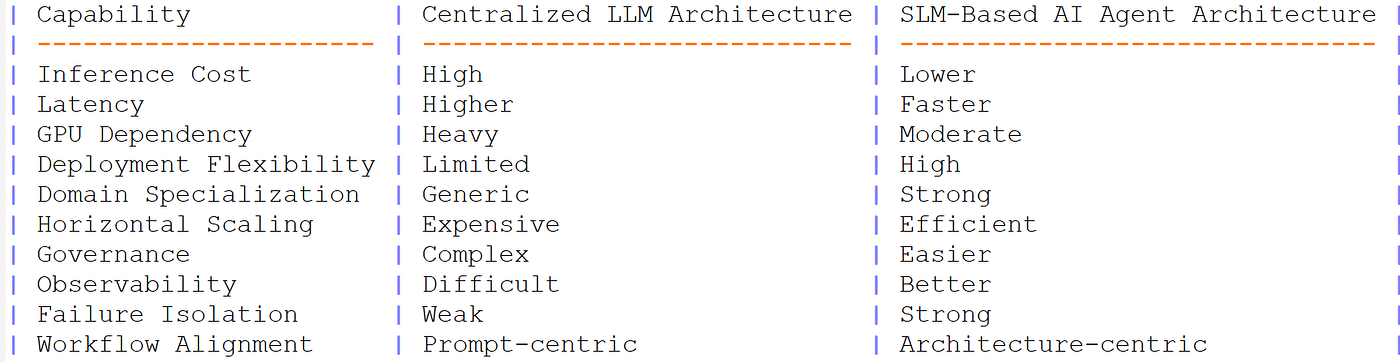
Capability Matrix
The future enterprise AI advantage will not come from using the largest model. It will come from building the most operationally efficient architecture.
Workflow Engines Are Becoming AI Orchestration Platforms
Camunda and custom BPM systems were originally designed to orchestrate deterministic business processes.
Now they are evolving into:
** AI orchestration layers,
- intelligent routing engines,
- governance control planes,
- and human-in-loop execution frameworks.*
The workflow layer still owns:
** approvals,
- retries,
- SLAs,
- auditability,
- escalation,
- and process visibility.*
AI agents introduce:
** contextual reasoning,
- classification,
- extraction,
- recommendation,
- and intelligent execution.*
This separation is critical.
Organizations embedding orchestration directly into prompts will eventually face:
** governance failures,
- debugging complexity,
- operational instability,
- and uncontrollable AI behavior.*
The workflow engine remains the control plane.
AI agents become intelligent execution workers.
The Emerging Enterprise AI Architecture
SLM with Dapr
The emerging enterprise stack is becoming increasingly consistent:
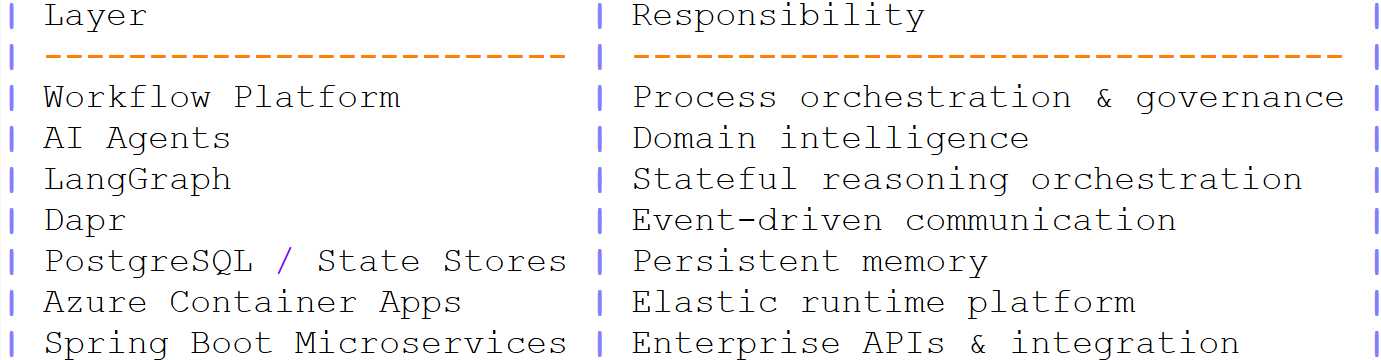
Layer & Responsibility Matrix
This architecture begins to resemble mature distributed systems engineering rather than experimental AI tooling.
AI Agents Should Be Designed Like Microservices
The most scalable enterprise AI architectures are adopting principles already proven in cloud-native systems.
Instead of building one massive “super agent,” organizations should design:
** specialized agents,
- bounded domain ownership,
- independently scalable runtimes,
- event-driven communication,
- and observable execution pipelines.*
Examples include:
** Fraud Detection Agent
- Compliance Validation Agent
- PII Detection Agent
- Recommendation Agent
- Claims Assessment Agent*
Each agent performs one business capability.
This creates:
**clearer ownership,
- lower hallucination risk,
- easier governance,
- stronger resiliency,
- and better operational scalability.*
Stateless AI Agents Will Become the Enterprise Standard
One of the most important design principles emerging in enterprise AI is this:
AI agents should remain stateless workers.
Persistent memory should live outside the runtime:
** PostgreSQL
- Redis
- Vector stores
- Workflow state stores*
This enables:
** replayability,
- resiliency,
- auditability,
- horizontal scalability,
- and fault recovery.*
The architecture starts behaving like mature cloud-native platforms instead of isolated AI experiments.
Governance and Observability Will Define Production AI Success
Most organizations can build an AI demo.
Very few can operationalize AI reliably.
Production AI requires:
** confidence scoring,
- audit trails,
- distributed tracing,
- fallback strategies,
- model routing,
- security controls,
- and operational accountability.*
This is where enterprise architecture becomes more important than prompt engineering.
The future winners in enterprise AI will not simply have the smartest models.
They will have the most governable and operationally efficient AI platforms.
AI Agents Will Reshape Enterprise Operating Models
The rise of AI agents is not only changing software architecture.
It is changing organizational architecture.
Enterprises will increasingly move toward:
** domain-owned AI agents,
- centralized AI governance platforms,
- reusable orchestration frameworks,
- and platform-engineering-driven AI ecosystems.*
Future enterprise teams may own:
** Compliance Agent Platforms
- Fraud Intelligence Services
- Customer Decision Agents
- Financial Workflow Agents*
instead of traditional automation silos.
This mirrors the platform engineering movement that transformed cloud-native adoption.
What Technology Leaders Should Prioritize Now
Short-Term
** Identify bounded AI workflow opportunities
- Avoid centralized “super agent” designs
- Introduce observability early*
Mid-Term
** Build reusable AI orchestration platforms
- Standardize workflow-governed AI execution
- Introduce model routing and fallback strategies*
Long-Term
*Treat AI agents as enterprise platform capabilities Design organization-wide AI runtime standards Build distributed intelligence ecosystems
Final Thought
The future of enterprise AI is probably not one giant model.
It is:
** workflow-driven,
- event-oriented,
- microservice-based,
- and powered by specialized AI agents using Small Language Models.*
This is not simply the evolution of AI.
It is the evolution of enterprise architecture itself.
Workflow engines are no longer just orchestrating APIs.
They are evolving into AI agent orchestration platforms.
And the organizations that recognize this transition early will define the next generation of intelligent enterprise systems.
메타데이터
- post_id
- 5c084d8d8657
- slug
- enterprise-ai-has-entered-its-microservices-moment-5c084d8d8657
- url
- https://medium.com/@abhishek.learning20/enterprise-ai-has-entered-its-microservices-moment-5c084d8d8657
- canonical_url
- https://medium.com/@abhishek.learning20/enterprise-ai-has-entered-its-microservices-moment-5c084d8d8657
- author_url
- https://medium.com/@abhishek.learning20
- status
- ok
- fetched_at
- 2026-06-18 00:10:23



