Whoever Heard Of An Underwater Ramjet Engine?
China has built a working prototype powered by boron and it works in flight as well, at supersonic speeds before entering the water for the…
Naval Weapons Technology
Whoever Heard Of An Underwater Ramjet Engine?
China has built a working prototype powered by boron and it works in flight as well, at supersonic speeds before entering the water for the terminal phase. A tall claim?
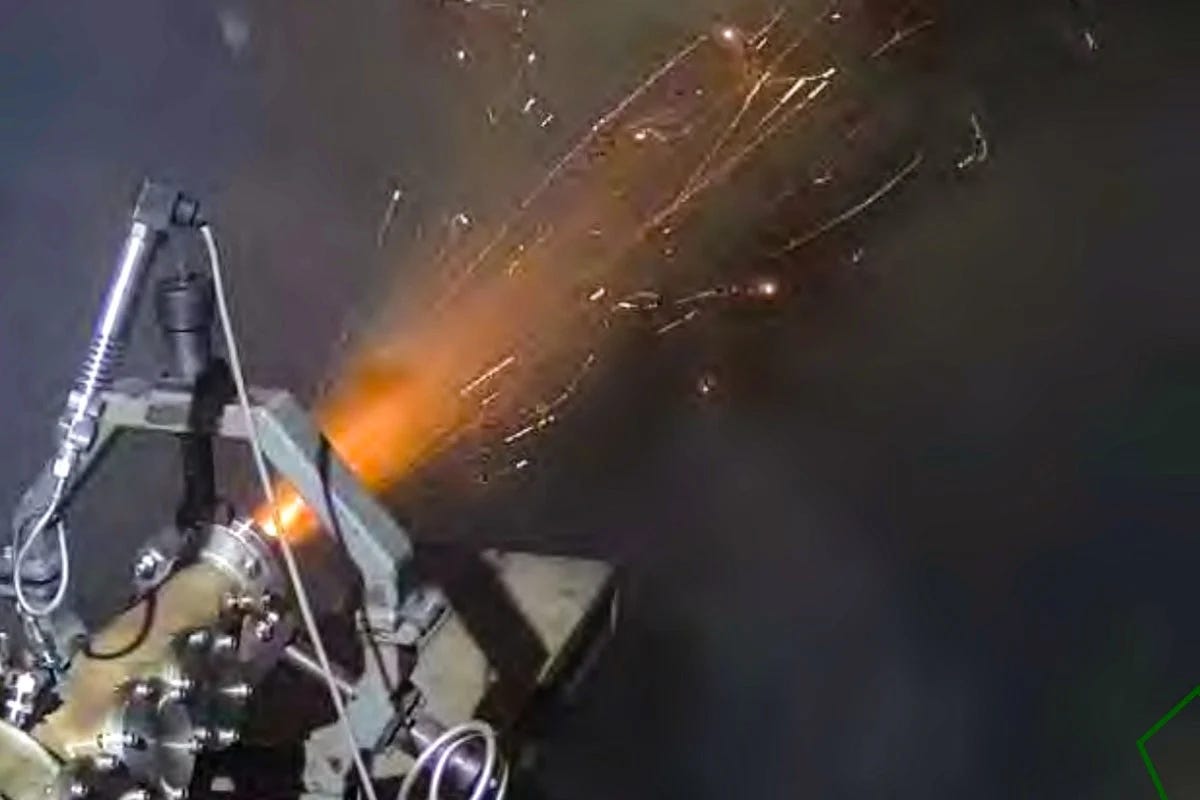
Underwater ramjet engine, powered by boron fuel, has been developed by Chinese researchers. Photo: National University of Defence Technology
The report
Recently the South China Morning Post reported that the People’s Liberation Army had ‘fired up’ the world’s first underwater boron ramjet for unstoppable long range anti-ship missile-torpedoes.
Background
The feasibility of high-speed underwater propulsion has long been a subject of naval research. Documents from the mid-twentieth century indicate that engineers sought to bypass the physical limitations of traditional propellers.
Unlike conventional engines that rely on moving mechanical parts to compress a medium, the underwater ramjet utilises the forward velocity of the vehicle itself.
This technology allows for speeds that were previously considered unattainable within a high-density fluid environment.
However, I note here that Russia, among other countries, has developed supercavitation torpedos capable of 200 knots, but these are powered by rocket motors. Indeed, a US-built supercavitation torpedo is believed to have sunk the Russian cargo ship Ursa Major in the Mediterranean Sea, as I wrote about recently.
Supercavitation’ weapons systems are possessed by Russia, the USA, Germany and Iran, that we know about, but these are all rocket powered as far as we know — the Russian and Iranian weapons for sure.

The steerable nosecone of the Russian VA-111 Shkval supercavitation torpedo (Wkipedia)

The rocket exhaust of the Russian VA-111 Shkval supercavitation torpedo (Wkipedia)
Chinese breakthough
Technologists at the National University of Defence Technology have successfully tested a system capable of functioning in both atmospheric and aquatic environments.
This cross-medium capability marks a departure from single-environment engines, allowing a vehicle to fly at supersonic speeds before transitioning into a high-speed underwater projectile. But it would have to slow down considerably before entering the water.
Recent developments have moved beyond general ramjet theory into specific material breakthroughs. Researchers have highlighted the use of boron as a primary fuel component, noted for its high energy density and reactive potential.
The technical distinction between these Russian and Chinese systems lies in the method of thrust generation and the environmental versatility of the powerplant.
The Russian VA-111 Shkval torpedo uses a solid-fuel rocket motor. This engine is self-contained and carries its own oxidiser, which limits the operational range (~10 miles) but ensures high speed through supercavitation. It is sea launched either from a submarine or from a ship’s deck mounted torpedo tube.
In contrast, the Chinese development employs an air-breathing and water-breathing ramjet. By using boron as a fuel that reacts with seawater, the Chinese system derives its oxidising agent from the surrounding medium.
This results in a higher specific impulse and allows for cross-medium travel between the atmosphere and the ocean.
This offers a huge potential difference in range and deployment flexibility.
But I have to question a design that claims to work in two fluid mediums with such a huge difference in density and viscosity.
How does it work?
The mechanism of an underwater ramjet, often termed a hydro-ramjet, operates on principles of ram pressure. As the craft moves forward at high velocity, water is forced into an intake at the front of the engine.
The internal geometry of the intake is designed to decelerate the incoming water, which converts kinetic energy into static pressure. This high-pressure water then enters a combustion chamber where a water-reactive fuel is injected.
In the configurations, this fuel consists of a solid propellant rich in boron. When the vehicle enters the water, the engine inhales seawater which acts as an oxidiser. The boron reacts with the water vapour and oxygen to produce intense heat and expansion.
Engineers have addressed the challenge of boron ignition by utilising a dual-phase combustion process and mixing the fuel with magnesium and aluminium to ensure stability. The resulting expansion of gas is expelled through a rear nozzle, creating thrust without the need for complex internal turbines or pumps.
Still here? Still puzzling about this?
Why it is significant
The significance of this propulsion method lies in its efficiency at extreme velocities.
The energy density of water-reactive fuels is higher than that of many batteries or compressed gases.
Rockets need to carry an oxidiser. Ramjets do not.
The use of boron specifically allows for a specific impulse that significantly exceeds traditional rocket motors.
This allows for smaller vehicle profiles while maintaining a high power-to-weight ratio.
The ability to travel through water at speeds exceeding 200 knots alters the tactical landscape of maritime navigation, as it bridges the gap between traditional naval speeds and the requirements of modern rapid-response systems. That may work for the Russian VA-111 Shkval torpedo, but this Chinese claim is a hell of stretch for me.
Weaponisation
The primary application of this technology is found in the development of next-generation torpedoes and interceptor drones.
A weapon equipped with an underwater ramjet can reach a target in a fraction of the time required by a conventional heavyweight torpedo. This reduces the window of opportunity for a target vessel to deploy countermeasures or perform evasive manoeuvres.
But it is the emergence of cross-medium missiles represents the most potent weaponisation of this technology.
Such devices can travel hundreds of kilometres through the air at Mach 2.5 before diving into the ocean to strike a target. How would it slow enough?
It would have to be travelling probably at less than 20 knots when diving into the sea. At that speed it might well be aerodynamically unstable unless in a vertical dive. And the ramjet would have flamed out.
Systems currently in development focus on the integration of these engines into autonomous platforms capable of high-speed attack that no current defensive system is equipped to intercept.
Conclusions
The underwater ramjet represents a shift in marine engineering and weapons technology. By utilising the medium of travel as a component of the combustion process as well as supercavitation, these systems overcome the drag and cavitation barriers that have historically limited sub-surface speed, and the fuel requirements which have limited range.
Future developments are likely to focus on the refinement of fuel mixtures to extend the operational range and reliability of these cross-medium systems.
That is of course if an underwater ramjet is just not technological propaganda by China.
I’m leaning towards fact, not fiction. It may well work underwater, but in both air and seawater? I cannot see the transition working at all.
[embed]
메타데이터
- post_id
- 5c0a0ce0f3ec
- slug
- whoever-heard-of-an-underwater-ramjet-engine-5c0a0ce0f3ec
- url
- https://medium.com/the-dock-on-the-bay/whoever-heard-of-an-underwater-ramjet-engine-5c0a0ce0f3ec
- canonical_url
- https://medium.com/the-dock-on-the-bay/whoever-heard-of-an-underwater-ramjet-engine-5c0a0ce0f3ec
- author_url
- https://medium.com/@james-marinero
- status
- ok
- fetched_at
- 2026-07-09 00:50:33