Why Technology Is Changing the Future of Financial Astrology and Market Analysis
Financial markets have become faster, more interconnected, and increasingly dependent on technology. Investors today can monitor global…
Why Technology Is Changing the Future of Financial Astrology and Market Analysis
Financial markets have become faster, more interconnected, and increasingly dependent on technology. Investors today can monitor global equities, commodities, currencies, interest rates, volatility, economic developments, and technical indicators almost instantly.
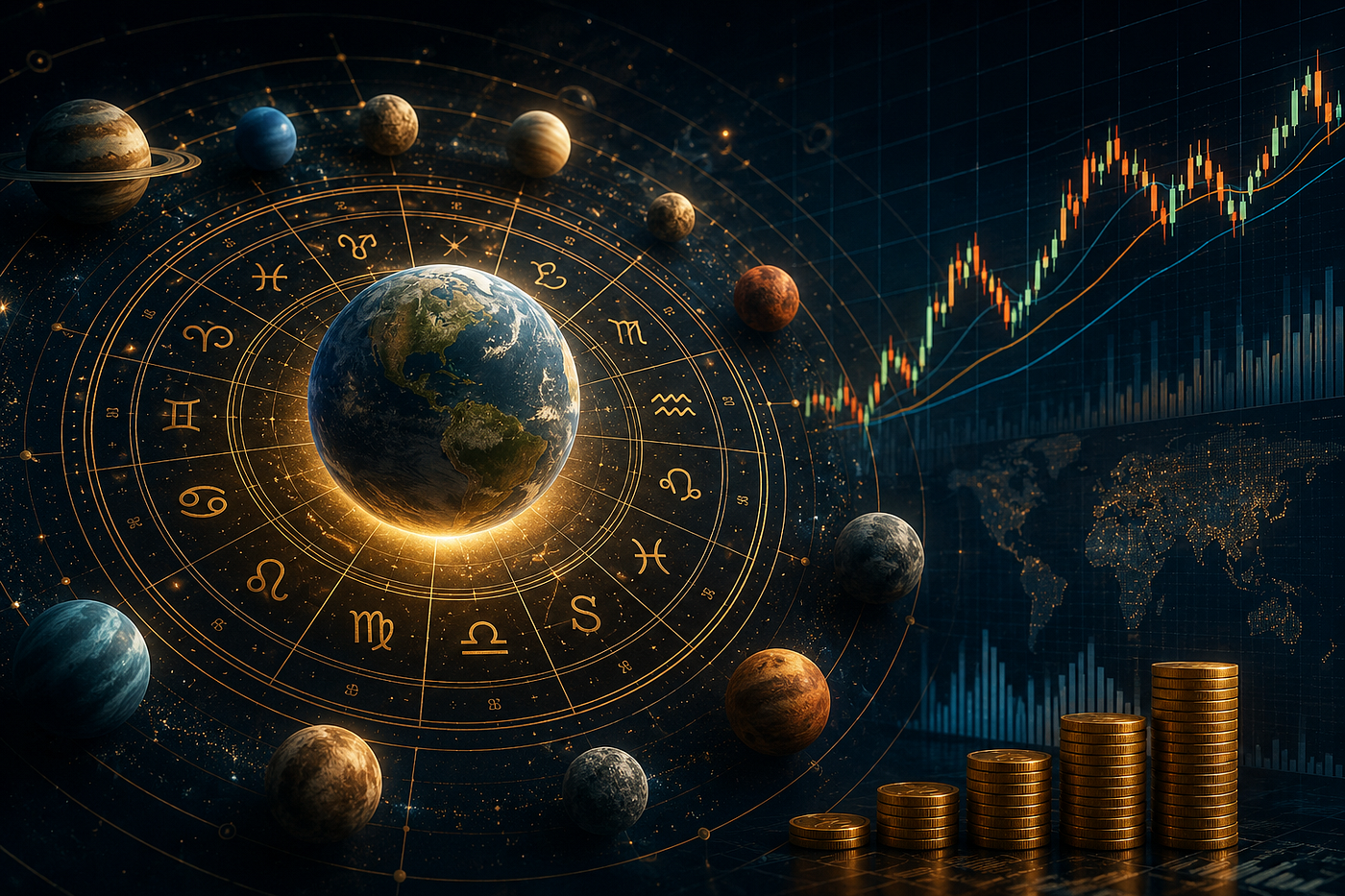
Financial astrology is also evolving within this technology-driven environment.
Traditional financial astrology relied heavily on planetary charts, manually calculated cycles, written forecasts, and an astrologer’s interpretation of how astronomical configurations might correspond with market behavior. Modern technology makes it possible to take a much more structured approach.
Planetary positions can now be calculated automatically. Historical market data can be compared with astronomical cycles. Technical indicators can provide price confirmation. Artificial intelligence can analyze large datasets, while real-time platforms can monitor several markets simultaneously.
This evolution is creating interest in the combination of a financial astrology terminal technical analysis framework.
Instead of treating astrology and technical analysis as competing methods, technology can connect them.
Financial astrology may identify when a market deserves greater attention. Technical analysis can show what price is actually doing during that period. Real-time data can then determine whether the timing hypothesis deserves action.
This does not mean technology proves financial astrology. There is no established scientific consensus showing that planetary configurations cause financial markets to rise or fall.
Technology instead makes financial astrology more testable.
That difference could define the future of the field.
How Financial Astrology Traditionally Worked
Financial astrology has historically focused on the relationship between planetary cycles and market behavior.
Researchers and astrologers may study conjunctions, oppositions, squares, retrogrades, eclipses, lunar phases, planetary ingresses, and longer astronomical cycles.
Vedic approaches may additionally analyze Rahu, Ketu, nakshatras, and other timing factors.
The astrologer then interprets whether a particular period could coincide with changing market sentiment, volatility, momentum, or a potential turning point.
This process was traditionally highly manual.
An astrologer might prepare a yearly forecast, monthly report, or trading calendar.
Investors would then compare those forecasts with financial markets.
Technology is changing nearly every stage of that process.
From Astrology Reports to Financial Astrology Terminals
One of the biggest changes is the development of terminal-style research environments.
A traditional astrology report provides static information.
A terminal can provide continuously updated intelligence.
A financial astrology terminal can potentially organize planetary timing calendars, global market prices, technical indicators, volatility, financial research, and trading signals in the same environment.
This creates a fundamentally different user experience.
Instead of reading a forecast and then opening several other platforms to check markets, investors can potentially study timing and price together.
That integration is particularly important for professional market analysis.
Why Technical Analysis Matters
Financial astrology focuses heavily on time.
Technical analysis focuses on price.
This creates a potentially complementary relationship.
Suppose an astrological timing model identifies the coming week as an important market window.
That information alone does not determine whether an investor should buy or sell.
Technical analysis can provide additional evidence.
Is price approaching important support?
Is the market testing resistance?
Is momentum improving?
Is the trend weakening?
Is volatility expanding?
Has a breakout occurred?
These observable market signals can help determine how the timing window should be interpreted.
Financial Astrology Terminal Technical Analysis Creates a Two-Layer Framework
A financial astrology terminal technical analysis approach can divide the decision process into two fundamental layers.
The first layer focuses on time.
Planetary cycles provide predefined periods that researchers believe may deserve additional market attention.
The second layer focuses on price.
Technical analysis evaluates whether the market is actually confirming a meaningful development.
This distinction is essential.
A planetary cycle may identify when to watch.
Price behavior determines what the market is saying.
The combination can create a more disciplined process than astrology alone.
Why Price Confirmation Is Important
Financial markets are influenced by countless variables.
Corporate earnings change.
Central banks alter monetary policy.
Inflation moves.
Currencies fluctuate.
Liquidity expands and contracts.
Geopolitical events occur unexpectedly.
Because of these forces, the same planetary configuration may appear in very different financial environments.
Technical analysis provides current market evidence.
Suppose an astrological model identifies a potentially bearish timing window.
If the market remains above major support, momentum remains strong, and breadth continues improving, there may be little reason to take an aggressive bearish position.
If price breaks support while volatility rises, however, the risk thesis may deserve greater attention.
Technology allows this confirmation process to happen almost instantly.
Support and Resistance Improve Timing Decisions
Support and resistance are fundamental technical concepts.
Support identifies areas where buying demand has historically appeared.
Resistance identifies areas where selling pressure has previously developed.
Imagine that an important financial astrology timing window approaches while the S&P 500 is testing long-term resistance.
The timing window may become more interesting.
But investors should still wait for evidence.
A decisive breakout could indicate continuation.
A rejection could indicate increasing downside risk.
The planetary timing provides context.
Technical price structure determines the practical interpretation.
Trend Analysis Is Essential
One of the biggest mistakes in market forecasting is attempting to predict reversals against extremely strong trends.
Financial astrology may identify a possible turning point, but the existing trend can continue.
Technical trend analysis helps reduce this risk.
Moving averages, market structure, trendlines, and price momentum can reveal whether buyers or sellers remain dominant.
When a financial astrology timing signal aligns with a changing technical trend, the combination may deserve greater attention.
When the two disagree, price evidence should generally receive greater weight.
Momentum Adds Another Confirmation Layer
Momentum measures the strength of a market move.
A market can continue rising while momentum gradually weakens.
This divergence may indicate that the trend is becoming less powerful.
Suppose an astrological timing window appears during such a divergence.
The combination could justify closer monitoring.
Alternatively, momentum may remain extremely strong during the timing window.
In that situation, attempting to predict an immediate reversal may be premature.
Technology allows momentum data to be incorporated directly into the financial astrology research process.
Moving Averages and Financial Astrology
Moving averages can provide a simple way to determine market direction.
A market trading consistently above important moving averages may remain in an established uptrend.
A market falling below them may be entering a weaker phase.
A financial astrology terminal can potentially display planetary timing alongside moving averages.
This helps investors avoid interpreting astronomical cycles without understanding the current market structure.
Again, the central idea remains simple:
Time identifies the observation window.
Price confirms whether it matters.
Breakouts Can Confirm Timing Windows
Breakouts represent another important technical signal.
Suppose a planetary timing window occurs while a commodity has been consolidating for several weeks.
If price suddenly breaks above resistance, the cycle window may correspond with trend acceleration.
If price instead breaks below support, the same period may correspond with bearish expansion.
This demonstrates why timing does not automatically equal direction.
The market determines direction.
That distinction can make modern financial astrology more practical.
Volatility Is Becoming Increasingly Important
Traditional financial astrology often focuses heavily on market direction.
Technology creates opportunities to focus more on volatility.
A planetary cycle may not consistently indicate whether a market will rise or fall.
However, it might theoretically correspond with changes in the magnitude of market movement.
A financial astrology terminal can monitor realized volatility, implied volatility, trading ranges, and other risk indicators.
Researchers can then evaluate whether specific timing windows historically coincide with unusually active markets.
This may provide a more useful research question than attempting to predict direction every time.
Market Breadth Strengthens Technical Analysis
Market breadth measures how many securities are participating in a move.
A major stock-market index can continue rising while fewer individual stocks participate.
This narrowing breadth may indicate increasing fragility beneath the headline index.
A financial astrology timing window occurring during weakening breadth might deserve closer attention.
If breadth remains strong, the market may still have healthy internal support.
Integrating breadth into a financial astrology terminal can therefore provide deeper market intelligence than watching index prices alone.
Technical Analysis Can Reduce Subjectivity
Financial astrology has traditionally involved significant interpretation.
Different astrologers may interpret the same planetary configuration differently.
Technical analysis provides measurable market evidence that can reduce some of this subjectivity.
Support either holds or breaks.
Momentum either strengthens or weakens.
Volatility either expands or contracts.
Breadth either improves or deteriorates.
These variables can be quantified.
A technology-driven platform can therefore require price confirmation before an astrological timing hypothesis influences a trading decision.
Real-Time Data Changes Financial Astrology
Another important technological development is access to real-time financial information.
Traditional forecasts could be produced days or weeks before a market event.
Today, investors can monitor price changes almost immediately.
Real-time data can show whether a planetary timing window is actually coinciding with unusual market behavior.
If a timing period begins but markets remain stable, the signal may receive little weight.
If volatility rises sharply and technical structure changes, the timing window may become more important.
This dynamic interpretation represents a major evolution from static astrology reports.
Artificial Intelligence Can Analyze Market Cycles
Artificial intelligence may further transform financial astrology research.
AI systems can analyze enormous historical datasets.
Planetary cycles can be synchronized with decades of financial-market information.
Researchers can investigate whether specific astronomical variables correspond with volatility, trend changes, sentiment, or market reversals.
AI can also incorporate technical indicators.
For example, a model could test whether an astrological timing window becomes more effective when the market is simultaneously overextended technically.
This creates new possibilities for systematic research.
AI Must Be Used Carefully
Artificial intelligence creates powerful analytical tools, but it also introduces serious risks.
Financial astrology includes a huge number of potential variables.
Researchers can test different planets, aspects, signs, retrogrades, nakshatras, lunar cycles, and timing windows.
Technical analysis adds even more variables.
If thousands of combinations are tested, some will appear profitable purely by chance.
This is known as overfitting.
The future of financial astrology technology therefore requires strict validation.
Complexity alone does not create reliability.
Backtesting Can Improve Financial Astrology Research
Backtesting allows researchers to examine how a hypothesis would have performed historically.
Suppose a particular planetary configuration is believed to identify potential equity-market turning points.
Technology can find every historical occurrence.
Researchers can then measure how markets behaved around those dates.
Technical conditions can also be included.
Was the market above or below its long-term moving average?
Was momentum weakening?
Was volatility increasing?
Did support break?
This provides much more information than studying only a few memorable historical events.
Technical Filters Can Improve Testing
A combined financial astrology and technical-analysis model could use filters.
For example, an astrological risk window alone might not produce a signal.
The model could require price to break support.
It could require momentum to weaken.
It could require volatility to rise.
Only when several conditions align would the system classify the market as higher risk.
Researchers can then backtest whether this combined framework performs better than astrology alone or technical analysis alone.
Evidence should determine the answer.
Out-of-Sample Testing Remains Essential
A model can produce excellent historical results and still fail in the future.
This is why out-of-sample testing matters.
Researchers can develop the model using one historical period.
They then test the unchanged rules on another period that was not used during development.
If performance remains useful, the hypothesis becomes more interesting.
If results disappear, the model may have been overfit.
Financial astrology terminals can make this process more systematic.
Time-Stamped Signals Improve Credibility
Technology also enables forecasts and trading signals to be time-stamped.
This is particularly important for financial astrology.
It is easy to identify planetary relationships after a major market event.
A more meaningful test is whether the timing window was identified beforehand.
A financial astrology terminal can store the original signal automatically.
Researchers can later compare it with the actual outcome.
This creates accountability.
Successful signals remain visible.
Failed signals should remain visible as well.
Financial Astrology Terminal and Daily Research
Another technological advantage is the ability to connect long-term forecasts with daily research.
An annual planetary calendar may identify important periods months in advance.
Daily analysis can then evaluate whether financial conditions are beginning to support those timing expectations.
Technical indicators can provide updated evidence.
The strategic forecast and daily market behavior remain connected.
This creates a multi-horizon research framework.
Live Signals Create an Execution Layer
Live signals can take the process one step further.
Suppose a longer-term cycle model identifies an important risk window.
Daily research becomes cautious.
Price then breaks major technical support during the trading session.
A live signal can provide immediate tactical information.
The process becomes:
long-term timing,
daily confirmation,
real-time execution.
Technology connects these horizons in a way that traditional astrology reports could not.
Financial Astrology Technology for Equity Markets
Equity indices are natural candidates for technology-driven financial astrology.
Markets such as the S&P 500, Nasdaq, Dow Jones, Russell 2000, Nifty 50, and other global indices generate enormous amounts of historical and real-time data.
Planetary timing variables can be compared with trend, momentum, volatility, breadth, and drawdowns.
The purpose should not simply be predicting whether an index rises tomorrow.
Researchers can instead examine whether timing windows help identify changing risk conditions.
Nasdaq and Technology-Sensitive Markets
The Nasdaq can be particularly sensitive to interest rates, liquidity, and investor risk appetite.
A financial astrology timing window therefore needs to be interpreted alongside those factors.
Technical analysis can reveal whether the index remains in a strong trend.
Bond yields can provide macroeconomic context.
Market breadth can show whether the rally remains healthy.
A terminal-style platform can bring these signals together.
This is much more useful than viewing astrology in isolation.
Gold and Financial Astrology Terminal Technical Analysis
Gold provides another important example.
A financial astrology timing model may identify a potential opportunity period.
Technical analysis can then examine whether gold is holding support or breaking resistance.
Real yields and the US dollar provide additional confirmation.
If several signals align, the timing window may become more relevant.
If they conflict, investors should remain cautious.
A combined platform allows the user to evaluate all of these factors together.
Silver Requires Strong Risk Controls
Silver tends to experience larger price swings than gold.
This makes timing important but also makes risk management critical.
A financial astrology terminal can combine planetary timing with technical support, resistance, momentum, volatility, and the gold-silver ratio.
However, no technical or astrological signal eliminates risk.
Position sizing remains essential.
Currency Markets Benefit From Real-Time Analysis
Foreign-exchange markets operate nearly continuously.
Economic reports and central-bank announcements can cause rapid price changes.
A financial astrology forecast produced days earlier may therefore require live confirmation.
Technical analysis can show whether a currency pair is breaking important levels.
Momentum can indicate whether the move has strength.
Real-time technology allows the interpretation to evolve with the market.
Commodity Markets Need Current Information
Commodity markets depend on changing supply and demand.
Oil can respond to geopolitical developments.
Agricultural prices can respond to weather.
Industrial metals react to economic growth.
Planetary timing may identify predefined observation periods, but fundamental market information remains critical.
Technology can combine those timing windows with current price and technical data.
This makes the process more adaptive.
Multi-Asset Analysis Is Becoming More Important
Financial markets do not operate independently.
Bond yields affect equities.
Currencies affect commodities.
Oil influences inflation.
Gold responds to real-rate expectations.
Credit markets can reveal financial stress.
A modern financial astrology terminal can therefore become more valuable when it analyzes several asset classes together.
Cross-asset confirmation can help determine whether a timing signal represents a broader market regime change or an isolated price movement.
Market Sentiment Can Be Integrated
Technology has made investor sentiment increasingly measurable.
Options positioning can indicate fear or speculation.
Volatility measures provide information about risk expectations.
News analysis can identify changing narratives.
Social data can reveal retail-investor enthusiasm.
These indicators can be compared with planetary timing.
If a supposedly important cycle occurs while sentiment is at an extreme, researchers can investigate whether the combination has historical significance.
Again, the relationship needs to be tested.
Liquidity Should Be Part of the Terminal
Liquidity can have an enormous influence on financial markets.
A technically expensive market may continue rising if liquidity remains strong.
A fundamentally attractive market may decline when liquidity contracts.
A financial astrology terminal becomes more useful when timing signals are evaluated alongside liquidity conditions.
Planetary cycles should not override the financial environment.
They should be interpreted within it.
Credit Can Provide Early Risk Confirmation
Credit markets can weaken before equities experience a major decline.
Widening credit spreads may indicate that investors are becoming more concerned about risk.
If this occurs during an astrological timing window and technical market structure also weakens, the convergence may deserve additional attention.
Technology can monitor these variables simultaneously.
This is how financial astrology can evolve toward multi-layer market intelligence.
Financial Astrology Should Become Probability-Based
Technology can also change the language of financial astrology.
Instead of predicting that a market must decline, a system can indicate that risk appears elevated.
Instead of declaring that a precise bottom will occur, the system can identify an opportunity window that requires confirmation.
This probability-based approach is more compatible with professional financial markets.
No indicator is perfect.
The objective should be improving decision probabilities rather than claiming certainty.
Risk Windows Are More Practical Than Exact Predictions
A financial astrology terminal may be particularly useful for identifying risk windows.
Suppose several planetary cycles converge during one period.
The system can alert investors in advance.
As the window approaches, technical analysis evaluates current conditions.
If price structure weakens, volatility expands, and breadth deteriorates, the portfolio manager may reduce risk.
If financial markets remain healthy, no major adjustment may be required.
This is a more practical framework than automatically predicting a crash.
Opportunity Windows Can Also Be Identified
Technology can use the same concept for potential opportunities.
Suppose equities experience a significant correction.
A predefined timing window approaches.
Technical momentum starts improving.
Market breadth stabilizes.
Price regains important support.
The combination may create a more attractive environment for staged capital deployment.
The exact bottom does not need to be predicted.
The objective is improving risk-to-reward conditions.
Portfolio Risk Management Should Remain Central
No financial astrology terminal should be treated as a substitute for risk management.
A trading signal can fail.
A breakout can reverse.
A timing window can produce no meaningful event.
Investors therefore still need controlled position sizes, diversification, appropriate leverage, and predefined exits.
Technology can provide more information.
It cannot remove uncertainty.
Institutional Investors Need Structured Research
Professional and institutional investors require transparent methodologies.
A vague astrological interpretation is difficult to incorporate into an institutional process.
A technology platform can improve structure.
Timing windows can be defined.
Signals can be archived.
Technical confirmation can be recorded.
Outcomes can be measured.
This makes the methodology easier to evaluate objectively.
Institutional investors still need to determine whether the signal adds measurable value.
Financial Astrology as a Market-Timing Overlay
The most practical role for financial astrology may therefore be as an overlay.
Fundamental analysis determines value.
Macroeconomic research explains the economic regime.
Quantitative analysis identifies statistical relationships.
Technical analysis evaluates actual price behavior.
Liquidity and credit reveal financial stress.
Financial astrology contributes a predefined timing hypothesis.
The portfolio decision comes from the combined evidence.
This hierarchy keeps observable financial-market information at the center.
Technology Is Changing the Role of the Financial Astrologer
The financial astrologer of the future may need a different skill set.
Understanding planetary cycles may remain central.
But knowledge of financial markets becomes increasingly important.
Technical analysis matters.
Risk management matters.
Data interpretation matters.
Technology matters.
Backtesting matters.
A successful research process may therefore look less like traditional astrology and more like an interdisciplinary market-analysis framework.
The Financial Astrology Terminal Could Become a Research Laboratory
Perhaps the most interesting technological development is the possibility of using a financial astrology terminal as a continuous research laboratory.
Every planetary hypothesis can be recorded.
Historical performance can be measured.
Technical filters can be tested.
Live signals can be archived.
Failed predictions can be analyzed.
The system improves over time.
Weak hypotheses can be discarded.
Promising relationships can undergo stronger testing.
This creates a culture of evidence rather than anecdote.
From Static Forecasting to Dynamic Intelligence
The biggest transformation may ultimately be the transition from static forecasts toward dynamic intelligence.
Traditional financial astrology asked what might happen based on planetary cycles.
Modern technology allows another question:
What is actually happening in the market as the timing window unfolds?
This creates a continuous feedback loop.
The planetary model identifies the timing window.
Technical analysis measures price.
Volatility measures risk.
Liquidity measures financial support.
Sentiment measures investor psychology.
Real-time data updates the interpretation.
The framework becomes adaptive.
The Future of Financial Astrology Terminal Technical Analysis
The future of financial astrology terminal technical analysis will likely depend on increasingly sophisticated integration.
Planetary calculations will become automated.
Technical indicators will update continuously.
AI will test historical relationships.
Market data will stream in real time.
Cross-asset dashboards will provide broader context.
Annual forecasts will connect with daily research.
Live signals will support tactical execution.
Performance databases will record both successes and failures.
The result could be a more transparent and measurable form of financial astrology research.
However, technology itself will never be enough.
The quality of the methodology will remain the most important factor.
Final Thoughts
Technology is changing financial astrology because it is changing what researchers can measure, test, monitor, and verify.
Financial astrology once depended largely on planetary calculations and written interpretation.
Today, astronomical cycles can be transformed into structured datasets.
Technical indicators can be integrated.
Global markets can be monitored in real time.
Artificial intelligence can analyze historical relationships.
Forecasts can be time-stamped.
Risk windows can be generated automatically.
Live signals can connect timing research with actual execution.
This is where the concept of financial astrology terminal technical analysis becomes particularly important.
Astrology does not need to compete with technical analysis.
The two can serve different purposes.
Financial astrology can propose a time window.
Technical analysis can determine whether price is confirming a meaningful development.
Real-time market data can show whether volatility, momentum, liquidity, or sentiment is changing.
Risk management can determine whether the evidence justifies portfolio action.
Financial astrology remains unconventional, and its proposed relationship with financial markets is not scientifically established. For that reason, technology should be used primarily to test the methodology — not to create greater certainty around an untested prediction.
The strongest framework is therefore:
Timing identifies when to pay attention. Technical analysis provides price confirmation. Technology connects the data. Risk management determines the action.
That combination may represent one of the most important directions in the future evolution of financial astrology and professional market-timing research.
For more insights into financial astrology terminal technical analysis, financial astrology technology, real-time financial astrology, financial astrology market timing, technical analysis, institutional market timing, artificial intelligence, global equities, gold, silver, commodities, currencies, and professional market intelligence, visit:
메타데이터
- post_id
- 5c2ffad35c4a
- slug
- why-technology-is-changing-the-future-of-financial-astrology-and-market-analysis-5c2ffad35c4a
- url
- https://medium.com/@financeterminal.astro/why-technology-is-changing-the-future-of-financial-astrology-and-market-analysis-5c2ffad35c4a
- canonical_url
- https://medium.com/@financeterminal.astro/why-technology-is-changing-the-future-of-financial-astrology-and-market-analysis-5c2ffad35c4a
- author_url
- https://medium.com/@financeterminal.astro
- status
- ok
- fetched_at
- 2026-08-09 04:52:39