On Being the First in Your Family to Love Books
There is no one to call when you finish a book that has broken you open.
On Being the First in Your Family to Love Books
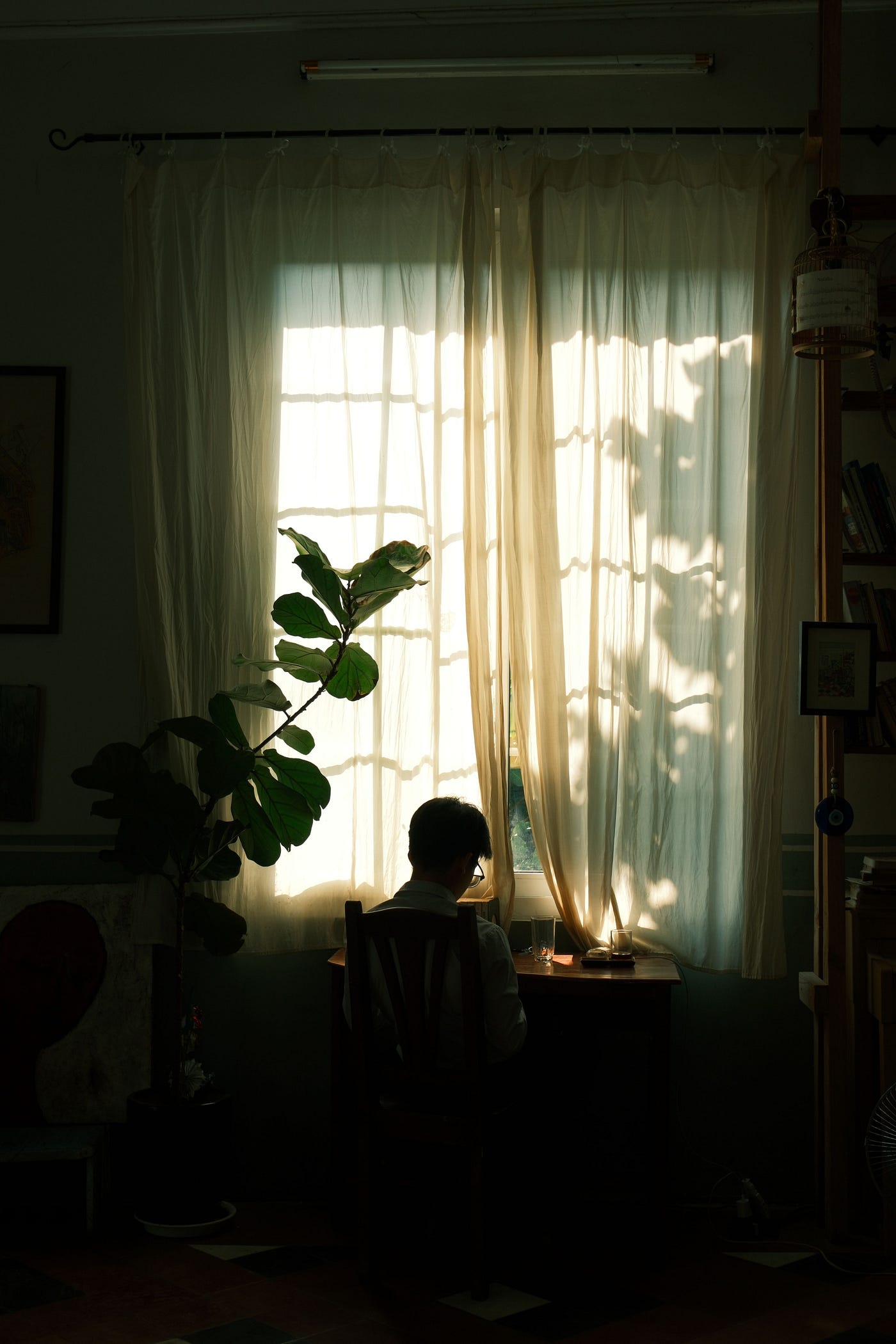
There is no one to call when you finish a book that has broken you open.
This is the thing nobody tells you about being the first reader in a family that did not read. Not that it is lonely, exactly. But there is a specific kind of solitude in having an interior life that the people who love you most cannot quite follow you into.
You love them. They love you. And there is still this place inside you, built quietly out of borrowed library books and second-hand paperbacks, that exists in a language they were never taught.
It starts innocently enough.
A teacher hands you something. A relative leaves a book behind. You find one at the bottom of a box being given away, and something about the cover makes you put it in your pocket. You read it in your room, or under a streetlight, or in the bathroom with the door locked because it is the only place in a full house where you can be alone.
And something happens. A door opens that does not close again.
The problem is that the door only opened for you.
Your family is not cruel about it. That is the complicated part. If they were dismissive or unkind, it would be simpler to name and easier to carry. Instead, they are simply somewhere else. They have their own languages, their own wisdoms, their own ways of understanding the world that were built from experience rather than pages. These are not lesser things. In many cases, they are more practical, more grounded, more useful for the actual business of surviving a life.

But they cannot talk to you about the thing that is happening inside you when you read. They cannot understand why you are crying over someone who never existed. They cannot follow you into the argument you are having with a dead Russian novelist at two in the morning. They look at you with a love that is real and complete and cannot reach the part of you that lives in books.
So you learn to live in two places at once.
There is a guilt that comes with this that takes years to name.
The feeling that your love of books is somehow a betrayal. A reaching toward something that implicitly criticises where you came from. An ambition that carries inside it, whether you intend it or not, a judgment about the people who did not reach for the same things.
This is not true. But it feels true for a long time.
What is actually happening is simpler and sadder and more ordinary than betrayal. You found a thing that made you feel less alone. You went toward it the way anyone goes toward anything that makes them feel less alone. You did not choose to leave anyone behind. You chose it because it was there and it opened something in you, and you were young and hungry for exactly that kind of opening.
The leaving behind, if it happened, was a consequence. Not an intention.
What you gain is real, and I will not pretend otherwise.
You gain access to centuries of accumulated human thought and feeling. You gain the ability to sit with complexity, to hold contradiction, to find language for things that resist language. You gain companions across time who understand the exact texture of feelings you were told were too much or too strange or too hard to explain.
You gain, in short, a second family. One is made of books and the dead people who wrote them. One that requires nothing of you except attention and asks nothing in return except that you show up and read honestly.
But you also carry something that does not have a clean name. The awareness of the distance between where you started and where reading took you. The complicated love for people who gave you everything they had and could not give you this particular thing because they did not have it to give. The knowledge that you built something inside yourself in a language that the people who built you cannot read.
I have never fully resolved this. I am not sure if it resolves.
What I have learned is that the books did not take me away from my family. They gave me a longer way back to them. A way of understanding their lives with more patience and more depth than I would have had without all that reading. Tolstoy taught me something about my father. Chekhov taught me something about the silences in my house. Woolf taught me something about the women around me who never had a room of their own and made something extraordinary anyway.
The books were not a door out. They were, eventually, a way of seeing more clearly what was already there.
It just took a long time to understand that. And there was still no one to call when I finished the book.
If you are reading this and you know exactly what I mean, then you already know you are not alone in this.
There are more of us than you think. First readers in families of non-readers, carrying our interior lives quietly, loving people we cannot fully share ourselves with, finding each other eventually in the margins of books and the comment sections of literary essays and the particular recognition that passes between two people who grew up reading alone.
We found our way here. That is nothing.
That is, in fact, everything.
메타데이터
- post_id
- 5c4d8ffe39c2
- slug
- on-being-the-first-in-your-family-to-love-books-5c4d8ffe39c2
- url
- https://medium.com/the-story-well/on-being-the-first-in-your-family-to-love-books-5c4d8ffe39c2
- canonical_url
- https://medium.com/the-story-well/on-being-the-first-in-your-family-to-love-books-5c4d8ffe39c2
- author_url
- https://medium.com/@shahzadmemon786
- status
- ok
- fetched_at
- 2026-07-11 14:08:24