Why Getting to Heaven Is Not the Point of Christianity
The spiritual AND the physical both matter to God
Why Getting to Heaven Is Not the Point of Christianity
The spiritual AND the physical both matter to God
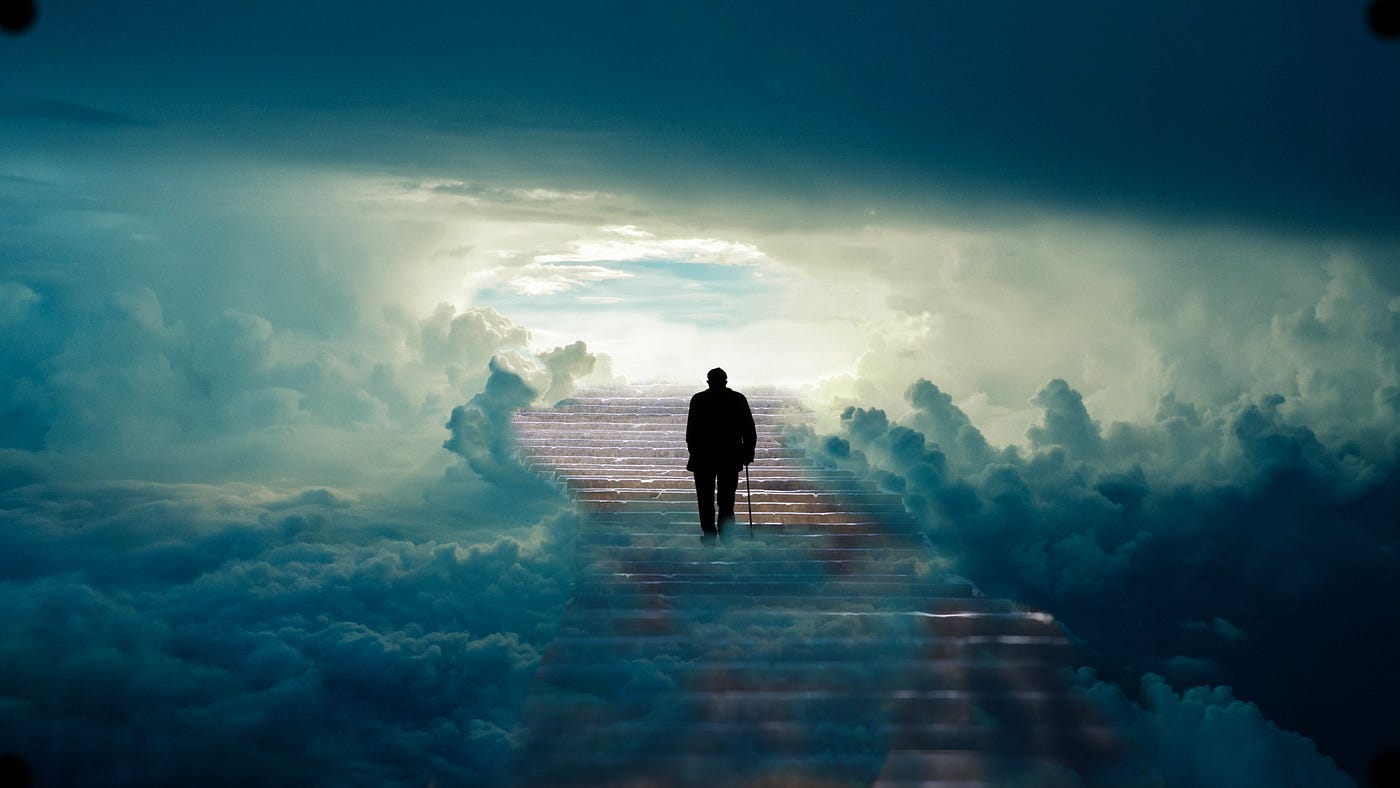
Photo by Javier Miranda on Unsplash
God is a materialist.
How do you feel when you read that statement?
It can be viewed in at least a couple of ways. One is that it’s an oxymoron because materialism is seen as the idea that nothing exists beyond the material. So, to talk of God, a non-material being, as a materialist doesn’t make sense. It’s like talking about a square circle.
The other way this statement can be seen is in the sense of a prosperity ‘gospel’ where God will bless you materially and has a great financial plan for your life.
Obviously, neither of those definitions is what I mean when I say that God is a materialist.
So what am I saying?
Let me ask you a question. Do you believe you’re going to spend eternity up in heaven with God? I once asked that question in a talk I gave on the topic; almost half the audience put their hands up.
Most of us have either grown up with or are still told in our churches that the spiritual is more important, and has greater value than, the physical or material world.
Don’t believe a word of it!
Just like the belief that our final destiny is ‘up’ in heaven with God, the idea that the spiritual is more important than anything else has seen Christian faith become irrelevant for millions of people. When you have it ingrained into you that being Christian is ultimately about being saved and going to heaven, then your faith has got nothing meaningful to say about issues of poverty, justice, politics, and economics.
Why would it if we’re going to leave this world after a short time and spend the rest of eternity up there with God?
If you do a Google search of ‘heaven’, the most images you will see are of stairs going up into the sky, and people on clouds. When Christians have a belief that that is our final destiny, it becomes natural that we then focus our energies on saving souls — getting people into heaven, and by implication, avoiding the other place.
That sort of belief not only short-changes the Gospel; if it’s true, then we can be bold enough to say that God hasn’t done a very good job.
Photo by Quino Al on Unsplash
Matter matters to God
The fact is that God loves the material world. Matter matters to God. After all, God made it and said over and over that it was good. And if God says it’s good, then who are we to deny its goodness by living our lives as if it’s not really that good?
The overarching theme throughout the whole of the Bible is that God is in the business of making all things new. When Jesus says this, which part of ‘all’ don’t we get? This world, the whole created order, everything, will one day be made new. Everything we see, touch, and feel today will one day be renewed, including our bodies. It is in that sense (and that sense only!) that God is a materialist.
God loves the physical and says it is no less valuable than the spiritual. In fact, God doesn’t even separate the spiritual from the physical like we do. That idea is more of a Western construct than a Christian one.
We can be assured that the works we do now in our efforts of justice are not in vain. They are central Gospel issues, just as much as evangelism is. We are not fighting for a better world that will one day be destroyed while we escape off to heaven and leave it all here to rot, as many Christians believe.
We are also not fighting a losing battle where wickedness and corruption always win. One day the tables will be turned; the first will be last, and the last will be first. There will be a day when there will be no more tears and no more pain because those things will all be of the past. That’s our great hope, and the great news is that we get to be a part of it right now.
We have the privilege of following Jesus into the places of poverty and injustice, into the places where the oppressed, the downtrodden, the troubled, and the addicted, are offered healing. It’s a revolution of love that overthrows the current world order. The Canadian singer Bruce Cockburn calls it “kicking at the darkness ’til it bleeds daylight”. I love that analogy.
Photo by Colton Sturgeon on Unsplash
The new world order
If you think back to the first Gulf War in 1991, President George H.W. Bush talked about creating a ‘new world order.’ Thankfully it never came off, because it was meant to be an order based on military might where the rich and powerful dominated the weak and vulnerable. How different to the new world order that Jesus came to establish.
To the might and power of a military imposition, we hear the quiet words of the Scriptures: ‘not by might, not by power, but by my Spirit, says the Lord.’ The kingdom that Jesus spoke about and lived, is a new world order that has already begun and will one day be completed when God finishes the job. It will be an order where all will experience justice, not just a privileged few. The privilege we have, though, is that we get to participate with God right now in renewing this world.
That’s why everything you do in this life matters. Every act of kindness, every act of care you do every day, matters. It matters not just to the people who receive your kindness, but it matters to God, and it has eternal significance. It will be a part of what we see when this new order is finally completed by God.
This is where the Gospel touches something deep inside all of us, something that tells us that there really is hope, that what we are doing really is worthwhile in the end, and that there really will be a day when everything will be put right. Sometimes it’s hard to believe, but hope literally springs eternal.
And it’s not a hope in the sense of ‘gee I hope it happens.’ It’s a hope based on what I’m convinced is historical fact. Otherwise, it would ultimately be empty and unfulfilling and wouldn’t be real hope.
If God hasn’t come to earth in the physical person of Jesus, and if Jesus wasn’t physically resurrected, then nothing really matters. We can make our own meaning and do all we can to bring justice while people are here, but if deep down we still know that it’s not everlasting — that in the end, everyone still dies and rots in the ground — then there is ultimately no justice, and no hope, and we come back to the sort of philosophy that people like Richard Dawkins espouse, which says,
“In a universe of blind forces and physical replication, some people are going to get hurt, others are going to get lucky, and you won’t find any rhyme or reason in it, nor any justice. The universe we observe has precisely the properties we should expect if there is, at bottom, no design, no purpose, no evil and no good, nothing but blind, pitiless indifference.”
Another Richard, Franciscan priest Richard Rohr, says that the human soul can live without success, but it can’t live without meaning. Deep down, we all crave significance. We all want to be part of something that matters and lasts. Rohr quotes Albert Einstein who said,
“At the end, “the only important question is this: Is the universe friendly or not?” Can it all be trusted? Is the final chapter of history victory and resurrection or a dying whimper?”
That’s the question we all face. Is there meaning in the universe?
Christian faith answers that question with a spectacular and emphatic “yes!” There is hope, and it’s real. Goodness really does prevail. As Martin Luther King said in a previous generation, “The moral arc of the universe is long, and it bends towards justice.”
The Christian message is that we live in a friendly universe. And so to the quote above by Richard Dawkins, we hear the reply from Jesus coming down through the centuries, “Even the very hairs of your head are all numbered.” You are significant, not just because you might tell yourself you are, but because you really are.
God is passionately interested in the physical just as much as the spiritual. A creation that’s renewed in every way — spiritual, emotional, psychological, and physical — is what God has begun and what we are involved in bringing to fruition.
God loves every part of what has been created — physical, spiritual — there is no difference. All are loved by God, and all are being renewed by God. That’s why works of justice are important. You and I are part of that renewal, and there is no greater job to do than that!
New to Medium? Click here to become a Medium member and get access to all of my articles and thousands of others.
The Backyard Church is not just a blog. It’s a real online community for people who have faith but can’t, don’t, or won’t go to church. Join today.
메타데이터
- post_id
- 5c61e6fc1185
- slug
- why-getting-to-heaven-is-not-the-point-of-christianity-5c61e6fc1185
- url
- https://medium.com/backyard-theology/why-getting-to-heaven-is-not-the-point-of-christianity-5c61e6fc1185
- canonical_url
- https://medium.com/backyard-theology/why-getting-to-heaven-is-not-the-point-of-christianity-5c61e6fc1185
- author_url
- https://medium.com/@NilsvonKalm
- status
- ok
- fetched_at
- 2026-07-11 21:25:18