The Mathematics of Hashing: From Uniform Distribution to Collision Resistance
Hashing is the cornerstone of modern computer science, transforming arbitrary inputs into fixed-size numerical outputs. This process…
The Mathematics of Hashing: From Uniform Distribution to Collision Resistance
Hashing is the cornerstone of modern computer science, transforming arbitrary inputs into fixed-size numerical outputs. This process enables everything from O(1) data retrieval in hash tables to the immutable security of blockchain ledgers.
This article provides a rigorous analysis of the probabilistic foundations of hashing, deriving key metrics like load factor and expected collisions while contrasting the design philosophies of data structure hashes versus cryptographic primitives.
1. Fundamentals of Hashing
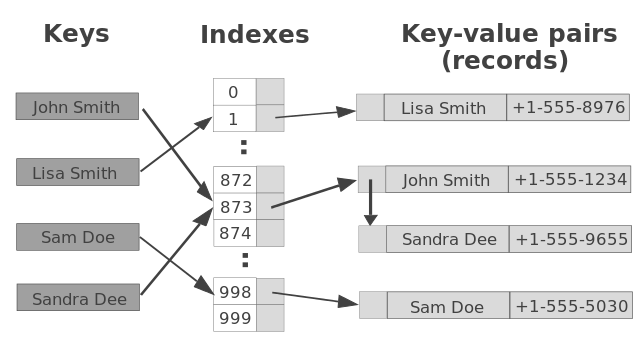
At its simplest, a hash function h: U → [m] maps a large universe of potential keys U to a finite set of m “slots” or “buckets.”
The Ideal: Simple Uniform Hashing
Under the Simple Uniform Hashing Assumption (SUHA), an ideal hash function distributes keys such that:
-
Each key is equally likely to hash to any of the m slots.
-
The hash value of a key is independent of where other keys have been hashed.
Mathematically, this implies Pr[h(x) = i] = 1/m, for all x ∈ U and i ∈ [m]. In practice, achieving perfect uniformity for a fixed set of keys is difficult, leading to the development of Universal Hashing.
Universal Hashing

A family of functions 𝓗 is universal if, for any two distinct keys x, y ∈ U, the probability of a collision is no greater than if the hash values were chosen truly at random:
Prₕ∼𝓗 [h(x) = h(y)] ≤ 1/m
A classic implementation is the Carter-Wegman construction:
hₐ,ᵦ(x) = ((a·x + b) mod p) mod m
Where:
- p is a prime > |U|
- a ∈ [1, p−1]
- b ∈ [0, p−1]
Because this family is pairwise independent, it ensures that
Pr[hₐ,ᵦ(x) = hₐ,ᵦ(y)] = 1/m exactly, effectively minimizing clustering and ensuring that a(x − y) ≡ 0 (mod p) only with negligible probability for x ≠ y.
Stronger Guarantees: k-Universal Families and Tail Bounds
While pairwise independence is sufficient for bounding expected collisions, it is not always adequate for controlling the maximum load in adversarial settings.
A hash family is k-universal if for any distinct keys x1,x2,…,xkx_1, x_2, …, x_kx1,x2,…,xk, the hash values are independent and uniformly distributed.
Stronger independence yields tighter concentration:
- With 2-universal hashing → good expectation bounds
- With O(log n)-wise independence → Chernoff-like bounds hold
- With 4-wise independence → sufficient to bound variance tightly in many practical scenarios
In particular, with sufficiently high independence, the maximum load satisfies:
max bucket size = O(log n / log log n) with high probability
This result is crucial in designing robust hash tables under adversarial inputs, where weaker hash families can degrade to linear-time behavior.
2. Load Factor and Performance Metrics
The efficiency of a hash table is dictated by its load factor,
α = n / m
Where:
- n = number of keys
- m = number of slots
Cache Locality and Memory Hierarchy Effects
While asymptotic complexity suggests O(1) operations, real-world performance is dominated by memory access patterns.
- Chaining suffers from poor cache locality due to pointer chasing
- Linear probing benefits from spatial locality, often outperforming chaining despite worse theoretical clustering behavior
This leads to a counterintuitive result:
Linear probing can be faster than theoretically superior methods because modern CPUs favor contiguous memory access.
The expected probe sequence length under linear probing grows rapidly as α → 1, but for α ≤ 0.7, it remains extremely cache-efficient.
This insight heavily influences production systems like:
- in-memory databases
- high-performance key-value stores
Occupancy and Distribution
For n keys, the number of keys in a specific slot Nᵢ = Σ (j=1→n) 𝟙[h(kⱼ) = i].
By the linearity of expectation, E[Nᵢ] = n/m = α
Under 2-universal hashing, the variance is Var(Nᵢ) = α(1 − 1/m). Using Chernoff bounds, we can bound the probability of a slot overflowing its expected capacity:
Pr[Nᵢ > (1 + δ)α] < e^(−δ²α / 3)
Search Time Complexity
Performance varies based on the collision resolution strategy:
- Chaining: Keys are stored in linked lists at each slot. An unsuccessful search scans α + 1 nodes. A successful search averages 1 + α/2 probes, assuming the target key is uniformly distributed within the chain.
- Open Addressing (Linear Probing): When collisions occur, the algorithm searches the next available slot. This leads to “primary clustering.” The expected number of probes for a successful search is approximately:
- ½ (1 + 1/(1 − α))
- Double Hashing: Mitigates clustering by using a second hash function to determine the step size, improving unsuccessful search time to:
- 1 / (1 − α)
3. The Geometry of Collisions
Collisions are mathematically inevitable when |U| > m (The Pigeonhole Principle). We define the total number of collisions C as the number of pairs (i, j) that map to the same slot.
Expected Collisions and the Birthday Paradox

For a universal hash function, the expected number of collisions is:
E[C] = (n choose 2) · Pr[h(kᵢ) = h(kⱼ)] ≈ n² / (2m)
This identifies a critical threshold known as the Birthday Paradox. Even with a large m, the probability of at least one collision exceeds 0.5 when n ≈ √(2m ln 2)
For a hash table to remain “collision-free” with high probability (Perfect Hashing), we typically require m = Θ(n²), which is space-inefficient for large datasets. This is why most systems use m = Θ(n) + collision resolution and implement robust resolution strategies.
Beyond Expectation: Distribution of Collisions
While the expected number of collisions is:
E[C] ≈ n² / (2m)
the distribution of collisions is also important.
Under simple uniform hashing, the number of keys per bucket follows approximately a Poisson distribution with parameter α:
Pr[Nᵢ = k] ≈ (e^{-α} α^k) / k!
This implies:
- Most buckets remain lightly loaded
- A small fraction of buckets dominate collision cost
Understanding this skew is critical for:
- designing load balancing strategies
- predicting worst-case latency in distributed hash tables
4. Perfect Hashing and Static Dictionaries

When the key set is fixed, we can eliminate collisions entirely using perfect hashing.
A two-level scheme works as follows:
- First-level hash distributes keys into buckets
- Second-level hash tables are constructed per bucket
If each second-level table has size proportional to the square of its bucket size:
mᵢ = Θ(nᵢ²)
then collisions can be eliminated with high probability.
Total space remains linear:
Σ nᵢ² = O(n) (in expectation)
This technique is widely used in:
- compiler symbol tables
- static keyword lookup systems
It demonstrates a key idea:
Randomization can convert worst-case guarantees into expected-case optimality.
5. Hash Tables vs. Cryptographic Hashes
While both use the same underlying math, their adversarial models differ significantly.


General Structure of a Cryptographic Hash Function
Cryptographic Requirements
- Preimage Resistance: Given y, it is hard to find x such that h(x) = y.
- Second Preimage Resistance: Given x, it is hard to find x’ \neq x such that h(x) = h(x’).
- Collision Resistance: It is hard to find any two distinct inputs x, x’ such that h(x) = h(x’).
Modern constructions like SHA-3 (Sponge Construction) use a “capacity” c to provide diffusion, while BLAKE3 utilizes tree-hashing to achieve speeds comparable to non-cryptographic hashes by leveraging extreme parallelism.
6. Advanced Theoretical Frameworks
k-wise Independence
While 2-universal hashing is often sufficient, k-wise independence (where any k keys are distributed uniformly and independently) provides tighter guarantees on the maximum load. For example, with 4-wise independence, the maximum chain length remains O(log n / log log n) with high probability.
Locality-Sensitive Hashing (LSH)

In specific applications like nearest-neighbor search, we actually want similar inputs to collide. LSH functions are designed such that:
Pr[h(x) = h(y)] = f(similarity(x, y))
This allows for sub-linear time searches in high-dimensional spaces by hashing “close” items into the same buckets.
Cuckoo Hashing: Deterministic O(1) Lookup

Cuckoo hashing uses two hash functions and guarantees worst-case O(1) lookup:
- Each key can reside in one of two locations
- Insertions may trigger “evictions” (like cuckoo birds)
Lookup:
O(1) worst-case
Insertion:
Amortized O(1), but may require rehashing
Load factor threshold:
α ≈ 0.5
Despite lower space efficiency, cuckoo hashing is used in:
- high-performance networking systems
- hardware hash tables
because of its predictable lookup latency.
Quantum Considerations
The advent of quantum computing introduces Grover’s Algorithm, which reduces the difficulty of finding a preimage from2ˡ → 2ˡᐟ². Furthermore, the BHT algorithm can find collisions in O(2ˡᐟ⁴). This necessitates a transition to longer digest lengths (e.g., SHA-512) or post-quantum hash-based signatures like SPHINCS+.
Practical Engineering Tradeoffs
In real systems, hashing decisions involve tradeoffs:
- Space vs speed (load factor tuning)
- Cache locality vs theoretical guarantees
- Simplicity vs adversarial robustness
For example:
- Python dictionaries use open addressing with perturbation
- Java HashMap switches to balanced trees under heavy collisions
These hybrid approaches reflect a deeper principle:
Theoretical guarantees guide design, but hardware realities determine performance.
Conclusion
From the O(1) lookup of a Python dictionary to the 2²⁵⁶ security margin of Bitcoin, the mathematics of hashing balances the trade-offs between distribution uniformity and computational cost.
Whether through the lens of Carter-Wegman universal families or Merkle-Damgård iterations, the goal remains the same: the efficient and predictable management of information in an unpredictable universe.
메타데이터
- post_id
- 5c805c2c8cd5
- slug
- the-mathematics-of-hashing-from-uniform-distribution-to-collision-resistance-5c805c2c8cd5
- url
- https://medium.com/@abhinavpabbaraju/the-mathematics-of-hashing-from-uniform-distribution-to-collision-resistance-5c805c2c8cd5
- canonical_url
- https://medium.com/@abhinavpabbaraju/the-mathematics-of-hashing-from-uniform-distribution-to-collision-resistance-5c805c2c8cd5
- author_url
- https://medium.com/@abhinavpabbaraju
- status
- ok
- fetched_at
- 2026-06-09 15:37:30