Bringing Back The Ice Age
Woolly mammoths are large, woolly, elephant-like mammals that roamed our planet during the Ice Age. They have been extinct for the past…
Bringing Back The Ice Age
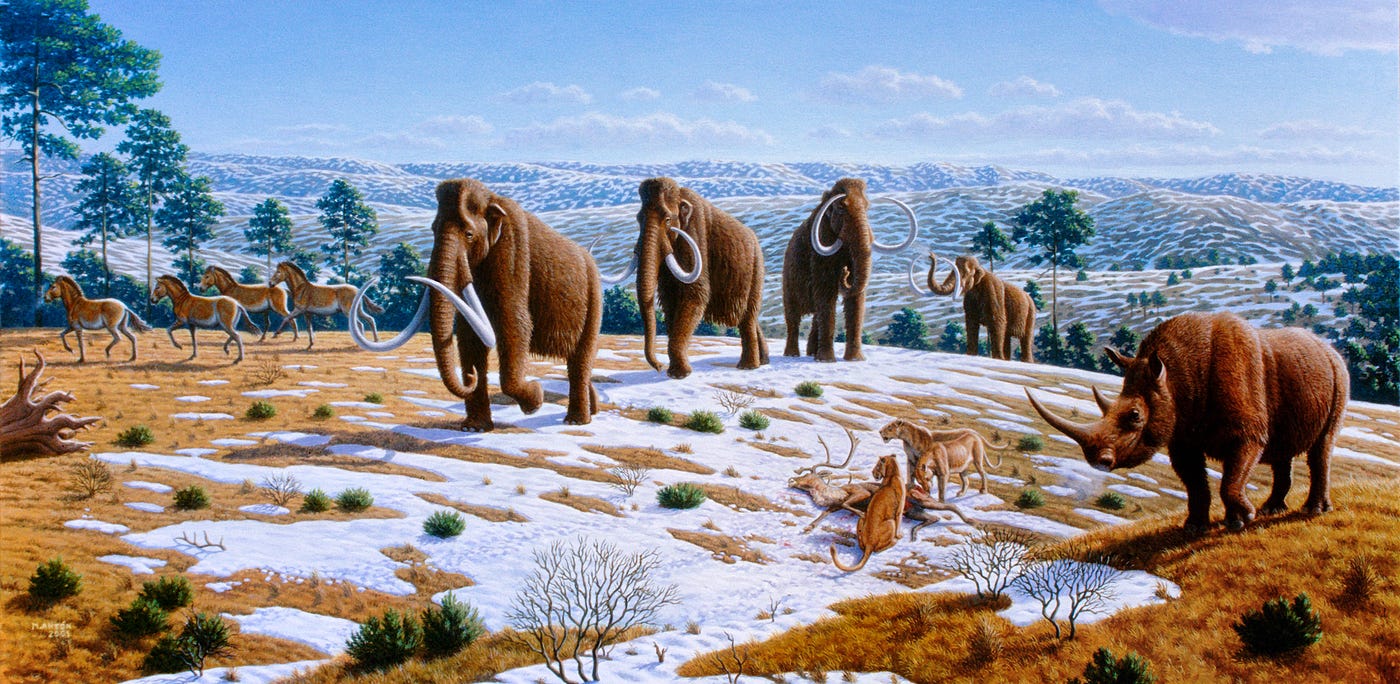
(Woolly Mammoth) © Pleistocene Park
Woolly mammoths are large, woolly, elephant-like mammals that roamed our planet during the Ice Age. They have been extinct for the past 4,000 years. But as technology advances, it becomes a possibility that they will not remain extinct for much longer. Pleistocene Park, the institution created by Sergey Zismov in 1997 aims to restore the highly productive grazing ecosystems (mammoth steppes) in the Arctic and bring mammoths back to life. As the Siberian Tundra, a biome similar to where a mammoth would have lived, is uninhabited by humans, woolly mammoths have a greater chance of surviving in the wild. Not only is the feat of mammoth de-extinction now achievable, it could even help to mitigate climate change. Despite the potential benefits, it is important to consider the ethical and logistical implications that a project of this scale could have.
The incredible task of bringing woolly mammoths back to life could potentially be achieved with CRISPR-Cas9 gene editing technology. CRISPR-Cas9 is the latest of gene editing techniques and is widely considered the biotechnology’s greatest innovation. Genes are hereditary and provide us with traits such as our hair colour and body type. In order to de-extinct mammoths, researchers would tweak the genes of Asian elephants, the closest living relative of a woolly mammoth, to edit their traits and turn them into woolly mammoths.
CRISPR-Cas9 works by using the Cas9 enzyme to cut the DNA of organisms. It is led to a specific site in the DNA by a guide RNA (a short strand of an RNA sequence that matches the DNA sequence of the gene that must be edited) and cuts through the double-strands of DNA. The organism is then injected with new DNA, in the hopes that the new DNA fills the gap left by the Cas9 cut. The cell’s existing repair processes then attempt to repair the DNA by putting the loose ends back together.

(CRISPR Genetic Scissors) © Pixabay / Artist Qimono (2020)
Pleistocene park would recreate the DNA of frozen mammoths and inject it into the egg cell of an Asian elephant, producing an elephant-mammoth hybrid. When an embryo has survived this process, it is repeated, turning the animal into a ¾ ‘mammophant’, then a ⅞ mammophant and so on until it is a true woolly mammoth.
Unfortunately, gene editing is an imperfect process. The guide RNA may be very similar to another part of the DNA sequence, causing the cut to be made there or the cell’s repair processes may repair the sequence inaccurately. These are only some examples of the plethora of errors that could occur. When dealing with animals, these off-target mutations can be detrimental, potentially leading to a gene being non-functional, cancerous or otherwise harmful to the survival chances and life of the animal. Unfortunately, success and safety with CRISPR will never be guaranteed — researchers can only aim to lessen the chances of it.
Although a process of uncertainty, CRISPR-Cas9 renders the task of de-extinction possible. To bring back mammoths, this technique would be used on the egg of Asian elephants to make minor changes. As Asian elephants live in hot areas, they have large ears (which they flap in order to fan themselves), thin subcutaneous fat layers and standard, low-temperature sensitive hemoglobin types. In contrast, wooly mammoths, who lived in icy tundras, had small ears, skin 5 times the thickness of an Asian elephant, a furry coat and hemoglobin that are adapted to cold temperatures. Making these minor changes are achievable with CRISPR-Cas9 and much research.
Not only is the challenge of returning woolly mammoths feasible, it could also be beneficial. In response to climate change threatening our planet, Pleistocene Park presents the solution of bringing back woolly mammoths and restoring the Siberian grasslands. The Arctic permafrost traps large amounts of methane, a greenhouse gas1, meaning that when the snow melts, much greenhouse gas is released into the atmosphere.
Re-introducing mammoths could potentially assist this issue because mammoths compress snow while walking on it, keeping it compact and frozen. Additionally, woolly mammoths used their huge bodies and immense strength to knock down trees, allowing cold air to reach the soil, further discouraging the melting of the permafrost.
Moreover, snow has a high albedo2 of around 0.9, but once it begins to melt, the albedo drops to below 0.5. This means that the snow absorbs almost double the heat that it did when frozen, expediting the melting of the snow around it. Grasslands are lighter in colour than shrubs and forests, keeping the surface cooler. By conserving the Siberian grassland, Pleistocene Park aims to keep the albedo, and therefore the rate of snow melt, of the area low.
Essentially, the melting of snow creates a chain reaction, melting more snow and therefore releasing methane. The methane released further increases the heat of the atmosphere, encouraging more snow to melt. This positive feedback loop is detrimental to our environment as the increased methane emissions heat up the rest of the world as well, encouraging more extreme climate events and the melting of polar habitats as well as limiting food supply and drowning entire countries. Fundamentally, reintroducing this species could slow climate change.

(Representation of the Siberian Tundra’s Current Feedback Loop) Artist Zahara Kittikhoun (2026)
On the other hand, the de-extinction of woolly mammoths raises many ethical and logistic concerns.
Firstly, as mammoths are very large creatures, they would need to consume many plants to receive the energy that they need to survive. This would limit the food that the pre-existing species of the Siberian Tundra have, potentially leading to the extinction of these animals. As well as this, by clearing trees, mammoths would take away the shelter of many animals. This further alters the food web of the tundra and would lead to the endangerment of all of the animals that currently inhabit it. Every biome is fragile and relies on a balance of all of its animals and plants. As seen in the Yellowstone National Park wolf reintroduction in 1995, the extinction of even one species could cause a ‘trophic cascade through the entire ecosystem’, impacting both wildlife and the land itself.
In addition, as aforementioned, CRISPR-Cas9 can be risky, potentially leading to off-target mutations and cancer. The process of creating mammoths could leave thousands of mammoths with unnoticed off-target mutations that hinder their growth and lives or take their lives. Additionally, these mammoths will grow up without a parent, making it difficult and even impossible for them to be taught survival skills. As this process would tamper with the development of real animals, many wonder if it is worth it.
Finally, bringing extinct animals into an evolved world can have many unforeseen consequences. One possible crisis, raised by Dr Robert Sheldon is that mammoths are the ideal carries for a disease, such as malaria, threatening the lives of both mammoths and millions of humans. As considering and preparing for all of the potential consequences of de-extinction is impossible, a project such as this is much more risky.
Essentially, the de-extinction of woolly mammoths could potentially endanger thousands of other animals, a habitat and the mammoths themselves.

(Woolly Mammoth) © Government of Yukon / Artist George “Rinaldino” Teichmann (1999)
In essence, while bringing back woolly mammoths is a feasible task and could slow climate change, it could also lead to the extinction of many other species and endanger the Siberian Tundra. Although, at first glance, many de-extinction projects seem beneficial, in reality they have a large potential for unintended consequences, making it crucial that researchers evaluate all aspects before beginning a project.
Endnotes:
1: Greenhouse gases, such as carbon dioxide and methane, reflect heat back into the atmosphere, creating a ‘greenhouse effect’. When the high energy short-wave radiation from the Sun travels to Earth, it is reflected or absorbed by the Earth. The radiation reflected becomes long-wave radiation (infrared) and travels back to space. Greenhouse gases then absorb the infrared radiation, bringing the molecule into an excited state. The molecule then releases that energy as heat which can go back to Earth, heating up the atmosphere.
2: Albedo is a measure of how much light a surface reflects as a percentage. A surface with an albedo of 0.9 reflects 90% of the light that it comes into contact with and absorbs the other 5%. Surfaces that absorb more light, or have a low albedo, turn the absorbed light energy into heat energy, heating up their environment.
References:
Henderson, T. J. (2025, November 26). The precision paradox: Off-target effects in gene editing. Drug Discovery News; Drug Discovery News Magazine.
Zimov, S. A., Zimov, N. S., Tikhonov, A. N., & Chapin, F. S. (2012). Mammoth steppe: a high-productivity phenomenon. Quaternary Science Reviews, 57, 26–45.
Zimov, S. A., Zimov, N. S., Tikhonov, A. N., & Chapin, F. S. (2012). Mammoth steppe: a high-productivity phenomenon. Quaternary Science Reviews, 57, 26–45. https://doi.org/10.1016/j.quascirev.2012.10.005
Brunson, T. (2021, September 3). How An Army of Mammoths Could Curb Global Warming — Colossal.
Colossal. https://colossal.com/how-resurrected-mammoths-could-curb-global-warming/
Albedo. (2024, September 30). NASA Earthdata; Earth Science Data Systems, NASA. https://www.earthdata.nasa.gov/topics/cryosphere/albedo
Henneman, H. E., & Stefan, H. G. (1999). Albedo models for snow and ice on a freshwater lake. Cold Regions Science and Technology, 29(1), 31–48. https://doi.org/10.1016/S0165-232X(99)00002-6
Wolves of Yellowstone. (2024). Nationalgeographic.Org. https://education.nationalgeographic.org/resource/wolves-yellowstone/
Sheldon, R. (2023, April 5). Pleistocene Park: What Could Possibly Go Wrong? Science and Culture Today; Discovery Institute’s Center for Science and Culture. https://scienceandculture.com/2023/04/pleistocene-park-what-could-possibly-go-wrong/
Scientific Background | Pleistocene Park. (2026). Pleistocenepark.Ru. https://pleistocenepark.ru/science/
Grigory Alekhin. (2026). Melting snow with water droplets hangs from the edge near rocky ground in winter landscape. Vecteezy. https://www.vecteezy.com/photo/76673667-melting-snow-with-water-droplets-hangs-from-the-edge-near-rocky-ground-in-winter-landscape
Dmitrii Kupetskii. (2025, March 28). Permafrost Methane Bubbles. Frozen Lakes with Trapped Greenhouse Gases. Dreamstime. https://www.dreamstime.com/eerie-arctic-lake-surface-covered-perfect-circular-ice-formations-where-methane-gas-bubbles-have-frozen-mid-escape-image371102592
Unsplash. (2026). Greenhouse Gas Pictures | Download Free Images on Unsplash. Unsplash; Unsplash. https://unsplash.com/s/photos/greenhouse-gas
Krol, A. (2023). What makes methane a more potent greenhouse gas than carbon dioxide? | MIT Climate Portal. In climate.mit.edu. https://climate.mit.edu/ask-mit/what-makes-methane-more-potent-greenhouse-gas-carbon-dioxide
Pixabay. (2020). In Pixabay.com. https://pixabay.com/illustrations/crispr-genetic-scissors-dna-5635795/
메타데이터
- post_id
- 5ca4b375296c
- slug
- bringing-back-the-ice-age-5ca4b375296c
- url
- https://medium.com/@zahara.kittikhoun/bringing-back-the-ice-age-5ca4b375296c
- canonical_url
- https://medium.com/@zahara.kittikhoun/bringing-back-the-ice-age-5ca4b375296c
- author_url
- https://medium.com/@zahara.kittikhoun
- status
- ok
- fetched_at
- 2026-08-19 16:19:04



