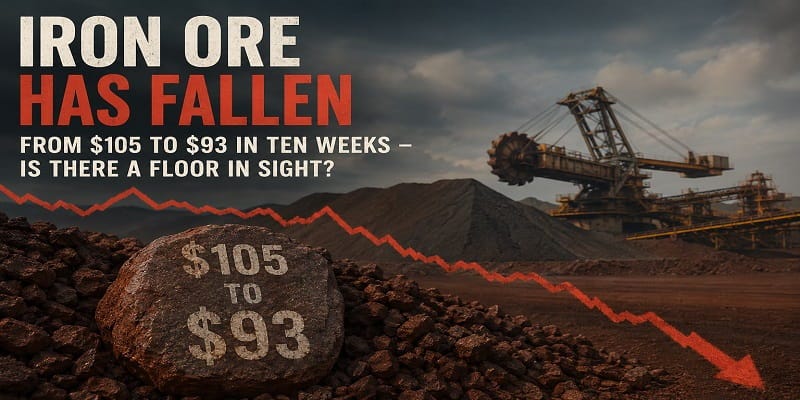
China’s Iron Ore Rally Is Real — And So Is the Surplus Waiting Behind It (Aug 15, 2026)
By Joliya Peterson, Steel Market Daily
China’s Iron Ore Rally Is Real — And So Is the Surplus Waiting Behind It (Aug 15, 2026)
By Joliya Peterson, Steel Market Daily
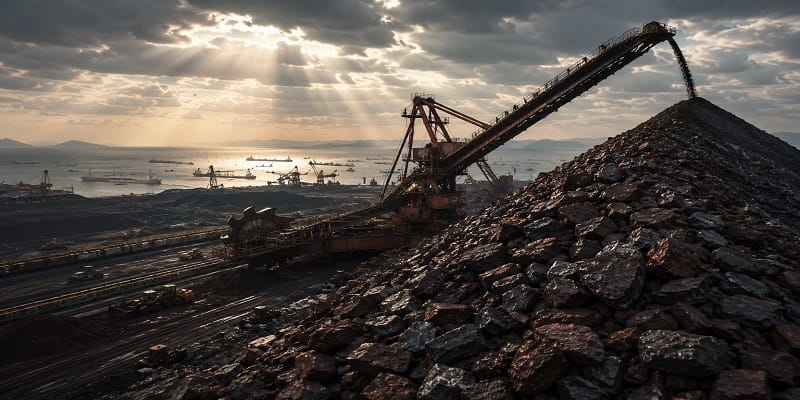
China iron ore port with large stockpiles, industrial conveyors, and cargo ships at a mining and shipping terminal
The 62% Fe benchmark settled at $95.17 per ton on Friday, August 14 — a marginal 0.13% gain that masks a sharper story underneath. China’s mills are restocking at a pace not seen in months, even as the structural surplus analysts have warned about all year sits just off-screen, waiting for restocking season to end.
The Restocking Signal Is Unmistakable
China imported 112.69 million tonnes of iron ore in June, up 6.4% year-on-year and the strongest monthly total in six months. First-half 2026 imports reached 628.87 million tonnes, up 6.3% from a year earlier. Crude steel output rose too — 83.67 million tonnes in June, a 0.4% year-on-year increase. On the Dalian Commodity Exchange, the most-active contract settled up 0.42% at RMB 710.5 per tonne on Friday, with spot offers at Qingdao port up RMB 5–9 on the day.
None of this reads like a market bracing for weaker demand. It reads like mills rebuilding inventory while prices are still comparatively low — a rational move, but one with an expiration date.
The Surplus Nobody Has Cancelled
Here is the tension: none of this restocking activity has changed the medium-term supply picture. Analysts continue to estimate a 2026 seaborne surplus of 30 to 75 million tonnes, driven by rising output from Australia, Brazil, and African producers running well ahead of a Chinese demand base that is structurally drifting lower from its 2020–2021 peak. The base-case range for 62% fines remains $95–115 per tonne — which means the ceiling on this rally was set before the rally started.
Vale’s equity performance is the clearest tell. Despite firmer Chinese steel data, Vale shares have fallen even as the benchmark holds steady — investors are already pricing in next year’s oversupply rather than trading today’s restocking bounce. That divergence between a firm physical benchmark and a discounted equity story is usually the market’s way of telling you which number to trust.
Australia’s Port Hedland Strike Adds a Wildcard
Labor action at Port Hedland — the world’s largest iron ore export hub — has added a layer of near-term supply risk that briefly firmed sentiment across ferrous markets. Chinese rebar futures, which touched a one-year low of RMB 2,085 on August 3, have since rebounded above RMB 3,020, tracking the broader ferrous complex higher on the disruption. But a strike-driven supply pinch and a structural surplus are not the same story, and conflating them is the mistake retail-facing coverage keeps making this month.
What Happens When Restocking Season Ends
The real test isn’t this week’s spot print — it’s what happens once Chinese mills finish rebuilding inventory and the market has to price the surplus on its own terms again. Softer domestic steel demand in China, tied to the ongoing property-sector contraction, hasn’t gone anywhere; it has simply been overshadowed by a restocking cycle that will not repeat indefinitely. Watch whether Vale’s discount to the spot benchmark widens further in the coming weeks — that gap, more than the daily Qingdao print, is the number that tells you where consensus is actually headed.
Market Snapshot — August 14–15, 2026
Metric Value Change Iron ore 62% Fe (CFR China) $95.17/t +0.13% (Fri) Dalian iron ore futures (I2701) RMB 710.5/t +0.42% China rebar futures RMB 3,020/t Up from RMB 2,085 (Aug 3 low) China June iron ore imports 112.69 Mt +6.4% y/y China H1 2026 iron ore imports 628.87 Mt +6.3% y/y China June crude steel output 83.67 Mt +0.4% y/y 2026 seaborne surplus estimate 30–75 Mt Analyst consensus
Domestic buyers tracking how these global benchmarks filter into finished-product pricing can follow daily movements on ahanonline.com’s steel price chart and archive, which tracks how raw material costs including iron ore feed into finished steel pricing.
Forward catalyst: With Chinese mills’ restocking cycle likely nearing its seasonal peak, the next material signal will be whether Qingdao spot offers hold their gains into September — or whether the 30–75 million tonne surplus starts asserting itself the moment mills stop buying ahead of need.
메타데이터
- post_id
- 5cb4fd85f04d
- slug
- chinas-iron-ore-rally-is-real-and-so-is-the-surplus-waiting-behind-it-aug-15-2026-5cb4fd85f04d
- url
- https://medium.com/@r.alizadehfard.2026/chinas-iron-ore-rally-is-real-and-so-is-the-surplus-waiting-behind-it-aug-15-2026-5cb4fd85f04d
- canonical_url
- https://medium.com/@r.alizadehfard.2026/chinas-iron-ore-rally-is-real-and-so-is-the-surplus-waiting-behind-it-aug-15-2026-5cb4fd85f04d
- author_url
- https://medium.com/@r.alizadehfard.2026
- status
- ok
- fetched_at
- 2026-08-22 17:46:27