The Season Where Water Disappears
Notes from Tojo Una-Una on 9 Ramadhan 1447 H
The Season Where Water Disappears
Notes from Tojo Una-Una on 9 Ramadhan 1447 H
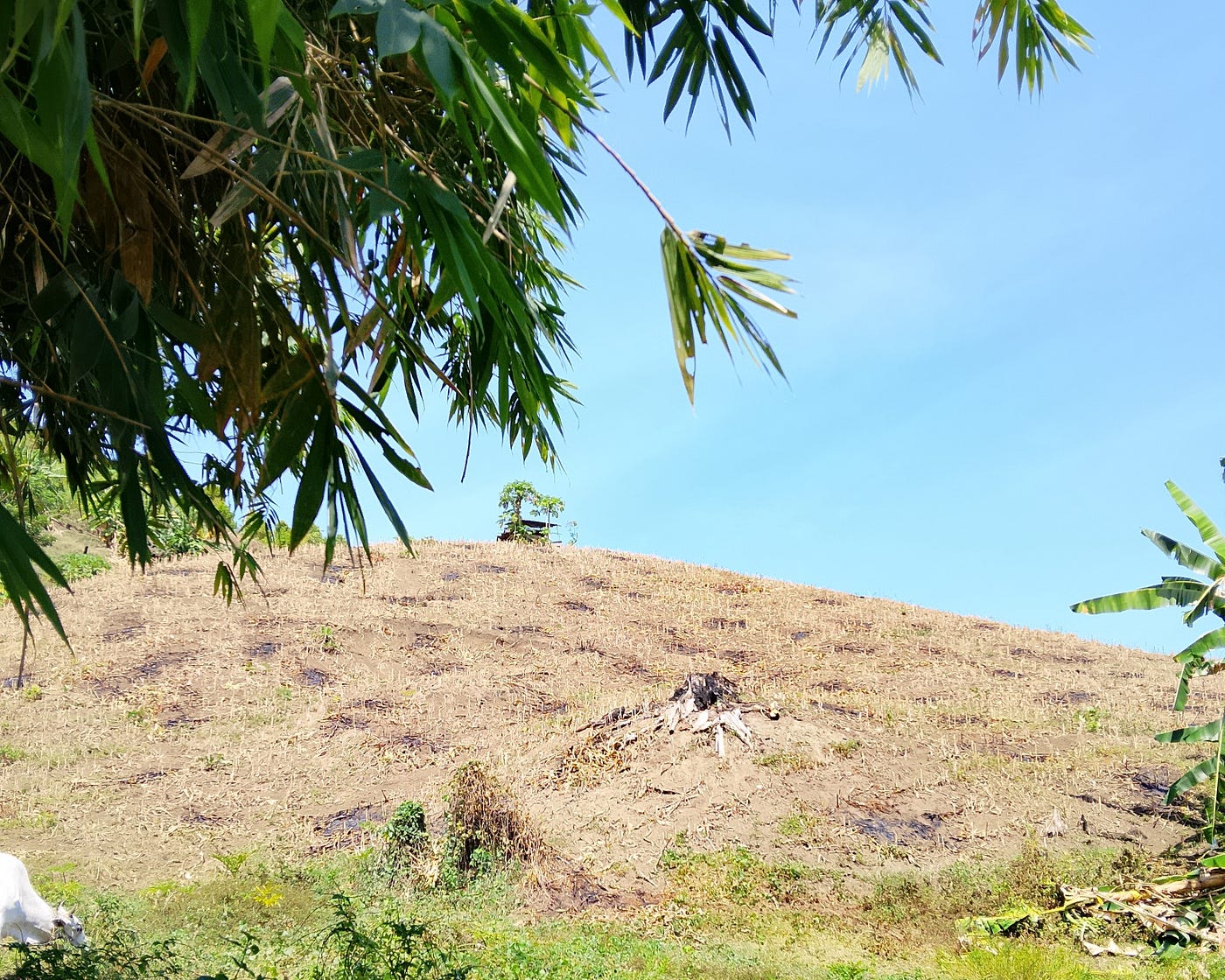
Photo by Ronald, 2026. Location: Saluaba.
In a corner of Tojo Una-Una Regency, right on the 9th of Ramadan 1447 H (Feb 26, 2026), someone sat on the terrace of his house. His mind drifted aimlessly in a certain direction. His hand was grasping the pen, while the book in his lap seemed to be waiting for the first line that had not been born that night. His gaze was fixed on the faucet in the courtyard, a small brass object that stood stiff like a silent statue. It has been three weeks without a drop of water flowing from it. In that long silence, the faucet changed meaning: no longer a tool, but just a decoration. Beautiful to look at, but it loses its function because it no longer emits anything.
The idea of writing all this down has been settled since 30 Sha’ban (Feb 17, 2026). That night, when some people were busy determining the beginning of Ramadan, there was anxiety about the water crisis that began to feel strange. Not because of the ability to divinate, but because the silence of the night often makes people honest with themselves — and that honesty says: there is something wrong with the way humans treat the earth.
Two weeks earlier, precisely since 10 Sha’ban (Jan 28, 2026), the local news began to report the same thing. PDAM Director Tojo Una-Una appeared in several online media with a straightforward statement but left anxiety. “Emergency measures,” he said. “We are deploying water tank cars in collaboration with relevant parties to serve the worst-affected areas.” His speech sounded firm, like a captain giving command in the middle of a storm. But at the end of the statement, he added something thought-provoking: the restoration of distribution to normal is still highly dependent on weather conditions.
And that’s where the problem lies — not in water, not in PDAM, but in dependence on something that cannot be controlled. A question arises: if the weather does not improve, will man succumb to fate? Will it just sit back, wait, and hope the heavens are merciful?
So one night, this was discussed with a friend. The friend was one of the people who — one year — succeeded in initiating a major activity in collaboration with the local government: the Torch Parade in the context of welcoming Ramadan 1447 H in Tojo Una-Una Regency. Thousands of people took to the streets carrying torches, filling the night with light and joy. From that success, the thought arose: if he could move a lot of people to the march, maybe he could also move them to something more urgent in real action.
In the conversation, the suggestion was made: “If you could initiate a torch march involving almost the entire community, maybe initiating something for this water crisis would be a little easier. There is a suggestion: take real action. Rainwater reservoirs, for example. So that there are reserves when a crisis like this comes again.”
The friend fell silent. That night, between two cooling cups of coffee, they talked about possibilities that had never been thought of before. About simple technology that can be built at strategic points. About water reserves that do not need to depend on the season. About ideas that — if done together — might change everything. Or at least, reduce thirst a little. There are no promises, no big deals. Only two people who, that night, felt that silence was no longer an option.
After the talk of something unexpected happened, the rain began to wet the Tojo una-una area and it lasted for the next four days.
It was no ordinary drizzle, but the rain that drenched most of the Tojo Una-Una area. People began to celebrate the sudden return of hope. The faucets that had been dead began to make a gurgling sound, then the water flowed again. For a while, the crisis is over.
But behind that excitement, there is a vigilance that arises. The sky is gray, puddles in the yard. This rain is only temporary. Such as pain relievers taken when the wound has not been treated.
His guess is correct.
After the fifth day, the water stopped flowing again. Faucets have become ornaments again. The rain leaves only memories — and the slowly drying puddles leave cracks in the ground. The water crisis is back, this time it feels quieter because the euphoria has passed.
And in the silence, wilder thoughts arise.
Perhaps this is some kind of message sent by the earth with a grammar that has never been listed in a textbook. If resources are managed without accountability, and if every effort made does not really touch the root of the problem, nature does not seem to need to show its anger through rumblings or dramatic floods. It simply works in silence, carrying out its calm but firm mechanism, without haste and without the need to explain itself. It is not an explosive curse, but something more subtle and even more pressing: making people sit, wait, and hang on to hope.
Because waiting and hoping — especially when certainty never shows up — is a form of reward that runs slowly. It does not hurt all at once, but erodes little by little, like water that used to flow now turns into nothingness that holds its breath.
There is an awareness that this thinking may be too pessimistic. It is also possible that this writing will not change anything. Not a single faucet will flow from reading this essay. None of the policies will change because someone pours his or her anxiety into words. In a world that prioritizes real action, contemplating and writing often seem like useless luxuries.
But deep down there, there is a belief that this must be said. Not to change the world, but so that it does not become a burden that continues to settle. There are certain wounds that cannot be cured silently, and sometimes the only way to heal them is through real deeds — even if they are just a series of words that those who are thirsty may not read.
A crisis that is allowed to drag on, similar to a wound that is deliberately left unhealed in the hope that time will heal it. Fortunately, the wound healed. But what if tetanus? If the infection spreads throughout the body? The effort required will be much greater, and it may be too late.
Reminds me of a friend who initiated the torch parade. People flocked to the streets with joy. There is something beautiful about such solidarity. But the question arises: why is it so difficult to present the same solidarity for something more fundamental? Maybe it’s because water — or lack thereof — isn’t photogenic enough to celebrate. Maybe because waiting and hoping that the water will flow again is more tiring than walking with a torch. Maybe it’s because the prolonged crisis makes people tired of caring.
Or perhaps, humans are indeed more likely to move for beautiful things than for emergency things.
Outside, the sky began to darken. There were no signs of rain. The faucet in the courtyard remains silent, faithful to its role as an ornament. One still sits on the verandah, no prayer for rain — not out of disbelief, but out of fatigue waiting for something uncertain. Better yet, think about what can still be done. Or at least, write down what you think.
That night, on the 9th of Ramadan 1447 H, a realization emerged: that man could survive without water for several days, but without reasonable hope — without the belief that there was anything to do but wait — man could die sooner. Not because of dehydration, but because of despair.
The notebook slowly closed, as if the wandering thoughts of the night had found a quiet spot, while the ink on the pen was running low. There were no neatly formulated conclusions, no advice carved to sound wise. All that remained was a simple awareness: tomorrow morning, this body would still have to wake up, again to draw water from the same well as every other day. And if time allowed a small gap, perhaps I would sit back on the veranda, staring at the still, silent faucet, and then ask a question that never truly went away: how long will this situation repeat itself?
That was it.
A question left hanging unanswered in the silence of the long Ramadan night.
메타데이터
- post_id
- 5cb506861439
- slug
- the-season-where-water-disappears-5cb506861439
- url
- https://medium.com/@RuangMozz/the-season-where-water-disappears-5cb506861439
- canonical_url
- https://medium.com/@RuangMozz/the-season-where-water-disappears-5cb506861439
- author_url
- https://medium.com/@RuangMozz
- status
- ok
- fetched_at
- 2026-07-13 06:23:13


