The New York Giants, the NFL, Kyle Rote, and David Berkowitz: Inside the 1979 Queens District…
In the Queens District Attorney’s reinvestigation files on the Son of Sam case, certain documents do not behave like traditional evidence…
The New York Giants, the NFL, Kyle Rote, and David Berkowitz: Inside the 1979 Queens District Attorney Tape Interview with Roger Woods and the Son of Sam Case
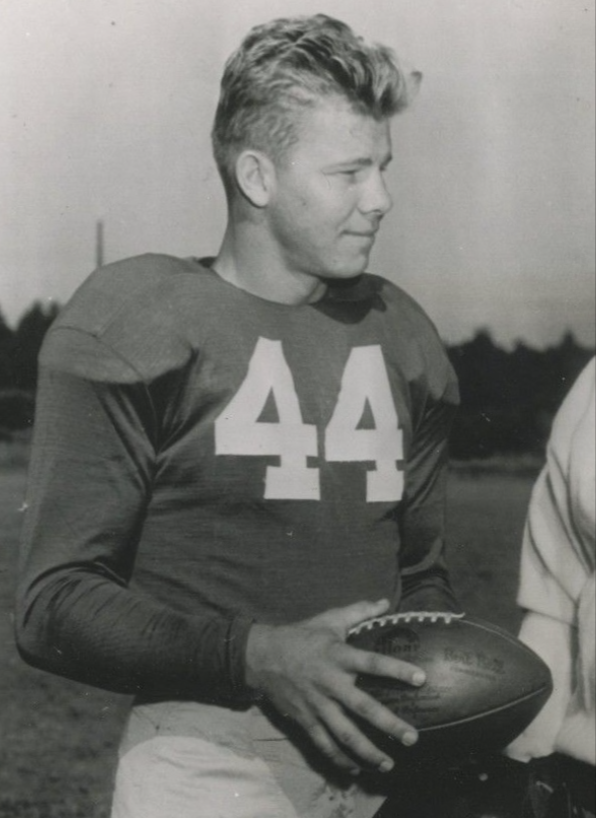
Image: Associated Press July 26 1951 Steve Owens & Kyle Rote New York Giants NFL FB wire photo
In the Queens District Attorney’s reinvestigation files on the Son of Sam case, certain documents do not behave like traditional evidence. They function instead as narrative pressure points; they are places where public memory, celebrity proximity, and institutional inquiry briefly overlap before falling apart under scrutiny. One such artifact is an undated tape into the 1979 reinvestigation involving Assistant District Attorney Michael Armienti and witness Roger Woods (1979), in which a secondhand allegation about David Berkowitz is tested, compressed, and ultimately left unresolved through current FOIA requests.
At the center of the exchange is a claim attributed to former New York Giants star Kyle Rote Sr. According to Woods’ (1979)testimony under questioning, Rote allegedly relayed that Berkowitz did not act alone and that a satanic cult operating in Yonkers was involved in the Son of Sam murders. The claim itself is not introduced as firsthand knowledge but as a socially transmitted account — something said at a business dinner, passed through conversation, and later filtered into investigative attention. By the time it reaches the Queens DA interview room, it is no longer a story but a chain of attribution: Rote to Woods to the District Attorney.
According to Fennessy (2008), William Kyle Rote Sr. was not a marginal figure in American sports culture but one of the most visible football personalities of his generation. Born in San Antonio in 1928, he rose through Thomas Jefferson High School and Southern Methodist University, where he became a standout halfback during a period when SMU football drew national attention. Playing alongside Doak Walker, Rote earned All-America honors and became known for his versatility, notably scoring all three SMU touchdowns in a near-upset against Notre Dame in 1949. His collegiate career culminated in national recognition, including a cover feature in Life magazine and selection as the first overall pick in the 1951 NFL Draft by the New York Giants.
Fennessy (2008) notes his professional career in New York placed him at the center of one of the NFL’s most visible franchises. Over eleven seasons, Rote became team captain, a Pro Bowl selection, and one of the Giants’ leading receivers, playing alongside Frank Gifford, Y.A. Tittle, and Pat Summerall. He later helped lead the team to the 1956 NFL Championship and was widely regarded within the organization as a stabilizing leadership presence. The respect he gained on and off the field of competition led his peers to elect him first president of the NFL Players Association. After retiring, he transitioned into coaching and broadcasting, working with NBC and New York radio outlets, embedding himself in the city’s sports-media-business ecosystem during the same decades that shaped the cultural environment surrounding the Son of Sam case.
A May 13th, 1958 appearance on the CBS program To Tell the Truth (1958) further illustrates the degree to which Rote was already a recognizable public figure by the late 1950s. In the episode, he appeared as one of three impostors claiming to be an undercover narcotics agent named “Texas Joe Foster.” The format of the show required a panel of celebrities — including Jim Backus, Joan Fontaine, and Polly Bergen — to interrogate the contestants and identify the real subject. Despite the deception, Rote convincingly maintained the role, with multiple panelists voting incorrectly for him as the authentic agent before the reveal. When asked to identify himself at the conclusion, he stated plainly that he was Kyle Rote of the New York Giants.
The significance of this appearance is not related to any investigative content but to the cultural mechanics it reveals. Rote was a figure whose credibility was socially legible — athletic, articulate, and embedded in national television visibility. By the 1970s, that same credibility would have extended into business and media circles in New York, making it plausible that his name could surface in informal conversations involving corporate networking, sales introductions, or social dinners, the very setting described in the Queens district attorney transcript.
That is what makes his role in the Woods (1979) interview structurally important. Rote functions not as a direct witness but as a credibility amplifier: a respected public figure whose alleged offhand remark transforms an otherwise unverified conversation into something investigators feel compelled to examine. Yet when the district attorney attempts to follow that chain backward, the structure collapses. The more precisely Woods is questioned, the less stable the narrative becomes. Geographic references shift without coherence, the business context absorbs and neutralizes the allegation, and no external corroboration is introduced to reinforce the claim.
In the Queens District Attorney’s reinvestigation file on Woods (1979), the transcript opens on a direct allegation already embedded in prior circulation: according to people present at a business dinner, Roger Woods allegedly stated that Son of Sam did not act alone and that a cult operating in Yonkers was involved in helping Berkowitz. The district attorney notes that one participant in the conversation was a very well-known sports celebrity, immediately situating the claim within a social environment rather than a formal evidentiary one.
The Woods (1979) exchange then fractures almost immediately. The telephone line drops mid-conversation. Armienti can be heard repeatedly saying “hello, hello” (Woods, 1979) attempting to reestablish contact before redialing. When the connection returns, an operator answers unexpectedly “Utility Power, good morning” (Woods, 1979) before the call is transferred back into the interview with Woods. The interruption becomes part of the record itself, not just background noise but a break in continuity that precedes any substantive resolution of the allegation.
Once the interview resumes, Woods (1979) re-enters the exchange with immediate hesitation rather than resolution: “I’d like to say I can’t help you but I’ll try” (Woods, 1979). The district attorney then returns to the central allegation, again grounding it in what “people present at that dinner” (Woods, 1979) reportedly said Woods had stated — namely that Son of Sam did not act alone and that a cult operating in Yonkers was involved. As the exchange develops, Woods pushes back against the premise and becomes increasingly defensive, ultimately suggesting that the information being attributed to him is being traced back through Kyle Rote.
Woods (1979) immediately denies the accusation. He states there is no connection, insists he did not belong to any group, and maintains that if he had known of any criminal activity he would have gone directly to law enforcement. He also denies making the statement attributed to him.
When Woods (1979) asked again where the information originated, the district attorney responds that Woods already knows, because he himself introduced the name of the individual in question. The exchange becomes circular, with attribution treated as confirmation rather than independent sourcing. Woods responds: “Wow. That is amazing” (Woods, 1979).
Woods (1979) redirects the exchange away from the allegation and toward the practical circumstances of the gathering, characterizing it as a standard business dinner tied to Houston-based plant discussions. He adds that the conversation also touched on prospective commercial work “overseas” in Mexico, and that Rote appeared to have knowledge of relevant contacts in that sphere. In his framing, nothing discussed carried any conspiratorial meaning; it remained within the boundaries of routine business networking and opportunity-sharing rather than anything related to cult activity or criminal implication.
At one point, Woods (1979) suggests there may be confusion about identities, implying that the district attorney and Rote may have the wrong person, noting that Rote reportedly ate at the restaurant frequently and could have confused individuals, though he also maintains that the meeting did occur and that his recollection of the time period is accurate. When pressed by the district attorney on how the evening concluded, Woods states that his wife left first, followed by Rote and Woods remaining behind for drinks. Woods adds that Rote had offered to assist with work, but the offer was declined as they did not believe he had much to contribute, describing the interaction as a standard business discussion. The district attorney, however, notes that he had been told the conversation was significant enough that Rote and his wife allegedly walked out in response to what was said.
Woods (1979) finally sought clarification about whether there is more to the Berkowitz-related allegation, but the district attorney declines to elaborate, directing him instead to newspaper coverage of the ongoing investigation.
The most significant methodological problem in the Woods (1979) Queens District Attorney interview is not that Roger Woods is inconsistent, but that the questioning never fully converts a layered social claim into a structured evidentiary inquiry. The allegation enters the record already pre-formed through “people present at that dinner,” yet the interview does not begin by dismantling that formulation. Instead, it carries the bundle forward as a single unit — Son of Sam, Yonkers cult, and a well-known sports figure — without isolating which component is being independently asserted, which is hearsay, and which is reconstruction.
A stronger line of questioning would have required the district attorney to establish a fixed timeline before any content was discussed. The transcript instead allows temporal markers to float between “about a month after the arrest” (Woods, 1979) business dinner context, and retrospective recollection without ever locking those claims to a verified sequence of events. In an investigation that depends so heavily on informal social memory, the absence of a stabilized chronology weakens every subsequent inference.
Equally limiting is the way the questioning allows reputational proximity to function as implicit corroboration. The presence of a well-known sports figure is introduced as a contextual detail, but it is never converted into a verifiable investigative node due to the absence of current FOIA releases on Kyle Rote and his spouse. This omission leaves the most significant node in the narrative structure unexamined, even as his name is used as a pivot point in Woods’ responses.
The district attorney also does not resolve the competing interpretive frames offered by Woods (1979). On one side is the allegation of a cult-linked statement involving Berkowitz — the other is Woods’ consistent framing of the meeting as routine business discussion involving Houston-based opportunities and prospective commercial work “overseas” in Mexico. Instead of forcing a clear evidentiary adjudication between these accounts, the interview oscillates between them, allowing both to coexist without resolution.
Together, these weaknesses produce an interview that repeatedly circles its own evidentiary center without ever stabilizing it. The result is not clarification of the underlying allegation, but a procedural loop in which social memory, reputational presence, and institutional questioning remain misaligned.
References
Associated Press July 26 1951 Steve Owens & Kyle Rote New York Giants NFL FB wire photo [Photograph]. (1951, July 26). Wikimedia Commons. https://en.wikipedia.org/wiki/Kyle_Rote#/media/File:Kyle_Rote1951(cropped)_(cropped).jpg
CBS Television. To Tell the Truth — “Undercover Agent” segment (featuring impostor “Texas Joe Foster” / Kyle Rote Sr. appearance). Panel: Jim Backus, Joan Fontaine, Polly Bergen. Broadcast May 13, 1958. To Tell the Truth (CBS). https://www.youtube.com/watch?v=KxIaGoDz9MI
Fennessy, J. (2008, December 23; updated January 26, 2019). Kyle Rote: A legendary football player’s journey. https://www.tshaonline.org/handbook/entries/rote-william-kyle-sr
Queens County District Attorney’s Office, Homicide Bureau. The People v. David Berkowitz: Recording of Roger Woods. Interview conducted by Assistant District Attorney Michael Armienti, Criminal Investigation Unit, 1979. 00:10:12.
메타데이터
- post_id
- 5cbc1030aa6a
- slug
- the-new-york-giants-the-nfl-kyle-rote-and-david-berkowitz-inside-the-1979-queens-district-5cbc1030aa6a
- url
- https://medium.com/@criminaljusticechris/the-new-york-giants-the-nfl-kyle-rote-and-david-berkowitz-inside-the-1979-queens-district-5cbc1030aa6a
- canonical_url
- https://medium.com/@criminaljusticechris/the-new-york-giants-the-nfl-kyle-rote-and-david-berkowitz-inside-the-1979-queens-district-5cbc1030aa6a
- author_url
- https://medium.com/@criminaljusticechris
- status
- ok
- fetched_at
- 2026-06-20 20:29:01


_(cropped).jpg)