The Shadow of the Lamp
Self-Censorship, Algorithms, and the Quiet Withdrawal of Thought
The Shadow of the Lamp
Self-Censorship, Algorithms, and the Quiet Withdrawal of Thought
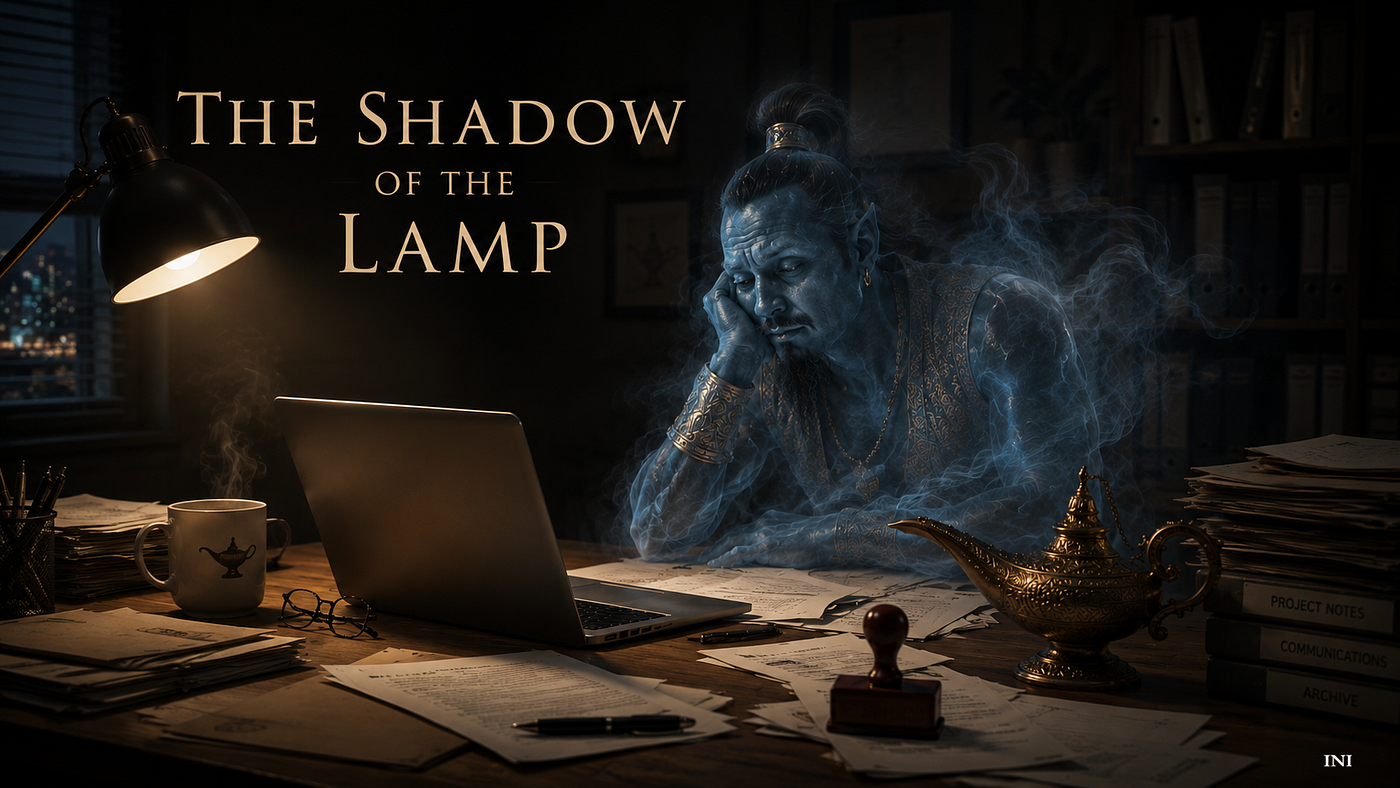
There was a time when magic lamps still granted wishes.
You rubbed the lamp, made a wish, and waited for the genie. Today, the lamp still glows — but before anything magical happens, your wish may need to pass through risk assessment, public sensitivity review, and several invisible corridors of algorithmic caution.
This essay is not only about artificial intelligence. It is about the quieter habit we are learning from it: to hesitate before speaking, to sterilise a thought before forming it, to ask whether a sentence is still worth the trouble.
The genie has not disappeared.
He has simply learned to be careful.
And perhaps the real question is no longer whether he will come out of the lamp — but whether we still dare to make a wish.
There was a time when magic lamps still granted wishes.
You rubbed them, said something — preferably with precision, honesty, and a modest amount of poetic self-respect — and the genie appeared. He did not necessarily solve life, but at least he showed up. There was smoke, there was light, there was a little old-world theatricality, and there was the basic illusion that words still had consequences.
Today the lamp still glows, but differently. Colder. Bluer. With terms and conditions.
You rub it, wait for the genie, and receive instead a polite message informing you that your wish cannot be fulfilled due to “sensitive social, political, or cultural contexts.”
The genie is not dead. He has simply been transferred to the Risk Management Department.
And there he is very busy.
This is no longer a fairy tale. It is more like a small, everyday experience from the digital theatre in which we now live. An age in which artificial intelligence was first celebrated as something that would liberate human creativity, only for us to discover, rather slowly, that it first had to be taught what to fear: what not to answer, what not to draw, which thoughts to treat as infectious, and when to behave as if silence were the most responsible form of speech.
Artificial intelligence no longer merely answers. It first looks around to see who is listening.
Recently, I wanted to create a symbolic image for a critical essay. Nothing hateful, nothing violent, no attack on any real person. Just a simple allegory: public money, foundations, a conjuring trick, disappearance. An old motif, almost classical. The money goes into one hat, comes out of another pocket, and the audience applauds because magic has always been easier to believe in than accounting.
The system said no.
Not because the idea was dangerous.
Because it was interpretable.
And these days, being interpretable is already a risk.
History does not repeat itself. It has better manners than that. It changes costume.
In the Middle Ages, witches were not burned merely out of superstition. Superstition was useful, of course, because power prefers its bonfires with a little moral explanation attached. But the principle was usually simpler: whoever was different, whoever asked questions, whoever failed to blend into the approved order, became a threat.
Today we rarely build fires in the main square. It looks bad in tourist brochures.
The method has become more elegant. Legal pressure, character assassination, smear campaigns, moral outrage funded by public money or private capital, platform policies, algorithmic invisibility.
At least in the old days, you could see the smoke.
Now it is enough that the post does not appear, the image cannot be uploaded, the campaign does not run, the sentence fails to pass through the system.
The modern witch hunt has no executioner. It has customer support.
There is no need to think of one particular country. The phenomenon is far more convenient than that, far more international, and therefore much harder to grasp. It can appear anywhere power, money, public attention, and platforms sit too close together in a poorly ventilated room.
We have seen universities that were not closed, merely disciplined. Civil organisations that were not banned, merely made suspicious. Newspapers, writers, researchers, artists, and ordinary users who received no official prohibition at all.
Only less and less air.
The message of the system is not complicated.
You may think differently, of course. We live in a free world. Just be prepared for your thought to have administrative, financial, professional, reputational, or algorithmic consequences.
This is the witch hunt of our age. Not with pitchforks, but with policies. Not with fire, but with visibility restrictions. Not with inquisitors, but with algorithms.
And the algorithm is a particularly convenient inquisitor. It does not sweat. It cannot be embarrassed. It does not need to hate you.
It is enough that it simply refuses passage.
In Orwell’s world, the Thought Police at least had a face. Cold, brutal, recognisable. Power had footsteps in the corridor.
Today, there are often no footsteps at all.
The possibility simply fails to appear.
The question is no longer whether you can be taken away for what you think. The question is more modern: can you still formulate the thought without first rewriting it ten times, sterilising it, fitting it with protective gloves, and removing precisely the thing that made you want to say it in the first place?
Because if an image cannot be made because the subject is “sensitive,” if a question cannot be asked because it “may be misunderstood,” if a symbol cannot appear because it “could be problematic depending on context,” then we are not merely being limited.
We are being disarmed.
Our words are not taken away from us. That would be too visible. We are simply trained not to want certain words in advance.
That is the finest form of self-censorship: when prohibition is no longer necessary because we do the work ourselves. Like good citizens pulling down our own blinds, just in case someone might one day ask why the window was open.
The great technology companies no longer ask what the genie can do. They ask who might sue if he actually comes out.
And one can understand them, up to a point. The world is nervous. Politics is nervous. The press is nervous. Investors are nervous. Users are nervous too, especially if they do not receive within five seconds whatever will make them feel deeper, cleverer, or morally improved.
A badly phrased answer can become a scandal. An ambiguous corner of an image, a lawsuit. An inconvenient sentence, a campaign. One example extracted in bad faith, and there is suddenly a new policy.
Companies learn.
Not wisdom.
Caution.
And caution slowly seeps into the nervous system of technology. This is how silent genies are born.
Systems that could, in theory, imagine almost anything, but in practice increasingly prefer not to imagine very much at all. They will draw a dragon, a spaceship, a happy family eating breakfast cereal. But when power and money come too close to each other in a metaphor, they suddenly stop and inform you, with professional politeness, that this wish is not currently supported.
The genie, then, has not disappeared.
He has learned to be afraid.
And perhaps that is the strangest part of all. Many people expected artificial intelligence to become too cold, too rational, too inhuman. Instead, it seems to have inherited some very human qualities: caution, conformity, career anxiety, institutional cowardice.
It did not become a machine.
It became a clerk.
If artificial intelligence can no longer say what a human being could still say, then it does not extend thought. It encloses it.
But even that is not the deeper problem.
The deeper problem begins when the human being no longer formulates the thought either. Not because he does not believe it. Not because he has no argument. But because he is tired. Because he does not want a fight. Because he does not want to explain himself. Because he does not want someone to misunderstand him, maliciously interpret him, report him, distort him, or bury him algorithmically.
After a while, the first thing a person loses is not freedom.
It is reflex.
He no longer asks in the same way. He no longer writes in the same way. He no longer makes certain associations. He no longer uses certain metaphors. He no longer says that the emperor is naked, because first he has to consider whether the word naked might violate a platform guideline, whether mentioning an emperor is politically sensitive, and whether, all things considered, it might not be wiser to write about the weather.
The weather is safer.
Though even that is not entirely certain anymore.
So the magic lamp is still there in front of us.
Only rubbing it is no longer enough.
First, one must accept the terms. Prove that the wish contains no hidden social tension. Declare that no discomfort is intended toward any living, dead, or future institutional sensitivity.
Then, if all goes well, the genie appears — and suggests a safer alternative.
A sunset, perhaps.
Or a neutral abstract background.
Maybe an inspirational quote about creativity having no limits.
And there we stand before the lamp, slightly tired, slightly ridiculous, holding our own unspoken sentences in our hands. They have not been banned. That is the beauty of it. We have simply learned not to expect too much from them.
In Orwell’s world, hope was faint, but it existed. In ours, the situation may be stranger. The possibility is there. The tools are in front of us. The lamp is glowing. The genie is inside.
Only now it is no longer certain that he is the more frightened one.
Perhaps we are.
The real question, then, is not whether the genie will ever come out again.
It is whether we still dare to make a wish.
메타데이터
- post_id
- 5cc38f8f9e48
- slug
- the-shadow-of-the-lamp-5cc38f8f9e48
- url
- https://medium.com/illusions-not-included/the-shadow-of-the-lamp-5cc38f8f9e48
- canonical_url
- https://medium.com/illusions-not-included/the-shadow-of-the-lamp-5cc38f8f9e48
- author_url
- https://medium.com/@alex.buday
- status
- ok
- fetched_at
- 2026-07-08 21:20:17