Why Are Japanese Stainless Steel Knives So Rust-Resistant?
The Answer Is Not Just Chemistry. It Is About How a Knife Is Meant to Be Used.
Why Are Japanese Stainless Steel Knives So Rust-Resistant?
The Answer Is Not Just Chemistry. It Is About How a Knife Is Meant to Be Used.
For chefs around the world, rust is one of the greatest enemies of a knife.
And yet, Japanese stainless steel knives — known for their sharpness and refinement — are also remarkably resistant to it.
At first glance, this seems contradictory.
A blade that performs at a high level, yet asks relatively little in return.
But the explanation is not a contradiction.
It is a design decision.
The Invisible Shield
The rust resistance of stainless steel comes from a simple mechanism.
When chromium — typically around 13% or more in Japanese stainless steels — reacts with oxygen, it forms an extremely thin, invisible oxide layer on the surface of the blade.
This layer is known as the passive film.
It acts as a barrier.
Moisture cannot easily reach the steel beneath. Oxygen cannot continue the reaction that produces red rust.
What makes this layer remarkable is not just that it exists.
It is that it restores itself.
If the surface is scratched, the exposed metal reacts again with oxygen in the air, and the passive film reforms almost immediately.
The protection is not fixed.
It is continuous.
What This Makes Possible
This self-healing property changes how a knife can be used.
A blade can be set down briefly without immediate damage. It can move through a busy kitchen without constant attention. It can tolerate small lapses in care without permanent consequence.
This is not just a material advantage.
It is a shift in responsibility.
The knife no longer demands constant awareness from the user.
It absorbs small mistakes.
In many modern kitchens — fast-paced, shared, and time-constrained — this matters.
The tool adapts to the environment.
Beyond Ordinary Stainless Steel
Not all stainless steels behave the same way.
Western stainless steels are often designed with a balance of corrosion resistance, toughness, and ease of production.
Japanese stainless steels, such as Ginsan (Silver 3), follow a slightly different path.
They aim to preserve a level of sharpness and hardness closer to traditional carbon steel, while still maintaining corrosion resistance.
This creates a different kind of blade.
One that sits between two worlds:
More demanding than mass-market stainless, but more forgiving than carbon steel.
The result is not a perfect compromise.
It is a deliberate position.
Why Care Still Matters
Stainless steel resists rust.
It does not eliminate it.
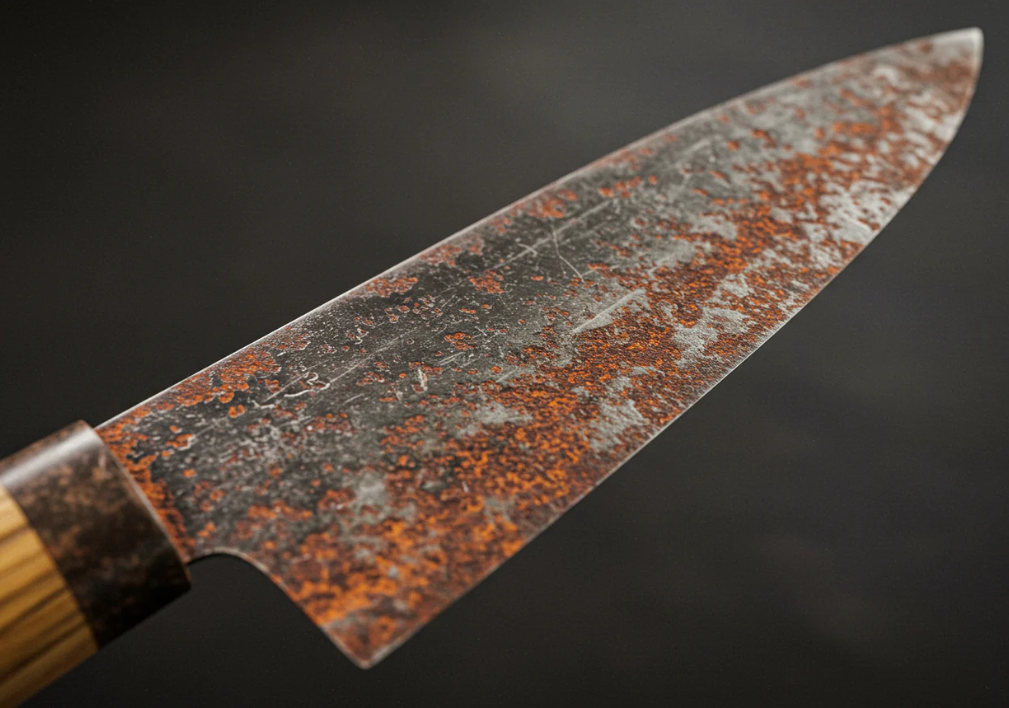
Salt, prolonged moisture, and certain acidic conditions can still compromise the passive film.
When that happens, corrosion does not always appear as surface rust.
It can appear as pitting — small, localized damage that penetrates deeper into the steel.
This is why experienced cooks still wash and dry their knives by hand.
Not because the knife will immediately fail without it.
But because care preserves performance.
The difference is subtle but important:
Carbon steel demands attention to survive. Stainless steel rewards attention to perform.

What This Tells Us About Modern Knife Culture
The development of stainless steel did not replace carbon steel.
It expanded the definition of what a knife could be.
Carbon steel represents a relationship built on attention.
Stainless steel represents a relationship built on reliability.
Neither is superior in general.
They answer different questions.
In a kitchen where time allows for care, carbon steel offers a level of engagement and responsiveness that stainless does not.
In a kitchen where consistency and speed are critical, stainless steel offers a stability that carbon steel cannot.
The existence of both is not a contradiction.
It is a reflection of different ways of working.
The Real Answer
Japanese stainless steel knives are rust-resistant because they were designed to be used in a world where constant attention is not always possible.
But they are still made within a tradition that values precision, care, and respect for the tool.
The passive film protects the steel.
The craftsman shapes how that steel behaves.
The cook decides how far to rely on the protection.
And that is the real answer:
Rust resistance is not just a property of the material.
It is part of a larger system — one that connects material, craft, and use.
메타데이터
- post_id
- 5cc4451ae1d2
- slug
- why-are-japanese-stainless-steel-knives-so-rust-resistant-5cc4451ae1d2
- url
- https://medium.com/@torui/why-are-japanese-stainless-steel-knives-so-rust-resistant-5cc4451ae1d2
- canonical_url
- https://medium.com/@torui/why-are-japanese-stainless-steel-knives-so-rust-resistant-5cc4451ae1d2
- author_url
- https://medium.com/@torui
- status
- ok
- fetched_at
- 2026-06-09 15:37:30