2Fast2Accountable
Last year, the California legislature passed the FAST Act to improve conditions for fast food workers. Last week, they did it again.
2Fast2Accountable
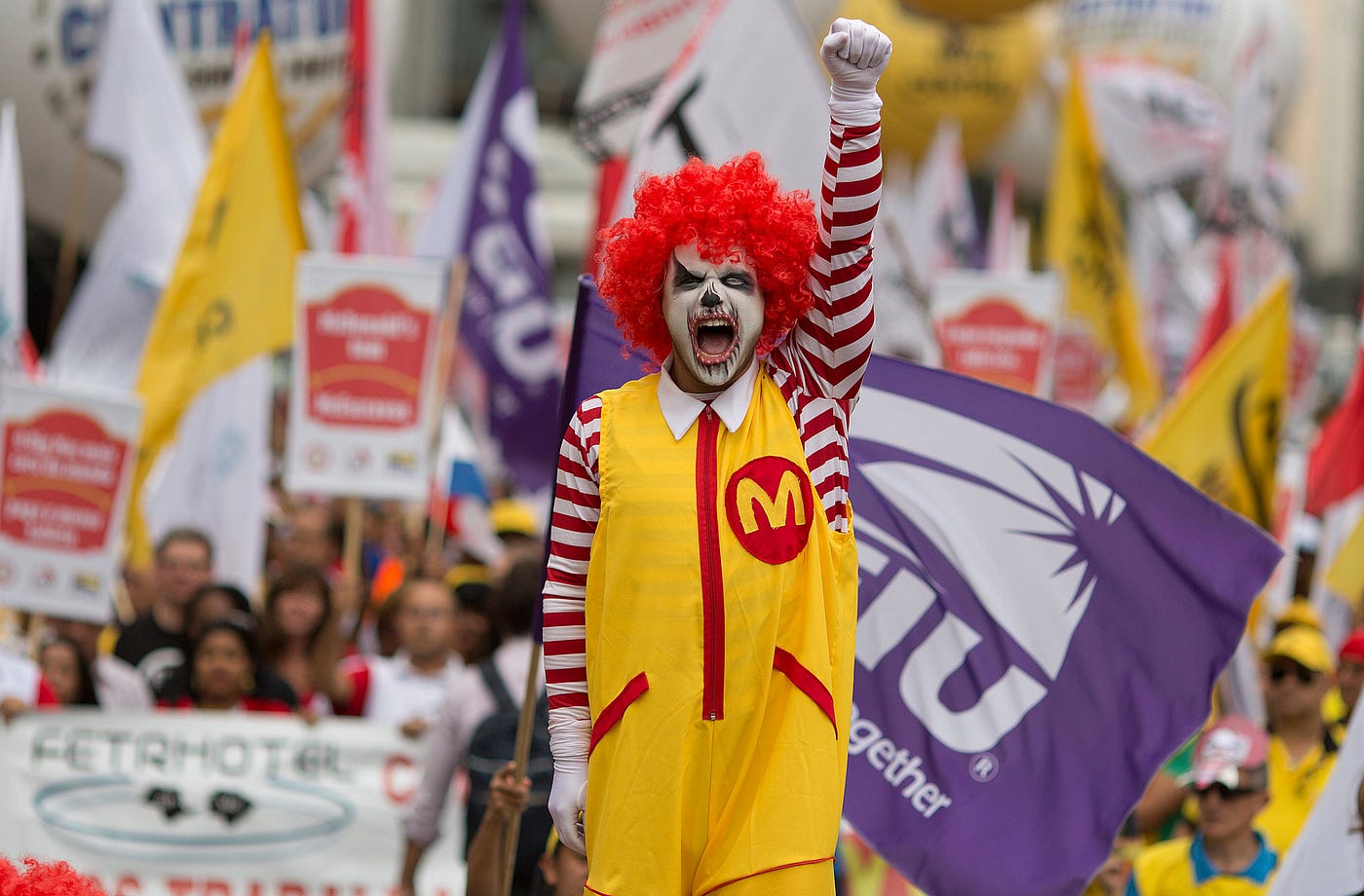
Brazil, 2015 (taken from the NYTimes)
Last year, the California legislature passed the FAST Act to improve conditions for fast food workers. An early version of the bill was truly radical: it created a worker-dominated industry council, and it used joint legal liability to put the big corporate brands (not the franchisees) on the hook.
What ultimately passed in August 2022 — after some last-minute deal-making — was more modest. At the time I called it “living-wage-plus.” The final legislation functionally provided a $22 minimum wage and a few other goodies, but it weakened the industry council and removed the joint liability.
This weakened FAST Act was still enough of a threat that the industry quickly spent millions trying (and lying) to overturn it: the Fast Act was placed on hold until the 2024 ballot.
But then SEIU (a) found a backdoor way for the state to not wait until 2024, and (b) also moved joint legal liability through the legislature.
So last week, the California legislature passed the FAST Act — again! And again, it’s a little bit weaker this time. Let’s take a look!
(This account drawn largely from coverage in the LATimes, Restaurant Business, Cal Matters, the American Prospect, and, you know, the policy language.)
The good:
- Certainty: this deal removes the main obstacles to the law going into effect. No more $200 million ballot fight forcing us all into door knocking next year. The law will be in effect by April 2024. With the precedent set, policy can be rolled out elsewhere in improved ways: onward and upward to New York, Minnesota, and elsewhere.
- A bigger universe: the version passed last year applied to chains with over 100 locations nationally. This one drops the threshold down to 60. (I don’t know the numbers on who gets swept in.)
- A $20 minimum wage: one of the highest minimum wages in the country will go to one of the largest occupational groups anywhere.
The bad:
- $20 is less than $22 (and $22 is less than the $24 from the original legislative language), and potential annual raises remain capped at 3.5%. Given that the actually-existing labor market has already pushed wages up, there is no guarantee all workers in California will get raises.
- Joint liability may have been the best tool for the long-term transformation of the fast food industry in pro-worker and pro-social ways, and it’s now off the table. (Of course, there are reasons to think joint liability was illusory anyhow: Newsom may not have signed it — and industry would have surely sued.)
- The composition of the fast food council has changed again in ways likely to favor industry. As now written, a Chamber staffer would probably qualify to be the neutral member of the public appointed by the Governor, but a County Fed staffer probably wouldn’t:
One unaffiliated member of the public who is not an owner, franchisee, officer, or employee in the fast food industry; who is not an employee or officer of a labor organization or a member of a labor organization representing fast food restaurant employees; and who has not received income from the fast food industry or any labor organization for a period of two years prior to appointment.
- Preemption: this may be the hardest pill to swallow. The new version of the FAST Act explicitly prevents cities from setting higher standards for fast food workers. (Some cities are already doing this.)
- Certainty…? While the corporate brands seem mollified, California franchisees are big mad, and feel like they’re getting screwed. (They kind of are.) Franchisees could still sue, but probably they can’t afford to?
And there’s still this fast food council. Except it is no longer clear what the council will do exactly. Originally it would have negotiated over wages and working conditions. Its scope was whittled down in the 2022 deal to negotiating over wages — but with a lower ceiling — and negotiating over working conditions — but not sick time or scheduling. But now the wage level has itself been set directly. Still, the council will meet:
The council shall hold meetings or hearings no less than every six months that are open to the public, at which the public, including fast food restaurant employees, shall have the opportunity to be heard on issues of fast food restaurant health, safety, and employment conditions.
SEIU’s Mary Kay Henry says “We intend to build worker organization as a part of making the council work.” This is absolutely the correct answer. Now it has to happen.
This has been a kind of amazing campaign with big moves and counter-moves, and it has been genuinely exciting to see SEIU impressively outmaneuver the industry. It makes sense to plant a flag, claim a victory, take a lap — and then get back to building organization.
We wanted $15 and a union. We got $20 and preemption. Those are both wins — but they are substantively different wins. Which is fine, so long as we’re clear-eyed about it, and about the challenge ahead.
메타데이터
- post_id
- 5cc5fae33fbf
- slug
- 2fast2accountable-5cc5fae33fbf
- url
- https://medium.com/@jon_64014/2fast2accountable-5cc5fae33fbf
- canonical_url
- https://medium.com/@jon_64014/2fast2accountable-5cc5fae33fbf
- author_url
- https://medium.com/@jon_64014
- status
- ok
- fetched_at
- 2026-08-23 09:16:53