Focused Ion Bem (FIB) Induced physical artifacts — Causes, Factors, and Resulting Physical…
Chengge Jiao, Tuesday, May 6, 2025
Focused Ion Bem (FIB) Induced physical artifacts — Causes, Factors, and Resulting Physical Substructural Modifications
Chengge Jiao, Tuesday, May 6, 2025

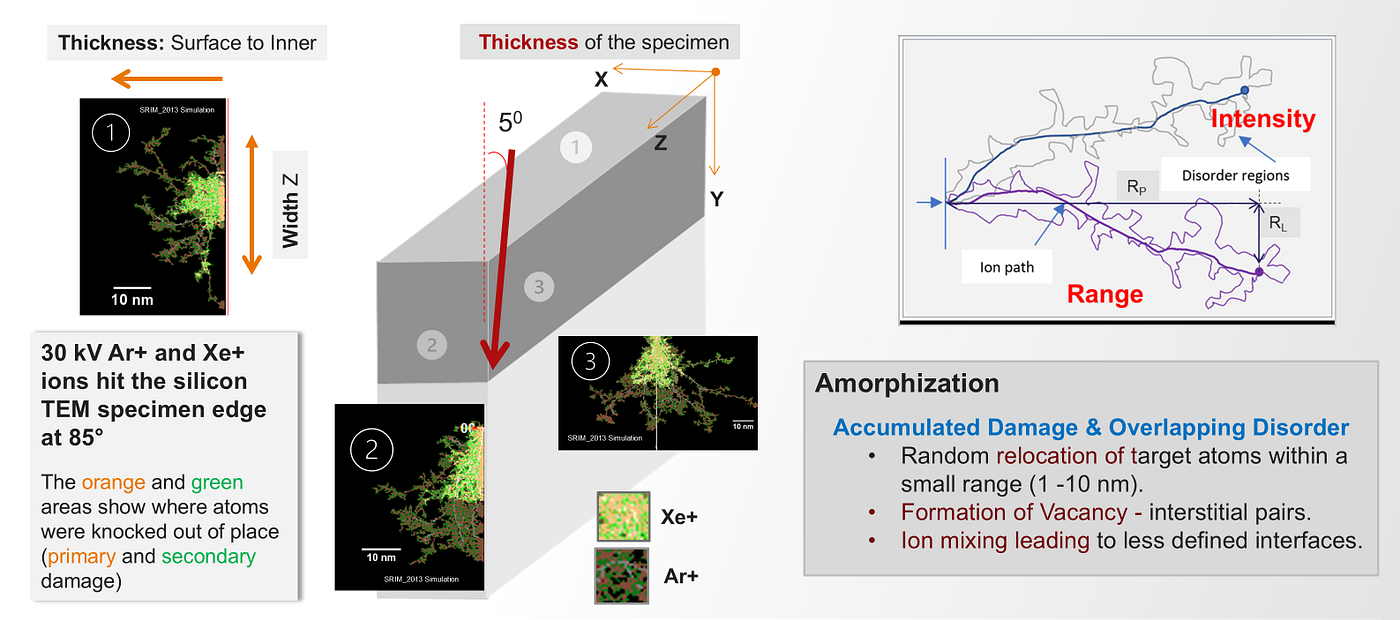
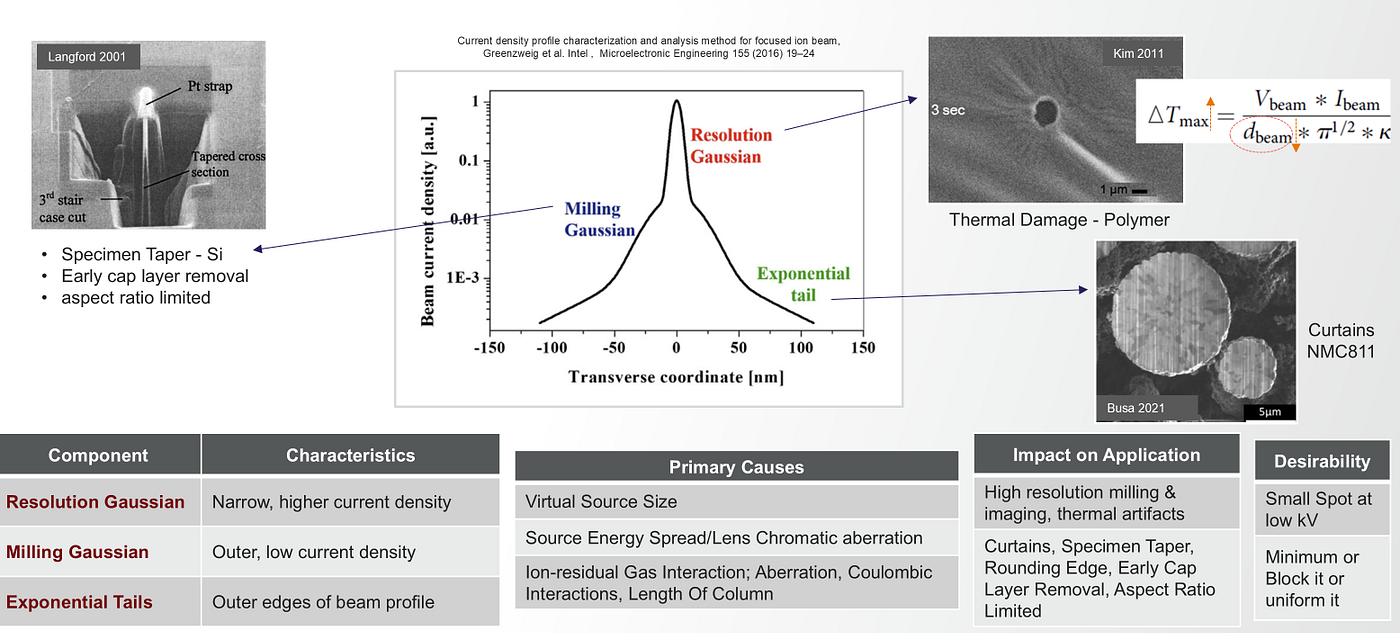
Fig. 1 FIB induced physical damage: causes and factors affecting it
This blog explains Focused Ion Beam (FIB) interaction with materials to create physical subsurface structure changes, primarily driven by the energy of the incident ions. It is very often referred to as physical artifacts.
Key Mechanisms and Effects
The primary driver for these physical artifacts is the kinetic energy transfer from the incident ions to the target material’s lattice. Upon impact, ions with significant kinetic energy initiate atomic displacement cascades. This process involves the energetic recoil of lattice atoms, leading to the generation of primary knock-on atoms (PKAs) and subsequent secondary and tertiary displacements.
A direct consequence of these displacement events is the formation of point defects, namely vacancies and interstitial atoms. The local supersaturation of these defects can then drive more complex defect evolution, including the nucleation and growth of dislocation loops.
Irradiation of a material with sufficiently energetic ions disrupts its microstructure. Some materials exhibit the ability to remain crystalline but not necessary in the original phase, hence phase transformation is observed, like Co in WC, from the face-centred cubic (FCC) cobalt transforms to the hexagonal close-packed (HCP) phase.
Furthermore, under certain irradiation conditions and accumulated dose, the crystalline structure can be destabilized, leading to amorphization of the near-surface region. This transition is strongly correlated with the energy deposition density and the material’s susceptibility to radiation damage.
Beyond these primary structural modifications, FIB interaction can also induce a range of other physical artifacts. The sputtering process and subsequent atomic rearrangement can result in the formation of nano-pores. When employing noble gas ions such as He+ or Ne+, sub-micron bubbles can nucleate and grow due to the low solubility and high mobility of these species within the material. Even in the absence of bubble formation, He+ or Ne+ irradiation introduces compositional changes and can modify the local stress state. Finally, the localized nature of the ion beam and the heterogeneous distribution of induced defects inevitably generate elastic strain gradients within the milled volume and its vicinity.
Factors Affecting Physical Artifacts
The extent and nature of these physical artifacts are critically dependent on several factors. The material type, including its crystal structure, atomic mass, and bonding energy, dictates its intrinsic susceptibility to ion-induced damage. The initial microstructure, such as grain boundaries and pre-existing defect densities, can influence defect migration and annihilation pathways.
Furthermore, the ion species employed significantly impacts the energy transfer efficiency and the projected range within the material. Heavier ions typically exhibit a shallower implantation depth and a higher sputtering yield compared to lighter ions at equivalent energies. Finally, the milling conditions are paramount. Higher incident ion energy leads to deeper penetration and a greater volume of material affected. The incident angle influences the surface sputtering rate and the depth profile of the implanted ions and induced damage. Lastly, the ion dose/current directly correlates with the total number of incident ions and thus the cumulative damage imparted to the material.
Additional Considerations
While this discussion focuses on physical changes, remember that ion implantation also introduces chemical changes by embedding the ion species into the material. In the simplest case, this can lead to the formation of a substitutional solid solution as the implantation. We will address chemical artifacts in separate blog post.
It is crucial to acknowledge that while simulation tools like SRIM provide valuable insights into ion-matter interactions, they often underestimate the penetration depth in crystalline materials due to the exclusion of ion channeling phenomena along low-index crystallographic directions, which lead to significantly deeper ion implantation and damage profiles than predicted by purely amorphous target models.
In conclusion, FIB milling inevitably induces a complex array of physical substructural changes within the target material. A comprehensive understanding of these mechanisms and the influencing factors is essential for optimizing FIB-based nanofabrication and for the accurate interpretation of FIB-based analytical techniques. This knowledge allows us to mitigate unwanted artifacts and to leverage the ion-matter interaction for controlled material modification at the nanoscale.
메타데이터
- post_id
- 5cd382992e2a
- slug
- focused-ion-bem-fib-induced-physical-artifacts-causes-factors-and-resulting-physical-5cd382992e2a
- url
- https://medium.com/@cgjiao/focused-ion-bem-fib-induced-physical-artifacts-causes-factors-and-resulting-physical-5cd382992e2a
- canonical_url
- https://medium.com/@cgjiao/focused-ion-bem-fib-induced-physical-artifacts-causes-factors-and-resulting-physical-5cd382992e2a
- author_url
- https://medium.com/@cgjiao
- status
- ok
- fetched_at
- 2026-06-26 21:52:29