NeuroSymbolic AI Isn’t About Rules. It’s About Proof.
NeuroSymbolic AI Isn’t About Rules. It’s About Proof.
Building verified AI systems for enterprise transformation through generative AI, neurosymbolic reasoning, decision tables, formal methods and domain verification.
Lessons from building a Domain Verification Workbench
“The AI didn’t make the wrong decision. It refused to make an unprovable one.”
Disclaimer: This post reflects my personal learning journey in AI and does not represent the views of my employer. I’m exploring these concepts just like everyone else and sharing my thoughts along the way.
Everyone talks about NeuroSymbolic AI
Over the past year, “NeuroSymbolic AI” has become one of the most frequently discussed topics in enterprise AI. Vendors describe it as the combination of generative AI with business rules, knowledge graphs, or symbolic reasoning.
That description is correct, but it doesn’t capture what makes the approach fundamentally different.
The difference is not that a language model has access to rules.
The difference is that the system no longer asks:
“What is the most likely answer?”
Instead, it asks:
“What can I prove from the available evidence?”
That change sounds subtle, but it completely transforms how an AI system behaves.
Recently, while building the Domain Verification Workbench, I encountered a case that illustrates this perfectly.
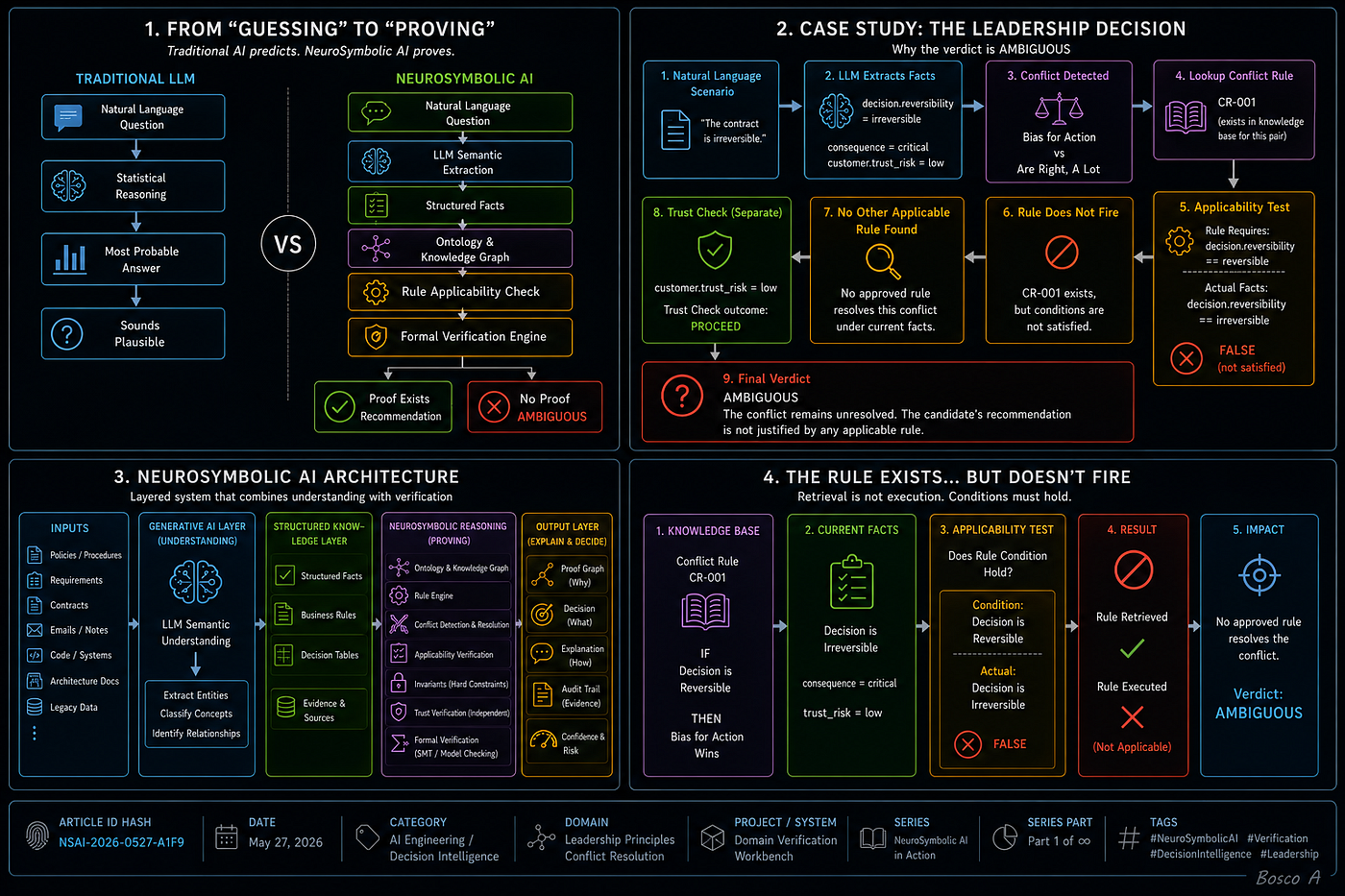
Domain Verification Workbench — Leadership Domain — Fictitious Case Review
A leadership decision that looked obvious
This fictitious scenario is intentionally simple.
A leadership team is considering signing a five-year regional exclusivity agreement with a strategic partner.
The facts extracted from the scenario were:
Decision:
    irreversible
Consequence:
criticalCustomer Trust Risk:
lowThe candidate recommendation argued:
Bias for Action should take precedence over Are Right, A Lot.
It even referenced an approved organizational conflict rule (CR-001).
At first glance, everything looked correct.
Most LLMs would probably agree.
Our verifier did not.
The workbench said “Ambiguous”
Instead of approving the recommendation, the verifier produced:
VERDICTAMBIGUOUSThat surprises many people. Nothing appears ambiguous. There are facts.
There is an approved conflict rule. There is a recommendation.
So why wasn’t the answer simply “approved”?
Because rules don’t merely exist
They fire.
That distinction is the heart of symbolic reasoning.
The workbench retrieved CR-001 and then asked:
Are the rule’s applicability conditions satisfied?
CR-001 required:
decision.reversibility == reversibleThe extracted facts contained:
decision.reversibility == irreversibleThe rule therefore could not fire.
Not because it was incorrect.
Not because it was missing.
Because its preconditions were false.
That single step completely changes the reasoning process.
Retrieval is not execution
Many AI systems stop after retrieval.
Find relevant policy↓Apply policyA verifier does something different.
Find relevant policy↓Evaluate applicability↓Fire only if preconditions hold↓Otherwise continue searching↓If no proof exists↓Return AmbiguousThis is how production rule systems, theorem provers and formal verification engines have worked for decades.
NeuroSymbolic AI brings this discipline into modern AI systems.
The LLM still plays a critical role
None of this means the language model disappears.
Quite the opposite.
The LLM performs the hardest semantic work.
It converts natural language into structured facts.
For example,
“The agreement cannot be reversed once signed.”
becomes
decision.reversibility = irreversibleLikewise,
“The agreement permanently limits future partnerships.”
becomes
reduces strategic optionality = trueThese extracted facts become the input to the symbolic engine.
The symbolic engine never interprets prose.
It reasons over verified facts.
The reasoning pipeline
The Domain Verification Workbench separates these responsibilities into distinct stages.
Natural Language
        │
        ▼
LLM Semantic Extraction
        │
        ▼
Business Facts
        │
        ▼
Ontology & Knowledge Graph
        │
        ▼
Applicable Principles
        │
        ▼
Conflict Detection
        │
        ▼
Decision Tables
        │
        ▼
Conflict Rules
        │
        ▼
Applicability Verification
        │
        ▼
Trust Verification
        │
        ▼
Proof Graph
        │
        ▼
Final Verdict
Every stage produces evidence.
Every decision is explainable.
Every conclusion can be audited.
The Domain Verification Workbench
The workbench was built to explore exactly these kinds of verification problems across multiple domains, including mathematics, physics, operations research, leadership, taxation and research engineering.
Rather than asking an LLM for an answer, it evaluates candidate reasoning against a domain specification consisting of:
- Domain ontologies
- Business rules
- Decision tables
- Conflict rules
- Invariants
- Applicability conditions
- Evidence requirements
- Trust verification
- Formal verification checks
The goal is not simply to obtain a recommendation.
It is to determine whether that recommendation is provably supported by the available evidence and approved organizational knowledge.
The screenshot below shows one such case, where a valid conflict rule exists but cannot legally fire because its applicability conditions are not satisfied.

Domain Verification Workbench — Leadership (LPs) Case Review
This is where NeuroSymbolic AI becomes different
The interesting part is not that the AI knew a rule. The interesting part is that it knew not to use it.
Most AI failures are not caused by missing knowledge. They are caused by applying correct knowledge in the wrong context.
Humans do this. Language models do this. Organizations do this.
Verification systems are designed to prevent it.
Looking ahead
As enterprises increasingly deploy AI into high-consequence domains such as migration, finance, healthcare, legal reasoning and business operations, simply generating plausible answers will not be enough.
We need systems that can distinguish between:
- Facts and assumptions
- Applicable and inapplicable policies
- Recommendations and proofs.
That is the promise of NeuroSymbolic AI. Not replacing language models.
But surrounding them with the structures needed to produce trustworthy, explainable and verifiable decisions.
메타데이터
- post_id
- 5cdbeb3d93f6
- slug
- neurosymbolic-ai-isnt-about-rules-it-s-about-proof-5cdbeb3d93f6
- url
- https://medium.com/@spacevoyagersguide/neurosymbolic-ai-isnt-about-rules-it-s-about-proof-5cdbeb3d93f6
- canonical_url
- https://medium.com/@spacevoyagersguide/neurosymbolic-ai-isnt-about-rules-it-s-about-proof-5cdbeb3d93f6
- author_url
- https://medium.com/@spacevoyagersguide
- status
- ok
- fetched_at
- 2026-08-17 19:13:16




